For the past year I haven't listened to any "new" music. That startling conclusion started to dawn on me during the closing rehearsals of our Good Friday liturgy saturated with John Coltrane's "A Love Supreme."
NOTE: for the truly curious, this is streaming on PCTV; go to: http://www.pittsfieldtv. org/access-pittsfield-show-search/ and search for a love supreme.)
This is not to say that I haven't listened to any music in a year, nor is it true that all the "old" songs I took in weren't"new" to me - for they were. The majesty of Ray Brown's bass playing with Oscar Peterson, the nuances of pianist Herbie Hancock's journey from Miles Davis protege to grand master jazz/funk/fusion guru in his own right, the later recordings of Joni Mitchell, the collaboration between upright bass man Ron Carter and guitar playing Bill Frisell, and Ahmad Jamal's "Saturday Morning" have regularly filled this past year with sounds of grandeur. But, while most of this music was new to me, it has not been cutting edge.
Oddly, when I started to search for some of the best new jazz recordings of 2016, many of them involved old artists: Greg Abate and Phil Woods, Bucky Pizzarelli, Larry Young and Stan Getz. Last summer I heard Bad Plus Joshua Redman play some wildly inventive new jazz - and I was turned on to Quebecois pianist/composer Maryanne Trudell, too (whom we'll make a point to see in late June at the Ottawa Jazz Festival.) So like Joni once sang, "...maybe it's the time of year, or maybe it's the time of man but I don't know who I am but life's for learning." I can't speak for the culture's obsession with nostalgia. I just know that I needed to saturate myself in the tradition both to feel its depth as well as learn its grooves. Now, I am sensing an interest in not only listening to new creations but also creating something new, too. Dylan was right: I must learn my song well before I start singing... .
Yesterday, for the first time in more than a year, I spent the whole day in study, prayer and writing - and it felt like I was finally sleeping in my own bed again. For more than 33 years I have set aside one full day for Bible study, prayer, quiet reflection and writing for Sunday worship. But since returning from Montreal it hasn't worked out that way. I suspect that there are a variety of reasons for the gap, but after yesterday's focus I've quit trying to make this past year's scattered style suffice. In a mixed metaphor way, yesterday's saturation in Scripture and silence brought this version of "Summertime" to mind by many of my favorite masters.

WHEN LOVE COMES TO TOWN: REFLECTIONS ON TENDERNESS IN A CHAOTIC CULTURE
Thursday, May 19, 2016


Tuesday, May 17, 2016
a time to go deeper and a time for rest...

Now the reason for this experiment involves two, interwoven ideas about the tension between church and culture
+ First, our fast paced culture trains us for a diminished attention span. We want and need only the news we can use in byte size portions. So while I will not become a slave to consumer culture, I am curious about what might take place if we tried something like this: a) We read a short text from the Hebrew Bible aloud; b) I offer a concise but serious reflection on why it is important in our tradition and contemporary culture; c) .We pause in community for a short, silent reflection; and d) then close our prayer with a shared song. Two additional readings - and a Psalm - will follow to be concluded with another short critical refection in conversation. The total time for engaging Scripture won't change, but the way we focus will. And while I might be totally whacked, I sense that putting the Hebrew Bible into context is vital for this moment in time: if we are going to reclaim a shared vision for compassion and justice, then our people who are wildly unaware of ancient Israel's prophetic wisdom need some remedial tutoring.

+ Second, I want to help our folk reclaim the wonder, power and awe of the Bible. Too many people say, "Can you explain that reading to me more thoroughly so I can grasp its context?" Or even, "I don't really get why we read so much Bible during worship when I don't know the bigger picture." There are times when I even see people's eyes roll back in their heads as we move from the Palm into the Epistle - and by the time the Gospel comes around they are goners. Eugene Peterson found much the same thing back in his church in Maryland and started to rework the texts into the gracious, bold and demanding language we have come to know as The Message. Could it be that using his reworked text mixed with a time of silence, music and quiet prayer might unlock our peoples' passion for the LIving Word of the Lord? I don't want to dumb things down any more than our culture already does, but my experience at midday Eucharist suggests that many who gather really are hungry to genuinely hear the word of God in Scripture and have it interpreted, too.
Maybe playing with the liturgy in this way will be a total flop. But I won't know until we try. I have already discovered that more contemplative prayer with candle lighting makes a difference for some folks. Same is true with walking meditation to different prayer stations in our massive Sanctuary. So, we'll see with this new experiment. We'll give it a try as we move into Ordinary Time and evaluate things after phase one of my summer vacation. Obviously the composer of the anthem we'll be doing this Sunday, Craig Curry, wasn't afraid to experiment by taking both the singers and congregation to a deeper and more challenging place... I'll keep you posted.
Sunday, May 15, 2016
blessed pentecost...

As I looked down at Louie during Eucharist, two thoughts washed over me: first, his momma was just about that age when I was ordained; and second, what a sweet life cycle now that I am moving towards the close of ministry. What's more, in three weeks we're going to ordain a brilliant young man from within the congregation and he, too, has a family much the age of mine on the day of my ordination 35 years ago.

As we all gathered in the Chancel this morning around the communion table, serving one another the bread and the cup - singing the Sanctus with gusto as old timers were surrounded by new friends and guests - I found my eyes swelling up with tears of gratitude (much as they are now): this is the Body of Christ. Broken, often frail but always a sign of hope in a world too often obsessed with power and busyness. This is a PLACE for real people - a community of solidarity where everybody knows your - and this fills my heart with joy. In fact, during my homily, I spontaneously asked people to make a point to go introduce themselves to someone they
didn't know rather than light a candle for prayer, because our small size is a gift now a problem.
After wards, two different people told me something sacred about one of our special needs members: one man mentioned that our friend is now engaged to be married (a blessing that I knew about) while Di told me that during part of the liturgy, this same gentleman took off his red Pentecost scarf (we handed some out at the start of worship) and placed it over the shoulders of a care-giver. He wanted her to know that she she was welcomed. This stuff mostly only happens in church. It is usually not seen by those too busy getting important things accomplished. And to have my grandson a part of this feast was almost more than I could contain. Blessed and happy Pentecost to you all.

Friday, May 13, 2016
hey the family is coming...
There is a unique charism to cleaning the bathroom, scrubbing the floor and making the house
 look hospitable. This is not a unique insight, of course, as everyone from St. Benedict and Brother Lawrence to Kathleen Norris and Anne Lamott have weighed in on the subject.
The Bible is full of evidence that God's attention is indeed fixed on the little things. But this is not because God is a great cosmic cop, eager to catch us in minor transgressions, but simply because God loves us--loves us so much that the divine presence is revealed even in the meaningless workings of daily life. It is in the ordinary, the here-and-now, that God asks us to recognize that the creation is indeed refreshed like dew-laden grass that is "renewed in the morning" or to put it in more personal and also theological terms, "our inner nature is being renewed everyday". Seen in this light, what strikes many modern readers as the ludicrous details in Leviticus involving God in the minutiae of daily life might be revisioned as the very love of God. (Quotidian Mysteries: Laundry, Liturgy and Women's Work)
For nearly two hours, we have been engaged in the common drudgery of vacuuming dog hair (waaay too freakin' much!), dusting, scouring toilet bowls and waxing the floor in anticipation of our children and grandson. For some odd reason, I have always found satisfaction in such work. Yes, it can be oppressive - especially if you are the only one doing it - and often there can be too much of it. But like good liturgy, there is something calming about making a sink shine. Or adding a fresh coat of wax to a once grimy hardwood floor.
 I feel much the same way about setting a beautiful table with flowers, crisp linen, candles and all the rest. Norris writes that St. Benedict was clear that: Whatever you do repeatedly has the power to shape you, has the power to make you over into a different person— even if you’re not totally engaged’ in every minute! I find that my mind wanders while washing the floor: I think of ideas for an ordination sermon I've been asked to preach in early June - or find old wounds and resentments rising to the surface of consciousness - or even memories of those long gone from this world wafting through my mind as they remind me how to do "women's work" and why it matters.
Well, now there is a dog to wash, more floors to finish and groceries to be gathered before the troops arrive in a few hours. I like the way Ms. Norris wraps it all up:
When it comes to the nitty—gritty, what ties these threads of biblical narrative together into a revelation of God’s love is that God has commanded us to refrain from grumbling about the dailiness of life. Instead we are meant to accept it gratefully, as a reality that humbles us even as it gives us cause for praise. The rhythm of sunrise and sunset marks a passage of time that makes each day rich with the possibility of salvation, a concept that is beautifully summed up in an ancient saying from the monastic tradition: “Abba Poeman said concerning Abba Pior that every day he made a new beginning.”

The Bible is full of evidence that God's attention is indeed fixed on the little things. But this is not because God is a great cosmic cop, eager to catch us in minor transgressions, but simply because God loves us--loves us so much that the divine presence is revealed even in the meaningless workings of daily life. It is in the ordinary, the here-and-now, that God asks us to recognize that the creation is indeed refreshed like dew-laden grass that is "renewed in the morning" or to put it in more personal and also theological terms, "our inner nature is being renewed everyday". Seen in this light, what strikes many modern readers as the ludicrous details in Leviticus involving God in the minutiae of daily life might be revisioned as the very love of God. (Quotidian Mysteries: Laundry, Liturgy and Women's Work)
For nearly two hours, we have been engaged in the common drudgery of vacuuming dog hair (waaay too freakin' much!), dusting, scouring toilet bowls and waxing the floor in anticipation of our children and grandson. For some odd reason, I have always found satisfaction in such work. Yes, it can be oppressive - especially if you are the only one doing it - and often there can be too much of it. But like good liturgy, there is something calming about making a sink shine. Or adding a fresh coat of wax to a once grimy hardwood floor.
Well, now there is a dog to wash, more floors to finish and groceries to be gathered before the troops arrive in a few hours. I like the way Ms. Norris wraps it all up:
When it comes to the nitty—gritty, what ties these threads of biblical narrative together into a revelation of God’s love is that God has commanded us to refrain from grumbling about the dailiness of life. Instead we are meant to accept it gratefully, as a reality that humbles us even as it gives us cause for praise. The rhythm of sunrise and sunset marks a passage of time that makes each day rich with the possibility of salvation, a concept that is beautifully summed up in an ancient saying from the monastic tradition: “Abba Poeman said concerning Abba Pior that every day he made a new beginning.”
Thursday, May 12, 2016
the journey into pentecost...
This Sunday, the Feast of Pentecost, we are experimenting with another participatory and sensory worship celebration. There are two candle-lighting prayer stations at the back of the Sanctuary: after two of four different brief reflections - one on the Genesis 11 text and the other on John 14 - people will be invited to do "walking mediation" as they move, light candles re: the brokenness of the world (first) and the Spirit's calling to us to be healers (second) as we create two jazz improvisations. In my head, I hear this bluesy groove of Herbie Mann's take on "Come Together" for the second improv.
During the other readings, Acts 2 and Psalm 104, our children and youth will unfurl "tongues of fire" from the balcony (rolled crepe paper) and sing and chant the ancient Psalm. The culmination of this liturgy will be Eucharist - as in the unity of different peoples coming together in the Christian encounter with Pentecost - where people will leave their seats and gather around the communion table. They will serve and be served the bread of life and cup of blessing in the round.
One of my mini-reflections on each text, John 14, articulates one of the Pentecostal insights like this:
This is the “other” Pentecost story in Christianity: the promise and presence of the Holy Spirit – the Paraclete in the Greek text – who gives us hearts to trust and eyes to see the essence of God in Jesus – and then to LOVE the Lord our God by living in the WAY of Christ. The fundamental insight in John’s gospel is that we can see what God is like – and how to love and serve God – by following, embracing and living the way of Jesus. Jesus is the man of peace – the soul of humility – the servant teacher who gets down on his knees to wash the feet of his confused and surly friends and then tells them: this is my new commandment for you – love one another as I have loved you – on your knees as humble servants. Do this and you will come to know the Lord your God in your flesh. And there are three essential insights to embrace here:
 We also know that all across the United
States and Western Europe there are people who are interested in the way of the
Lord but say: Show me a church where ministers
aren’t self-serving, where hypocrisy has been purged away, where love is
genuine, and I’ll become a member. From
our own experience we know that these folk will have to wait a long, long time
for such a church to take root on earth because in the words of St. Paul: too often we do what we hate and forget what
we love. We are uncomfortable
embracing the radical humility of Christ – we are afraid – and we hedge our
bets. We are too busy and we forget to
reach out to others in love. We are broken and need our own love, forgiveness
and healing.
And so we gather for Pentecost to be reminded: if you love me, you will keep my commandment. I love the simplicity of this truth: it is challenging, positive, possible and life-changing. So let me invite you back into a walking meditation to light a candle and ask yourself: what is the next step for me in trusting the love of Jesus more than my own fear, hurt, confusion or guilt?
During the other readings, Acts 2 and Psalm 104, our children and youth will unfurl "tongues of fire" from the balcony (rolled crepe paper) and sing and chant the ancient Psalm. The culmination of this liturgy will be Eucharist - as in the unity of different peoples coming together in the Christian encounter with Pentecost - where people will leave their seats and gather around the communion table. They will serve and be served the bread of life and cup of blessing in the round.
One of my mini-reflections on each text, John 14, articulates one of the Pentecostal insights like this:
This is the “other” Pentecost story in Christianity: the promise and presence of the Holy Spirit – the Paraclete in the Greek text – who gives us hearts to trust and eyes to see the essence of God in Jesus – and then to LOVE the Lord our God by living in the WAY of Christ. The fundamental insight in John’s gospel is that we can see what God is like – and how to love and serve God – by following, embracing and living the way of Jesus. Jesus is the man of peace – the soul of humility – the servant teacher who gets down on his knees to wash the feet of his confused and surly friends and then tells them: this is my new commandment for you – love one another as I have loved you – on your knees as humble servants. Do this and you will come to know the Lord your God in your flesh. And there are three essential insights to embrace here:
+ First Jesus shows us in the flesh the polar
opposite of the Tower of Babel: they
follow themselves and cause destruction and violence; he follows the Father and
serves others with humble tenderness. They alienate themselves from God; he
embraces and is embraced by God’s love. They are self-centered, he is other
centered.
+ Second, by watching, following and learning
from Jesus we, too, will receive
 inspiration to become tender servants guided
by humility and love because God will inspire us from within. We can’t
manufacture such love. We can’t create it either – we can barely comprehend it.
But, by grace and in God’s own time, we will be given the inspiration of the
Holy Spirit – the Comforter – who will lead us into new and life-giving acts of
compassion.

+ And third, there is specificity as to what
it means to follow in the way of Jesus and his Spirit of holiness, not
ambiguity. In both the Old Testament and
the New, in Isaiah and the letters of St. Paul, the power of the comforter –
the Holy Spirit – is NOT some sacred teddy bear to snuggle with, but rather a
way of living born from above. It is a
calling and a commitment to make the way of Jesus flesh in our lives and
Scripture tells us that the gifts of the Holy Spirit are sevenfold: sound judgment or wisdom, understanding of
how grace and real life work, the ability to counsel others in the way of
faithful living, intimate experience with God’s grace, strength to persevere,
inner peace from prayer and a sense of awe concerning God’s love and power.
Pentecost is all about the promise and the
presence of Jesus in our flesh. Professor of homiletics at my alma mater
Union Theological Seminary in NYC, Barbara Lundblad, put it like this: Those of us who attend worship regularly know
all too well that we are rarely what Jesus called us to be: We spend
too much and share too little; we judge too many and love too few; we wait too
long and act too late.

And so we gather for Pentecost to be reminded: if you love me, you will keep my commandment. I love the simplicity of this truth: it is challenging, positive, possible and life-changing. So let me invite you back into a walking meditation to light a candle and ask yourself: what is the next step for me in trusting the love of Jesus more than my own fear, hurt, confusion or guilt?
I am looking forward to this celebration in sound and movement, thought and silence, insight and questioning.
Wednesday, May 11, 2016
rest is a crucial ingredient in the quest for justice...

Just as fields need to lie fallow, so does all creation — including us. In a world that is rife with addiction to busyness, it is imperative that we rediscover the lost art of re-creative rest. Only then can we effectively serve and yield fruit for the Kingdom of God.Justice work is good work. It is a high calling. It deserves great effort and exertion. But in today’s world, if our work in the realms of social justice mimics the exhausting routine of the fiercely competitive struggle for wealth and power, we would do well to take a moment to consider the biblical rhythm of Sabbath. The esteemed rabbi Abraham Joshua Heschel wrote in The Sabbath that the holy day serves as a “sanctuary in time.” The invitation of the Sabbath is a summons to dwell in the eternality of time, he wrote, to turn from “the results of creation to the mystery of creation, from the world of creation to the creation of the world.”
I've burned myself out too many times overlooking this truth - and I've been burned by self-righteous activists who are all hype and drive without a sense of inner peace, too. Small wonder Fr. Richard Rohr calls his ministry the Center for Contemplation and Action. It is a both/and reality, yes?

I just returned home from a "make-up" confirmation class where my young charge asked, "Why do we have to go to church each week, sit quietly and listen to stories about dead people we will never know?" Three weeks ago, we tried to answer that together in worship. But my hunch was we only scratched the surface of an authentic answer. So we spent 20 minutes talking and thinking this through from the perspective of soccer practice: we gather together at a set time to practice listening to and loving God and one another because without a set time, it wouldn't happen. You wouldn't grow as a player if you didn't have practice would you? And you wouldn't practice if it wasn't set and required, right? Over the years, we learn a little about ourselves, we are reminded of God's forgiveness and we find new friends who can help us when we're sad, confused or hurting. Have you met new people at soccer practice? Do you hang with them? How do they make you feel? (Like I want to become a better player!) Hmmm....
Well, we also gather to rest as the rest of the Sojourner's article continues:
Well, we also gather to rest as the rest of the Sojourner's article continues:
Compassion
for the world and practice of the Sabbath for the body and soul are intimately
interconnected. We cannot serve the world without setting time aside for
re-creative rest. We cannot do re-creative work from a place of exhaustion and
burnout. In
our current culture, this is downright subversive. We carry a pervasive idea
that we are defined by the volume of our work or the sweat of our brow. But
sometimes the best way we can celebrate labor is to rest from it — to discover
relaxation, restorative delight, and a sense of the sacredness of time itself.
And so it goes: church is truly a counter-cultural institution for those who take Sabbath seriously and honor it. For too many, however, it just one more thing to do that gets shoved to the bottom of the list - and eventually discarded. Life is already too busy and demanding. I am learning not to fret about this - I can't fix or change it - and God knows I've spent over 30 years trying. It is about time I simply pray the Serenity Prayer and change the things I can and accept what is not mine to alter. Tomorrow I will drink tea, write and pray, meet with a local artist about a Juneteenth event and then gather with local grassroots activists to listen for the Spirit within and among us about next steps in building our Berkshires justice network. On Friday, I will sleep late, clean the house and then welcome my Brooklyn family for the weekend - with a grand Saturday feast planned, too.
It really does come down to the song we sang at the close of today's midday Eucharist...
It really does come down to the song we sang at the close of today's midday Eucharist...
Tuesday, May 10, 2016
a bluesy piano jazz kinda day...
For some unknown reason I am in a piano jazz blues kind of place today - not melancholia, mind you - just something low down and gritty. It feels rather like Dave Brubeck's incredible groove building to a crescendo on "Travellin' Blues." Maybe you've felt this way, too? (Check it out here: man, can this cat play!)
Another absolutely sublime meditation in music is the Bill Evans classic: "Peace Piece." There may not be another jazz piano composition quite like this in all creation. It speaks to me of inner refreshment, the ups and downs of being real in a broken world and the quiet longing to hold on to awe for just a moment longer in this life even while knowing that is impossible. For my soul, this is what heaven sounds like. And I would be foolish to miss including Ahmad Jamal's most recent composition: "Saturday Morning." It was my big find last year in Montreal. This is the "reprise" take of the much longer version from the CD of the same name. In both the melody and interplay of instruments, this tune speaks to me of resting in the gentle beauty of the warm sun. It hints at love, too without a trace of sentimentality. It is truly a beautiful and playful work of art.
Another absolutely sublime meditation in music is the Bill Evans classic: "Peace Piece." There may not be another jazz piano composition quite like this in all creation. It speaks to me of inner refreshment, the ups and downs of being real in a broken world and the quiet longing to hold on to awe for just a moment longer in this life even while knowing that is impossible. For my soul, this is what heaven sounds like. And I would be foolish to miss including Ahmad Jamal's most recent composition: "Saturday Morning." It was my big find last year in Montreal. This is the "reprise" take of the much longer version from the CD of the same name. In both the melody and interplay of instruments, this tune speaks to me of resting in the gentle beauty of the warm sun. It hints at love, too without a trace of sentimentality. It is truly a beautiful and playful work of art.
Monday, May 9, 2016
going deeper into transformative silence...

Within each of us there is a silence
- a silence as vast as the universe.
We are afraid of it... and we long for it.
When we experience that silence, we remember
who we are: creatures of the stars, created
from the cooling of this planet, created
from dust and gas, created
from the elements, created
from time and space... created
from silence.
In our present culture,
silence is something like an endangered species...
an endangered fundamental.
The experience of silence is now so rare
that we must cultivate it and treasure it.
This is especially true for shared silence.
Sharing silence is, in fact, a political acdt.
When we can stand aside from the usual and
perceive the fundamental, change begins to happen.
Our lives align with deeper values
and the lives of others are touched and influenced.
Silence brings us back to basics, to our senses,
to our selves. It locates us. Without that return
we can go so far away from our true natures
that we end up, quite literally, beside ourselves.
We live blindly and act thoughtlessly.
We endanger the delicate balance which sustains
our lives, our communities, and our planet.
Each of us can make a difference.
Politicians and visionaries will not return us
to the sacredness of life.
That will be done by ordinary men and women
who together or alone can say,
"Remember to breathe, remember to feel,
remember to care,
let us do this for our children and ourselves
and our children's children.
Let us practice for life's sake."

Are you tired? Worn out? Burned out on religion?
Come to me. Get away with me and you’ll recover your life. I’ll show you how to
take a real rest. Walk with me and work with me—watch how I do it. Learn the
unforced rhythms of grace. I won’t lay anything heavy or ill-fitting on you.
Keep company with me and you’ll learn to live freely and lightly.
So much has changed over nine years - and yet so much remains the same. Most of the time these days when I encourage Sabbath rest and/or the exploration of contemplation I sense a quiet but brooding resentment: we've HEARD that before - been there/done that with you - can't we have something NEW?!? Truth is, no: not only do I only HAVE one real message in me - like most preachers, I only share the same sermon over and over in slightly new ways - but this is the key to our healing and renewal. Rest. Trust. Be still and know that I am God - and you are not. Middle class folk resent and resist radical trust (ie faith) unless or until we have a life threatening illness, catastrophe or tragedy. And even then, some choose to become cynical while others embrace denial in its many modes and only a few elect to go beyond the obvious. Many are called, indeed, but few choose to journey down the narrow path of trust.
I closed yesterday's reflection with a thought that is changing my understand of my call: while the

+ Like Jesus we all come into the life of faith as children: we are born and need nurture, love, guidance as well as the cultivation of our innocence and awe. This is the age of trust and mistrust. During this stage we will learn about autonomy and shame, guilt and doubt as well as the importance of initiative and hard work. Faith is simple and tender, a reality Fowler calls intuitive as it is based on a child's contextual experience. As our childish faith ripens, it takes on a literalism that believes every word of Scripture is true. This is the mythic stage of faith.
+ In time, with compassion and healthy boundaries, we become an adolescent like Jesus: there is a gospel story of Jesus remaining back in Jerusalem after Passover teaching the elders. When Joseph and Mary return for him in a panic, like all teens he gets cocky and tells them to back off. This is our stage of separation from childhood authority, where one part independence and two parts peer pressure launches a search for deeper truth. Faith here involves questions, rejection as well as yearning. Fowler speaks of this as a "synthesizing" stage where we draw from both questions and the wisdom of others as we experiment with making faith real and our own.
+ As young adults, faith is like that of the silent years in the story of Jesus: clearly he played with his tradition, took it seriously and even likely shared an apprenticeship with a wise elder in the form of the John the Baptist archetype. There is testing and evaluation taking place at this stage of faith, there is also the hard reality of developing a vocation, a public life and perhaps a family. The goal here, in the words of Thomas More, is to create a religion of our own. That is, to come to a personal sense of peace with a faith tradition and to explore in ways that bring us satisfaction. For a variety of reasons,some get stuck and remain as adolescents who are always questioning or rebelling. Whether grounded or unsettled, this stage of faith is all about personal meaning where some go deeper and others chuck it all away.
+ At some point, and in the story line of Jesus this involves the pinnacle of his public ministry, we not only face profound challenges but come to realize that life is not all about ourselves: more often than not this is midlife and we start to question again all of the old rules, rites, rituals and behaviors in our quest for meaning and zest. Sometimes this is destructive, sometimes it is unsettling, but the quest is real. Some deny their inner longing and do not come to any deep sense of peace: in the Jungian world these folk become cynics or old fools. A few stay with the pilgrimage and re-enter faith with humility after having made peace with the fact that there are truths greater than our ability to comprehend. In this, I see both the journey of Lent as well as the Passion Narrative writ large.
+ And then there are those who embrace and encounter the resurrection and ascension and those who oppose it: some are illuminated and at rest and some are bitter and oppositional until they die. Only those willing to spend time in silence and uncertainty reach Fowler's sixth stage of "universalized" faith. Some are too easily bored or distracted to do this work. Others are too afraid or wounded. But a few, even through their brokenness, keep at it. In today's reflection, Fr. Richard Rohr puts it like this:
I often use this line, a
paraphrase of Albert Einstein: "No problem can be solved by the same
consciousness that caused it." Unfortunately, we have been trying to solve
almost all our problems with the very same mind that caused them, which is the
calculating or dualistic mind. This egocentric mind usually reads everything in
terms of short-term effect, in terms of what's in it for me and how I can look
good. As long as you read reality from that small self, you're not going to see
things in any new way. All the great religions taught a different way of
seeing, a different perspective. This alternative vantage point is the
contemplative or non-dual mind. It is what we usually mean by wisdom.
The word contemplation has ancient roots, but for
a long time it was not taught much in the Western church. Contemplation was
finally rediscovered again through Thomas Merton's writings in the 1950s and
60s. What is contemplation? Simply put, contemplation is entering a deeper
silence and letting go of our habitual thoughts, sensations, and feelings. You
may know contemplation by another name. Many religions use the word meditation. Christians often use the
word prayer. But for
many in the West, prayer has come to mean something functional, something you
do to achieve a desired effect, which puts you back in charge. Prayers of
petition aren't all bad, but they don't really lead to a new state of being or
consciousness. The same old consciousness is self-centered: How can I get God
to do what I want God to do? This kind of prayer allows you to remain an
untransformed, egocentric person who is just trying to manipulate God.
As Rohr concludes, unless there is an inner change born of an altered consciousness, we are

engagement with acts of compassion that simultaneously educate us even as our hearts are broken.
That's one reason why
religion is in such desperate straits today: it isn't really transforming
people. It's merely giving people some pious and religious ways to again be in
charge and in control. It's still the same small self or what Merton called the
false self. Mature, authentic spirituality calls us into experiences and
teachings that open us to an actual transformation of consciousness (Romans 12:2).
I think some form of contemplative practice is necessary to be able to detach
from your own agenda, your own anger, your own ego, and your own fear. We need
some practice that touches our unconscious conditioning where all our wounds
and defense mechanisms lie. That's the only way we can be changed at any
significant or lasting level.
For
a full lifestyle change, I believe we need both action and contemplation. The state of the communal soul is the state of the social
order. As Jack Jezreel, founder of JustFaith puts it, "The world cannot be
changed by love to become just unless we are changed by love to become whole, but we cannot be made whole without engaging in the
work of making the world whole. Personal transformation and social
transformation are one piece."
Sunday, May 8, 2016
rest, wait and trust: sabbath thoughts about ascension sunday...
Today I put away most of my worship notes and simply spoke about the Sabbath connection
 and Ascension Sunday: wait for power from on high Jesus told his followers and then you can head out into the world to be my witnesses. And what was true then is just as important now. Wait. Rest. Reflect before acting. Don't go off half-cocked. Sr. Joan Chittister set the stage with this observation::

 blessing of spending a few days on Cape Cod a a couple's cottage. As is often the case, we slept, talked, read, walked about and visited some of the beaches and bookstores in this stunning little corner of the world. Last year at this time we were en route to Nashville and it was becoming clear that one phase of ministry was ending for us both. Three hundred and sixty five days later - after a year of waiting and discernment - some of the new blessings of new ministries are coming to light. It takes time. And prayer. And trust.

When
society rested on the fiat of kings and emperors, pharaohs and queens, tribal
chiefs and keepers of the clan,” writes Benedictine prioress Joan Chittister,
“it was religion that built freedom and feasting into the fabric of our lives.
When peasants and serfs, slaves and captives, bondsmen an indentured servants
all lived at the beck and call of the chief, it was religion that built freedom
into the very calendars of life for them. Long before the five-day work week
and fair labor legislation, religion required rest and fun, fiestas and feasts,
as well as fasting and prayer, discipline and self-control. The liturgical calendar
superseded the whims and fancies of either the obscenely rich or the
murderously powerful. (The Liturgical
Year)
So both today's liturgy and message were fun - there was a lot of dialogue and congregational commentary - all of which felt simple and right. To talk about our spiritual tradition's invitation to rest is something I've done often, but it is so counter cultural.The Christian Century's lectionary commentary this week for Ascension Sunday, reinforced the importance of waiting and taking time with this survey of the sacred number 40. It is a call to pay attention:

In the
scriptures, it is for 40 days that rain falls on Noah’s ark, that spies scout
out Canaan, that Goliath fought the Israelite army, that Ezekiel lies on his
right side (in mourning and prayer), that Nineveh is threatened with
destruction, and that Jesus is tempted in the wilderness after his baptism. At
age 40 Moses murders an Egyptian, 40 years later he meets with God on Mount
Sinai; and 40 years later he dies. For
40 years Israel wanders in the desert and for 40 years suffers under the
Philistines. Saul, David and Solomon each reign for 40 years, and every woman
is secluded for 40 days after the birth of a son. (Christian Century, April 27,
2016)
Nobody knows
exactly why 40 came to represent a long time in our spiritual story.
Some have guessed that it has something to do with a time that exceeds the 28
days of the lunar cycle. But no one knows for sure. “It is simply a mythical
period pregnant with the religious future:
Forty (seems to be) the metaphysical delay required in all human
experience before God’s intent can be realized… it is the legendary period of
hope, the duration of either joy or sorrow, that opens us to unknown emotions and
wisdom” born of the Lord. (CC)
So the oldest truths of the Judeo-Christian tradition give Ascension Sunday some shape and form by honoring the Sabbath and keeping it holy.
Rest. Wait. Trust that God is God so that you don’t have to act like you
are in charge of everything. Wait for
the promise of the Father. The second insight flows from the first: when you are
well-rested, then you have the vision, stamina, peace and presence to be a good
neighbor. What must I do to inherit eternal life – that is, a life of meaning
and value – the lawyer once asked Jesus? To which he said: Love the Lord your God with all your heart,
mind and strength – AND – love your neighbor as yourself. Everything else is
commentary. As I know all too well, it is hard to be a tender peace-maker without being well rested.
Clearly having a few days away for rest and renewal helped me today. Di and I were given the

While we were away, I spent part of each morning reading and pondering some of Henri Nouwen's wisdom in Spiritual Direction. He writes that "prayer is not something that comes naturally or easily. It is something that requires learning and discipline... (because) more than anything else, prayer is primarily listening and waiting. We listen for God in an attitude of openness of hearty, humility of spirit, and quietness of soul. And we let our mind descend into our heart and stand there (for a time) in the presence of the Lord." Therefore, prayer is not fundamentally about the individual, but rather how each of us engages with the world.
Prayer is not introspections. It does not look inward but outward. Introspection easily can entangle us in the labyrinth of inward-looking analysis of our own ideas, feelings and mental process - and can lead to paralyzing worries, self-absorption and despair. Prayer is an outward, careful attentiveness to the One who invites us to an unceasing conversation... prayer is the joyful affirmation that God knows our minds and hearts without anything being hidden.

From this conversation that becomes a way of life, each of us finds a unique way to be part of the healing of the world. This is the other blessing that came to me while in contemplation this weekend: as we wait for God's power from on high, new ministries are revealed. Nouwen writes:
Remember: You belong to God from eternity to eternity. You were loved by God before you were born; you will be loved by God long after you die. Your human lifetimes - long or short - is nly a part of your total life with God. The length of time doesn't matter. Life is just a little opportunity for you during a few years to say to God: "I love you, too."
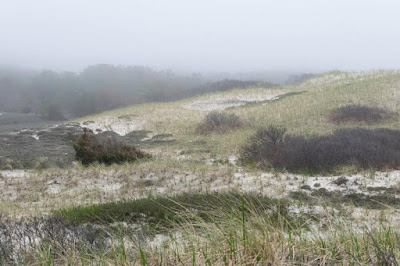
So take all the time you need to listen carefully, yes? On this quick trip away there was rain and sun, wind and fog, sand and water, sound and silence: a fullness for which I am grateful.
ps ` after worship today, three very different people (between the ages of 30-40) made a point to speak to me. The first, a guest, said: You nailed that - it was a message I needed to hear - AND you were so connected to the people. The second, a person who has attended worship since I started nine years ago told me: That was killer! I felt so good today BECAUSE I was rested and ready to engage. And third, a person who worships when possible and comes in from about two hours away: We in America rush to get things done on the weekend so that we have free time; in other places they simply do what needs to be done in an unhurried way and do it together. NO rushing. Hmmmm....?!? Our homework assignment? Do nothing for 30 minutes today - I got home, had a quick bite to eat and slept for 90 minutes!
photo credit: Dianne De Mott
Thursday, May 5, 2016
the insecurity of true believers...
As this campaign season has evolved - or degenerated depending upon your perspective - I have regularly been awed by the rise of "true believers" in both the Sanders and Trump camps. Mostly I have kept mum about this phenomenon, deferring to silence rather than sounding my concerns about this stunning loss of perspective. But I continue to carry questions in my heart about their bold and often arrogant assertions that their candidate alone (and by implication they themselves) posses a monopoly upon truth, virtue and promise.
I am not questioning the energy or mojo Sanders and Trump evoke for the buzz of group think born of political rallies, stadium rock concerts and worship in massive cathedrals and halls is powerful. Been there, done that at Springsteen shows, anti-war rallies and a few evangelistic events. I know how energizing and ecstatic it is to lose yourself in a mass of like-minded souls who yearn for vision, cohesion and hope in a dysfunctional world. One of the reasons I am attracted to dystopian/apocalyptic movies like "Blade Runner": comes from a deep lament over the brokenness of the world. So I am not questioning nor judging the angst and anguish of those drawn to these candidates.
Rather, what concerns me is their zeal that too often overrides reality. At times it appears in crude or rude judgments about the ability of those with whom they disagree to discern "the truth" of any given issue: how can you support such a crook - if you were a real progressive (or insert independent or conservative as you like) you wouldn't stay ignorant of the true facts - oh come on you know that is a lie, etc? At other times, a uniquely naive albeit Byzantine parsing of reality occurs - think of the histrionics about super-delegates, the remaining Democratic primaries or the hypothetical polling results of how one candidate fares against another - that is tainted with an unwillingness to honor the hand-writing on the wall. And then there is the all out assault that both denigrates the opponent's integrity while dumping an avalanche of "facts" into the conversation: it is a classic bait-and-switch. The result is always the same: rarely is there a measure of doubt or humility expressed about the possibility that Sanders or Trump could be wrong.
Perhaps the insights of longshoreman philosopher, Eric Hoffer, have been forgotten. Or the work Erich Fromm did after WWII re: the rise of Nazism in Germany in Escape from Freedom. In Hoffer's The True Believer he makes the claim that the unwillingness to consider alternatives is a sign of inner insecurity. And the refusal to accept the possibility that we are wrong about an issue, a candidate or a movement is more a social illness than a strength. "“Propaganda ... serves more to justify ourselves than to convince others; and the more reason we have to feel guilty, the more fervent our propaganda.”
So I am troubled. I don't experience or discern this taking place much within the Clinton camp. I am sure it is there because that is always true during an election. But the demonizing of opposition and the scapegoating that continues to grow in both the Sanders and Trump realm worries me. Hoffer got it right when he concluded:
The enemy—the indispensable devil of every mass movement—is omnipresent. He plots both outside and inside the ranks of the faithful. It is his voice that speaks through the mouth of the dissenter, and the deviationists are his stooges. If anything goes wrong within the movement, it is his doing. It is the sacred duty of the true believer to be suspicious. He must be constantly on the lookout for saboteurs, spies and traitors.
PS - In closing, as I have revisited my political history, I recall enthusiasm for George McGovern even while I saw him as a tragically flawed idealist. I had respect but only modest expectations about Jimmy Carter and later Bill Clinton. Must be the influence of Niebuhr, the insights of Dr. King and the experience of working with Cesar Chavez: we are all broken. How does St. Paul put it: all have sinned and fallen short of the glory of God. No exceptions - and that includes Bernie, Hilary and the Donald. The dynamics of the messianism of the campaign are not likely to change, right? It feels like a Steely Dan song unfolding in real time...so here we go to do it again.
Wednesday, May 4, 2016
growing up while married...
 Twenty one years ago tomorrow, Dianne and I were wed. It was a very small ceremony with three friends and our two daughters in attendance. It was celebrated outdoors by a waterfall in one of Cleveland's glorious Metro Parks. Afterwards, we repaired to our small apartment for an English high tea. When people ask, "Wow, you chose to get married on Cinco de Mayo! How cool is that?!!?" I would smile and reply, "Cinco de Mayo had nothing to do with it: one of our favorite songs is Dylan's "Isis" wherein the narrator sings, 'I married Isis on the 5th day of May, but I could not hold on to her very long...'" Some people dig it, but others just give me a quick, uncomfortable smile and quickly move on.
I married Isis on the fifth day of May
But I could not hold on to her very long
So I cut off my hair and I rode straight away for the wild unknown country where I could not go wrong
I came to a high place of darkness and light the dividing line ran through the center of town
I hitched up my pony to a post on the right went in to a laundry to wash my clothes down
So I cut off my hair and I rode straight away for the wild unknown country where I could not go wrong
I came to a high place of darkness and light the dividing line ran through the center of town
I hitched up my pony to a post on the right went in to a laundry to wash my clothes down
She was there in the meadow where the creek used to rise
Blinded by sleep and in need of a bed
I came in from the East with the sun in my eyes
I cursed her one time then I rode on ahead
She said, “Where ya been?” I said, “No place special”
She said, “You look different.” I said, “Well, not quite”
She said, “You been gone.” I said, “That’s only natural”
She said, “You gonna stay?” I said, “Yeah, I jes might”
Isis, oh, Isis, you mystical child
What drives me to you is what drives me insane
I still can remember the way that you smiled
On the fifth day of May in the drizzlin’ rain
It is the perfect song for us: a mythopoetic, archetypal rock and folk song about Yin and Yan engery with a wildass fiddle weaving throughout while Allen Ginsberg dances around the band in ecstasy. What more could a couple ask for? It is all about living into the darkness and light. We've wondered whether life was worth living with - and without - one another. We've left one another. Regrouped. Fought and everything in-between. And God knows we've changed over the years even if we've been "no place special.". It has been a beautiful, agonizing, sacred, messy, real, frightening and joy filled journey of love. I would never have "grown up" and gotten a little healthier were it not for Dianne. I suspect that the same is true in reverse.
 We were two hippies of different ages when we wed - and that hasn't changed much Last year at this time we were on the magical mystery tour of our Sabbatical. We had a sweet little flat in the East Village for a week and went to a French restaurant to celebrate our 20th anniversary. During that grand tour, we also bought ourselves new wedding rings at a Quebecois jewler - and renewed our vows later that summer in our Montreal kitchen.
This year we're going to take a quick trip out to Cape Cod - I haven't been there since 1971 and it has been a long time for Di, too - and we've never been there together. The weather is supposed to be rainy and cold, but we like to walk on the beach and take in the beauty and solitude that rain affords those willing to brave the elements. By nature we are introverts and hermits - except I like to hit the jazz, folk and rock clubs of big cities from time to time. The art museums, bookstores, churches and cafes, too. Di tells me I've corrupted her over the years because she now loves this almost as much as me. Mostly we just like to hang by ourselves: we read, laugh, talk, walk and love one another quietly. Who knows what we'll find on the Cape - a quiet celebration for sure.
Mary Oliver put it like this:
Not anyone who says, “I’m going to be
careful and smart in matters of love,”
who says, “I’m going to choose slowly,”
but only those lovers who didn’t choose at all
but were, as it were, chosen
by something invisible and powerful and uncontrollable
and beautiful and possibly even
unsuitable —
only those know what I’m talking about
in this talking about love
So I give thanks to this woman/friend/lover/soul mate as we honor 21 years of marriage. Here's one of many songs that have shaped and touched our commitment.
Subscribe to:
Posts (Atom)
all things must pass in liminal time...
October is filled with celebrations and challenges. In New England, the season is a glorious in-between time: summer's verdant bounty gr...

-
 Some 35 years ago I started tinkering with a garden. I didn't know what I was doing, of course, I simply found solace and a measure of ...
-
 One of the many truths about contemporary life in these periodically "United States" is that we have monetized everything - inclu...