Tuesday, November 19, 2019

a novitiate in noticing...

Everywhere I turned this week, someone was speaking, writing, or reflecting on the wisdom of trees. "In the old times," Richard Rohr posted, "our elders say, the trees talked to each other. They’d stand in their own council and craft a plan." In Ottawa in a chance conversation at a coffee house about housing prices, the spectacular tree in the wetlands behind our house that bursts into an electric yellow for a few days each autumn found a way into our reflections. And in the exquisitely crafted and meticulously researched BrainPickings, a weekly "inventory of the meaningful life" by Maria Popova, a "lyrical exploration of Robert Macfalrane's Underland: A Deep Time Journey," was featured in Sunday's editionOne particular passage called out to my heart:

Beneath the canopy, Macfarlane marvels at the slim contour of empty space around each tree’s crown — a phenomenon known as crown shyness, “whereby individual forest trees respect each other’s space, leaving slender running gaps between the end of one tree’s outermost leaves and the start of another’s.” In this, too, I see a poignant lesson in love, evocative of Rilke and what may be the greatest relationship advice ever committed to words: “I hold this to be the highest task of a bond between two people: that each should stand guard over the solitude of the other.” (for more go to: https://www.brainpickings.org)

Wisdom keepers from differing traditions have long trusted that a web of sacred connections exists within creation that is in constant communion. That is, there is an "interconnected nature" to reality that we rarely see.. Sometimes we ascribe the effects to angels, other times to "telepathy, providence, or synchronicity," periodically we call this chance, or even the mysterious will of the Lord. Fr. Rohr has started speaking of the phenomenon as "quantum entanglement" where all of reality, spiritual and material, embrace. "In quantum physics, it appears that one particle of any entangled pair “knows” what is happening to another paired particle—even though there is no known means for such information to be communicated between the particles, which are separated sometimes bu very large distances." (Rohr, https://cac.org/the-field-of-love-2019-11-07/The Psalmist of ancient Israel once told us that there would come a time when we would trust that: "Steadfast love and faithfulness will meet; righteousness and peace will kiss each other. Faithfulness will spring up from the ground, and righteousness will look down from the sky." (Psalm 85) In our lifetime, contemporary wisdom keepers help us acquire the analytical tools needed to describe long trusted mystical insights as well as new poetry to teach our hearts. In this I think of Wendell Berry, Jane Kenyon, Donald Hall and Mary Oliver. From Berry's Sabbath Poem collection:

The clearing rests in song and shade.
It is a creature made
By old light held in soil and leaf,
By human joy and grief,
By human work,
Fidelity of sight and stroke,
By rain, by water on
The parent stone.
We join our work to Heaven's gift,
Our hope to what is left,
That field and woods at last agree
In an economy
Of widest worth.
High Heaven's Kingdom come on earth.
Imagine Paradise.
O Dust, arise!

The trees, the land, the water, the air, the sounds and our movement through them all are asking us to notice. Pay attention. This is the holy telling you something essential about your life and all life.

Scientists don’t know how far this phenomenon applies beyond very rare particles, but quantum entanglement hints at a universe where everything is in relationship, in communion, and also where that communion can be resisted (“sin”). Both negative and positive entanglement in the universe matter, maybe even ultimately matter. Prayer, intercession, healing, love and hate, heaven and hell, all make sense on a whole new level...Ilia Delio says, “If reality is nonlocal, that is, if things can affect one another despite distance or space-time coordinates, then nature is not composed of material substances but deeply entangled fields of energy; the nature of the universe is am undivided wholeness.”

What we say matters. What we think has consequence. How we use our time and resource can strength or destroy life. As part of my on-going training in the realm of spiritual direction I recently revisited the story of St. Ignatius of Loyola, the father of the Jesuit movement. Upon being wounded in battle, and taking up residence in a convent for healing, Ignatius started to notice what brought him a lasting sense of life and what was fleeting. As a wealthy soldier he had long loved wild, exciting stories with romance and violence. One of our generations wise women, Teresa Blythe, writes: 


Not having those books in the covent... Ignatius daydreamed about romance and noticed that when he did, he would feel warmth and joy for a little while, but was left feeling "dry and dusty." And when he read about the life of the saints, he noticed that he felt a lasting peace and a desire to be like them...(From this) Ignatius determined that we too can examine the movements of our heart for evidence of consolation - those lasting feelings of peace, joy, love and patience; or for desolation - the feelings of being dry, dull, despairing, or anxious. He taught that an examination of these inner movements can help us discern how to follow the path of life which is what God desires fore us all. 
(Spiritual Direction 101: p.36)

Imagine my surprise when two days later at the L'Arche Ottawa retreat we started to use a streamlined version of Ignatius's examen: what brings us life, and what drains life from our being? Now here's the thing: as soon as we start noticing patterns, repetitions, and connections in our lives, a quiet sense of joy is being born in our hearts. We are NOT alone. Alienated. Grasping in isolation with despair. We are a part of the communion of saints, the living family of God, in every realm including the trees, the water, the air, and the earth. Rejoicing in these connections, however, calls me to slow down and ponder them. Honor them. Strengthen them.

So much of my life has been lived in a blur. Not because I didn't care about those I loved, not at all. I thought I needed to be important to make a difference for God. I had to be big: struggling constantly for power and numerical success in both my churches and justice organizations. That's part of the burden of changing gender roles for men, but also the dominant model for engagement in my all-too activist denomination. In my soul I knew this wasn't the path of life for me, but it was the model I embraced, so I kept at it and regularly chose a self-obsessed mania rather than the peace that passes understanding. To use the parlance of my tradition these were my sins of omission rather than sins of commission. I overlooked what was small and in need. I failed to notice when my little ones needed more quiet time with dad. I chose a way of being in the world that brash and selfish. Not in all things, of course. My skills for noticing nuance in one-on-one pastoral encounters were well-honed. I reveled in the practice of quiet, tender listening. And others said that I had a reasonably sophisticated eye for grasping the macro-trends when it comes to social and political analysis. But time and again I missed the mark with those who were small, quiet, and not obviously important. As the stories of many saints like Francis or Ignatius document, when you believe yourself to be the center of the universe , there's no room for the still, small voice of the Lord. So, time and again reality conspires with the holy to help us crash and burn. The expression, "the bigger they come, the harder they fall" comes to mind.

One result of my collapse after 25 years of ministry has to do with honoring what is small. God's still small voice, of course, but also that small sense of grace deep within my heart. Or the small voices of people who just want their hand held. Or a song sung to them. One of my mantra's continues to be: small is holy. So after we came back from Tucson last winter, I started to think of myself as a novice in noticing. Much like new recruits in a monastery must learn formation, prayer, obedience, and trust, I need to pay attention to the small world of our wetlands and gardens if I am going to trust the connections between all living beings. Jesus used to say that there are some who know how to read the signs of the sky but are clueless about the signs of the times. To become more tender, more real, more present, and more connected to those I cherish I am about to enter year two of my novitiate of noticing. Like it says in Deuteronomy 30: what we need "is not too high or too far away - the word is in your hearts for you to observe." Hard research and vigorous prayer are telling us to pay attention to the connections:

There is now compelling evidence that our elders were right—the trees are talking to one another. They communicate via pheromones, hormone-like compounds that are wafted on the breeze, laden with meaning. Scientists have identified specific compounds that one tree will release when it is under the stress of insect attack—gypsy moths gorging on its leaves or bark beetles under its skin. The tree sends out a distress call: “Hey, you guys over there? I’m under attack here. You might want to raise the drawbridge and arm yourselves for what is coming your way.” The downwind trees catch the drift, sensing those few molecules of alarm, the whiff of danger. This gives them time to manufacture defensive chemicals... The individual benefits, and so does the entire grove. Trees appear to be talking about mutual defense... There is so much we cannot yet understand with our limited human capacity (and certainly) tree conversations are still far above our heads.

(NOTE: It is softly snowing right now, by way of confirmation of what I am discerning.) This weekend a small consortium of musicians are calling together other artists and friends to sit together in community and sing, pray, dance and think about how we can strengthen the ties that bind. For me, music-making in community embodies sacred connections: our very flesh becomes an instrument. We are able to listen to others do likewise and realize we are not alone. We are connected. If you are in town on Friday, November 22 @ 7 pm, join us at First Church on Park Square (27 East Street, Pittsfield, MA) for a few hours of little blessings and a whole lotta fun.

Saturday, November 16, 2019

let's do it again: reflections on repetition as blessing

Shortly after moving to New England some 12 years ago, I happened upon a
slim volume of poems by Mary Oliver: Evidence. It is a treasure. More often than not, when I am searching for a way to evoke in words for others something I am experiencing deep within my soul, St. Mary rarely fails. Just last week while on retreat with the community of L'Arche Ottawa, her poem "Praying" gave me the clarity I needed to craft a brief encounter with stillness and song.

It doesn’t have to be
the blue iris, it could be
weeds in a vacant lot, or a few
small stones; just
pay attention, then patch

a few words together and don’t try
to make them elaborate, this isn’t
a contest but the doorway

into thanks, and a silence in which
another voice may speak
.


Oliver's genius is mixing ordinary words about everyday experiences in ways that reveal the sacred mystery built into creation. You don't need a thesaurus or an advanced degree to be blessed by her poetry (not that either don't have their places!) Standing in a tiny bookstore in Northampton 12 years ago after reading her poem, "Mysteries, Yes," I was a goner.

Truly, we live with mysteries too marvelous
   to be understood.

How grass can be nourishing in the
   mouth of the lambs.
How rivers and stones are forever
   in allegiance with gravity
      while we ourselves dream of rising.
How two hands touch and the bonds will
   never be broken.
How people come, from delight or the
   scars of damage,
to the comfort of a poem.

Let me keep my distance, always, from those
   who think they have the answers.

Let me keep company always with those who say
   "Look!" and laugh in astonishments,
   and bow their heads. 

In returning to these little miracles, I experience comfort and joy alongside challenge and ambiguity. I need all of that these days to remain grounded. As a young man I once believed that returning to reread my favorite poems was intellectually sloppy and ethically sentimental. "We need to break new ground," I insisted, "new insights, new metaphors, new images, new ways of being." New. New. New. Over the past 40 years, however, I have seen how there is nothing new under the sun. I have stood by bedsides and sung memory bank hymns like "Just a Closer Walk with Thee" or "In the Garden" while one of the community's saints is dying and seen the peace that passes understand spread through their flesh as we sang. I have prayed the old words of the tradition with men and women of dementia who suddenly experience a moment of clarity when the Lord's Prayer or Psalm 23 is said aloud. I have found myself led beyond the valley of the shadow of death and despair contemplating the ancient prayer: "Lord Jesus, Son of God, have mercy on me."

This morning I rose earlier than usual on a Saturday and looked out upon the wetlands. The sun has returned for a short visit - and my head cold is waning. I snuggled with our dog, Lucie, as part of my morning prayer ritual and opened my laptop to a morning poem as I sipped hot tea. Not every daily offering speaks to me, but "A Proposal" by Carl Dennis connected.

Why don't we set aside for a day
Our search for variety and have lunch
At the same café where we had lunch yesterday
And order the same avocado and Gouda sandwich
On whole wheat bread, toasted and buttered?

Why don't we stroll again after lunch
To the river and back? I'll be glad to interpret
Your wearing the blouse you wore yesterday
As a sign you're still the person I think you are,
That this is the walk you want to take,

The one you didn't get your fill of before.
And later, why don't we hope for a sunset
That duplicates the valiant effort of yesterday:
Enough clouds for the light to play with,
Despite a haze that dims the hues?

Isn’t the insight worth repeating
That the end of the day may show itself
To be just as colorful as the beginning,
That a fine beginning isn't a veil
That the end is destined to strip away?

The same words, but yesterday
They may have sounded a little tentative,
As if we weren't sure we were ready
To stand behind them. Now if we choose

To repeat them, it means we are.

I suspect that as this day unfolds we will walk again through the same woods we have visited over and over - and be delighted. I will throw the same old ratty tennis balls for Lucie and she will become ecstatic - and then exhausted. I will roast a chicken using a French recipe I tried a few weeks back for our All Saints and Souls Feast and we will pray with out tongues, noses, and bellies. We will then likely watch some British mystery on TV as is our habit, resting in the certainty of the tender mercies and quiet mysteries God has shared with us throughout this day. The same words? Yes and now we choose to repeat them and stand behind them by faith.
 

Friday, November 15, 2019

coming home...

At the close of my time in Ottawa, it was clear that I needed to spend some more time in prayer and solitude. And as I drove home, the mystery of this moment was physically confirmed for me in the darkness. Right after crossing the border, my car's gas light came on. With mounting frustration I could not find any gas stations that were open. So much has been abandoned and boarded up in Upper State New York. Taking a turn towards Fort Drum on a wing and a prayer, I literally coasted into a small convenience store at the end of the line on fumes. With gratitude, I popped my ATM card into the machine and pumped almost 16 gallons into my bone dry tank before setting off again as the sun slipped below the horizon. Just past 5 pm, the sky suddenly looked like midnight. I was weary. The road looked deserted. The air was bitter cold. And my passive-aggressive GPS kept telling me to get off the interstate and take some mysterious short cut on a back road. Candidly, I was just too tired to even consider such a gamble.

So I plodded forward for another hour filled with uncertainty and trepidation. My throat was scratchy and I could feel a cold taking root within. I was not thrilled to know I would be on the road for another four hours.  And then, when I least expected it, a huge moon popped into view illuminating the night sky and banishing my disorienting darkness. Spontaneously, I fumbled through my cache of CDs to find the New York Rock and Soul Review/  And  then like Van Morrison himself, I danced with the moon in the car the rest of the way home. Pulling into the security of our driveway I sensed that while there are still a host of perplexing obscurities to sort out in the months ahead, St. John's experience was still right: a light shines in the darkness and the darkness cannot put it out. By faith I trust this to be true.

Our old dog, Lucie, dashed down the basement stairs to greet me doing 360's in midair. Di says that for three days Lucie spent time simply staring at the basement door wondering, "When the hell is he coming back?" She moped and whined. Paced incessantly, too. And then went berserk with thanksgiving when I finally came home. Her rejoicing at these homecomings is drop dead funny - but humbling, too. Di, who is tons more restrained than Lucille, was equally loving in making certain I felt welcomed back into the fold. We talked and laughed, held one another, ate simple omelettes for supper, and caught up on all that had taken place over the days I was away. 

My head cold is miserable today: constant sneezing and wheezing with a throat that is sore intermittently. Still, I wouldn't have missed being in community for anything. Nor would I have missed the joy of this homecoming. Paul Hostovsky puts it like this in his poem, "History of Love."

Because he loves the way she has
of touching him
and because she loves the way he has
of loving her
each has learned the other's
way and the other's touch
so when love turns
and the world turns
and the lovers turn from each other and go
to other lovers they take
they take all they know
of love and of touch
and they give it to another
and in this way love grows rich
and wise and wide among us
and in this way we are also
loving those who will come after
and those who came before
we ever came to love

Tuesday, November 12, 2019

bless the lord my soul...

NOTE: Here are my notes for the closing prayer at the Community Day retreat at L'Arche Ottawa. My spoken comments came out a bit different, but the heart is the same. What a joy and privilege to be a part of this living body. I began by playing "Blackbird" by The Beatles slowly and softly...

Today, to close our retreat, let me invite you to be with me in ways that might nourish our hearts. I would like to pray with you with song, in silence and in the spirit stillness. So, take a deep breath and let it go into God’s loving grace as we sing: Alleluia.

Psalm 40 in the Hebrew Bible asks us to be still and know: know God, know that we are loved, know that God’s will is greater than our fears, plans, differences, and everything else that so often ties us in knots. And last night the wisdom of God was shared through God’s first word – creation/nature – when it snowed. Everything around us had to slow down and be careful. We had to become watchful. We had to pay attention if we were out on the roads. And if we were really listening when we got home, we had the chance to simply be still and quiet and just rest and into the darkness. Resting in silence or stillness in one of the ways we can all pray. No words just resting. And when I saw the snow last night, it was clear to me the one of the ways we needed to pray together today was simply to rest into the spirit of this season.

One of my teachers, the late Fr. Ed Hays of Lawrence, KS, used to put it like this: O sacred season of winter, be my teacher, for I wish to learn the virtue of contentment. We live in a society that is ever-restless, always eager for more mountains to climb, seeking happiness through more and more things. So let us be still together right now just like last night's snow and rest. Let us feel the blessings that are already in our hearts just waiting for us to sense them. And after a moment of silence, we can sing a song of resting in God's presence that you've been practicing for the last 18 months: Bless the Lord My Soul.
+
What did singing that feel like? Quiet? Restful? Peaceful? Safe? Tender? See you already know how to pray in restfully with stillness. Your hearts are just helping you realize it. Let's sing it again and rest in the quiet after we're done...
During this season when it gets dark early and is so often wildly cold, another thing God’s first word in nature can teach us during the winter is our need for one another. In the summertime we might think we can make it all by ourselves, but when its frozen and it hurts to breathe – when we can’t dress ourselves - or we need help with shoes and boots and mittens, then we remember the blessing of friends and those who care for us. There’s a beautiful passage in Christian scripture at the end of the Gospel of St. John where Jesus tells Peter that: when you were young you went where you wanted and did what you wanted, but as you grow older there will come a time where you can’t go where you want and you will need another to help you dress. And that will be a time where you will be led into those places you do not want to go.

So let me ask you to offer up two prayers right now: One is the name of just one person you are grateful to have in your life – someone who helps you, loves you, encourages you, gets you ready for life everyday – one person who brings something of God’s love into your life these days. Take a moment to get that name… and then on the count of three say it out loud as a prayer of thanksgiving to the Lord. Ready? One, two, three… un, deux, trois...  Second, let's sing the Alleluia again together as a way of returning thanks to God for the people in our lives who love us, help us, and show us we're not alone. These are prayers of honoring and gratitude...

And there's one other gift that the snow offers to us when we pray and that is to
hold silently in our hearts one of those places you don’t want to go to: we all have them and we just like we can't take away the winter darkness, we can’t deny the dark and hard places of our lives. Jesus promises us that God’s love will be with us even in those dark, hard places. So this is really a prayer about trust – resting in God’s love that is greater than our ability to understand or even control in those times when we’re hurting or confused. I think the winter darkness can help us to open our hearts in trust. 

So let’s close our eyes together and be still for another moment of winter prayer together in the spirit of this season’s darkness and silently lift up to the Lord one of those dark places in your life, ok? One of those challenging or painful places. At the close we’ll turn it all over to the One who is Holy with the prayer song: Bless the Lord my soul…

Friday, November 8, 2019

a prophetic dusting of sacred snow...

This morning we awoke to a light dusting of dry snow. Resembling the dream-like frosting proclaimed by James Taylor, the unofficial Bard of the Berkshires, it is a visual answer to my prayers. I am fascinated by snow fall - and revel in it most of the time. Like most everyone else in these hills, I hate the snow when it becomes ugly and slushy. And long about the end of February I am ready for it to leave for another season. But a bold and fulsome storm blanketing everything it touches in white silence? Walking in the woods during or just after such an event? Pure grace to me. And now that I rarely have any place I have to be, I love the snow even more. 

With one qualification: I love our niveous precipitation only so long as I don't have to drive in it at night for long distances. My life is too short for such adventures in uncertainty and potential danger. The poet, Mark Noll, captures something of the paradox of a snowfall in "Snow."

The snow falls down, fluffing the city to death.
Children and those at peace like sails, 
catch the surge, mastered giggle-like, and roll
into the snow across the wide, wide spaces
white; the wraith - lovely, inscrutable - calls.
Cars begin to sputter and curse; one by oone
withered white they die
as buttoned, capped, and booted, you and I
go dancing, tromping, dancing by.

Yesterday, all was rain. Two days prior, the wetlands and woods basked in a late autumn sun. But now...? Our one burning bush with leaves still stands proud but fragile against last night's changes. But it won't be able to last long. Soon it must surrender to the stark emptiness of the season like the rest of her sisters. In the anthology, Winter: A Spiritual Biography of the Season, a posting from "The Daily Hallel - Hallel Sheb'khol yom" caught my eye:

In Jewish liturgy, the Daily Hallel are the last six songs in the Book of Psalms: Psalms 145-150. They are psalms of praise, the last five of which begin with "Halleluyah!" In this tradition, the snow and wintry ice too come from God's hand... But in this translation, taken from My People's Prayer Book Volume Three, the emphasis is on the participation of winter in all the affairs of creation. The only appropriate human response to frost and cold, suggest the psalms, is one of praise.
(Winter, p. 152)

Consider Psalm 147: "God sends his command earthward and his word runs quickly. He grants snow like wool and scatters frost like ashes. He casts out his ice like crumbs; who can stand before his cold? He sends out his word and melts them. By his wind He causes the water to flow. He declares his word to Jacob, his law and statues to Israel. He has not done so for every nation who do not know his ways. Halleluyah!" (I would argue this point theologically that the Lord is loving, inclusive grace and the property of no one religion, gender, nation, or tradition.)

Or Psalm 148: "Fire and hail, snow and fog, stormy wind, all fulfill his word. The mountains and all the hills, the fruit tree and all cedars, wild beasts and all animals, bugs and birds and fowl, rulers of the earth and all nations, princes and judges of the earth, young men and women alike, the old with the young: Let them praise the Lord, for God's name alone is exalted... Halleluyah!"

If September and October are outposts on our pilgrimage of letting go with the 
trees, shrubs, and plants serving as visual mentors; then November becomes the portal through which we pass to practice our season of emptiness. Autumn incrementally leads us into the inevitability of winter - and each stage of this journey is instructive to those with eyes to see. For decades I mostly felt the melancholia of fall: it was a bitter sweet season to me that offered the bounty of apple cider and pumpkins only to have it stolen quickly away by a bleak and flinty midwinter. I dreaded the shift. Cringed even as I shuffled through fallen leaves like a child. Knowing all too well that the colors and light would be too soon gone. But living here - intentionally listening to the land while watching the wetlands icons - is changing my heart and my perception. Yes, autumn is fleeting - of course it is beyond my control - but each week offers me a chance to practice letting go so that when the frigid fates of winter arrive (as they always do) I am ready. Or at the very least, engaged enough to relinquish what is gone so that I might sing "Halleluyah!"

In this, the light snow becomes prophetic. It is both ordained and sacred. For no matter how much I might wish otherwise, winter is almost here. How did Fr. Richard Rohr put it recently: "Reality is the greatest ally of God for God is fully aligned with Reality, both in life and death."

The most profound insight in the history of humankind is that we should seek to live in accord with reality. Indeed, living in harmony with reality may be accepted as a formal definition of wisdom. If we live at odds with reality (foolishly), we will be doomed, but if we live in proper relationship with reality (wisely), we shall be saved.

Having refused to race through the early days of autumn, I an learning to savor this month of transition. We created an autumn tableau on the front porch and strung white lights through the corn, gourds and pumpkins as a balance to the early darkness that envelops us all by 4 pm in the afternoon. I added tiny "fairy" lights in the front room and sun room, too to evoke candles of hope in the encroaching darkness. And I dug out more tea light candles to adorn my All Saints/All Souls day family altar. We raked leaves into the garden beds, trimmed back trees, finally washed our winter gear, repaired the deck, and made a quiet trip to the pumpkin farm to walk around in those grand and wild treasurers. 

My entree into November is far from perfect, I get as much wrong as I get right. But it is a small step into the freedom of letting go. And small steps are what define the spiritual journey. Henri Nouwen once wrote that none of us know how to love consistently. What matters is not our failures, but our willingness to let them go and live into forgiveness.

Love among people is not first of all a feeling or an emotion or a
sentiment but a decision of the will to be faithful to each other. . . . There are really no people whom we can love with unlimited feelings of love. We are all imperfect, broken, sinful people, but we are able to love one another because we are able to will to be faithful and constantly forgive each other’s unfaithfulness.

That is how I see my pilgrimage into the wisdom of the seasons. That is how I am learning to measure my descent as well. Incrementally. Intentionally. Faithfully returning to grace and forgiveness over and over for others as well as myself. Today I give thanks to God for an old teacher, Fr. Ed Hays, who long ago invited me into the reality I am just now grasping.

O sacred season of Autumn, be my teacher,
for I wish to learn the virtue of contentment....
I live in a society that is ever-restless,
always eager for more mountains to climb,
seeking happiness through more and more possessions...
Teach me to take stock of what I have given and received,
may I know that it's enough,
that my striving can cease
in the abundance of God's grace...
As you, O Autumn, take pleasure in your great bounty,
let me also take delight
in the abundance of the simple things in life
which are the true source of joy.
With the golden glow of peaceful contentment
may I truly appreciate this autumn day.

Thursday, November 7, 2019

praying with my eyes: the wetlands as icons...

Quite by accident, I came upon a lovely little website: Friends of Silence (check it out @ https://friendsofsilence.net) For October this question is asked: could it be our time to let go of expectations, hurts, fears, and distractions that keep us from living fully into the mystery of life? Much like my own inward/outward journey into the wisdom of creation, these on-line friends know that: "In autumn, the golden glow of tawny hues signals the waning of the chlorophyll that has been transforming sunlight into food. Trees let go of their leaves, plants their flowers, and we let go of bird song and water play and butterflies on the wing. Fall is the season of letting go." Patricia Donegan, a poet who worked with Allen Ginsberg and Chögyam Trungp at Naropa University, frames the challenge with clarity in Haiku Mind:

it is not the thing itself...that is the problem; but it is our clinging to the thing even when it causes us, ourselves, and others mental or physical pain, which blinds us to a bigger view and snowballs into more suffering. Ultimately, the challenge of letting go becomes a spiritual act in some way: in many spiritual traditions, surrender is the backbone, as Mohammed says in the Qur'an, "True religion is surrender." And so as we grasp at the beautiful red leaf, we just might let it spin again in the autumn wind, delighting in that tiny leaf-filled and empty moment.


Letting go - relinquishing - surrender or acceptance is at the heart of serenity. It is also an incremental process much like a pilgrimage: it takes time to shed that which is unnecessary or even unhealthy. It takes days - often months - to get to our destination and place of holy prayer. Yet during the quest there are lots of times to ponder not only why we are making the journey in the first place, but what is being shown to us along the way. On pilgrimage getting there is every bit as important as arriving - if we are paying attention. What's more, the return trip is often ripe with new insights that bubble up slowly from below. The Welsh poet, R.S. Thomas - who is also an Anglican priest - wisely wrote:

Life is not hurrying on to a receding future, nor hankering after an imagined past. It is the turning aside like Moses to the miracle of the lit bush, to a brightness that seemed as transitory as your youth once, but is the eternity that awaits you.

For the past 12+ years I have been praying with my eyes using the iconography of the wetlands behind our home to lead me closer to the Lord. For a few years, I still don't know how many, I didn't realize I was in prayer. Nor did I understand that the land, sky, water, and light were teaching me something about the sacred. I just kept looking. And taking photographs on my IPhone. Eventually my quiet watching and waiting was revealed to me as prayer. Not all at once and never with a blast of insight: it was a truly gradual awakening. As I found words today to describe my awakening, other words from Henri Nouwen in his little book, Behold the Beauty of the Lord: Praying with Icons, called out to me:

We are assaulted by images in a society where consumerism comes at us through posters, billboards, television, movies and store windows. But icons are a different thing completely... By giving the icons long and prayerful attention, talking about them, reading about them, but mostly just gazing at them in silence I have gradually come to know them by heart. I see them now whether they are physically present or not. I have memorized them as I have memorized the Our Father and the Hail Mary, and I pray with them wherever I go.

I have icons all over my study. Maybe this is where I first learned to pray - and want to pray - with my eyes. Music certainly opened my ears and heart to the prayer of songs. And my four pilgrimages to Russia deepened my appreciation for this spiritual practice. So while I am unable to say with clarity when I started to see the wetlands as an organic icon, I know that the land continues to call me into deeper contemplation. Silence. Letting go. Today, as the photo atop this reflections shows, almost all of the green has fallen away in an autumn rain. In the midst of the remaining silvers and grays, however, are hints of red and even violet. They are ghost-like with a casual glance. With time and concentration, the passionate shades of vermilion rise up to visually embrace the whole wetlands much like bookends. When the family gathered for our All Souls feast last weekend, the fields and woods were not so barren. But now they are - they have let go - except for sanguine shades of mystery. 

One of the blessings I now hold dear about this place is that it lets me see, touch, taste, smell, and encounter the wisdom of the seasons in real time. There is nothing abstract or purely academic about the wetlands. Or the rain. Or the snow. Or the summer gardens. Here in these hills, the wisdom of creation is palpable. Christopher Hill notes that "when we're cut off from the moon, the night, and the waters of mystery, the spiritual world is blinding and blisteringly arid."

Mystery refreshes us. Mystery is a cool dark underground stream, a tributary of the river of living water that bub bled into that well in a dusty Middle-Eastern village where Jesus stopped at midday and spoke to a Samaritan woman. When our roots are sunk into mystery, we flourish like trees planted by a stream. (Holidays and Holy Nights: Celebrating Twelve Seasonal Festivals of the Christian Year, p.50)

On Sunday, I will drive six hours one way to Ottawa to be in community with L'Arche. Once again I will encounter stillness. And a wildly changed physical terrain. Already there is snow in Canada - and even more darkness than here. It is that season, that moment in time, when we are invited to let go so that something else might grow deep within. Today, I am grateful.

Wednesday, November 6, 2019

accepting and enduring this moment: the promise of the close of autumn

The past weekend's feast on All Souls Day - an autumn celebration uniting us one to another in a love that endures beyond the limits of time and space - comes at the close of the season. You can feel this ending in the air, see it in the fields and sky, and taste it in the foods gracing our tables. It is, as the poets know, the afternoon of our days where shadows lengthen and the hint of winter's evening hides just beyond the horizon. It is my favorite time of year.

My Sorrow, when she's here with me,
Thinks these dark days of autumn rain
Are beautiful as days can be;
She loves the bare, the withered tree;
She walks the sodden pasture lane.

Her pleasure will not let me stay.
She talks and I am fain to list:
She's glad the birds are gone away,
She's glad her simple worsted grey
Is silver now with clinging mist.

The desolate, deserted trees,
The faded earth, the heavy sky,
The beauties she so truly sees,
She thinks I have no eye for these,
And vexes me for reason why.

Not yesterday I learned to know
The love of bare November days
Before the coming of the snow,
But it were vain to tell her so,
And they are better for her praise

(Robert Frost, "My November Guest")

The late Madeleine L'Engle, wise woman of creativity and faith) wrote that at this moment of the year, we anticipate not a new world, but rather an apocalyptic end of the old that must be both "anticipated and endured." For "a new year can begin only because the old year ends."

As rain turns to snow, puddles to ice, the sun rises later and sets earlier; and each day it climbs less high in the sky. One time when I went with my children to the Planetarium, I was fascinated to hear the lecturer say that the primitive people used to watch the sun drop lower on the horizon in great terror, because they were afraid that one day it was going to go so low that it would never rise again; they would be left in unremitting night. There would be weeping and wailing and gnashing of teeth, and a terror of great darkness would fall upon them. And then, just as it seemed that there would never be another dawn, the sun would start to come back; each day it would rise higher, set lower. Somewhere in the depths of our unconsciousness we share that primordial fear ; and when there is the first indication that the days are going to lengthen, our hearts, too, life with relief. The end has not come: joy! and so a new year makes its birth known. (Winter: a Spiritual Biography of the Season, eds. Schmidt and Felch, p. 6)

Anticipating and enduring both the closure of creation and its renewal strikes me as the right temperament for this moment in our culture. Like apocalyptic stories across the ages, ours is grounded in grief: grief over squandering the beauty and resources of the natural world, grief over our assault upon all vulnerable people regardless of age, race, gender or class, grief over our greed, grief over our addiction to consumption, grief over our lost innocence, and grief over the necessary death of our empire. Sr. Joan Chittister spoke to her own grief recently when she confessed that her naivete in confronting the evil and violence of our generation strengthened rather than dismantled the power of institutional oppression: 

There really are forces that are working consciously against cultural change. Built into society, it seems, is the wanton destruction of creation for the sake of personal profit. The casual dismissal of scientific concern for the care of the Earth, the ongoing destruction of nature for money, and the gall to enshrine a minimum wage rather than provide a living wage, and under it all, a new political goal: the increasing concern by politicians to create a political base for themselves in order to retain their seats for years rather than secure the future of the country.

What's more, she lamented like one of the prophets of ancient Israel, the very constellations of people professing a calling to justice and compassion have, "become more committed to ensuring privileges, to hiding church scandals, to tolerating church corruption than it is to exploring new and theological questions like priestly celibacy or clericalism or sexism or accountability, all of which strike at the very meaning of 'church.'"

We have ignored the question of what it means to be a real community in a church when less than 1% of the body purports to control the other 99%, its lay population, with no input from them at all theologically. The church has forgotten the kind of genuine pastoring Pope Francis calls 'shepherds smelling of the sheep.'  Instead, "the visible church lives in bishops' palaces in the style they have become accustomed, far from the people and even farther from the prophets of the street," she said. "We have watched the bishops of the church become sanctuaries for pedophile clerics rather than sanctuaries for undocumented aliens. And if we have a heart and soul at all, we have been saddened, actually sickened, totally shattered by it, while their victims were shattered for life. In the midst of it, I have heard too many Christians go silent in both the church and state in the face of moral, ecclesiastical, economic and political collapse."


Grief is what the afternoon - the autumn - of our era requires: without it we are avoiding truth. And truth or reality, writes Fr. Richard Rohr, "is the greatest ally of God for God is fully aligned with Reality, both in life and death." Quoting one of the insights of philosopher Loyal Rue, Rohr adds: "The most profound insight in the history of humankind is that we should seek to live in accord with reality. Indeed, living in harmony with reality may be accepted as a formal definition of wisdom. If we live at odds with reality (foolishly), we will be doomed, but if we live in proper relationship with reality (wisely), we shall be saved." 

Another woman of wisdom, Joanna Macy, amplifies the role sorrow plays in our anticipation and endurance: "The insights and experiences that enable us to make a shift of reality (so that we might discern) a new way of seeing...  arise from grief for our world that contradicts illusions of the separate and isolated self." Like Walter Brueggemann noted, prophetic grief aligns our souls with reality so that we might break free from bondage, illusion, and privilege. Macy calls this realignment a "shift in our perception of reality... and it is happening now, both as cognitive revolution and spiritual awakening."

While the shift may not be obvious in my own generation, we need look no further than the ongoing powerful and prophetic presence of young leaders, like indigenous teenagers Tokata Iron Eyes (a member of the Standing Rock Sioux tribe who plays a key role in the “Rezpect Our Water” campaign) and Autumn Peltier (also a water protector and a citizen of the Wiikwemkoong First Nation); they have been joined recently by Swedish environmental activist Greta Thunberg, who spoke at the United Nations Climate Action Summit and helped inspire Climate Strikes around the world. In the face of criticism, Greta calls her Asperger’s syndrome a “superpower” that gives her a clear perspective on the climate crisis. May we be motivated by these committed young advocates and lend our voices and strength to heal our wounded world.
(As quoted in Richard Rohr's recent CAC reflection: November 4, 2019)

Many of my friends and colleagues hate the close of autumn. It is all too true that seasonal depression at the loss of sunlight fills many with anguish and dread. It is no surprise that "the metaphors we often use for winter - the ground is as hard as iron, snow blankets the landscape, the cold numbs, the frost whitens the locks - can be applied to the spiritual life as well: the winter of our discontent." (Schmidt/Felch, p. 6) 

Without ever trivializing their experience - and always striving to honor the bleakness born of organic depression - I am noticing something else going on within me: I am starting to glimpse the counter-intuitive wisdom of both autumn and the apocalyptic stories of my tradition that testify to the living presence of God's new song arising from our lament. "In hunkering down, we recognize that the existence of such a season - in both an external and internal sense - is inevitable... and in acceptance of the inevitability - even necessity - of winter, we find a way to live in its cold blows." (Schmidt/Felch, p. 7) The apocalyptic tales in Scripture are bleak, to be sure. But they point to a new heaven and new earth a'borning from our grief. The very emptiness of our sorrows creates space for sacred creativity to take up residence within and among us. Macy and Rohr put it like this:

We may find ourselves inspired by the wisdom traditions of native peoples and mystical voices in the major religions; we hearken to their teachings as to some half-forgotten song that our world is a sacred whole in which we have a sacred mission. St. Hildegard von Bingen (1098–1179), a Germanic nun, mystic, and healer, was doing this 800 years ago. In her book Scivias she wrote, “You understand so little of what is around you because you do not use what is within you.” Somehow, she already understood what science is now affirming: “The macrocosm is mirrored in the microcosm.” Science is finding that the world is an integrated whole rather than separated parts. Nothing in the cosmos operates independently. We are all holons, which are simultaneously whole in themselves, and at the same time part of a larger whole. This understanding is moving us from a narrow, mechanistic, Newtonian view of the universe to a holistic/ecological view. Nothing is static, and if you try to construct an unchangeable or independent universe for yourself, you will be moving against the now obvious divine plan and direction.

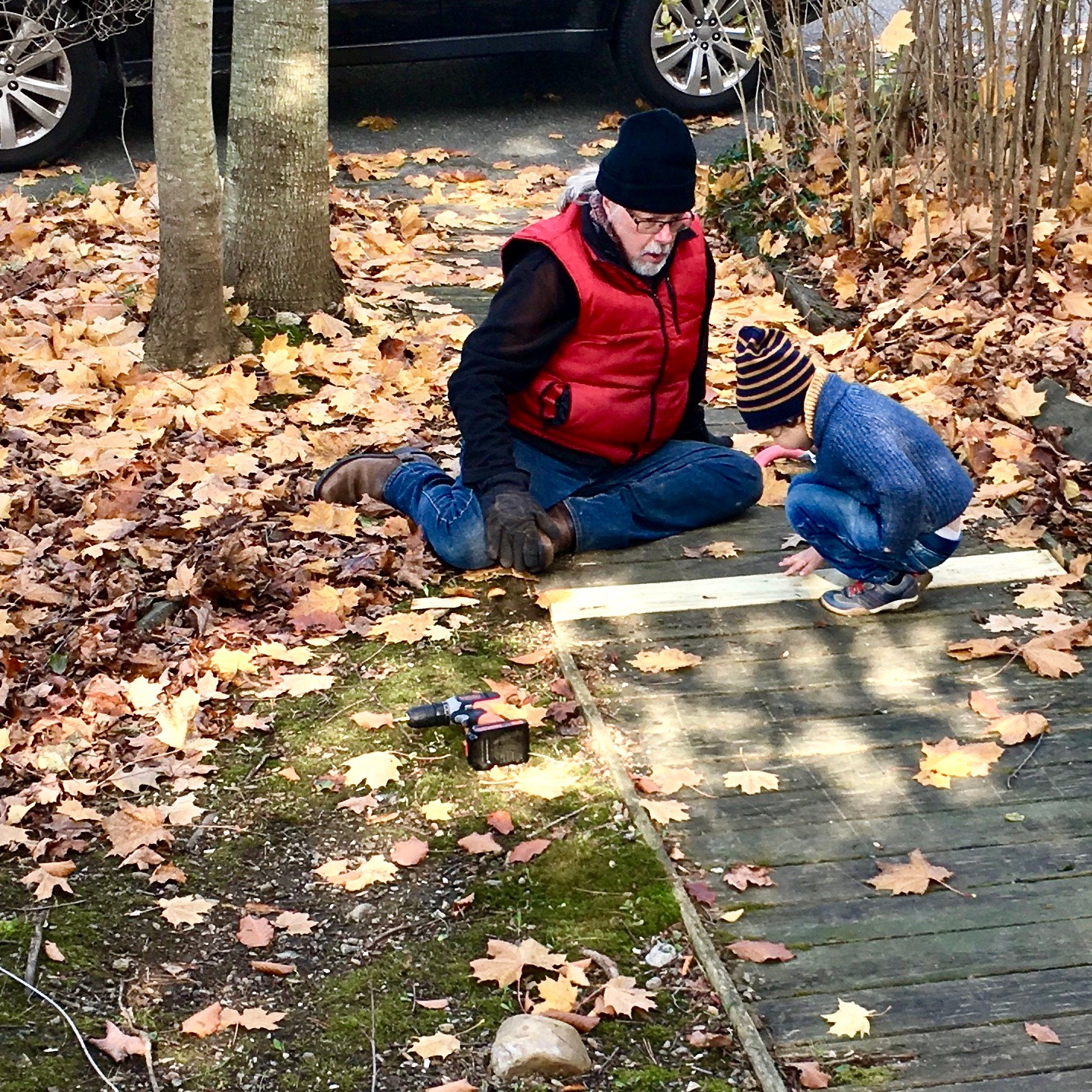
This year we have made a conscious effort to anticipate autumn's end so that we might better endure the season of hunkering down. Today I will take one of the rotting pumpkins on our front porch out of our autumn tableau so that it might go to seed in what I hope will be next year's pumpkin patch. This past weekend, in-between feasting with my beloved family, grandson Louie and I repaired rotting wooden slats on a walkway both as anticipation of enduring winter as well as anticipating the passage of love from one generation to the next. Last night I even took in the late news on TV to learn that some of the destruction of this current regime was being challenged and changed in Virginia and Kentucky. In our own small, scrappy little city it was happening too as the voters returned a progressive slate of public servants to office.

What is it about November
that always gives me the blues?
Is it the sky, heavy as sin
or is it the wind that seems to whistle
through the caverns of my skull?
Is it the earth, once warm and loving
but now grown hard and cold? Is it
all the fallen fruit that lies
and rots upon those grassy places
where I tread? Everywhere there is
the decadence and hush of dying leaves —
decay and death, I seem to drift,
a disembodied wraith, through mist
that settles like a shroud
upon that plain without a name —
though some would call it Limbo —
that land of stranded souls,
lost, damned or just forgotten.
Oh let me soon climb out of this
slough of despond, and cast aside
November blues to find delight
again in love, colour, laughter, light.
(Pete Crowther, "November Blues")

Monday, November 4, 2019

a month for making music for peace, justice, beauty, and hope

This Sunday, November 10 between 10 am and 12 noon, Famous Before We're Dead will be playing Dottie's Sunday Brunch in Pittsfield. Later that day, some of the band (Hal and John) will be playing Infinity's Bistro in Norfolk, CT starting at 7 pm. I will be on the road to Ottawa for time with my L'Arche Community.
On Friday, November 22 @ 7 pm, I am organizing a music and poetry benefit for BIO (Berkshire Interfaith Organizing). We are raising funds for their Sanctuary effort and immigrant justice initiatives in Berkshire County. It is a joy to share doing this show with great musicians and poets who are creative, talented, fun, committed to justice, peace and love, and are truly remarkable friends. The gig will be at First Church on Park Square (27 East Street in Pittsfield) and all are welcome. (BTW if you can't afford the suggested $12 donation, come anyway and share whatever you can, ok?) Here are some of the artists who will be kicking out the jams:

Andy Kelly, Eileen Markland, Charlie Tokarz, John Kelly: the Gypsy Jazz Ambassadors
Linda Worster

Between the Banks: Dianne De Mott, Jon Grenoble, James Lumsden, Brian Staubach, Dave McDermott

Jon Haddad


An Evening of
Music, Poetry and Solidarity
  A Benefit for Berkshire Interfaith Organizing (BIO)
First Church on Park Square
27 East Street, Pittsfield, MA

Friday, November 22, 2019 - 7:00 pm
$12/Ticket
Andy Kelly – Charlie Tokarz -Linda Worster 
Jon Haddad - John Hamilton – Between the Banks – Juan Pablo Morales -Jesse Miner - Berkshire County Poets

Sunday, November 3, 2019

honoring the organic rhythm of the feast and the fast: all souls day 2019

One of my favorite experiences in the world - and one of the most restorative, too - is feasting with my family. 

In this I am not unique and count this shared joy as a sacred gift born into us by a gracious and tender Creator: built into our bodies, habits, histories, thoughts, yearnings, seasons,spiritualities, and souls is a rhythm of living shaped by feasting and fasting. The land is clearly our mentor in this if we aren't too busy to notice. To everything there is a season: times of planting and harvesting, productivity and laying fallow, abundance and absence, hot and cold, day and night. In 21st century America, with schedules that are too full, time that is too lit, and appetites that are all too often sated by too much fast food, many of us have forgotten this blessing of this organic rhythm. 

But the yearning, while buried, abides. C.G. Jung once prophesied that when a culture loses touch with its life-giving rituals and symbols we create pathological substitutes. Forgetting that the feast is fundamentally not about the food but nourishing our hearts with gratitude and affection, we have constructed those ubiquitous temples of immediate gratification: the drive-through, fast food restaurants that now exist on every corner of our communities. There we stuff our faces with substitute love in the privacy of our own cars. Ironically, having lost touch with the natural balance of existence, we have normalized both bingeing and purging as well as perpetual dieting in a sea of obesity. While shopping earlier this week in anticipation of this weekend's feast, Di picked up one of the magazine's the line the check-out counter: "In time for the holidays," read the banner headline, "our latest 'INSTANT WEIGHT LOSS' plan!"  O Lord, in your mercy, hear our prayers.

One contingent of the clan arrived on Friday night from Brooklyn and quickly set about getting their little ones settle for the night. The next day there was time for visiting and then a long walk in the woods. Coming upon a sea of milkweed pods an idea was hatched to create "Louie's Milkweed Butterfly Garden." And after a light lunch of flatbread and hummus, that's what we did. The hill town family arrived later that day and we feasted into the night telling stories, laughing, enjoying everyone's presence, and then bringing the party to a close so that the youngest might get a good night's rest. Throughout the celebration I was keenly aware that it was All Souls Day. As the conversation and mayhem ebbed and flowed I found myself silently returning thanks for my mom and dad as well as Dianne's parents along with mentors Ray Swartzback and Sam Fogel. I set out a shot glass for them all - and toasted both Lou Reed and Mike Daniels who both brought heart and soul to me life over the years.

This morning, after Louie and I swept out his new garden and trimmed some branches from the path, we decided we needed to repair the wooden walkway that connects our deck with the driveway. Just as I had the chance to listen to him closely while creating the garden and its various signage yesterday, today I got to work with him closely measuring boards, showing him how to use a hand saw, prying up the rotten slats before power drilling the new wood into place. It was total granddad (or Gwad as he has called me for years) heaven. Later we raked-out the drainage ditch, pulled the wheel barrow around the yard together and then snacked on left over brownies.

I was keenly aware of my own mortality as we feasted - and hiked - and talked, and did home repairs. It was glorious basking fully in these moments with those I adore. Now the house is still except for the hum of the dishwasher. I can tell a nap is coming soon - and this too feels like part of the natural order of feasting, savoring, reflecting, letting go, and fasting both figuratively and literally in the days to come.

finally...

These past three months have taken their toll. Grief and anxiety will do that even if you don't fully recognize the signs. I certainly d...