Today I offered up "Send in the Clowns" by Stephen Sondheim as a prayer. It mostly worked - except for the bridge. I ended up re-writing it because I could not figure out the piano transcription for guitar chords. That is often a problem when piano music includes guitar chords. More often than not, the chords are technically right. They get ALL the right notes. But the guitar has six strings played with four and five fingers while the piano has 88 strings. What usually happens is that a piano player writes the chords as the sheet music is prepared and puts in too many chords. They are all correct, but too many changes for most guitar accompaniment.
In the Mexican folk song, "De Colores," for example, the New Century Hymnal (#402 for the church musicians) starts out in A (it should be C), immediately adds a 7th and then goes to an Em for the second measure. That fits, but it isn't standard Mexican folk music form: that would require an E7 (the five chord in a I, IV, V set up.) Then in the middle, the arranger throws in another A7, A9, A7#11, before ever getting to the D (the IV chord.) And NEVER resolves it with the essential E7. All I am saying is that pianists make guitar charts too freaking complicated. That's one problem.
The other is that the passing notes played on a piano require different chording on a guitar - and are usually written wrong. That was my problem figuring out the bridge for "Send in the Clowns." (Ok, I blew the timing a little, too and made it more squared off than necessary. Something I resolved later in the day and will address next week.) No matter how hard I tried, I could not make the suggested guitar chords work - so I rewrote the bridge with some jazz chords, changed the melody (not for the better), and was able to get back to the turn around that let me restart the melody for the closing. It wasn't always pretty but it mostly worked.
This afternoon, Di and I spend 90 minutes working through the odd Sondheim timing - not a problem - and the weird chords in the bridge - a REAL mofo! By the end we got it but not with a lot of wrangling, experimentation, and careful listening. I hope to rework it more tomorrow when the snow storm hits so that I can do it justice. And maybe get Di to join me sometime on key board so I can lay down and upright bass track, too.
Here's the link from this morning's livestreaming reflection. More soon.
Reflections on living as a sacred clown in this era of cynicism and chaos: how the spirituality of Jesus celebrates feasting and relationships vs. the way of John the Baptist's harsh asceticism
I've been absent from this forum since the inauguration: three Wednesday's in a row tore me apart, filled me with angst, and then started to knit me back together again with cleansing and grace. God was present in them all - but that exhausted me - so I checked out for a time. Today I am back rejoicing in the birthday of a friend and finishing my work for tomorrow's reflection. I came upon this poem too that is sublime.
Phase One: Written by Dilruba Ahmed
For leaving the fridge open last night, I forgive you. For conjuring white curtains instead of living your life.
For the seedlings that wilt, now, in tiny pots, I forgive you. For saying no first but yes as an afterthought.
I forgive you for hideous visions after childbirth, brought on by loss of sleep. And when the baby woke repeatedly, for your silent rebuke
in the dark, “What’s your beef?” I forgive your letting vines overtake the garden. For fearing your own propensity to love.
For losing, again, your bag en route from San Francisco; for the equally heedless drive back on the caffeine-fueled return.
I forgive you for leaving windows open in rain and soaking library books again. For putting forth
only revisions of yourself, with punctuation worked over, instead of the disordered truth, I forgive you. For singing mostly
when the shower drowns your voice. For so admiring the drummer you failed to hear the drum. In forgotten tin cans,
may forgiveness gather. Pooling in gutters. Gushing from pipes. A great steady rain of olives from branches, relieved
of cruelty and petty meanness. With it, a flurry of wings, thirteen gray pigeons. Ointment reserved for healers and prophets. I forgive you.
I forgive you. For feeling awkward and nervous without reason. For bearing Keats’s empty vessel with such calm you worried
you had, perhaps, no moral center at all. For treating your mother with contempt when she deserved compassion. I forgive you. I forgive
you. I forgive you. For growing a capacity for love that is great but matched only, perhaps, by your loneliness. For being unable
to forgive yourself first so you could then forgive others and at last find a way to become the love that you want in this world.
(Now we'll feast on pizza, beer and watching "Rent" for the first time. Thanks be to God!)
Today, once again, a light snow is falling. We can safely say that winter is truly here, as each day brings a bit more snow and the temperature will not climb beyond 30F for the next few weeks. I know that not everyone loves falling snow. Oh, perhaps they can savor it from a distance - or appreciate it's beauty in a film - but so many have moved away from north country because they hate the cold and the snow. I have come to cherish the whole experience as sensually clarifying. There is silence and cleansing in the snow, obscured vision along with an invitation to take care, too. I still hate driving long distances in a relentless snow storm, but while still in town with no place to go, I appreciate the snow's call to slow down and pay attention. It awakens me to the nuances of the day.
On Saturday morning, we woke to four inches of new snow that showed up over night. It was a surprise. Sadly, the sky soon turned to sleet and the purity of that surprise became a freezing mush that had to be cleared. And, damn, if those four inches didn't quickly become a heavy, sloppy mess that strained our backs. I felt the legacy of that storm yesterday while shoveling two new inches from the deck and driveway. I kept thinking, "There's nothing like aching arthritis to remind you of your mortality." I was grateful that today's coating was refreshingly light - even as it continues to fall gently.
Like many physical tasks - washing dishes, sweeping floors, scouring toilets - I find that shoveling snow often takes me into prayer. Not liturgical prayer, mind you, but the quiet awareness of once random thoughts making connections with their kin. Yesterday, Carrie Newcomer posted this on her Speed of Soul site:
The snow is coming down in enormous fluffy flakes. I lift up my purple mittens to catch a few on the back of my hand. Even with the naked eye I can see each crystal wheel with their individual arms and legs of ice. There is a solitary stillness in the ravine back by the creek and few sounds beyond the occasional hammering of a pileated woodpecker and intrepid jingle of my dog's collar tags. It is so quiet I can hear the soft hissing sound of those large flakes landing on the tree branches and forest floor. It is that still. It is in these quiet moments that I sense the expansiveness of time beyond my own life. I sense there is an abiding wellness even in these bruised and troubled times. What is whole is still whole. What runs deep still runs deep. Even our troubles seem transient when the falling snow lands on the ground like the most tender kiss - and you are truly there to hear it.
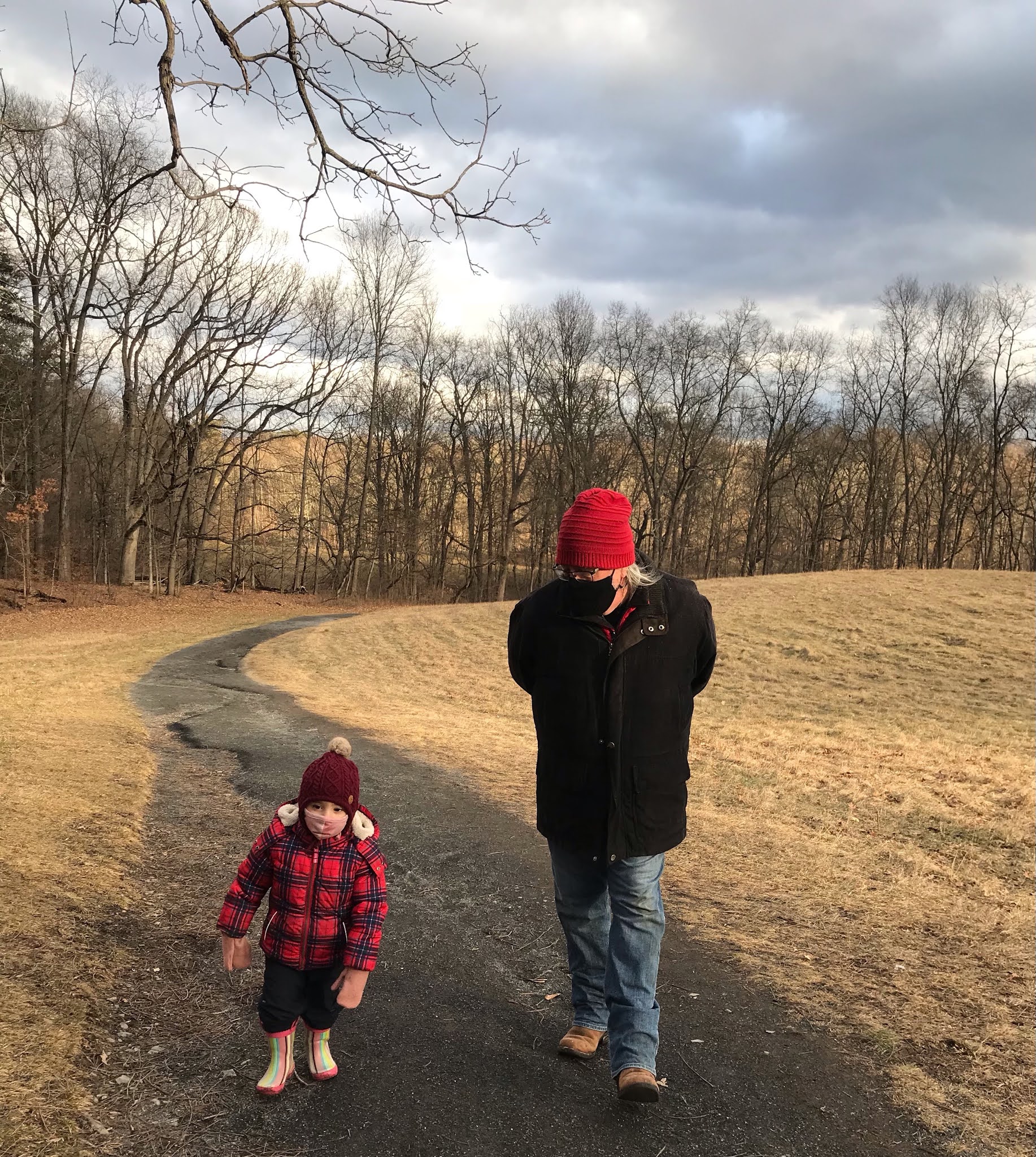
She taps into what I have come to trust, too: the presence of a small but salvific assurance that "what is whole is still whole." I felt this while walking with my children and grandchildren on Sunday as well. For three hours we hiked through the woods and fields of Poet's Walk along the Hudson River. Anna loved "drawing pictures" in the md with her new boots. Louie and I marveled at the way water runs to the lowest point in a meadow to pond into pools of fragile ice resembling ancient panes of glass. The adults rejoiced in being together. We spoke of how the pandemic has been exhausting but clarifying, too: a simple walk in the woods is now filled with blessings. As we were schlepping back through the woods to our cars at twilight, barely able to see one another as the light fled into the night, our daughter mused that "it's been at least a decade since I walked through the woods at sunset." Me, too, I realized and and drifted back to something the late Macrina Wiederkehr wrote that I caught my eye earlier that morning:
Slowly She celebrated the sacrament of Letting Go… First she surrendered her Green Then the Orange, yellow, and Red… Finally she let go of her Brown… Shedding her last leaf She stood empty and silent, stripped bare Leaning against the sky she began her vigil of trust… Shedding her last leaf She watched its journey to the ground… She stood in silence, Wearing the color of emptiness Her branches wondering: How do you give shade, with so much gone? And then, the sacrament of waiting began The sunrise and sunset watched with Tenderness, clothing her with silhouettes They kept her hope alive. They helped her understand that her vulnerability her dependence and need her emptiness her readiness to receive were giving her a new kind of beauty. Every morning and every evening she stood in silence and celebrated the sacrament of waiting.
Within the quiet assurance of sacred nature, among those I adore most dearly, in a gentle flurry of quiet snow, I let go of my fretting for a spell - and slept like a child again that night.
I pass a woman on the beach. We both wear graying hair, feel sand between our toes, hear surf, and see blue sky. I came with a smile. She came to get one.
No. I'm wrong.
She sits on a boulder by a cairn of stacked rocks. Hands over her heart, she stares out to sea. Today's my turn to hold the joy, hers the sorrow.
The poet is Jeanie Greensfelder, an artist I know nothing about, who hails from San Luis Obispo, of which I know precious little, too. Apparently SLO lies about halfway between Los Angeles and San Francisco. I have lived in both of those cities - and visited many of the mission towns in-between. SLO is one of the oldest California communities to be inhabited by Europeans but historians say that the Chumash people have been on the land since about 7000 BCE. Our daughters are "California girls. One was born in LA and the other in SF; one while working with Cesar Chavez and the Farmworkers Union, the other while I was a student at SF State University. I rarely think of them as Californians, however, as they both carry a Midwestern countenance from our days in Saginaw, MI and Cleveland, OH.
My heart was awakened (again) after spending a little time with "Taking Turns." It so neatly summarizes what it means to be a sacred clown: smiles and stillness, careful listening and sharing reality without ceremony. The clue comes in the line: by a cairn of stacked rocks. One is grieving and is respected while she silently rests in her sorrow. The other holds the mourner in her heart without interrupting or imposing: beyond sound, a sacred sacramental moment is shared.
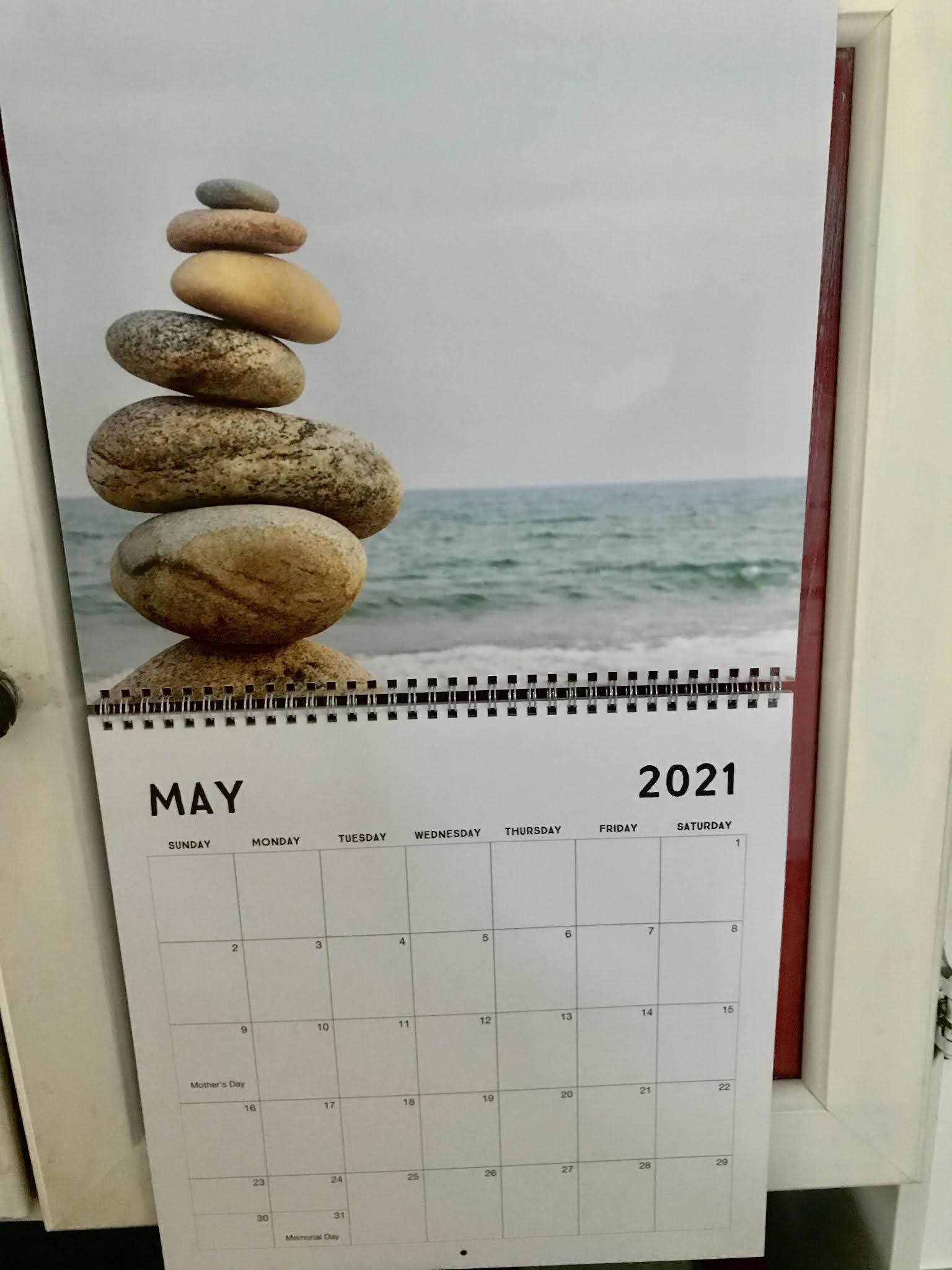
Later in the day, during lunch, our mail arrived bringing us two packages. In one there were new masks to wear while engaging the world during the contagion. In the other, the annual calendar one of our daughters shares with the wider family linking her photographs to the march of days including birthdays and anniversaries. For so many reasons, the month of May spoke to me of the Spirit praying for us all with sighs too deep for human words.
Two recent insights about living as one of God's sacred clowns or holy fools spoke to my heart. The first is found in an old text from 1979 by Fr. Henri Nouwen entitled, Clowning in Rome. I have had this book for a long time but never spent any time with his reflections on the sacred but small nature of living as one of God's sacred clowns. Nouwen had accepted an invitation to spend five months living in Rome where he shared four lectures to a variety of English speaking communities. In the introduction, Nouwen cuts to the chase: "Slowly, I started to realize that in the great circus of Rome, full of lion-tamers and trapeze artists whose dazzling feats claim our attention, the real and true story was told by the clowns.
Clowns are not in the center of the vents. They appear between the great acts, fumble and fall, and make us smile again after the tensions created by the heroes we came to admire. The clowns don't that it all together, they do not succeed in what they try, they are awkward, out of balance, but... they are on our side. We respond to them not with admiration, but with sympathy, not with amazement but with understanding, not with tension but with a smile. Of the virtuosi we say, "How can they do it?" Of the clowns we say, "They are like us." The clowns remind us with a tear and a smile that we share the same human weaknesses … The longer I was in Rome, the more I enjoyed the clowns, those peripheral people who by their humble, saintly lives evoke a smile and awaken hope, even in a city terrorized by kidnaping and street violence.
Nouwen then names "four clownlike elements" of the spiritual life: solitude, devotion (or celibacy), prayer, and contemplation. "My growing love for the clowns in Rome made me desire to clown around a little myself and speak about such foolish things as being alone, treasuring emptiness, standing naked before God, and simply seeing things for what they are." He added that within the bustle of Rome's grandeur, he discerned another desire within, a creativity that "wants to play, dance, smile, and do many other 'useless' things." And by 'useless' Nouwen means profoundly personal acts of compassion, companionship, creativity, and community-building like the students "wasting their time with grade-school drop-outs."
The Medical Mission sister dedicating all her time to two old women who had become helpless and isolated... the young men and women who picked up the drunks from the streets during the night and gave them a bed and some food. The priest forming communities for the handicapped ... women and men of all ages offering their lives to others with a disarming generosity.
I found myself returning to one of Alana Levondowsk's songs that gave shape and form to Thomas Merton's comments about St. Theresa of Lisiuex: "Little Flower."
I can't fully explain why this song grabs me where I live. Beverly Lanzetta writes that the sacred can only be hinted at poetically and evocatively: it is too sublime to confine to linear explanations. On my journey, her words - and Alana's song - come as close as possible in this realm. First, there are the "useless" little flowers and clowns who live for tenderness rather than recognition, power, or productivity.
Then there was what Fr. Richard Rohr wrote about spending time with those in the community of Mother (now saint) Theresa of Calcutta. Serendipitously, his time in that community came to a close on October 1, the feast day St. Teresa, who is one of Rohr's all-time favorite mystics! He observed that for the first time he:
... finally met a “conservative” yet fully contemporary form of religious life that I could trust. The sisters were not rigid; rather, they were simply devoted women. They did not need security, answers, and order, as we see in most traditionalist movements in the West. In fact, they were willing to live without security, with very few answers to their questions of mind and heart, and amid almost total disorder. All in union—hour by hour—with God. They lived that amazing and rare combination of utter groundedness and constant risk-taking that always characterizes the true Gospel. The sisters didn’t waste time fixing, controlling, or even needing to understand what is wrong with others. Instead, they put all of their time and energy into letting God change them. From that transformed place, they serve and carry the pain of the world, which they are convinced is the pain of God. This is the synthesis on a communal level that I am always seeking. I have encountered it in many individuals, but hardly ever in public and social form.
And when asked why this order did not engage in the social powers that create so much of the suffering they attend to, Rohr was calm told that:
Mother Teresa felt that if... she played the firebrand she could not be what Jesus had told her to be—love to and for all. She said that if she started correcting and pointing out “sinners” she could no longer be an instrument of love and reconciliation for them. Humiliated and defensive people do not change. Like her patron Thérèse of Lisieux, “her vocation in the church was to be love.” She knew that her primary message had to be her life itself, not words or arguments or accusations. She had found that “third something” that is always beyond the calculating and dualistic mind.
In my journey of faith, this simplicity resonates with me at this stage of life. It celebrates the way Nouwen describes sacred clowns as "useless" to the world but so vital, too. And, it does not negate the importance of organize against social injustice. Rather, it acknowledge, as St. Paul insisted, that the Holy Spirit gives to us various gifts and each individual does not carry all the Spirit's charisms. I know that at other times in my life I have been an organizer. An advocate. An activist ally. But not now. Today, as an old, straight, white male intellectual, I am much more of a holy fool who simply lives and shares small and often seemingly insignificant acts of love. Period. Well, ok, I still do some advocacy online and am allied with the Poor Peoples Movement. But my life, in person and online, is much more "useless" as the charism of the clown fills my soul.
As I write this confession, the political realities of my nation have become absurd as well as dangerous. The current regime is acting out ugly threats to subvert the recent presidential election as it hunkers down into conspiracy theories. Its allies are both the lunatic fringe of American right wing ideology and crass opportunists positioning and posturing for elected office in 2024. That they care little about the short or long term consequences of their hatred is irrelevant right now: they are going to do everything short of violent insurrection to advance their cause - and some less stable souls will inevitably spill over into acts of violence, too. In a nation saturated with weapons and hellbent on selfish individualism, you can see disaster coming. It is sad, frightening, tragic, ugly, and raging towards a full blown confrontation that few seem willing to avert...
... all the more reason why the charism of the foolish and useless clown takes on a new urgency...
Now that our pilgrimage into a Celtic Advent has come to a close - a quiet time of reflection, silence, song, prayer, and creative wandering for 40 days - I've been wondering
continue to be unchartered territory - an evolving pilgrimage of sorts - where the challenge and invitation will be to experientially honor a new manner of emotional, physical, political, spiritual, and creative meandering by faith. Fr. Richard Rohr speaks of our time as an unveiling where, "despite the uncertainty and disorder, our present moment is an opportunity to awaken to a deeper transformation, love and hope." He adds that finally "learning that we are not in control situates us correctly in the universe."
If we are to feel at home in this world, we have to know that we are not steering the ship. That teaching is found in the mystical writings of all re ligions. Mystics know they are being guided, and their reliance upon that guidance is precisely what allows their journey to happen.
A few clues keep climbing into consciousness. Christine Valters Paintner insists that paying attention to the threads of synchronicity that keep showing up in our lives - following them, listening to them, observing them, and honoring them - is one way to live into the holy wandering of Celtic pilgrimage. The ancient monks did not move towards a fixed destination as theirs was neither a linear pilgrimage nor a goal as is common in the West. Rather, theirs was an expedition of the heart, a quest for inner resurrection where our best self is revealed and renewed. It is where our truest songs are heard and sung. It is where our soul finds safety and succor to resume our odyssey into mystery. And while our heart's resurrection always rings true deep within, discerning where it will show up next is always a surprise.
Before Advent, I found myself reading about Alana Levandoski and listening to selections from her most recent album: Hymns from the Icons (check her out @ https://gumroad.com/alanalevandoskimusic) Awhile back I'd seen some press for her work with James Finley - particularly Sanctuary - but truth be told I am so done with worship and praise music that I stayed away. In retrospect, that was my mistake because it is a powerful collection, but as they say, "only when the student is ready will the Buddha appear." I liked the artists she covered on Icons - Leonard Cohen, Bob Marley, Mary Gauthier, Bob Dylan, Grateful Dead, Johnny Cash and others - they are among some of my favorites, too. And while listening to "Mercy Now," there were tears in my eyes.
Frederick Buechner wrote in his masterful, Whistling in the Dark, that we should pay attention to our tears:
YOU NEVER KNOW what may cause them. The sight of the Atlantic Ocean can do it, or a piece of music, or a face you've never seen before. A pair of somebody's old shoes can do it. Almost any movie made before the great sadness that came over the world after the Second World War, a horse cantering across a meadow, the high school basketball team running out onto the gym floor at the start of a game. You can never be sure. But of this you can be sure. Whenever you find tears in your eyes, especially unexpected tears, it is well to pay the closest attention. They are not only telling you something about the secret of who you are, but more often than not God is speaking to you through them of the mystery of where you have come from and is summoning you to where, if your soul is to be saved, you should go to next.
So I went to her website, found that she was offering a collection of CDs before Christmas, and put in an order. Coming from Canada took a bit of time and when they finally arrived I was wrapping up my own Celtic Advent and L'Arche Ottawa writing. I thought, "Let's just wait until the 12 days of Christmas and take this new music slow." Last night, however, Levandoski put out a steam-punk song based on lyrics from Alfred Lord Tennyson she calls, "Ring Out the Bells." It is brilliant - and her own precise and insightful description of why and how she put it out warrants sharing.
In 1850 Tennyson published a requiem called In Memoriam, written as he grieved the sudden death of his sister's fiancé, who was also a beloved friend. The poem Ring Out, Wild Bells, oft-used to ring in the New Year, was part of that requiem. In my own more roots-oriented style, I composed music for this poem because I was drawn to the universal hope and longing contained within the poem. It is overreaching, and perhaps naive, especially in light of the colonialism of Tennyson's time, and that two world wars were on their way, that would catapult a technology that was rooted in destructive ideas, rather than life-giving ideas. Still, I was drawn to how universal the sincerity of the longing was.
I decided to have a steampunk-themed video, because steampunk was inspired by early tech and the victorian era... and as a contemplative Christian, I wanted to push the envelope a bit... in terms of the boxes we put ourselves into. This year has been strange and difficult, and filled with suffering. And invoking a bit of the sacred clown energy, I decided to bring in a bit of burlesque, to offset the "awful solemnity" (as Thomas Merton called it) I am seeing, especially in spaces of comfort and privilege. I sometimes struggle with awful solemnity... and it renders me unable to find the infinite possibilities for traction that we have... to work collectively toward true equity, which is what, I think, this song is longing for.
I think this song is a prayer for JUBILEE. Forgive us our debts.
And... from a 21st century perspective, part of my work is to draw attention to the debts owed to people of colour, and indigenous people. When I sing this song, and invoke the words "purer laws", I imagine (at the very least), archaic policies in Canada, harmonizing with the United Nations Declaration of Indigenous Rights. When I sing "ring out the narrowing lust of gold", I imagine a time when a critical mass of people who own more than their fair share of land, participates in a phenomenal movement of land reparations, and all the young people of colour who want to farm, can own land, and have total sovereignty. When I sing "ring in the Christ that is to be", I imagine a day when the over 27,000,000 people still who are enslaved today, are raised the very highest of all.
In other words, I didn't record this song as an excuse to bypass the heavy lifting that is ahead, for especially people who live with more comfort than is good for them. I wrote, and recorded this for the longing... and the vision... and maybe it was naïve of me... but I still hope for epiphany... which is just around the corner from New Years!!!
And AGAIN with those tears - and once more later today while doing errands and listening toPoint Vierge in the car. Tears, tears, and more tears. Tears of gratitude and joy. Tears of confession and clarity. Tears of synchronicity and sojourn. That's when it all came together for me: the sacred clown. She has been my mentor since "Godspell" days. The holy fool impelled me bring Frank Zappa music into church back in the day. The Beatles, Joni Mitchell, Leonard Cohen, the Eels, U2, Sarah MacLachlan and Joan Osborne too in a later incarnation. The holy fool and the feast of fools was at the center of my doctoral dissertation, While My Guitar Gently Weeps: A Spirituality of Rock'n'Roll and so much of what we did in ministry back in Tucson and Pittsfield. No wonder I copied this from note from Carrie Newcomer's "Speed of Soul" reflections over the weekend and saved it:
"You've made this day a special day, by just your being you. There's no person in the whole world like you, and I like you just the way you are." — Fred Rogers
I have to admit, I totally love Mr. Rogers. He was never afraid to speak directly to a three year old. He didn't worry if people made jokes about is communication style, he just put on his sweater and spoke about love and kindness, community and neighborliness. He wasn't talking to adults, although he didn't mind if we listened. He was speaking to the hearts and ears that needed to hear they were special, they were whole and that the bedrock of their very being was good stuff.
What I learned from Mr. Rogers was to never be embarrassed of being tender. That I could go ahead and speak from the goodness of my heart and the truth of who I am, go ahead and say out loud, "I love you." "There is no one in the whole world like you, and I'm so grateful you are in my life" or "I believe in you" or even, "I'm so sorry."
So today - think of it as a little Mr. Rogers exercise - Tell someone in your life you care. Tell them a specific something you love and appreciate about them. Maybe just a text saying, "This thing you do and are...I so deeply appreciate", or a phone call or email to say, "I know this is hard, but I believe in you." Tell someone in your life today what Mr. Rogers hoped 4 year olds ( and who they became when they grew up) could learn to say to one another and to themselves, " You are special, You are whole and the bedrock of your very being was and is good stuff."
Fred Rogers, in his own humble way was a holy fool challenging the cruelty of the status quo with tenderness. While on sabbatical in Montreal, I heard my heart urging me to go deeper into what I was calling a "spirituality of tenderness" that was more profound than the peace-making of my youth and more foundation just music alone. Listening to the song of the sacred clown led me to L'Arche - and keeps me connected. It is one of the few truths that remains strong in my heart after living through the desecration of the current political regime's manipulation of Christ's church. And, upon careful reflection, that holy fool was my inspiration for spending 40 years in ordained ministry. In middle class Protestant America, there was not a lot of interest in contemplation and simple living. There was even less interest in sacramental spirituality let alone the importance of beauty as one of God's voices. Yet that's where God called me - and for years I thought I had made a mistake - but now I realize it was one incarnation of the holy fool who: "attempts to live calmly in the middle of chaos, productively in an arena of waste, lovingly in a maelstrom of individualism, and gently in a world full of violence." (Sr. Joan Chittister)
So that is what I am sensing we'll explore as we resume our pilgrimage into 2021 during the age of contagion, chaos, solitude, and disorder. Thank you, Alana Levandowski! Thank you Joan Chittister! Thank you Frederick Buechner! Thank you, Harvey Cox! Thank you, Celtic pilgrims! Thank you, Christine Valters Paintner! Thank you, Henri Nouwen! Thank you, L'Arche Ottawa! Thank you band mates in Tucson and Pittsfield! Thank you, Martha! Thank you, Pam! Thank you, don E! Thank you, Frank Zappa, Beatles, U2, Sarah MacLachlan, Joan Osborn, Leonard Cohen, Bob Dylan, Joni Mitchell, Joan Armatrading, Bob Marley, Tom Waits and so many others. Thank you, Richard Rohr! And especially thank you, Di! It seems like now is the right time to honor "being small rather than strong, valuing joy over pleasure, avoiding positions of power, and enjoying rather than avoiding moments of insecurity, fear, and awkwardness." (Jon Sweeny in The St. Francis Prayer Book)
Merry Christmas: Christmas Eve Homily at L'Arche Ottawa
Something we are all thinking and feeling this year, but not saying out loud, is how hard this past year has been for all of us mostly because of that blasted Covid-19 virus. It has turned everything upside-down and inside-out: it has brought suffering and sometimes death to those we love, it has thoroughly disrupted our routines and securities, and it has caused us to be creative and unusually patient amid the agonizing stress, anxiety, and confusion. And while I join you all in praying, wishing, hoping, social distancing, masking, and hand-washing that this dark time of disease will be over soon, I am also aware that in ways that are mysterious and far greater than my understanding the contagion is showing me just how much we are like the vulnerable Christ Child Jesus born this night in the city of David as our Savior. What I mean by this is that God came into the world for us as a baby – a small, helpless child born into a cold night to humble parents who were trying to make sense of life in a nation occupied by a sometimes cruel and always demanding invading army – and this wasn’t an accident. For this infant to thrive, it was essential that someone held and caressed him, loved and clothed him, changed his messy diapers, sang to him, fed and nurtured him, too because he couldn’t do it himself. I’m not being sentimental or coy here: the smallness of the one we call Messiah was not an accident – and tells us two surprising truths about the blessings and responsibilities of Christmas:
First, the Christ Child makes clear that God is found in what is small, what is
weak, what is hidden. Fr. Henri Nouwen, who spent his last years in community at L’Arche Daybreak in Toronto used to say that most of us look for the Lord in big, impressive, and loud happenings that document the Creator’s power. We expect God to show up in “spectacles, power plays, significant and extraordinary events” that will change the course of history. We, ourselves, are often taken-in by wealth, prestige, and sparkling things that glitter and shine. We can be so easily distracted. Perhaps that is why the Lord chose to come to us as a small child of Palestin-ian peasants in an insignificant stable surrounded by animals and shepherds. The way of God’s kingdom is humble, simple, small, and so very vulnerable. The first surprise about Christmas is that the holy shows up for us in the most unlikely little places – and if we refuse to look for God in what is small, Fr. Nouwen suggests, we will likely give-in to despair.
The second surprise about the Christ Child’s birth is that each of us has a small, tender, afraid, wounded, and little place within our hearts, souls and memories that needs the same comfort and caring as the baby Jesus. We don’t like to
confess this: we’d rather look strong, significant and in control. But that vulnerable infant part of us still cries out to be loved, still aches to be held, still yearns to be cherished and comforted in a harsh and frightening world. During this blasted pandemic I rediscovered how afraid and confusing life can be – and how much I need God’s comforting presence as well as the love and encouragement of others I trust to be safe and kind, too. During these covid days, I am keenly aware of the Christ Child within me.
One of mysteries of suffering is that it reveals some of the ways we must change; some of the ways we are still small, broken, and tender; and some of the ways we can share God’s love with other who are hurting and anxious. Our dark days are not dissimilar to the night into which Jesus was born once – and continues to be born among us still in small, childlike acts of love and trust. For me, and for our community, this is where I believe God’s good news is being revealed this Christmas. And for that I say: Thanks be to God!
It was snowing lightly for a moment this morning, all but gone now in
anticipation of returning another day, but still lovely. The weather guy - or "snow" man at the Greylock Snow Day blog site - says that the glorious white blanket that currently graces our hills will vanish by Christmas Day as rain and above average temperatures "do major damage to our snow base." He laments this - as do I. Once upon a time, I hated the stuff. But, as time has passed and I relinquish a measure of my prissy demeanor, we've become friends. I love the way Lucie frolics in the frost like a pup despite her arthritis. And I have discovered the sacred silence of the air as snow falls and muffles all earthly distractions except the stillness for a spell. The Belfast poet, Louis MacNiece, hints at these layered truths in his composition called simply: "Snow."
The room was suddenly rich and the great bay-window was Spawning snow and pink roses against it Soundlessly collateral and incompatible: World is suddener than we fancy it.
World is crazier and more of it than we think, Incorrigibly plural. I peel and portion A tangerine and spit the pips and feel The drunkenness of things being various.
And the fire flames with a bubbling sound for world Is more spiteful and gay than one supposes— On the tongue on the eyes on the ears in the palms of one's hands— There is more than glass between the snow and the huge roses.
From our secluded solitude surrounded as we are by snow, trees, and wetlands, it is hard to grasp the horror that so much of the rest of the world is experiencing. Author and historian, Diana Butler Bass, recently wrote that as she and her family were watching the TV news headlines, her college-age daughter gasped: "We are in hell. We are in freaking hell." She adds:
When the medieval church assigned “Hell” to the Fourth Sunday of Advent, I’m certain they wanted to scare people about their eternal state — to straighten up and get right with God to prepare for Jesus’ coming. I’m equally certain that those preachers weren’t thinking about the hell that we humans make right here on earth. But we’ve got a whole lot of hell this year. Right here. And people are scared about what is going on in the world.
There is every good and bad reason to be scared about what is going on right now - and hell is a fitting description. It feels disorienting and surreal to affirm this pain from where I sit in silent isolation, but hell is precisely true - even necessary. Editor, David Leonhardt, put it like this in today's New York Times newsletter: "For many Americans, the coronavirus recession has done almost no damage to their finances."
They still have their jobs, and their expenses have gone down while they've been stuck mostly at home. Their homes have not lost value, unlike the financial crisis of 2007-9. If they are fortunate enough to own stocks, their portfolio is probably worth more than a year ago. Of course, millions of other Americans are struggling mightily. Nine million fewer people are employed than a year ago. Others are coping with big medical bills. Many small businesses have closed or may soon. And state and local governments are planning deep cuts.
Talk about parallel universes! The gap between we-of-privileged solitude and they
-of-economic-vulnerability is every bit as massive and incomprehensible as that between fanatics consumed by delusional conspiracy fantasies within the Trump regime and the rest of us. Such separation breeds fear, and fear too easily morphs into hatred and violence towards all that we don't understand. Or know. Or even see. Dr. Bass puts this contrast into a context for those of us exploring an Advent spirituality: "The horrible headlines (of our day) have me reflecting on these verses, familiar words for many, from Luke 2:"
"But the angel said to them, ‘Do not be afraid; for see — I am bringing you good news of great joy for all the people: to you is born this day in the city of David Savior, who is the Messiah, the Lord. This will be a sign for you: you will find a child wrapped in bands of cloth and lying in a manger.’ And suddenly there was with the angel a multitude of the heavenly host, praising God and saying: ‘Glory to God in the highest heaven, and on earth peace, goodwill among people!" It is a beautiful vision — the angels, the heavens singing. No matter the angelic announcement, however, the world was still in the shadow of sin. Jesus was born. But Caesar was on the throne. The Messiah had come. But Israel was occupied, a client state of Rome. Peace and goodwill were proclaimed. Yet violence remained the power of empire. Peace! Hark! Peace - and yet no peace.
The band U2 crafted a song in the wake of an IRA bombing in Omagh in 1998 that captures the anguish of our social chasms. They link our "hell" to the dreams we celebrate during Advent/ Christmas. I consider it one of their finest compositions. When they shared it after the 9/11 terrorist attacks, it took on added significance - one that warrants our renewed interest and attention.
Bass, U2, and many people of goodwill can't help but wonder right now how we might reach across the divide of hell to live into solidarity with sisters and brothers who are our walking wounded. The way of Jesus was never meant to be an other-wordly, inner peace only faith. Not for a Messiah we claim to be the essence of God's word made flesh. My hunch - and experience - suggests that one ingredient must be lament. Tears can be God's presence breaking our hearts open. We do not need more abstractions, theories, or feelings of debilitating fear. This is time for a love that is greater than despair. And if we don't grieve deeply now, when we have the time and space to weep and own this horror, it is unlikely it will happen after our vaccinations. I quoted Fr. Henri Nouwen earlier this week when he clarified what it means to live through despair into joy:
Joyful persons see with open eyes the hard reality of human existence and at the same time are not imprisoned by it. They have no illusion about the evil powers that roam around, “looking for someone to devour” (1 Peter 5:8), but they also know that death has no final power. They suffer with those who suffer, yet they do not hold on to suffering; they point beyond it to an everlasting peace.
Increasingly, I have come to trust that incarnation - magnifying the Lord like Mary or making the ideas of the holy part of our fleshy habits - requires Fr. Henri's insights to be embraced by the poetry of Lucille Clifton. Together they express an embodied grief in love that breaks our hearts. As we feel connected to all of life - the beautiful as well as the broken - then we can choose what small ways we can nourish and strengthen it. As our spiritual cousin in Judaism often say: "L'chaim! Here's to LIFE!"
people who are going to be in a few years bottoms of trees bear a responsibility to something besides people if it was only you and me sharing the consequences it would be different it would be just generations of men but this business of war these war kinds of things are erasing those natural obedient generations who ignored pride stood on no hind legs begged no water stole no bread did their own things
and the generations of rice of coal of grasshoppers
by their invisibility denounce us
(generations by Lucille Clifton)
Monday, December 21, 2020
Merry Christmas 2020
As Advent slowly gives way to Christmas, and the
Winter Solstice promises that more light will soon break through our darkness, life
here feels wistful: sorrow mixing with quiet anticipation. Throughout this year
we have known both grief and joy, uncertainty and hope both at the same time. Clearly,
we are being called to learn living with paradox, but it’s been rough going – even
from the relative safety and solitude of our small, quiet home in Western
Massachusetts. Some lives continue-on with real albeit modest inconveniences
while others are consumed by chaos, suffering, anxiety, fear, and death. From within our bubble of privilege, we are
learning what St. Paul meant when he told the early faith community in Rome
that we must learn to practice waiting in patience:
The Spirit helps us in our weakness; for
we do not know how to pray as we ought, so that very Spirit intercedes with
sighs too deep for words. And God, who searches the heart, knows what
is the mind of the Spirit, because the Spirit intercedes for the saints
according to the will of God. (In this we can trust that) all things work
together for good for those who love God and live according to the wisdom of
creation.
This year I have learned that the early Celtic
Christians refused to waste their waiting. Believing that when the Word of God
became flesh at Christmas, God was reminding us that what was true in the
beginning is still true today: the Holy created humans in the sacred image so we,
like creation, are infused with original blessing, not original sin. Each day
becomes another opportunity to live into God’s goodness in our ordinary lives.
This regularly floated to the surface for me over the past ten months as I rediscovered
what is most important: love, using limited resources wisely, going deeper into
prayer, beauty, silence, and nature and giving new attention to small acts of
tenderness. The Irish poet, John O’Donohue, wrote:
At Christmas, time deepens. The Celtic
imagination knew that time is eternity in disguise. They embraced the day as a
sacred space. Christmas reminds us to glory in the simplicity and wonder of one
day; it unveils the extraordinary that our hurried lives conceal and neglect.
We have been given such immense possibilities. We desperately need to make clearances
in our entangled lives to let our souls breathe. We must take care of ourselves
and especially our suffering brothers and sisters.
To hallow each day as sacramental is to claim time,
love, words, prayers, thoughts, songs, house-cleaning, dishwashing, laundry,
home-cooked meals, short walks in the wetlands, and whatever time remains as gifts
too precious to take for granted. For when they are cherished and savored,
these little things become restorative. I've long suspected that the
"small is holy" and now we’re learning what that means from the
inside out. Henri Nouwen put it like this:
Joyful persons see with open eyes the
hard reality of human existence and at the same time are not imprisoned by it.
They have no illusion about the evil powers that roam around, “looking for
someone to devour” (1 Peter 5:8), but they also know that death has no final
power. They suffer with those who suffer, yet they do not hold on to suffering;
they point beyond it to an everlasting peace.
Many of my plans did NOT happen in 2020 the way we
planned, but what DID take place became holy ground – and I am so grateful to
have shared some of it with you. May all that is holy continue to ground you in
grace and love you from the inside out.