
I believe that Jesus was totally honest when he told us: “I have come that my joy may be your joy – and that your joy might become wholly mature. This is my new commandment: love one another as I have loved you… and your joy shall be full.”
+ With everything that is sacred within me – heart, mind, body and soul – I believe and trust that this is true: I have come so that your joy may be full.
+ And I know that most Christians don’t really believe it because no matter what we sometimes tell ourselves, our tradition is obsessed with sin. One theologian likes to quote his Buddhist friend who told him, “You Christians must be very bad people – you’re always confessing your sins!”
So in the spirit of Jesus – and his call to love and mature in authentic joy – I want to suggest this morning that I think the time has come to let go of some of our sin talk. Not abandon it or pretend like sin doesn’t exist; but rather let’s put our humanity into a larger spiritual context where sin is only one aspect of our faith.
You see, I believe that the time has come for us to speak about the human condition with depth and breadth – with nuance and subtlety – with tenderness, honesty, affection a nd grace. And Christianity’s historic obsession with sin is just… incomplete at best. It is often unjust and even harmful to those who have been wounded by life.
+ I have come to prefer the way Thomas Keating speaks of the human condition; rather than sinners, he talks about broken souls searching for their true selves.
+ I like when Frederick Buechner speaks of being lost. “I think it is possible,” he writes, “to say that in spite of all its extraordinary variety, the Bible is held together by having a single plot. It is one that can even be simply stated: God creates the world; the world gets lost; and God seeks to restore the world to the blessings for which God created it.”
 shall be full.”
+ With everything that is sacred within me – heart, mind, body and soul – I believe and trust that this is true: I have come so that your joy may be full.
+ And I know that most Christians don’t really believe it because no matter what we sometimes tell ourselves, our tradition is obsessed with sin. One theologian likes to quote his Buddhist friend who told him, “You Christians must be very bad people – you’re always confessing your sins!”
So in the spirit of Jesus – and his call to love and mature in authentic joy – I want to suggest this morning that I think the time has come to let go of some of our sin talk. Not abandon it or pretend like sin doesn’t exist; but rather let’s put our humanity into a larger spiritual context where sin is only one aspect of our faith.
You see, I believe that the time has come for us to speak about the human condition with depth and breadth – with nuance and subtlety – with tenderness, honesty, affection a
 nd grace. And Christianity’s historic obsession with sin is just… incomplete at best. It is often unjust and even harmful to those who have been wounded by life.
+ I have come to prefer the way Thomas Keating speaks of the human condition; rather than sinners, he talks about broken souls searching for their true selves.
+ I like when Frederick Buechner speaks of being lost. “I think it is possible,” he writes, “to say that in spite of all its extraordinary variety, the Bible is held together by having a single plot. It is one that can even be simply stated: God creates the world; the world gets lost; and God seeks to restore the world to the blessings for which God created it.”
+ Or consider the way Marcus Borg deepens this insight of Buechner’s by embracing other creative images. In addition to our original blessing – and the reality of sin – he suggests that the human condition is also: Blind, in exile, in bondage; we have closed hearts, we hunger and thirst, we are lost.
Each of these i mages for the human condition, he writes, has a correlative image; that is, each implies a remedy, a solution, even a healing. If we are blind, we need to see; if we are in exile, we need to return; if we are in bondage, we need freedom; if we have closed hearts, we need to have them opened; if we hunger and thirst, we need food and drink; and if we are lost, we need a way – a map – and we need to be found.
This is another way of saying that it is time to let go of sin as the dominant and even solitary description of the human condition because it is neither true nor helpful. It is certainly a piece of our puzzle, but not our totality. Again, Borg’s words are helpful:
Our problem is not simply that we have been bad and have rebelled against God (although that may be true), but also that we are blind, estranged, lost, in exile, self-centered, wounded, sick, paralyzed, in bondage, grasping, afraid and broken… and Christi anity’s traditional answer or response to sin – forgiveness – does not fully address this deeper reality. More than forgiveness, we need a way – a way of return from exile, a way to reconnect to Christ’s joy, a way of freedom from our bondage, a way in which our sight is restored, a way of having our hearts opened and a way that leads from being lost to finding and being found.
Now before I go any further, let me pause to ask: how does this grab you?
+ What are your reactions to my suggestion that we need to move beyond using sin as the central description of the human condition?
+ Is this a good idea – or bad? Is it helpful – or confusing?
You see, I believe that ours is a living tradition. The central theological understanding of the Reformation is: reformed and reforming. Like comedian Jon Stewart said about religion: If you want a Catholicism that is alive and creative – with choices and a place for sorting out the hard truths – they call it being Protestant. So I think we have to wrestle with both our past traditions and their implications if we are going to embody this wholly mature joy that Jesus promises: without doing this – without critically reflecting on what the ancient truths are saying to contemporary reality – ours is just a religion of the ancestors.

Now, we have some pretty creative ancestors in our tradition:
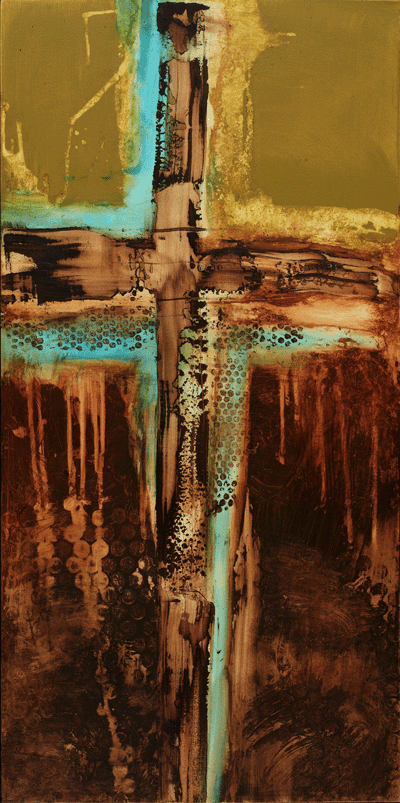
+ For the first 300 years of Christianity, sin was not the central image that defined the church: it was the Cross. Douglas John Hall, one of the great Reformed theologians of our day, has noted that Christians were essentially defined by their willingness to pick up the cross and follow Christ into lives of compassion, justice and integrity. There was suffering in this life, to be sure, but our suffering was born more of obedience, than sin. Like the old hymn says: I have decided to follow Jesus… the Cross before me, the world behind me… no turning back, no turning back.
+ Then, after the Church was institutionalized and made an instrument of empire, the emphasis shifted from bold obedience to the Cross to a spirituality rooted in personal sin and unanimity. That is, there was a revision from living as a community of the cross to searching for the way of holiness – and the key to this new paradigm was unity and obedience. No longer did Christians look to the Cross as the symbol of their praxis, they recited a Creed: I believe in one holy catholic and apostolic Church. I acknowledge one baptism for the remission of s ins; and I look for the resurrection of the dead, and the life of the world to come. Amen.
And our ancestors have wrestled with this tension for nearly 1500 years: Luther sought to revive the via crucis – the way of the Cross – but was enmeshed in an obsession with the politics of his day. In the 20th century, two of the great theologians of our tradition – Reinhold Niebuhr and Paul Tillich – sought to redefine our obsession with sin. Seeking the common good, Niebuhr spoke of original sin as our battle against hubris and self-centeredness while Tillich went inward and explored the experience of estrangement.
Each of these i
 mages for the human condition, he writes, has a correlative image; that is, each implies a remedy, a solution, even a healing. If we are blind, we need to see; if we are in exile, we need to return; if we are in bondage, we need freedom; if we have closed hearts, we need to have them opened; if we hunger and thirst, we need food and drink; and if we are lost, we need a way – a map – and we need to be found.
This is another way of saying that it is time to let go of sin as the dominant and even solitary description of the human condition because it is neither true nor helpful. It is certainly a piece of our puzzle, but not our totality. Again, Borg’s words are helpful:
Our problem is not simply that we have been bad and have rebelled against God (although that may be true), but also that we are blind, estranged, lost, in exile, self-centered, wounded, sick, paralyzed, in bondage, grasping, afraid and broken… and Christi
 anity’s traditional answer or response to sin – forgiveness – does not fully address this deeper reality. More than forgiveness, we need a way – a way of return from exile, a way to reconnect to Christ’s joy, a way of freedom from our bondage, a way in which our sight is restored, a way of having our hearts opened and a way that leads from being lost to finding and being found.
Now before I go any further, let me pause to ask: how does this grab you?
+ What are your reactions to my suggestion that we need to move beyond using sin as the central description of the human condition?
+ Is this a good idea – or bad? Is it helpful – or confusing?
You see, I believe that ours is a living tradition. The central theological understanding of the Reformation is: reformed and reforming. Like comedian Jon Stewart said about religion: If you want a Catholicism that is alive and creative – with choices and a place for sorting out the hard truths – they call it being Protestant. So I think we have to wrestle with both our past traditions and their implications if we are going to embody this wholly mature joy that Jesus promises: without doing this – without critically reflecting on what the ancient truths are saying to contemporary reality – ours is just a religion of the ancestors.

Now, we have some pretty creative ancestors in our tradition:
+ For the first 300 years of Christianity, sin was not the central image that defined the church: it was the Cross. Douglas John Hall, one of the great Reformed theologians of our day, has noted that Christians were essentially defined by their willingness to pick up the cross and follow Christ into lives of compassion, justice and integrity. There was suffering in this life, to be sure, but our suffering was born more of obedience, than sin. Like the old hymn says: I have decided to follow Jesus… the Cross before me, the world behind me… no turning back, no turning back.
+ Then, after the Church was institutionalized and made an instrument of empire, the emphasis shifted from bold obedience to the Cross to a spirituality rooted in personal sin and unanimity. That is, there was a revision from living as a community of the cross to searching for the way of holiness – and the key to this new paradigm was unity and obedience. No longer did Christians look to the Cross as the symbol of their praxis, they recited a Creed: I believe in one holy catholic and apostolic Church. I acknowledge one baptism for the remission of s
 ins; and I look for the resurrection of the dead, and the life of the world to come. Amen.
And our ancestors have wrestled with this tension for nearly 1500 years: Luther sought to revive the via crucis – the way of the Cross – but was enmeshed in an obsession with the politics of his day. In the 20th century, two of the great theologians of our tradition – Reinhold Niebuhr and Paul Tillich – sought to redefine our obsession with sin. Seeking the common good, Niebuhr spoke of original sin as our battle against hubris and self-centeredness while Tillich went inward and explored the experience of estrangement.
And I share that quick overview with you to remind you that rethinking and reworking our understanding of the place of sin and salvation in our spirituality is not something new. I’m not making it up to be hip, cool or even entertaining: it is in our blood as people who ache to make the Word of God flesh in our generation.
+ So, does that make sense?
+ Do you have questions about my overview? It was down an d dirty, I know, but I hope it was suggestive of how this all works together, yes?
As a congregation, you see, we have been doing exactly this same kind of theological reflection in the creation of our mission statement. Did you know that? If you look at the top of your worship bulletin you will read: In community with God and each other, we gather to worship, to reflect on our Christian faith, to do justice and to share compassion. And there are implications to this statement of mission, yes? There are five of them to be specific:
+ First we are promising to learn how to be a community rather than a collection of individuals. We are saying that we are going to look for the presence of God together – that being a community is essential to us – in this age of hyper-individualism. That is a counter-cultural claim, my friends, and it sets us apart from other spiritual traditions that emphasize what one of my daughter’s calls the “Jesus is my boyfriend” way of living. First, we seek God in community.
+ Second, we are spiritual pilgrims searching for God’s way in worship. And worship is God centered first and foremost – it puts us in relationship with the Creator in a unique way – where we have to learn that we are not the center of the universe. We may be created just a little lower than t he angels, but we are not God: we gather in community to worship God. And that, too, is counter-cultural in an era that emphasizes getting all the gusto you can grab!
+ Third, we promise to reflect on our Christian faith – not parrot unconsidered slogans or blindly follow tradition. Reflecting means that we think – we love God with all our mind – but we also love God with all our heart, soul and strength, too. We are claiming an integrated and holistic spirituality – the inward and outward journeys – the faith of Jesus as way of questioning, doubting and always going deeper as much as studying, learning and trusting. We reflect on our Christian faith.
+ And then we make justice real and share compassion. Notice what we do not say in this mission statement: we do not say that we are going to evangelize a sin-filled world and win souls to salvation. We do not speak once about sin; rather we talk about making God’s grace visible in the real world – justice – and sharing tenderness with creation – compassion – just as the Hebrew prophets taught: What does the Lord require but to do justice, share mercy or compassion and walk with God in humility – not hubris.
Does that make sense to you? Do you understand how we have already be gun to shift our emphasis away for an obsession with sin to something deeper, more creative and nuanced?
+ Ok, then let me add one additional insight: let’s be intentional about doing this? We want to embody a life of joy – not a tradition of obligations or requirements – and that takes practice.
+ Let’s find ways every week – in worship and reflection, in acts of justice and compassion – to consciously make a shift away from an obsession with sin. For example, I think that in addition to sharing a time for confession, we might also have a time for praying about the ways we are in exile – or the ways we are lost – or broken.
+ What do you think about that? We could pray for our blindness – our hungers – our fears – our lost connection to the heart of God – how we might be set free – new life out of death. Are you with me? I love the way the new theologians speak about salvation:
Salvation is about our life together. Salvation is about justice, peace and compassion within community and beyond it, too. It is about shalom – a word that means right relations between all people and creation – about the healing and hope… and joy. Indeed, salvation comes from God although it also involves our response.
Now, I could be wrong about this, but I sense that you are ready for this kind of approach – because you are already living into it – even if not in a wholly mature way. And I know this to be true because… I have experienced it. Over the past few weeks, while Dianne’s mother was sick – and then dying – and finally gone, we both felt your prayers: it was palpable in both our lives and we were hundreds and hundreds of miles apart. But you didn’t stop there:
+ One day I went into my office and you had left me this goody basket filled with sweet reminders of your compassion: bread and wine, a few sweets and a lovely, tender card.
+ And then last Sunday, just before we pulled out for the funeral, you came and gave Dianne a prayer shawl – a warm gift of compassion and remembrance – that said: we are with you always in love.
This is a spirituality grounded in Christ’s joy, beloved, not an obsession with sin. This is way of being faithful that makes the Lord’s words flesh: I was lonely and visited me… hungry and you gave me food… afraid and you brought me comfort. And they said, “When did we see you hungry, Lord and feed you… naked and bring you clothes… afraid and share compassion? And he said… do you remember? Whenever you did it unto one of the least of these, my sisters and brothers, you did it unto me.
I have come that my joy may be your joy – and that your joy might become wholly mature. This is my new commandment: love one another as I have loved you… and your joy shall be full. I can see it happening – let’s take it even deeper. Grace and peace to you always.
+ So, does that make sense?
+ Do you have questions about my overview? It was down an
 d dirty, I know, but I hope it was suggestive of how this all works together, yes?
As a congregation, you see, we have been doing exactly this same kind of theological reflection in the creation of our mission statement. Did you know that? If you look at the top of your worship bulletin you will read: In community with God and each other, we gather to worship, to reflect on our Christian faith, to do justice and to share compassion. And there are implications to this statement of mission, yes? There are five of them to be specific:
+ First we are promising to learn how to be a community rather than a collection of individuals. We are saying that we are going to look for the presence of God together – that being a community is essential to us – in this age of hyper-individualism. That is a counter-cultural claim, my friends, and it sets us apart from other spiritual traditions that emphasize what one of my daughter’s calls the “Jesus is my boyfriend” way of living. First, we seek God in community.
+ Second, we are spiritual pilgrims searching for God’s way in worship. And worship is God centered first and foremost – it puts us in relationship with the Creator in a unique way – where we have to learn that we are not the center of the universe. We may be created just a little lower than t
 he angels, but we are not God: we gather in community to worship God. And that, too, is counter-cultural in an era that emphasizes getting all the gusto you can grab!
+ Third, we promise to reflect on our Christian faith – not parrot unconsidered slogans or blindly follow tradition. Reflecting means that we think – we love God with all our mind – but we also love God with all our heart, soul and strength, too. We are claiming an integrated and holistic spirituality – the inward and outward journeys – the faith of Jesus as way of questioning, doubting and always going deeper as much as studying, learning and trusting. We reflect on our Christian faith.
+ And then we make justice real and share compassion. Notice what we do not say in this mission statement: we do not say that we are going to evangelize a sin-filled world and win souls to salvation. We do not speak once about sin; rather we talk about making God’s grace visible in the real world – justice – and sharing tenderness with creation – compassion – just as the Hebrew prophets taught: What does the Lord require but to do justice, share mercy or compassion and walk with God in humility – not hubris.
Does that make sense to you? Do you understand how we have already be
 gun to shift our emphasis away for an obsession with sin to something deeper, more creative and nuanced?
+ Ok, then let me add one additional insight: let’s be intentional about doing this? We want to embody a life of joy – not a tradition of obligations or requirements – and that takes practice.
+ Let’s find ways every week – in worship and reflection, in acts of justice and compassion – to consciously make a shift away from an obsession with sin. For example, I think that in addition to sharing a time for confession, we might also have a time for praying about the ways we are in exile – or the ways we are lost – or broken.
+ What do you think about that? We could pray for our blindness – our hungers – our fears – our lost connection to the heart of God – how we might be set free – new life out of death. Are you with me? I love the way the new theologians speak about salvation:
Salvation is about our life together. Salvation is about justice, peace and compassion within community and beyond it, too. It is about shalom – a word that means right relations between all people and creation – about the healing and hope… and joy. Indeed, salvation comes from God although it also involves our response.
Now, I could be wrong about this, but I sense that you are ready for this kind of approach – because you are already living into it – even if not in a wholly mature way. And I know this to be true because… I have experienced it. Over the past few weeks, while Dianne’s mother was sick – and then dying – and finally gone, we both felt your prayers: it was palpable in both our lives and we were hundreds and hundreds of miles apart. But you didn’t stop there:
+ One day I went into my
 office and you had left me this goody basket filled with sweet reminders of your compassion: bread and wine, a few sweets and a lovely, tender card.
+ And then last Sunday, just before we pulled out for the funeral, you came and gave Dianne a prayer shawl – a warm gift of compassion and remembrance – that said: we are with you always in love.
This is a spirituality grounded in Christ’s joy, beloved, not an obsession with sin. This is way of being faithful that makes the Lord’s words flesh: I was lonely and visited me… hungry and you gave me food… afraid and you brought me comfort. And they said, “When did we see you hungry, Lord and feed you… naked and bring you clothes… afraid and share compassion? And he said… do you remember? Whenever you did it unto one of the least of these, my sisters and brothers, you did it unto me.
I have come that my joy may be your joy – and that your joy might become wholly mature. This is my new commandment: love one another as I have loved you… and your joy shall be full. I can see it happening – let’s take it even deeper. Grace and peace to you always.






.jpg)


