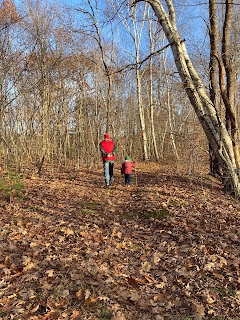
Thursday, January 27, 2022

anyone? anyone? bueller...?

It won't come as news to those who know me well that I'm often "late to the party" when it comes to discerning social trends, new tunes, resources, politics, or authors. And forget about the wonderful world of film - I'm hopelessly behind the times here when I used to go to a new film (or three) every Friday. 
Such is the fate, blessing, and curse of solitude and contemplation, yes? 

One of the many reasons I stepped away from pastoral ministry after sensing in Montreal that God wanted something different from me, was the realization that my artistic references were so outdated that those both older and younger than myself often had no idea what I was talking about when sharing a popular culture quote. "Anyone, anyone? Bueller?" was still drop-dead funny and appropriate to me, but only so for an increasingly smaller cadre of those in public worship. And that circle was rapidly shrinking, too even before the pandemic. As it became increasingly clear, I no longer shared a common cultural language with that small handful of souls who were interested in public worship: from time to time we might find a measure of unity in mutual emotions, but rarely in a lingua franca of culture. 
The deeper I retreated into silence, the more I accepted that "to everything there is a season," including my time in the local church. Paradoxically, while I was still committed to the way of Jesus, the importance of spiritual reflection upon culture, and the joy of making music in public, my old ways had not only become to me irrelevant but personally unsatisfying as well. So, while the Psalmist was probably right in telling me it was time to "Sing a new song unto the Lord," I had no idea what that might sound like let alone what words to use.

In time it dawned on me that this was a season to create the space to wait upon the Lord. I was at an age when I could afford to slow down rather than push the envelope in frantic uncertainty. And while waiting and discernment have never been my long suit, the time was right. Trusting that 
darkness would always be part of the journey towards light, I said, "Let's give it a go, Joe!" And after months of inward/outward waiting, fretting, trusting, and doubting, two new/old practices showed up to help me find my focus: 1) listening to Mother Nature as I gardened and walked through the wetlands; and, 2) reclaiming a few important old songs on the acoustic guitar. 

Listening to the the rhythms of Mother Nature has been a consistent path for both celebration and resistance among First Nations people for millennia. Their practices are not mine to appropriate in any way, shape, or form. Yet their wisdom re: the rhythms of nature are well-known the world over. For the past three years my sacred listening and moving about required reclaiming my people's way of listening with the charism of Celtic spirituality. The beloved 4th century Welsh heretic/saint, Pelagius, insisted that: if you want to know the Creator, you must spend time with what's been created. Learning the rhythms of the seasons - and their corresponding spiritualities - has been life-changing. Getting my hands in the dirt, building raised garden beds, exploring native seeds to refashion our common space into a sacred sanctuary, and to doing so with plants, flowers, and vegetables that support bees and butterflies is teaching me a bit about patience as well as a new way to hope. Incrementally I am learning to engage reality at the speed of Mother Nature as a spiritual discipline that will carry me gratefully to my final resting place in the soil. Every Lent I used to say, "From ashes we came and to ashes we shall return," before making the sign of the Cross on the foreheads of saints and sinners. Now, I scour seed catalogues and blogs for appropriate plants that might help renew a bit of life within the ashes of this small corner of God's green earth. 

And returning to my acoustic guitar: I haven't played jazz or rock bass in three years. Writing this makes me sad. But after an intense 7 years of serious music, it was time to leave my upright bass sitting in the corner of my study. These are small and quiet days. My soul seeks gentleness and nuance. 
It started writing "Small is Holy" three years ago with an opening verse and chorus that showed up almost automatically:

Thinking big and acting strong – led me into all that’s wrong.
Hitting bottom taught me well strategies to get through Hell.
Touch the wound in front of you – that’s all you can really do.
Keep it close, don’t turn away, make room for what’s real today.
Small is me, small is you, small is holy and rings true.
Small is hard, small reveals the way our hearts can be healed.
 

But I couldn't get the rest of it right: I tried some Tom Petty-esque grooves but they felt derivative. Other verses and the bridge sounded preachy. I was searching for something more gentle and quiet, but I didn't yet know what that was. About this same time I exited music making with my dear friends because I felt stuck - and my stalled song was the outward and visible sign of my inward and spiritual pothole. We took a quick trip to Tucson to see old friends and get a break from the winter and when we got home: BAM it was covid time and solitude and silence became our new normal. 

Curiously, inch by inch, a whole new melody, chord structure and lyric started to emerge from the shell of "Small is Holy." It began to feel "real" and even alive to me. That's when I realized what a second spiritual discipline of listening slowing to the sacred within was asking of me. To date, I've reclaimed "Healer of My Soul" from JM Talbot's catalogue, Leslie Duncan's elegiac "Love Song," my stripped down take on St. Lou Reed's "Sweet Jane" and a few quiet hymns. During Advent 2021 I found beauty and rest in an instrumental setting for, "O Come, O Come Emmanuel" and "In the Bleak Midwinter." Revisiting these small, quiet songs has been salvific and satisfying. For as much as I like to tear it up, shake my booty, and rock'n'roll all night long, that's not where my heart is most of the time these days.
One other new/old blessing that has arrived while waiting on the Lord has to do with following the small threads of serendipity into the synchronicity of the Holy Spirit. I've noticed six important clues showing up over the past 36 months that make me smile and sit up and take notice. Like the old adage says: "When the student is ready, the Buddha will appear." You may enjoy following these links, too.

1) The writing and music of Alana Levandowski: 

2) The writing of John Philip Newell:

3) The online wisdom and music of Carrie Newcomer.

4) The novels of Richard Powers and Louise Erdrich:

5) The music of Robert Plant and Allison Krause:

6) The insights of Kaitlyn Curtice:

james baldwin, caitlyn curtice and jesus...

The late Thomas Merton – monk, author, and activist – discerned that to speak of Christ’s blessing to the weird among us, he needed poetry more than prose and wrote:

Into this world, this demented inn, in which there is absolutely no room for him at all, Christ comes uninvited. But because he cannot be at home in it, because he is out of place in it, and yet he must be in it, His place is with the others for whom there is no room. His place is with those who do not belong, who are rejected by power, because they are regarded as weak, discredited, denied status of persons, who are tortured, bombed and exterminated. With those for whom there is no room: Christ is present in this world.

Today’s appointed lesson from the gospel according to St. Luke says much the same thing. As Jesus opened the scroll of the prophet Isaiah at his home synagogue, his public ministry began among friends and neighbors. They were eager to hear what he might have to say about this ancient text – and hoped he might bring them a word of comfort, too.

He unrolled the scroll and found the place where it was written: “The Spirit of the Lord is upon me, because he has anointed me to bring good news to the poor. He has sent me to proclaim release to the captives and recovery of sight to the blind, to let the oppressed go free, and to proclaim the year of the Lord’s favor.”


Merton, Jesus, and the prophet Isaiah are explicit: when we are inspired to share
compassion and act to right human relations one with the other and all with creation, it is the Spirit of the Lord at work within us. The incarnation did not occur only ONCE in theology or history, but wherever the poor or wounded experience comfort and solidarity, God’s word becomes flesh. James Baldwin and Kaitlyn Curtice have accepted this anointing – one old and one young – albeit in different contexts.

One is black, the other mixed race; one is male, the other female. But to paraphrase words ascribed to St. Paul from a baptismal liturgy in Ephesians 4, Baldwin and Curtice are of one heart : leading lives worthy of the calling which comes from the Spirit; with all humility and gentleness, with patience, bearing with one another in love, making every effort to maintain the unity of the Spirit in the bond of peace (we trust that) there is one body and one Spirit, just as you were called into the one hope of… one Lord, one faith… and one God and Creator of all. This is what Baldwin and Curtice have done as writers, poets, and activists: they’ve linked their literary creativity to faithful activism challenging the status quo on behalf of the oppressed as the spirit empowers them to give shape and form to the blessed weirdness we’re celebrating on the road to Lent. The astute words of marketing renegade, Rob Siltanen, proclaim:

Here’s to the so-called crazy ones. The misfits. The rebels. The troublemakers. The round pegs in square holes. The ones who see things differently. They’re not fond of rules and they have no respect for the status quo. You can quote them; disagree with them; glorify or vilify them. About the only thing you can’t do is ignore them. Because they change things. They push the human race forward. And while some may see them as crazy, we see genius. Because the people who are crazy enough to think they can change the world are the ones who do it.


So, let me offer a few insights about today’s text from St. Luke’s gospel before considering the anointing the Spirit has poured upon James Baldwin and Kaitlyn Curtice. As kindred within our tribe of blessed weird ones, I invite you to open your hearts with me in prayer that we might be ground-ed in grace. Using Padraig O’Tuama’s words from the Corrymela Community of Belfast, we pray:

O God of Yesterday, we knew you then: your promises, your words, your walking among us. But yesterday is gone, and so, today, we are in need of change. Change – and change us. Help us see life now not through yesterday’s stories but through today’s. Amen.

Today’s story, like all New Testaments texts, is layered with multiple meanings and best NOT to treat it as literal, linear history. St. Luke’s purpose in writing both this story as well as the Acts of the Apostles – part two of his gospel – is to teach a Gentile community how the ministry of Jesus is both the natural continuation of the blessings God first shared with ancient Israel in the Exodus wilderness and to show the world how the church now supersedes Israel’s once favored status. As Dr. Amy-Jill Levine notes in The Jewish Annotated New Testament: Luke’s “presentation of Jews and Judaism is complex… it solidly locates Jesus within a vibrant Jewish environment of faithful Jews engaged in faithful Jewish practices… while also depicting the synagogue as a place of violence (including) scathing caricatures of Pharisees and chief priests.”

· She adds that while the “harsh rhetoric resembles that of the Biblical prophets and the Qum-ran writings (of the Dead Sea Scrolls), the distinction is that Jesus’ criticisms against his fellow Jews are now embedded in a text directed primarily to Gentiles.” One critique was internecine, a family feud among Jewish equals, while the other is oppositional between theological and cultural adversaries. We should note, too that by the time St. Luke’s gospel had been codified, most likely at the close of the 1st CE or the start of the second – after Roman legions had beaten back a Jewish insurrection, decimated the second temple in Jerusalem in 70 CE, and banished Jews from living in their own capital city – this gospel told a story from the perspective of the victors of history, not the vanquished.

· Consequently, St. Luke sometimes romanticizes Christian community, creating idealized descriptions of life in the church that were never historically accurate; other times it willfully misrepresents the intent and practice of Jewish rituals; and regularly minimizes the tensions existing between the followers of Jesus before the Temple’s destruction in 70 CE and those enforcing the Roman occupation of ancient Palestine. It’s a REAL mixed bag. And while I love lots within it, it’s good to be clear about its baggage as well, ok?

What I want to highlight today, however, is St. Luke’s refusal to spiritualize the pain and suffering of those allied with the Jesus Movement of his day. Our text, as well as the version of the Sermon on the Mount in chapter 6 of St. Luke, use what most scholars consider some of Christ’s earliest words: Blessed are you who are poor for yours is the kingdom of God. Blessed are you who hun-ger now for you will be satisfied. Blessed are you who weep now for you will laugh. Here Jesus doesn’t speak metaphorically about the poor as St. Matthew does in his beatitude where the poor become: “the poor in spirit.” Rather he uses the word for those who are dirt poor – ptochus in Greek – those who have been reduced to begging in the street because they are “destitute of resources – especially farm and family.”

Jesus in St. Luke’s text addresses the discarded homeless who beg for alms and sometimes find themselves locked away in debtor’s prison. St. Matthew universalizes God’s blessing while St. Luke exposes the agony of class struggle. Consider the careful restatement of these differences in Eugene Peterson’s The Message. In Matthew’s “sermon on the mount” we read: You’re blessed when you’re at the end of your rope. With less of you there is more of God and God’s rule. You’re blessed when you feel you’ve lost what is most dear to you. Only then can you be embraced by the One most dear to you. Luke’s parallel verses become: You’re blessed when you’ve lost it all. God’s kingdom is there for the finding. You’re blessed when you’re ravenously hungry. Then you’re ready for the Messianic meal. Do you sense the distinctions? One is metaphorical and personal; the other is existential and class conscious.

Like Matthew and Mark, Luke sets this story as Jesus returns from his desert vision quest: he’s been initiated by his wild man cousin, John the Baptist in the Jordan River; he’s fasted and prayed for 40 days in the elements of Mother Nature; and now starts to slowly meander through the region taking-in what’s happening to his kin as he teaches in the synagogues of the area where the text tell us he was well received wherever he went.

Scholars suggest that this is the evangelist’s way of saying that Jesus had started to assume the mantle of a prophet. He’s wandering, watching, listening, learning, and responding to the broken and discarded among his people and receives their blessing. In time, he returns to his hometown of Nazareth where, on the Sabbath, he reads from the prophetic poet’s promise of God’s Jubilee Year from the scroll of Isaiah. In our era, this portion of Isaiah is only ritually included in the “haftarah” – a passage from the prophets (Nevi’im) that complement the sabbath Torah lesson – at one specific time of year: the last Sabbath before Rosh Hashanah and the Days of Awe called Yom Kippur.

· We should recall, however, that during the time of Jesus there was a measure of fluidity in the public liturgies of the synagogue as Jewish tradition was still emerging in the 1st CE. So, whether in keeping with the practices of his home community or personal innovation, Jesus reads Isaiah’s poetry about God restoring and renewing blessings upon the most destitute: The Spirit of the Lord is upon me because I have been anointed to bring good news to the dirt poor of Israel.

· Closing the scroll, he then identifies himself within the Jewish Jubilee tradition of Leviticus 25 and Deuteronomy 15 telling the congregation: Today, in your hearing, this promise of the Lord has been fulfilled.

To make sense of this proclamation, let’s note that Leviticus articulates a series of
practices de-signed to make the rest and renewal of a holy Sabbath normative within Israel’s economy. The first stipulation states that people as well as the land and its animals be allowed to lay fallow and free every seven days. To honor the Sabbath and keep it holy in creation is to practice weekly what God once set in motion in history: Six days shall ye labor but on the seventh you shall rest. Remember that you were slaves in Egypt and that the Lord your God brought you out of there with a mighty hand and an outstretched arm.

The second qualification was that Sabbath rest was to be given to the land every six years to allow creation itself the restoration and replenishment human beings need to thrive. And the third obligation was that every seven weeks of years – that is seven years times seven years – on the day of atonement THAT year was to be marked as the acceptable year of the Lord: The Jubilee where all land, humans, animals, insects, and all of creation seen and unseen would celebrate God’s grace by freely experiencing God’s rest and renewal for the entire community. Jubilee opened the doors of the debtor’s prisons and returned any land that might have been sold during the past 50 years to its original owners. Over a thousand years, Deuteronomy built upon the older Jubilee of Leviticus insisting that the seventh year of sabbaths bring rest to the economy by liberating any acquired slaves. In St. Luke’s gospel, THIS is how Jesus begins his public ministry: proclaiming to his home synagogue that the ancient prophecy had been fulfilled by his anointing. Small wonder the poorest and hungriest cheered, yes?

Now, we should be clear that Jubilee in ancient Israel was more often a sacred intention than a well-developed fact: it was the aspiration of a people committed to God’s generosity some fifteen hundred years before Jesus told us that we cannot serve both God and wealth. I think our tradition’s wisest contemporary scholar of the Hebrew Bible, Walter Brueggemann, got it right when he wrote:

God’s holiness was not simply a cultic affair or a religious phenomenon. God’s holiness was relentlessly committed to the neighborhood; for that reason, holiness tilts toward covenantal neighborly justice. And the Bible insists – most clearly in the Jubilee tradition – that faith and ethics are necessary aspects of the same coin, though they are by no means identical. Faith must demonstrate its authenticity by the way it operates in the ordinary affairs of life.

Given this spiritual and ethical legacy, coupled with the condition of his kin as they struggled under the boot heel of Roman occupation, it is no surprise that Jesus would search for the scroll of the prophet Isaiah and reclaim the Jubilee promise as the acceptable year of the Lord. My seminary advisor, Cornel West, used to tell us that: Justice is what grace and love look like in public.

Biblical sociologists Bruce Malina and Richard Rohrbaugh amplify this in their definitive Social Science Commentary on The Synoptic Gospels writing: The passage Jesus recites in the context of his ministry is Isaiah 61: 1-2. The captives he is referring to are probably the debtors in prison for nonpayment (of loans.) Debtors (in that day) were put in prison as a form of extortion since it was their families that would have to pay for their release. The release proclaimed is that of the Jubilee year in which ALL debts were canceled. The acceptable year of the Lord was the Jubilee: a year-long Sabbath. Which to my weird way of holding the sacred and the profane together – honoring the unity of both the heavenly within ALL that is human – the struggles of real people for bread and dignity as the marriage of justice with grace – a Jubilee Jesus sounds a lot like both God’s blessed weird ones we know as James Baldwin and Kaitlyn Curtice. Brother James spins it for us like this in “Jimmy’s Blues” from 1983.

If the hope of giving is to love the living, the giver risks madness in the act of giving. Some such lesson I seemed to see in the faces that surrounded me. Needy and blind, unhopeful, unlifted, what gift would give them the gift to be gifted? The giver is no less adrift than those who are clamoring for the gift. If they cannot claim it, if it is not there, if their empty fingers beat the empty air and the giver goes down on his knees in prayer knows that all of his giving has been for naught and that nothing was ever what he thought and turns in his guilty bed to stare at the starving multitudes standing there and rises from bed to curse at heaven, he must yet understand that to whom much is given much will be taken, and justly so: I cannot tell how much I owe.

From out of the African-American community, Baldwin arose as a bi-sexual prophetic poet of love and fear, writing novels, plays and prose that named the demon of race hatred as America’s original sin even as he searched for common ground with his oppressors. Curtice, born into a white /native mixed family in Oklahoma, traces her roots back to the First Nations Potawatomi people of lower Wisconsin. From her experience she rages, celebrates, laments, and challenges us much like Baldwin did a generation before she was born. Her 2017 poem, “Why EVERY Day is Indigenous Peoples Day” is righteous:

Step out and beyond. There are invisible realities in the world, stories the history books cannot tell us. Put your bare foot into the water of a river or a lake and let it remind you– there are unspoken histories that can only be honored, felt, often misunderstood. Because so many of us walk around with invisible prison bars around us. We are bound by our currencies, our schedules, our loud voices and un-listening ears. Do you wat to know why every day is Indigenous Peoples’ Day? It is because of the land. It is because of the rivers and rocks, mountains and trees. It is because the dirt still holds our feet to the ground and the fires that still burn. The forest trees still shed their leaves, the wind still blows, the waters still erode the rocks to create stones that we skip across her reflective face. You see, we belong to the land, not the other way around. That is a constant lesson that indigenous peoples are taught, that we continue to learn, that we wish others learn as well. She is our storyteller, our creation keeper. She continues to re-create us, to tell us our own story. So we take the sage and sweetgrass, tobacco and cedar, and while we let their smoke rise over us, we listen. For non-native people, the stories are still there. People still came before. Learn their names. Learn their stories. That takes more than an afternoon, doesn’t it? It takes more than resisting a colonial holiday? And so, every day we continue to learn. Every day that I look in the mirror, I celebrate that I am indigenous. That I am still here. Every word I write is to bring us closer to the Kingdom of God, the God who sees and knows my Potawatomi blood, who mourns when I mourn and celebrates when I raise my head and pray in my native language, Migwetch, Mamogosnan. Migwetch Mamogosnan. Every day is Indigenous Peoples’ Day because our histories tell our stories, our language tethers us to each other and this earth, and while we are here, there is justice to be done. There are wrongs to be made right, and there is healing on the horizon. Will you join me there, beyond our prisons? Will you join me on the other side?


This is 20th and 21st century Jubilee poetry: sacred, righteous worship talk mixed with a call to action asking what do we want: chaos or community? Race wars or circle dances? A barren earth of strip mines, strip clubs, and strip malls, or, the beloved community where I cherish the sacred in you and you are safe enough to trust doing the same for me? James Arthur Baldwin was born in New York City’s Harlem in 1924. Kaitlin B. Curtice was born in an Indian hospital in Ada, Oklahoma in 1988. Brother James died a year before Sister Kaitlin was born – but what does the Appalachian hymn tell us about the circle? It’s unbroken, right? We are surrounded by a great cloud of witness bigger than time, class, race, gender, and culture. And I cannot help but see and hear these two weird, blessed souls as part of God’s never-ending choir inviting us to join them singing: O freedom, oh freedom, oh freedom over me; and before I’d be a slave, I’d be buried in my grave, and go home to my Lord and be free.

Before I ever heard the early feminist insight that the personal is political, Baldwin’s fiction spoke to me of a quest for identity and meaning that mirrored the intertwined tumult raging through the United States in the 50’s and 60’s. His first novel, Go Tell it on the Mountain from 1953, speaks of a young black man coming of age in the city who aches for more love and creativity – more freedom than he found within the constraints of his father’s Pentecostal religion. At 15, I was struck by the contradictions in my own New England Puritan spirituality – it’s blind spots, sexual hypocrisy along side its inspirational hymnody and legacy of social justice – Baldwin’s words rang true for me.

I still remember watching the debate between Baldwin and William F. Buckley on our black and white TV in February 1965: I was knocked-out by Baldwin’s clarity, moral outrage, tender heart, and articulate challenge to the pompous, white arrogance of Buckley’s just barely constrained bigotry. When Baldwin said, looking straight into Buckley’s eyes, “It came as a great shock around the age of 5, or 6, or 7, when I discovered that the flag to which you have pledged allegiance, along with everybody else, has not pledged allegiance to you.” In a manner inconceivable to me in 2022 – but still all too real – Buckley replied without a hint of irony, “You, sir, have been treated with kid gloves as you claim to be a victim. But the fact that your skin is black is utterly irrelevant to the arguments you raise.” If you’ll pardon my bluntness, that same bullshit is being said about critical race theory today almost 60 years later. Buckley’s refusal to acknowledge a reality in these barely United States that was different from his privilege, race, gender and class can be found today among those giving credence to the Big Lie. So, what makes Baldwin’s words and witness so blessedly weird – even salvific to me – is the “complex and creative way he honors the social, psychological, spiritual, and personal pressures of his race, gender, and class with clarity, humility, and pizzaz!”

I experience the wisdom and wonder of Kaitlin Curtice in much the same way. She’s much younger than Baldwin. Her oeuvre is more limited, too – although every week she adds to it through blogs that didn’t exist in the era of Brother James. This past Indigenous People’s Day, Di and I were away from America’s discord for a short retreat to Quebec’s Eastern Townships, I spent some time with this insight from Curtice:

The trees are nearly bare, and leaves cover the ground. It’s taking a long time for Autumn to visibly come to an end and we still have a few weeks left. We wait and wait for the next season to come, and when it does, we forget how magical it is. We forget that the leaves changing and falling are teaching us something every day about the way things work, perhaps about magic, perhaps about love. We are still learning to love and honor the earth’s ways, and we are still learning to love and know ourselves. I continue to be amazed at my AHA! moments, how they come from nowhere and tell me something new that I never realized, or something I had for-gotten over the years… That’s why this year we cancelled Thanksgiving. November is always a hard month. Despite it being Native American Heritage Month, we watch people carry on toxic stereotypes of Indigenous peoples around the Thanksgiving narrative, especially in public schools. Despite the difficulty, I continue to romanticize the idea of a meal around a table, because I want these moments of hospitality and community to be perfect, meaningful, and good. I was ready to hold a special Friendsgiving meal with my family and a few friends, in the safety of my questions. I was going to cook Indigenous dishes and speak truth and acknowledgment. Then I got a stomach virus and everything was cancelled. When, as life happens, things don’t turn out so good or meaningful, I’m left disappointed, and I struggle with the tension of holding things loosely and being okay with things not working out when I hoped so much for them. I struggle with the tension of things left unresolved.

A big reason we left the US over our Thanksgiving holiday was respite care – taking a break from the tension of things left unresolved – to walk in the woods in the bitter cold and eat incredible French baguettes. Sister Kaitlin not only describes the spiritual and social schizophrenia of being a mixed-race woman in 21st century America, like Baldwin, she grasps that her discernment is both political and personal. She’s one of the wise voices I listen to as I try to make peace with this massively broken culture and country in the presence of Mother Nature.

It’s all too easy to slip into despair these days. Cynicism, too. Every week I’m bounced about on an emotional roller coaster that wears me out. Exhaustion and angst have become our new normal. And that’s why the witness of Brother James and Sister Kaitlin are so important for us all.

Baldwin lived through the murder of his beloved MLK, Malcolm X and Medgar Evers. He endured realities I only know in my nightmares. And still, with conviction and compassion, he told us: You think your pain and your heartbreak are unprecedented in the history of the world, but then you read. It was books that taught me that the things that tormented me most were the very things that connected me with all the people who were alive, who had ever been alive. I imagine one of the reasons people cling to their hates so stubbornly is because they sense, once hate is gone, they will be forced to deal with their pain. That’s what he did – dealt with his pain with love and clarity – inviting us to encounter and trust one another’s pain as well. Jesus did exactly that when he told his home synagogue: I’ve been anointed to honor the wounds of the most broken poor among us. THIS is how our wounds are bound – by seeing them and sharing them – and honoring them with love.

Curtice, I think, walks this same road albeit as a 21st century Native woman. Her book, Native, tells of a time she joined the protests at Standing Rock against big oil’s pipelines. “Indigenous resistance s NOT a one-time even,” she writes. “It continually asks: what proliferates in the absence of empire and settler colonialism?” She answers that saying that when she stood:

With the elders as water protectors, gathered to both pray AND resist… the Spirit of creation said go and listen: listen to the land that is still broken but speaking. Listen to the acorns falling from the tops of the trees that remind me that gravity is meant to ground and sustain us right here. Listen to the birds arguing in the sky who remind me that my angle of seeing is limited. That I am small. Listen to the dying autumn leaves that remind me it’s part of life to die and then live again, that death itself can somehow be beautiful. And listen to the rocks and dirt at my feet that remind me that though they are sore, they still have something so say to me just like they had something to say to the people who came before me in this place.

Listening with love is resistance right now as we learn to trust that weariness and winter will one day become a spring of freedom and joy…

Monday, January 17, 2022

jumbled gratitude on mlk day...

Our spring seed order has shipped, I've spent the last few hours shoveling 5" of snow, the days are growing incrementally longer, and Di is taking a quick COVID test: welcome to MLK Day 2022 in our small corner of God's creation. The so-called "wintry mix"- some deranged meteorologist's idea of a poem for the dangerous, freezing slush that plagues these parts - is falling again with a vengeance. Last week's episode left our homes, trees, shrubs, and driveways coated in a quarter inch of ice that required hours of intense chopping to remedy. About half our deck has finally been liberated, but given the current precipitation, I'm afraid there's more mess to come. So, accepting and surrendering what I cannot change, I moved our most recent acquisition of Anna's art work to my desk to remind me of St. Julian's mystical insight: All shall be well - and all manner of things shall be well.
Obliquely, that's a theme wafting through the two most recent novels from Richard Powers: The Overstory and Bewilderment. Christmas gifts from our children two years running, both works of art are saturated with loss and our quest for meaning within the morass. We live in grim and trying times. So, I think Heller McAlpin of NPR comments ring true: "Powers informs us in an author's note, bewilderment has come to mean confusion and bafflement, but its original meaning was to head back into the wild."

Indeed, at times of extreme stress, Powers' bewildered duo do head back into the wild, where they find temporary solace — and where Powers clearly finds inspiration. Few writers capture nature's glories quite so vibrantly. A spectacular "fluted ribbon of fungus rippled through itself to form a surface as convoluted as an Elizabethan ruff." A millipede smells like almond extract, which reminds Robin of his mother's baking. The Milky Way spills out in the dark sky like "countless speckled placers in a black streambed. If you held still, you could almost see the stars wheel." In novel after novel, Powers has built a case for holding still and really looking at the natural world. He helps us see things differently.

Still, there is a wisdom at work in creation beyond our control - often beyond our seeing and knowing, too. I lived within an anthropocentric bubble for most of my life. I've been awed by nature's beauty and inscrutable power to create and destroy at times; but have not really paid close attention - for good and bad reasons - like so much of the rest of my life. Imagine my surprise when I was awakened to the world all around me by the relatively recent new liturgical Season of Creation some ten years ago. "I once was lost, but now I'm found, 'twas blind but now I see." That is, now I consciously listen and look for the wisdom of Mother Nature most days. Not perfectly and not consistently. But with a modest vigor and intentionality I trust that every day is going to surprise me with a sign of God's first word at work. My ongoing labor at a spiritual sanctuary in our garden has helped. So, too living so close to a New England wetlands. And without a doubt, caring for our special needs dog, Lucie, regular pushes buttons I never knew existed. Amazing grace, indeed.

Resting my weary and arthritic back after my third snow-shoveling endeavor, I paused this afternoon to give thanks to MLK. The good doctor, preacher, prophet awakened my conscience like creation awoke my awe. I was called into ministry in 1968 just two months after Dr. King's assassination. His witness, his writing, and his wisdom shaped both my time with the farm worker movement of Cesar Chavez and my undergraduate thesis on non-violent social change. MLK gave shape and form to my seminary days and my advocacy for poor children while serving as part of an inter-racial reform slate on the Cleveland Board of Education back in the day. Putting it all together feels a bit like Robert Hunter saying to the Grateful Dead: what a LONG, strange trip it's been. But that's what it's been: a LONG and STRANGE trip. 

On this national holiday, 24 precious hours set aside for reflection and service, I regularly find the insights of Dr. King speaking to me in new ways. This year I am moved by the strength of his revolutionary compassion during his darkest hours. He told the garbage workers of Memphis the night before he was gunned down that he'd been through some amazing ups and some horrible downs. He made it clear that the threats against his life had increased since coming out against the war in Vietnam and mixing the struggle for Civil Right with economics. If yo watch Brother Martin, he is weary. Exhausted. And then, as if lifted from above, he says the following:

And then I got into Memphis. And some began to say the threats, or talk about the threats that were out. What would happen to me from some of our sick white brothers? Well, I don't know what will happen now. We've got some difficult days ahead. But it really doesn't matter with me now, because I've been to the mountaintop... And I don't mind. Like anybody, I would like to live a long life. Longevity has its place. But I'm not concerned about that now. I just want to do God's will. And He's allowed me to go up to the mountain. And I've looked over. And I've seen the Promised Land. I may not get there with you. But I want you to know tonight, that we, as a people, will get to the promised land!

If you've never watched that speech, you owe it to yourself and your neighbors to do so without hesitation. It will give you a whole new perspective on what is being asked of us during pandemic fatigue, political dysfunction, and fear and loathing in America. "I been to the mountain top... and I've seen the Promised Land..." Check it out. It always puts my heart and soul back into perspective. And so tonight I am
grateful that Di's COVID test came back negative. I am grateful that I've been blessed to care for Lucie (even when she drives me mad), grateful for the solitude of shoveling snow and even the "wintry mix" on this quiet day in January, grateful for a loving family, a warm home, reasonably good health, friends in L'Arche Ottawa, friends who encourage me on "Small is Holy." Soul mates in the wild world of poetry and for exquisite novels the likes of those of Powers. All of this and so much more awakens me to the heart-break running amok among us right now. It is exhausting, frightening, trying, and surprising in ways that are often debilitating. So, I pause, rest a bit trusting that tomorrow I can do my small part to advance my trust that all manner of things shall be well, and return thanks to God for MLK.  

Sunday, January 9, 2022

quiet time with garden thoughts during an ice storm...

It is a grim, cold, and gray day in our Berkshire hills: a thin coating of ice shrouds our bushes, the deck in increasingly a sea of mush, and the roads are treacherous. Good thing we're staying inside to drink Scottish Breakfast tea and listen to John Renbourn and friends play tunes from the old country. 

After tidying my study - including sequestering our suitcase of Advent/Christmas CDs back into solitude - it was time to order native seeds and plants for the vernal planting season. Late in the fall I dug two new seed beds which will become raised beds come March. 

Some five years ago, while wandering Brome Lake Books (home of Louise Penny and the Gamache series set in Québec's Cantons de l'Est (Eastern Townships), Di encouraged me to bring home Jessi Bloom's Everyday Sanctuary: A Workbook for Designing a Sacred Garden Space. It was a good call for a host of reasons. Early on Ms. Bloom quotes Joseph Campbell: "Your sacred space is where you can find yourself again and again." Then, before offering a wise overview of ethical concerns in designing sacred space, she writes: "What is sacred space? No two people have the same response to this question, but most focus on themes of peacefulness, protection from a harsh world, and rejuvenation." Bloom tells us that creating a sacred space garden must take time for pondering and prayer, research, planning, watching the movement of the sun across the land, discovering what animals show up, and then taking within the soul care that happens for all of us in the cosmos through these tiny acts.

The earth is alive, breathing and evolving, and all that she carries and supports forms a weave of complex ecosystems that are critical for life. I believe as stewards of the land, we are to honor it first and foremost. Then we can feel and envision what we need, want, and desire, and make sure this is in alignment with what the land needs in order to be cared for. As you design your sanctuary garden, refer to these ethical guidelines, which also form the foundation of permaculture, a design approach to living sustainably on the earth. Note that whenever one ethic seems to be in conflict with another, the first trumps the rest: 1) care for the earth; 2) care for people; 3) give back; 4) pace yourself.

Over the last half decade I've come to appreciate each of these markers - especially the last - pace yourself. As one who came of age in white Middle America in the 50s and 60s, I like to "get the job done!" But as Gertrud Mueller-Nelson advises: "Nothing healthy comes about through rushing..." So, as much as I want to see the fruit of my labors, I've learned a measure of patience in the crafting of the garden sanctuary. Early on I planted tomatoes without ample sun. Same, too with pumpkins. I dug a new garden bed in a place Lucie likes to pee in! I had NO idea what to do with voles. Or the mildew and mold that can show up on squash vines. Each challenge has been a lesson in research and slowing down. Bloom wisely notes:

It's not just about the end goal but also about how we get there. The approach we use is just as important as the end product. We want to acknowledge that any transition takes time. We are not going to change overnight from stressed-out urban dwellers to perfectly balanced beings who incorporate nature's gifts into our daily routines. We must be patient and gentle with ourselves as we engage the question of how to find every sanctuary and as we form new, healthier habits in our lives. Building our sanctuary space and practices may take a period of years and is best understood as an ongoing journey toward wellness.

Settling into this place as our permanent resting place was not part of our original plan when we moved from Tucson nearly 15 years ago. Once again, however, we had to learn how little we genuinely control, yes? Making peace with reality is a work in progress. A spiritual practice of letting go and discovering the holy in the quiet, small places. This sacred garden continues to teach me to wait - and ask simple questions including "what is the condition of our soil? Is it more clay, loam, or sand? Which areas remain soggy after a rainfall and which areas dry out quickly?" The second year brought a grand crop of wild flowers, but the deer soon ate away all the flower tips in record time demanding a new strategy for the next year. Wise old Wendell Berry said it well: 

Whether we and our politicians know it or not, Nature is party to all our deals and decisions, and she has more votes, a longer memory, and a sterner sense of justice than we do.

Monday, January 3, 2022

beatitudes for the weird series: january 2 - february 27

For the next two months - the liturgical season of epiphany - my Sunday evening prayer reflections will consider how the "weird people" bring blessings to themselves and all the rest of us. The way I see "Small is Holy" before Lent 2022 will utilize the gospel reading from the Common Lectionary and the Poem, "Beatitudes for the Weird." Tune in Sundays @ 4 pm for the live streaming. @
https://www.facebook.com/Be-Still-and-Know-913217865701531

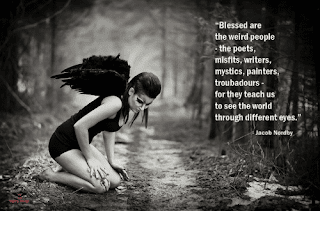
Blessed are the weird people: poets, misfits, writers, mystics, heretics, painters, and troubadours for they teach us to see the world through different eyes.
Blessed are those who embrace the intensity of life’s pains and pleasures for they shall experience uncommon ecstasy.
Blessed are those who see beauty in ugliness for they shall transform our vision of the world.
Blessed are the bold and whimsical for their imagination shatters ancient boundaries of fear.
Blessed are those who are mocked for unbridled expressions of love for your crazy kind of freedom is what the world is unconsciously begging for.
Blessed are those who have endured life’s brokenness for you are the resplendent cracks through which the light shines in.

January 2: Introduction

January 9: Wendell Berry and Robin Wall Kimmerer

January 16: Greta Thunberg and Malala Yousafzai

January 23: James Baldwin and Kaitlin Curtice

January 29: Lou Reed and Dorothy Day

February 6: Mary Lou Williams and Frank Zappa

February 13: Krista Tippett and Padraig O’Tuama

February 20: WEB Dubois and Roxanne Dunbar-Ortiz

February 27: Sounds of Sacred Jazz

Saturday, January 1, 2022

new year's eve into new year's day...

Having read many of my favorite authors' end of the year summaries - some of which were insightful and moving - I've been pondering my own. We crafted something similar in the Christmas/Year's End letter we sent out in mid-December. I have no need to repeat myself except to say 2021 was a mixed bag: our entire family was vaccinated and boostered; we had the chance to visit Montréal, Ottawa, and the Eastern Townships of Canada; we feasted and grooved to great jazz at Dièse Onze (thanks Gary Tremblay); celebrated the high holy days with family; worked our gardens vigorously; loved one another tenderly; and listened more carefully to the rhythms of the sacred within Mother Earth. There were losses, of course, grief, anger and sorrow as well. I found value in the way Diana Butler Bass put it in her most recent newsletter:

I’m moved by the words of the blessing (below) from John O’Donohue: “We bless this year for all we learned, for all we loved and lost.” 2021 was anything but carefree. Many people will be glad to see it go. But I love the notion of blessing a year as it departs and looking back with gratitude to the last twelve months for the gifts — of grace and of grief — that came to our lives. Instead of just kicking the old year to the curb of history, we might listen to its world-worn wisdom even as we are wooed by the hope of a new-born year. It may be that we need reflective appreciation for what has been more than resolutions about what will be. Take a few minutes in the remaining hours of 2021 — What have you learned in the last year? What have you loved? What have you lost? (https://dianabutlerbass.substack.com/p/blessing-the-old-year?t)

Yesterday was spent living into those questions. Incarnating them, if you will. I gave a few hours to sorting out the clutter and dirt from the basement: the tools are now back on the work-bench, the gardening materials are ordered in their own places, CDs and books to pass-on to others are set aside, and the car's berth has been swept and readied for winter (which is likely to arrive early next week in these parts.) 

+ Di and I watched a French mystery from the TOPIC portal which became creepy and unsettling causing us both to agree we don't need to take in any more violence as entertainment (and canceled out that show.) We watched the new Jane Campion film, The Power of the Dog, too. In all candor, it was uneven, at best, and too heavy-handed in places as well. I was simultaneously intrigued and disappointed with how a creative story-line was mismanaged. From the get-go, setting a Western in New Zealand looked visually wrong: more like Fellowship of the Rings than YellowstoneWatching it did evoke a deep conversation both about the plot and what we need in a visual story. So, we ate some cauliflower pizza, had a beer, and sang "Auld Lange Syne" at midnight before tossing back a toast of single malt to ring in the New Year.

+ I spent the morning editing my Sunday "Small is Holy" reflection on the Magi as some of God's blessed "weird people" who bring us wisdom and new perspectives. Di slept. And slept some more. She made crepes for brunch before we schlepped in the wetlands for a bit with Lucie. We lit the Christ candle, listened to old Celtic carols and took a wee nap. I'll prepare Greek Lemon chicken with basmati rice for supper and we'll check out something new on from France on TOPIC.

What I discern about last year's lessons and losses that inform the year to come might be best said in this poem by Lynn Ungar that is my prayer for 2022:

You are not obliged to be beautiful
You don't have to shine.
Blooming will happen when it happens.
If you can be still for a moment
you might notice that
the roots that feed you
are still reaching silently through the dark.
My commitment to L'Arche Ottawa will intensify - even long-distance - as I have a chance to serve using my gifts in a creative and life-affirming way. It is well past time to tune out ALL ugly media - so-called entertainment as well as 24/7 news - especially those vicious mind-sucks that start out as mysteries only to become an excuse for vicarious violence. My soul is too tender now to view these experiences any more (they give me nightmares) and life is too short, yes? There's much more time behind than ahead of me in 2022 - and I hope to savor it. Especially making music, writing, baking bread, being fully present to Di, loving my children and grandchildren more vigorously and.. oh yes, walking meditatively more in the woods. I cherish this prayer poem from Padraig O'Tuama.

So let us pick up
the stones over which we stumble,
friends, and build altars…

Let us name the harsh light and
soft darkness that surround us.

Let’s claw ourselves out from the graves we’ve dug.

Let’s lick the earth from our fingers.

Let us look up and out and around.
The world is big and wide and wild and wonderful and wicked,
and
our lives are murky, magnificent, malleable, and full of meaning.
Oremus.
Let us pray
.

Monday, December 27, 2021

christmas eve 2021...

Christmas Eve 2021 was spent in Brooklyn with a Zoom trip to L'Arche Ottawa for our Pageant. My grandson, Lou, joined us on the ukulele for the opening tune - and then sang the carols with us, too. 
Later we feasted on a modified Italian tradition with a three fish supper cooked by our brilliant and talented son-in-law. It was a quiet and rich time of being with one another in love. Here are my homily notes...

Text: In that region there were shepherds living in the fields, keeping watch over their flock by night. Then an angel of the Lord stood before them, and the glory of the Lord shone around them, and they were terrified. But the angel said to them, “Do not be afraid; for see—I am bringing you good news of great joy for all the people: to you is born this day in the city of David a Savior, who is the Messiah, the Lord. This will be a sign for you: you will find a child wrapped in bands of cloth and lying in a manger.” (St. Luke 2: 8-12)

Grace and peace to you dear L’Arche Ottawa as we celebrate this second Christmas Eve of the Covid era: it has been a trying, heart-breaking, demanding, clarifying, confusing, oddly restful year that at times has challenged our mental, physical, and spiritual health. It has made clear that we’ve been called by God to live as a community crafted on compassion. Fr. Richard Rohr tells us that: “Com-passion asks us to go where it hurts, to enter into the places of pain, to share in brokenness, fear, confusion, and anguish. Compassion challenges us to cry out with those in misery, to mourn with those who are lonely, to weep with those in tears. It requires us to be weak with the weak, vulnerable with the vulnerable, and powerless with the powerless. Compassion means full immersion in the condition of being human...

… and immersion into the human condition is what we’ve done. We’ve known profound loss as Michelle and then Louise crossed over from life into death and life beyond death by God’s love. We’ve encountered changes in our community life and leadership as well as a new way of being together given lockdowns, Zoom, masks, vaccinations, and social distancing. Considering all that has happened, I want to say out loud to you what the angels told the shepherds on Christmas Eve: “Do not be afraid! Good news and joy are coming, and this will be a sign for you: you will find a child wrapped in bands of cloth and lying in a manger.” The baby Jesus – a vulnerable child – was a sign of God’s presence during life’s ups and downs. That is, baby Jesus wasn’t a mistake – unexpected, to be sure, surprising, you bet – but not a mistake.

It’s easy to forget that often God shows up in the world in what is small, unexpected, and vulnerable. That’s why powerful, professional, and busy people so often miss meeting Jesus – especially baby Jesus born into a stable – they’re too busy and distracted to be still – and know. But not you, L’Arche Ottawa, not you. At your best, you practice going slowly so that you can see and love the Christ Child in each and all of us. In this, you are like the shepherds, a living witnesses to the soul of Christmas Eve. You may not realize it going through your daily tasks, but you quietly show the world something of that precious Christ Child whenever you love one another in community. Your patience, laughter, trust, tears, tenderness, and remarkable forgiveness for one another reveals the baby Jesus among us for those with eyes to see.

You do this quietly – humbly– much like the Lord’s birth in a stable in that dink, backwater town called Bethlehem. Carefully, not perfectly but always honestly, you give shape to what God’s love looks like in the flesh. St. Luke writes that Jesus was born in the darkness – not the bright lights downtown where anybody might notice – but in a barnyard cave filled with work animals. In the middle of nowhere – surrounded by people who were discarded or forgotten by their society – love came down from heaven at Christmas. Sound familiar?

It could be L’Oasis. Or Le Tournesol, Mountainview, Wabanna, La Caravanne or La
Source. I keep a picture of Terry, Sylvan, Jim, and Raymond and a few assistants dressed as shepherds on my prayer wall at home to keep me grounded. I have another with Francine, Lorie, Louise, and Michelle dressed as angels – and one of Chastity adorned as the Blessed Virgin Mary. No one is rushed or harried in these pictures. No one is forgotten, dismissed, discarded, or overlooked either. Each and all are treasured with a unique and cherished place in community. Honestly. Humanly. Not sentimentally but humbly and profoundly – and I call it holy ground.

Today we celebrate that Jesus is with us now: in community, our hearts, our homes, our supper tables. I think I’ve even seen Jesus at some of our Friday Zoom meetings, too. He’s been with us quietly this year as we found new ways to love, respect, and care for one another during lockdowns and loss.

But let’s be clear that part of Christmas is trusting that Jesus will be with us NEXT year, too – and we’re going to need him! There’ll be some heavy lifting in comm-unity where we’ll have to trust living by faith not sight. I give thanks that Christ is with us now (by whatever name we give him) and pray we’ll continue to discover him in the most unexpected places as the New Year ripens. I’m grateful to God that L’Arche Ottawa makes Jesus visible to a broken world with quiet humility and grace. And I am blessed to share a small part of it with you. Thank you, dear friends: Merry, Christmas et Joyeaux Noel.


Thursday, December 23, 2021

and so it continued both day and night...

I thought Christmas THIS year would be different. So did everyone else. Our family has been fully vaccinated - and boostered - and I mean the whole extended family. We've continued to practice social distancing and masking-up indoors since the beginning of the pandemic. We avoid crowded public places, prefer the solitude, serenity, and silence of our home more than ever, and still trust that a vigorous hand-washing matters. And 
the plague roars on: it morphs, mutates, and amazes creation to such a degree that more than once I've found myself singing the closing line from verse two of The First Noel after taking-in the evening news: "... and so it continued both day and night." Truth be told, I don't often make it to the chorus some days - "Noel, Noel, Noel, Noel, born is the King of Israel" - that just seems a bit too inflated and premature, don't you think?

I understand that my disappointments are miniscule. I grasp that this is a time to try our souls as now we must live fully by faith and not by sight. I concur with President Biden that Christmas 2021 is vastly different from Spring 2020, but in so many ways it is still more "In the Bleak Midwinter" than "Joy to the World." The NY Times speaks about covid fatigue amongst the privileged - and that rings true.
When I am able to step back from my modest sorrow, however, I can see the sacred paradox albeit it is through a glass darkly. The wise, mystical musician from Manitoba, Alana Levandowski, put words to what I trust beyond the obvious when she wrote in her Sunday Song and Rumination post (You should really check it out @ https://www.alanalevandoski.com):

Our Mother, this planet, may be weary of the fissures we wrought upon her in our teenaged tantrum throwing. But she is not tilt-weary. Our Mother may be churning by the externalizations of our psyches, our inner worlds now neck-deep in artificial light… the digital wasteland… dreams that are supposed to illuminate a silvering path, better seen in a woodland, in the dark. She may be churning, but she holds the wooden spoon. And the truth of it is… we are unmoored in her cauldron. The holy Grail.

I do not foresee mayhem. Although mayhem there may be. I foresee an awakening … an organic bubbling of dreams, held in the womb openings of every person who dares to wax poetic, who will not walk bloodless, and with a bit of dirt under their fingernails. I foresee sacred, intentional, slow, movement. Pilgrimage. Seed protectors. Water protectors. Earth builders. Sequesters - roots of the plains. Tree lovers entwining their legs in a branched silence. I do not see a king’s puritanical salvation… but a manger filled with matter… life… flesh and bones humility. Mary the inexhaustible fountain. My spirit exalts.

This is what the wisdom-keepers I trust keep saying. Kaitlin Curtice, a Potawatomi woman writer from the USA, reminds us that this moment is an in-between time. As she muses upon the insights of her First Nations creation narrative (you can read this on line @ https://kaitlincurtice.substack.com/p/this-not-that or in her book, Native) she offers grounding for our anxiety writing:

This, not that.
This moment.
This variant.
This missed holiday.
This gathering.
This worry.
This extra zoom meeting.

Not that “normality”.
Not that holiday.
Not that beloved one.
Not that celebration.
Not that milestone.
Not that hug.
Not that moment on the airplane.

I know better than to say that we need that “return to normality” because we know that the status quo of “normal” often means that poor, immuno-compromised, disabled, and minority communities are most oppressed. It’s not a return to “normal” but a turn toward something else. But while we are waiting for that turn, we sit in the variant reality...we are ready to begin again. We want That, not This. But for now, This is what we’ve got. We’ve got a new variant to deal with. We’ve got less hugs and gatherings. We’ve got to protect one another. We’ve got the fear of the unknown. We’ve got the cold water on our legs and a floating log and the lack of imagination for what the world might look like again. But don’t lose heart. The story doesn’t end there. We may not have That yet, but while we’ve got This, don’t forget to ask who’s holding you here. As the new world is born, what dreams will come forth?

Diana Butler Bass brought a measure of solace and light, too by sharing a poem from the late Madeline L'Engle entitled, "The Risk of Birth."

This is no time for a child to be born,
With the earth betrayed by war & hate
And a comet slashing the sky to warn
That time runs out & the sun burns late.

That was no time for a child to be born,
In a land in the crushing grip of Rome;
Honor & truth were trampled to scorn—
Yet here did the Savior make His home.

When is the time for love to be born?
The inn is full on the planet earth,
And by a comet the sky is torn—
Yet Love still takes the risk of birth.

This is our season for the wisdom of Mary to shine within our collective darkness. It is Mother Earth wisdom-time. Sacred feminine wisdom time where the poetry and rhythm, the songs and circle dances of the holy embrace our humanity with the promise of new life. Dr. Bass tells us birthing is messy. Having delivered both our daughters at home I know the fear and trembling of that sacrament.

Bodies are messy. Birth is messy. Unpredictable, dangerous even. You can pretty it up by talking about a virgin birth, thereby undermining both Mary’s sexuality and the real physical pain of bringing a baby into the world. But the truth of the matter is that Mary was a real woman, and Jesus a real baby who grew to be a real man; both were flesh and blood, both had real bodies. A woman’s body was torn open by a baby forcing its way into the world, a hungry, crying, and helpless infant body to feed, wash, and warm. Eventually, the mystery of God’s glory runs smack into the muck of human bodies; the divine Word became flesh from the same dust and spittle that made us all. Mary’s body brought forth the tiny body of God; her water breaking and the bloody birth made possible the water and blood of the cross some thirty years later. “To you is born this day in the city of David a Savior, who is the Messiah, the Lord.” We emphasize “Savior,” “Messiah,” and “Lord,” but forget the most amazing word in the angelic proclamation: “born.”

This year, unlike the last, we will be with family again. We won't yet be able to be in public worship; that must wait for another time. Nevertheless, we will be together: safely and gratefully. Rejoicing. Renewing. Returning thanks with feasting and song. And periodic quick covid tests, too. As my friends from the Jewish tribe tell me, "dayenu" means that would be enough to return thanks to the Creator. And indeed it will. We are nearly packed now. Moving slowly but intentionally. We'll be in the city by early evening ready to settle in to a new way of doing Christmas together. We will be there for THIS feast, not those others, and that will be holy ground.


Monday, December 20, 2021

mary oliver meets mary of nazareth: advent IV

SMALL IS HOLY REFLECTION FOR ADVENT IV
So, here we are at the Fourth Sunday of Advent in the second year of Covid. That’s two ways of marking time. We could also say it’s the 12th month in the two thousandth twenty-first year of the Common Era in the West; or, the five thousandth, seven hundred and eighty second year of time within Judaism. And if we really want to have some fun, we might note that it’s nearly the four and a half billionth Winter Solstice on Mother Earth – give or take 50 billion years. Scientists say that our planet is about 4.5 billion years old; so, for those counting at home, that’s two and a quarter million times around Father Sun in a universe almost 13.8 billion years old. Each of these ways of measuring time are true and hold some value for us. But they only tell us part of the unfolding story of our embodied spirituality.

In the Northern Hemisphere those committed to the inward/outward journey are
now living into what was once known as the stay-at-home season. Like the indigenous people of North America, my Scots Irish kin moved everything indoors at this time of year – animals included – taking a few months to journey inward during the quiet and dark months. Winter has long been recognized as an occasion for resting after the harvest of autumn, listening to our lives after the brilliant bustle of summer, and telling stories in anticipation of a new life cycle come spring. A ditty adapted from the Carmina Gadelica – the Celtic book of sacred/secular wisdom collected from the Scottish Highlands and islands – puts it like this:

Hey the Gift, ho the giver that came to us in the time of winter.
See the hills, see the host on the wing,
See the icy strand of Christ the King.
See the angels in the clouds and the messengers in the snow
Coming with words of friendship for all down below.
The Child of the dawn is born, the Child of the clouds,
The Child of the planets, the Child of the stars, the Child of the rain, 
the Child of the dew, the Child of the flames, the Child of the dark,
the Child of all spheres, the Child of the moon, 
the Child of the elements, the Child of the sun. 
the Child of God: Mind and Mary, the Child of good news, 
Bright and cheery. 
So, hey to the Gift and ho to the Giver:
That came to us in the heart of winter.


To live in harmony with the seasons is to practice an ecological economics. Robert Costanza, one of this movement’s founders, calls this a trans-disciplinary field integrating psychology, history, anthropology, archaeology, and spirituality with the ways we live in nature and make that living. It is, he says, “a grounded way to design a sustainable future that does not stop with an analysis of the past but applies that analysis to something new and better.” It is the contemporary academy catching up with an ancient way of being that always set winter aside to be a story telling season.

+ Once upon a time, winter was the organic time to take stock of what had happened in the year past; contemplate what had been revealed, learned, and lost; and share those insights with one another – especially our youth – so that tradition, understanding, and hard-won common sense didn’t fall by the wayside when our outward lives resume.

+ I think it was the public philosopher, Will Durant, who used to say: Animals have instincts to keep them safe; given the way the human brain developed, our instinctual center is small, so we developed stories to pass our legacy on one generation to the next. “Most of us, however, spend too much time with feelings from the last 24 hours and too little time with the stories of the last six thousand years.”

Our pre-scientific Christian elders grasped Durant’s insight millennia before him and, over time, crafted twelve holidays and holy nights to be the container for stories of our distilled human wisdom to be shared with those we loved most dearly. Liturgically, artistically, musically, theologically, kinetically, and emotionally, the feasts and fasts of the Christian year were designed to pass on what’s been gleaned from the careful consideration of one generation to the next. Using a series of descending concentric circles reaching back 6,000 years to the cradle of Western civilization and the earliest experiences of our Jewish cousins in faith, the Christian year offers those with eyes to see and ears to hear a way to construct a life of meaning that is in harmony with creation and at peace with all of God’s beloved. Like Rudy Wiebe wrote: 

We show wisdom by trusting people; we handle leadership by serving; we respond to offenders by forgiving; manage money by sharing; deal with our enemies by loving; and challenge violence by suffering…. In the Jesus movement we repent and change our priorities NOT by feeling bad but by thinking differently and making our thoughts flesh everyday.

Part of our commitment to living in harmony with God’s creation is knowing that ours isn’t the only vehicle for sharing sacred wisdom and practical truths, right? First Nations people in North America have been sharing their wisdom traditions for at least 15,000 years on these lands – more than twice as long as our Judeo-Christian heritage has existed. And the evidence from Africa suggests that an ecological economy has been thriving there for 300,000 years. I can’t help but think of Jesus telling his friends: “In my Father’s house there are many mansions.” A variety of ways to pass on God’s truth and a host of tools to mark and celebrate time.

As we honor this deep ecumenism, it becomes clear that almost all spiritual traditions share a con-stellation of stories, songs, rituals, and archetypes linking the cycles of nature with holy/human wisdom: we all speak of light and dark, fire and water, community and solitude, sound and silence in our effort to tell each emerging generation what it means to choose life over death – and why it matters. Christopher Hill puts it like this in his brilliant volume explaining the 12 key Christian cere-monies of the Lord’s Year: Contemporary people in the West think of time as a “straight, horizontal line with a middle point – where we currently stand – called the Present.”

This line is always moving past us like a conveyor belt. On the left is the Past, where present moments constantly flow and immediately cease to exist. On the right is the Future, which is always moving toward the Present but never actually arrives…This view of time is not bad… it can be a useful tool… but it’s not the way we experience time in the deepest parts of ourselves, on the level of our hearts, and it is not the way God experiences or expresses time. Above and below our abstract, one-dimensional timeline is… reality… which for most of human history, people have experienced not as a line but more of a circle or cycle. The cycles of sun, moon, and stars; of the seasons; of a woman’s body; of the life, death, and birth of plants, animals, and human beings. Everything went away, but then in some way everything always came back… and THIS way of engaging time is how the Year of the Lord in Christianity passes on its wisdom
. (Holidays and Holy Nights, pp.6-7)

Our Christian cycle of stories, songs, and celebrations are each designed to stand alone but also take us deeper the more they’re repeated. Today we’re asked to consider what it means for the essence of God’s love, Jesus, to be born into human flesh within the darkness. It tells us that God’s love came down from heaven to dwell with and among us in a stable in a backwater town called Bethlehem within the womb of a Palestinian peasant woman.

One of our two night vigils, Christmas Eve, at its best, is a sacrament of feminine spirituality. Like the Triduum of Lent – Maundy Thursday, Good Friday, and the Holy Saturday Vigil that moves into Easter Sunday – Christmas Eve is shrouded in darkness and steeped in womanly wisdom which includes waiting, mystery, embodied trust, and a quiet, healthy incubation of the holy within our humanity. As I shared at the start of Advent, masculine culture is all about problem solving, treating waiting and patience as a waste of time. Feminine spirituality, however, knows that nothing healthy comes from haste. “As in pregnancy,” writes Gertud Mueller-Nelson, “nothing of value comes with- out a period of quiet incubation:”

Not a health baby, not a loving relationship not a reconciliation, a new understanding, a work of art, never a transformation. Rather, a shortened period of incubation brings forth what is NOT whole or strong or even alive. Brewing, baking, simmering, fermenting, ripening, germinating, gestating are the feminine processes of become – and they are the symbolic states of being which belong in a life of value – absolutely essential for human transformation. (To Dance with God)

It is no accident, therefore, that both vigils feature women as spiritual mentors who can lead us through the darkness into the light on a journey of new birth. Miriam of Nazareth is at the center of the Christmas story and Mary of Magdala resides at the heart of Lent. At Christmas, the flesh and blood of Mary, blessed Virgin of tradition and sacred Theotokos – Mother of God – by the spirit, speaks to us about treasuring matter – celebrating the earthly and feminine in their rightful place – as equal in value “to the godly and spiritual.” Dr. Mueller-Nelson says: “It is our lack of belief in the equal value of our earthly matter that misleads us into making false gods and idols. The aberration of materialism which so contaminates our current celebration of this season is just one example of our confusion.” She adds:

For the Lord, matter was NOT too humble. Woman was fully worthy to
bear God’s child. Straw and animals, peasant-shepherds and the smells of the barnyard, all that the world deems inferior and worthless was the setting for God’s self-disclosure amongst us… which holy scriptures frames saying: the very stone which the builders rejected has become our cornerstone…” The great mystery of faith involves our embrace of seeming opposites – the marriage of heaven and earth – the dance of the holy with everything that is utterly natural: a virgin shall be with child, the blind shall see, the dear hear, the lame leap, the dumb sing as the wolf becomes the guest of the lamb, the calf and young lion browsing fields together and a baby becoming our leader.


So, like our ancestors in faith, as winter arrives, we tell one another again how God came to a young woman, Miriam, empowering her to trust the Holy Spirit within herself in such a way that her flesh gave shape and form to the sacred. This embodied trust in a young woman was made equal in value to all the ideas, words, dogmas, and abstractions about the Spirit that our masculine tradition loves to emphasize. With over half a century of marking time in the Christian Year, I’ve come to believe that the reason why God keeps calling us back to this story at this time of year has something to do with how quickly we forget it in our busyness.

Personally, and throughout Christian history, there have been extended and brutal seasons when the feminine mysteries have been ignored, erased, denigrated, and denied. The revolutionary grace Mary incarnates disturbs power – and it’s no coincidence that those most unsettled by Mary are men wielding power. Fr. Richard Rohr cut to the chase when he said: in Mary’s Magnificat this young woman of God tells us a truth we’ve neglected for at least fifteen hundred years:

Her song proclaims that it is the people on the bottom of the system — any system — who are usually much more ready to hear the word of God. Longing and thirsting for righteousness, they are more ready to stop protecting the status quo. Therefore, they're much more ready for conve-rsion because they have a head start, a symbolic if not real advantage. When Jesus matures and says: 'I've come to preach the gospel to the poor' it is linked to Mary’s wisdom and nurture. And what we must finally own after fifteen hundred years in the Western church of trying to preach the gospel primarily to kings, princes, the rich and powerful, is that this message always seems to get prostituted. It liberates nobody: the powerful remain in their illusions and preoccupations with security while the poor remain victimized and often bitter.

Rohr then adds in much the manner of our ecological economists that 21st century people of faith are finally making an important discovery. When you preach to the prisoners, to the financially poor, the handicapped and those who are not the beneficiaries of the system:

You get a much purer response to the gospel. It is not as likely to be used and abused for the purposes of control and power. I think that's why we're only now coming to deal with Jesus' words about war and poverty. If we continue to preach the gospel to the people on top, it will be used by them to support their system and worldview and they will never get around to dealing with the radical questions Mary sings about in the Magnificat.

More than ever before I believe the Holy Spirit has been working through the blind spots, bias, and patriarchy of our tradition’s wisdom keepers so that every winter we’re called back to the basics of feminine spirituality as Mary sings to us of the upside-down realm of God’s grace. Structurally and poetically, that’s what chapter one of St. Luke’s gospel is all about. It opens with a high priest from ancient Israel, Zechariah – father of John the Baptist – being struck dumb while Mary, the peasant woman from Nazareth, breaks forth in song. This contrast between Mary and Zechariah is stark – and intentional. One Bible scholar wrote: “Zechariah has heard the word of the angel and not believed it. He wants proof. He wants to know because unfaith always wants to know. To be in control. But the angel of God is not about knowing.” Trust comes in the story when Mary hears and responds as our role model. This winter story shows us two people:

One is a priest of the highest order in Israel who does not believe. The other is a common peasant woman – and she does! She is all that Zechariah is not… Mary believes the words of the promise. The angel Gabriel scolds Zechariah because he did not believe the words of promise. Zechariah is struck dumb while Mary sings: "Here am I," she says, "the servant of the Lord; let it be with me according to your word." Faith has everything to do with hearing the promised word of God and trusting that word (with our whole embodied selves.) That's the simple yet profound message of entering the dark womb of Christmas. Not to condemn Zechariah, mind you, because we’re all too much like him. But rather to know that there is another way – Mary’s way – the way of song, love, and embodied trust
. (CrossMarks, Brian Stoffregen)

And the poetry of Mary Oliver, I think, helps us hold these contrasting stories
together so that we, too might opt for the embodied trust of Mary over the quest for control that haunts Zechariah. Oliver has a sweet gift for synthesizing spiritual truth into clearly stated poems that evoke count-less ordinary epiphanies. She tells us in, “To Begin with: the Sweet Grass,” to simply behold. Behold what God has already shown us in creation. Behold. Watch. Listen. Wait. Taste and see the love of God already becoming flesh within and around you.

Will the hungry ox stand in the field and not eat of the sweet grass?
Will the owl bite off its own wings?
Will the lark forget to lift its body in the air or forget to sing? 
Will the rivers run upstream?
Behold, I say—behold the reliability and the finery 
and the teachings of this gritty earth gift.

Oliver is a wisdom-keeper of feminine spirituality par excellence. She doesn’t give us complicated texts to wrestle with nor impenetrable prose to ponder: just stop and look at what has now been created for you – take in the beauty of this gritty earthy gift – and the holy will become visible.

Eat bread and understand comfort. Drink water, 
and understand delight.
Visit the garden where the scarlet trumpets 
are opening their bodies for the hummingbirds
who are drinking the sweetness, who are thrillingly gluttonous.
For one thing leads to another. Behold and soon you will notice how stones shine underfoot.
Eventually tides will be the only calendar you believe in…
And someone’s face, whom you love, 
will be as a star both intimate and ultimate,
and you will be both heart-shaken and respectful.
And you will hear the air itself, like a beloved, whisper:
oh, let me, for a while longer, enter the two beautiful bodies of your lungs.


Oliver trusts embodied faith – the mystical marriage of heaven and earth – and gives her heart, mind, body, and soul to the grace of living in radical trust. Like Miriam of Nazareth, Mary Oliver has become a singer of revolutionary love. “Surrounded by the all too real shadows of fear, hatred, and contempt” both women consciously choose the path of prophetic poetry to show how love can lead us through the darkness into the light. Mary of Nazareth sings:

My soul magnifies the Lord, and my spirit rejoices in God my Savior, for I know that God’s mercy is for those who fear God – that is, those who are in awe of the Lord – from generation to generation. God has scattered the proud in the thoughts of their hearts, brought down the powerful from their thrones and lifted up the lowly; God has filled the hungry with good things and sent the rich empty away.


Mary of Provincetown sings this in her own way:

Let me ask you this. Do you also think that beauty 
exists for some fabulous reason?
And, if you have not been enchanted by this adventure— your life—what would do for you? What I loved in the beginning, I think, was mostly myself. Never mind that I had to, since somebody had to. 
That was many years ago. Since then I have gone out
 from my confinements, though with difficulty. 
I mean the ones that thought to rule my heart. 
I cast them out, I put them on the mush pile. 
They will be nourishment somehow (everything is nourishment somehow or another). And I have become the child of the clouds, and of hope.
I have become the friend of the enemy, whoever that is. 
I have become older and, cherishing what I have learned, 
I have become younger. And what do I risk to tell you this, 
which is all I know? Love yourself. Then forget it. Then, love the world.

This is the Serenity Prayer in poetry! Mary’s Magnificat for the 21st century. Bold, revolutionary feminine love is calling us all into an awareness of God’s grace expressed in real time: “Love yourself – then forget it – and love the world!” PERFECT! Mary Oliver gives another gift on this fourth Sunday of Advent in anticipation of the birth of Christ: it’s the tender reminder that songs can be another form of embodied prayer. Mary of Nazareth knew this but somehow our harried culture tends to forget it. So, Oliver pleads with us to reclaim song as communion with the holy.

I wish I were the yellow chat down in the thickets who sings all night,
Throwing into the air praises and pandhandles, plains in curly phrases,
half-rhymes, free verse too, with head-dipping and wing-wringing,
with soft breast rising into the air – meek and sleek, broadcasting,
with no time out for pillow-rest, everything: pathos – thanks-
Oh, Lord, what a lesson you send me as I stand listening
to your rattling, swamp-loving chat singing of his simple, leafy life-
how I would like to sing to you all night in the dark just like that.

I wonder: what songs of love and justice are prayers for you? How do you express joy and revolutionary love? What songs turn your world upside down and empower you to bring some loving new grace to birth in the darkness? EVERY time I hear Aretha sing, “Respect” I get pumped up! Same when the Boss belts out: “Come on up for the rising, come on up put your hand in mine!” I’m pretty damn partial to U2, Carrie Newcomer, the Beatles, Joni Mitchell, and St. Lou Reed as well.

The discipline – the spiritual practice – of this Fourth Sunday in Advent is to feed
and fortify our commitment to compassion. We call it love when lighting the Advent candle, but it’s not at all sentimental: it’s hard won, gritty, earthy compassion. Standing with another. Carrying another’s water and burdens and lightening their load in solidarity. Mary Oliver found inspiration for her compassion listening to the yellow chat down by the river.

Mary of Nazareth tapped into the song of her Jewish ancestor, Hannah, as inspiration for her own song which she belts out in the Magnificat. I’ve found God’s call to compassion coming from my Celtic kin as they sing, “The Christ Child’s Lullabye.” It’s NOT Aretha or Bruce but it is a love song of commitment of embodied trust and compassion in a gentler mode. So, let’s give it a try:

My love, my treasured one are you; My sweet and lovely son are you
You are my love, my darling new, Unworthy I, of you
Alleluia, Alleluia, Alleluia, Alleluia

Your mild and gentle eyes proclaim the loving heart with which you came
A tender, helpless tiny babe with boundless gifts of grace
Alleluia, Alleluia, Alleluia, Alleluia

King of Kings, Most Holy One, God the son, eternal one
You are my God and helpless son, High ruler of mankind
Alleluia, Alleluia, Alleluia, Alleluia

NOTE: Here's a FB link to the livestreaming

the wisdom and grace of mystery...

In this week's summary of reflections at the Center for Contemplation and Action, Barbara Brown Taylor's synthesis of the apophatic ...