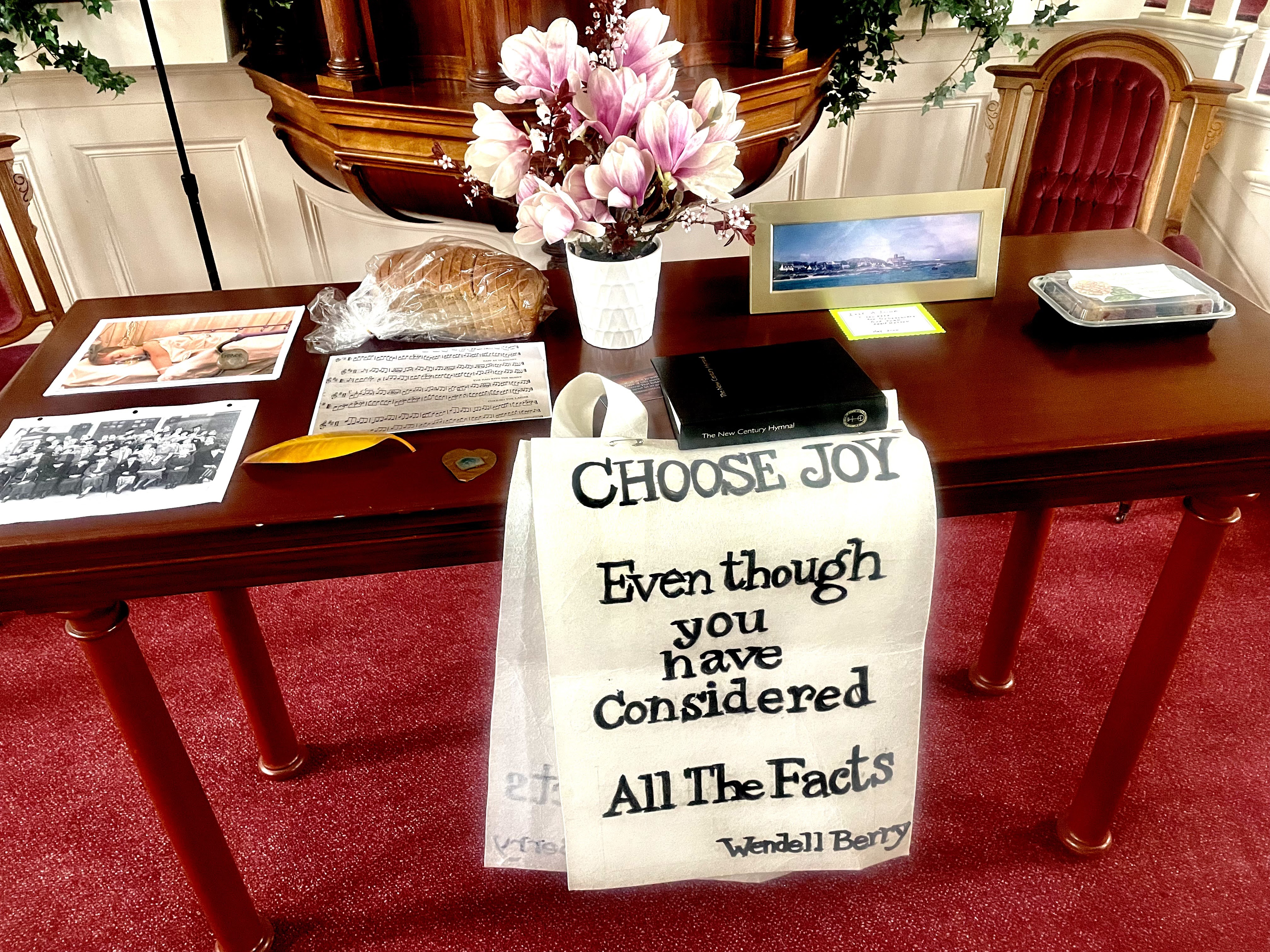
What we're doing is a counter-cultural act that is ALL about being together: call it solidarity, culture change, or even resistance to the status quo but it is an embodied act of sharing love and beauty in real time. We're not the only ones doing it, of course; but what we offer is unique. I can't tell you how many folk thanked me/us for creating the safe space to simply celebrate that "life can be ecstasy, you and me endlessly... groovin!" Our eclectic choice of songs, our willingness to hang our egos at the door, our commitment to bringing out the best in one another for the common good - or even healing our souls - was pure holy ground. Further the way we're putting these events together is also counter-cultural. Sure, I do a LOT of organizing (really a LOT - and make some on the spot changes) but we all weigh-in on ways to do a tune, we each bring our own gifts both to the songs and to the song selection. And, we laugh and care for one another while doing all of this. I can't tell you how prayerful that feels to me: more sacred than a LOT of church, for sure.
Monday, May 22, 2023
an experiment in music as love...
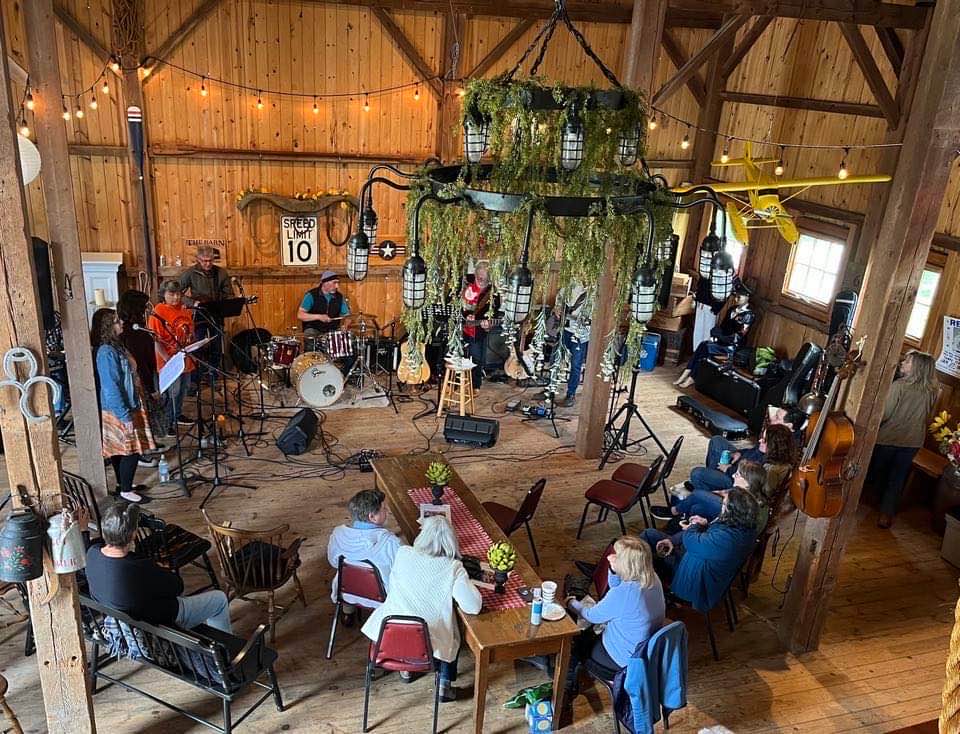
What we're doing is a counter-cultural act that is ALL about being together: call it solidarity, culture change, or even resistance to the status quo but it is an embodied act of sharing love and beauty in real time. We're not the only ones doing it, of course; but what we offer is unique. I can't tell you how many folk thanked me/us for creating the safe space to simply celebrate that "life can be ecstasy, you and me endlessly... groovin!" Our eclectic choice of songs, our willingness to hang our egos at the door, our commitment to bringing out the best in one another for the common good - or even healing our souls - was pure holy ground. Further the way we're putting these events together is also counter-cultural. Sure, I do a LOT of organizing (really a LOT - and make some on the spot changes) but we all weigh-in on ways to do a tune, we each bring our own gifts both to the songs and to the song selection. And, we laugh and care for one another while doing all of this. I can't tell you how prayerful that feels to me: more sacred than a LOT of church, for sure.
Monday, May 1, 2023
good shepherd sunday: reflections on contemplation and letting go
This was a surprisingly good news week for those of us considering today’s
appointed passage from the gospel according to St. John – especially if you hear it from Peterson’s reworking of the text in The Message:
Let me set this before you as plainly as I can: If a person climbs over or through the fence of a sheep pen instead of going through the gate, you know that person is up to no good—a sheep rustler! So, watch out for thieves, wolves, and other fakes who are out to steal, kill, and destroy you!
· Tucker Carlson – that sheep rustler is OUT! Fox News after their settlement with Dominion – those fakers are OUT $787 million dollars. Even CNN’s Don Lemon was taken OUT after shoot-ing off his once well-respected mouth in a sexist jab at Nikki Hailey’s age. Talk about wolves in sheep clothing, hucksters, con-artists, and thieves!
· The fourth Sunday after Easter has historically been set aside as Good Shepherd Sunday – a time to investigate both what it means for Jesus to identify himself as God’s good shepherd and what that means for us personally and in community. It is NOT an idyllic, sentimental cliche slathered in banal pastels but a poetic invitation to live more deeply into the presence of the Living God.
That’s the promise of the 23rd Psalm, you know: Because the Lord is my shepherd – NOT Fox News, MSNBC, the Pentagon, or my needy ego – I need not want, worry, or fret. When God leadeth me, I can lie down to rest in green pastures, pause beside still waters as the Lord restoreth my soul. Even in the presence of mine enemies or the valley of the shadow of death, I am filled with peace. Now this may not be obvious at first with today’s reading because 21st century North American culture is light years from the realities of 1st century Palestine in the Common Era. But the mystical spirituality of Jesus as described in St. John’s gospel promises that the path of Jesus – his spiritual practices and prayers as the Good Shepherd – are a portal into grace. Jesus is NOT a gate KEEPER, mind you, but a threshold into a way of being that’s saturated in the sacred.
You may recall that Jesus told us that his way was light, easy, never an ill-fitting or burdensome yoke, but a counter-cultural set of practices that result in… what? Do you remember? REST! Come unto me ALL ye who are tired and heavy-laden, and I will give you… REST. My favorite rendering says: Come away with me, trust and follow my lead, and I will show you how to live into the un-forced rhythms of grace. It’s a summons to turn off the news, step away from work and worries for a spell, and practice connecting with God’s eternal, ever-present, silent and inobtrusive love. It is, if you will, honoring the Sabbath by carrying it with you wherever you go. St. John is telling us this to-day by using three mystical terms that made once sense in ancient Israel – the sheepfold, the gate, and abundant life – but sound like antiquated gibberish now. My hunch is that this is why the litur-gical tradition of Western Christianity at its best sets aside the seven weeks between Easter and Pentecost for contemplation.
The first three weeks of Eastertide shows us some of the ways our wounds can keep us from recognizing the Risen Jesus when he shows up right beside us and we’re grieving, ashamed, or disappointed. The next four weeks push us to practice a counter-cultural contemplation of the abundant life that Jesus promises leads us into rest, renewal, and even resurrection. The heart of Jesus, you see, is NOT so much concerned with life after death, but the possibilities of abundant joy, integrity, and gravitas BEFORE our passing. Some of the poetry of the 15th century Muslim mystic Kabir grasps the wisdom of Jesus with sparkling clarity:
Friend, hope for the holy while you are alive. Jump into the experience while you’re still breathing. Think – and think some more – while you’re still alive – For what you call salvation belongs to the time before death. If you don’t break your ropes now while you are alive: do you think a ghost will do it after? The idea that the soul will join the ecstatic just because the body is rotten – that is fantasy! What is found NOW, is found THEN! If you find NOTHING now, you’ll simply end up with an apartment in the City of Death. But if you make love with the divine NOW, in the next life you’ll have the face of satisfied desire. So, plunge into the truth of life NOW and let the heart of the sacred embrace and carry you.
Jesus tells us this, too but to appreciate his wisdom we must first recall the context of today’s pass-age as a part of on-going quarrel between Jesus and the Pharisees. This argument is often obscured because the arc of the story has been broken into chapters when in fact chapter ten of St. John’s gospel is a continuation of the quarrel that began in chapter nine. Je-sus has just healed a man blind since birth who rejoices at this blessing only to be confronted and interrogated by the so-called shepherds of Israel, the Pharisees, and eventually expelled from life in community. Bible scholar, Elizabeth Johnson, says that “Those who were called to care for, protect, and nourish the people… choose to banish this healed blind man from their community, refusing to believe that Jesus and his healing work come from God. They are more concerned about guarding their own power, authority, and prestige than the well-being of the people.” (Working Preacher)
· Sounds like the Montana House of Representatives expulsion of the duly elected legislator, Zoey Zephyr, to me. For a week, this transgender Democrat from Missoula tried to get the Republican majority to acknowledge that they would have “blood on their hands” if they banned gender affirming medical procedures for transgender youth.
· Eventually, the gallery of protestors shouted: LET HER SPEAK, LET HER SPEAK while Ms. Zep-hyr simply sat at her desk holding a microphone above her head. THIS was the so-called eg-regious violation of decorum that tarnished, “the rules, collective rights, safety, dignity, and integrity of the House of Representatives.” NOT the proposed law that threatens the life of young transgender youth, just Zephyr’s attempt to “amplify the voices of those who elected her to challenge legislation that will not only harm the community but will get some of them killed.” Hear what I’m trying to say? The forces of insanity, fear, and prejudice regul-arly resort to expulsion, silencing, and often violence – then – as well as now.
So, notice how Jesus responds to this because it’s ALL about abundant life. First, he welcomes the excluded one into HIS alternative inclusive community. “Having al-ready restored the sight of the man, Jesus seeks him out again after his expulsion from the synagogue and brings him into the community of his followers. For the blind man, salvation is not only receiving his physical sight but also spiritual sight, recognizing who Jesus is, believing in him, and becoming part of his alternative community. He followed the voice of Jesus before he could see him, and it led to new life. Now his days of isolation are over as he knows himself to be a valued member of Jesus’ flock, cared for, included, and protected.” (Johnson, Working Preacher, 5/7/17)
Second, after embracing the healed but rejected man, Jesus challenges the credibility of his accusers by first obliquely appealing to the poetic tradition of the prophets, and then directly calling out the Pharisees as wolves, liars, and sheep rustlers: Very truly, I tell you, anyone who does not enter the sheepfold by the gate but climbs in by another way is a thief and a bandit. The one who enters by the gate is the shepherd of the sheep.
In ancient Israel and Palestine, you see, the sheepfold was a safe space where vulnerable flocks re-tired to when it grew dark: it was a place of protection against predators and shelter from the storm. By analogy, Jesus connects HIS alternative, inclusive community with the sheepfold: a place of refuge for the wounded, a place of nourishment for the hungry, a place of rest, renewal, and I want to say resurrection. Communities of judgment, by contrast, are guided by prejudice and fear and have NOTHING to do with the abundant life God provides within the true sheepfold.
Could St. John be any clearer concerning what our churches and faith communities are to be about whether in the 1st or 21st century? With 20/20 hindsight, WE can see this now, but apparently this analogy was too obscure for both the Pharisees and the disciples. So, the text tells us Jesus amplified his poetic imagery, shifted gears, and proclaimed: I am the gate for the sheep. The symbolism of the gate may have been confusing, but everyone in that conversation would’ve know what Jesus was proclaiming with his I AM reference, right?
Back in Exodus, when Moses asked God for a name at the burning bush, the One who is holy replied: I am who I am, right? In ancient Hebrew, I AM was written as YHWH, the sacred name that sounds like we’re inhaling the breath of life. Jesus is directly coupling his healing and inclusive com-munity with the abundant life promised by YHWH to those fleeing exile two thousand years before he was born. He’s also reminding his allies and opponents that their own tradition celebrates radical hospitality, a fact first articulated by Moses in the Exodus stories and later advanced by the ancient prophetic poets Isaiah, Jeremiah, and Ezekiel. After being exiled in Babylon for 70 years, God tells the people through Isaiah that there will soon come a time when God’s people will learn to rebuild the ancient ruins and renew the places of devastation by practicing compassion. Isaiah 58:
Is not THIS the fast that I choose? To loose the bonds of wickedness and let the oppressed go free? Is it not to share your bread with the hungry, bring shelter to the homeless poor, cover the naked and open your hearts to the ones who are wounded? Do THIS and your light shall break forth like the dawn and your healing shall spring up speedily. Take away the pointing fingers, the wicked tongues and pour yourself out for the hungry and afflicted and the Lord shall be with you to lead you into abundant life forever!
I am the gate into the sheepfold, Jesus announces, welcoming the vulnerable into safe space just as God helped your ancestors passed from bondage into freedom through the Red Sea. "This passage way offers safety at night and nourishment by day. It is NOT a metaphor of “exclusion nor a license to think of ourselves as the true sheep of the Lord.” (SALT Project)
If we use it that way, we become like the Pharisees who expelled the blind man from their com-munity. No, the purpose of the gate is not to keep out other sheep. As says in verse 16 of this chapter: “I have other sheep that do not belong to this fold. And I must bring them in also so that they will listen to my voice. And then there will be one flock and one shepherd.” The purpose of the gate is to protect and guard the vulnerable against all that threatens the well-being of the flock — especially thieves, bandits, and wolves. (Johnson, Working Preacher)
· That’s why I poked Tucker Carlson and the rest who are finally getting their come-up pence: we know that there has always been predators – wolves dressed in sheep’s clothes – con artists preying upon the trusting – religious leaders who lie and manipulate our wounds to line their own pockets or pump up their puny egos. And we know that honestly, there always will be. Remember that Jesus once told his friends to become wise as serpents and gentle as doves. Savvy but not cynical; tender-hearted without giving in to despair or stupidity.
· Today, using mystical rhetoric and poetry, he says the same thing with: I am the good shepherd who knows how to lead you through the gate of God’s love into abundant life. I like how preacher and teacher Sarah Dylan interprets this:
Shepherds had a hard life and faced ALL of the hardships of the hostile landscape through which they herded their sheep. Being with the flock, they faced all of the dangers and difficulties that the flock faced and were just as vulnerable to heat in the day, cold at night, and all the human and animal predators all around them. They slept with their flocks when there were few enough predators for them to sleep; they were seen as poor prospects as husbands and fathers since they had to leave their families alone and vulnerable at night as well. And that's the life Jesus lives for and with us. Jesus journeys with the most vulnerable and takes on all of their vulnerability. He knows what it's like to be out in the cold. He knows what he's saying when he calls people to leave their homes and villages, and even their families, since he had done the same himself. He knows what it's like to have people think that you're crazy or irresponsible because of what you leave behind and let go of, because people said the same things about him. And he knows something else, too: this crazy life he lived, and calls us to live, is abundant life It's THE abundant life, to be precise.
Abundant life – eternal life – is practicing the hard but liberating, counter-cultural inclusivity and compassion of Jesus. That’s how God’s grace becomes flesh within and among us – the unforced rhythms of grace may be free but carry a cost. How does the old movement song put it: let there be peace on earth and let it begin with… who? ME. Let it begin with ME. That’s a call to contemplation: an invitation to practice resting in grace and trusting that being God’s love can ground us even in the cruel absurdities that currently envelope our culture. Recently Maria Popova wrote:
ABUNDANT LIFE IS LEARNING TO LIVE WITH THAT GENERATIVE BROKENESS…
Over the next three weeks I’m going to offer you three resources or tools to help you practice simple, tender, effective contemplative prayer that leads towards the unforced rhythms of grace. You know, I’ve been with you for about two and a half months now and have about that much more time to walk with you. And I simply CAN’T leave without at least offering you – IN WORSHIP – some of the time-tested practices that can help nourish peace inwardly, outwardly and every way in-between. And the first one I want to share is so simple you’ll think I’ve flipped. It might help if you know it comes from the Quaker artist and singer, Carrie Newcomer, who got it from the late Thich Nhat Hahn, a Vietnamese Buddhist teacher and peace activist. She writes:
Breathe in Peace (Take a deep slow breath in) Breathe out a Smile (and remember to actually smile, large or small, toothy or Mona Lisa amused). Repeat. That’s it. I use it when standing in line at a grocery store or airport cue, driving or walking down a street, anytime I catch myself doom scrolling or thinking “Holy crap, this world is such a mess.” There’s actually brain science behind this practice. When we contract the muscles that allow us to smile, it sends signals to our brain causing it to release tiny molecules called neuropeptides that help alleviate stress. It also re-leases other neurotransmitters like dopamine, serotonin and endorphins acting as a pain reliever and antidepressant. When we smile, we actually, physically feel better. But I also think the act of smiling (for oneself and toward others) is an act of welcome and graciousness. It is a gift we give, a spooled-out thread of connection between me and thee, if even for the briefest moment.
Try it with me? Breathe in: PEACE (inhale) Breathe out… a smile (and actually smile.) These are crazy times, my friends, and they’ll likely become a lot crazier, too. But we’re not without resources, possibilities, and options. Give it a shot, for God’s sake and your own, trusting that the mystical un-forced rhythms of grace can bring you and others a measure of deep, deep rest and abundant life. And maybe try praying with me as we close by singing:
You may say I ‘m a dreamer, but I’m not the only one, I hope someday you’ll join you’ll join us, and the world…will live as one.
Wednesday, April 19, 2023
i believe house cleaning is embodied prayer...
"Yes, honey,
Tuesday, April 18, 2023
peter learns that if you always do what you've always done...
I am the bread of life – all who eat this bread shall never die.
I am God’s love revealed – I am broken that… you may be healed.
Simple, gentle melodies saturated in Scripture, yes? As both time and I ripened, my way of prayer-ing changed and I put John’s songs away. I now value the deeper wisdom of silence but from time to time still find myself singing some of his choruses: they ground me in the gentleness of grace, they open my heart when I’m feeling alienated, and they lure me towards the paradox of Christ’s love that takes me deeper within so that I might be more compassionate and real in public.
I am the bread of life – all who eat this bread shall never die.
I am God’s loved revealed – I am broken that… you may be healed.
That couplet synthesizes what I call sensual sacramental spirituality: seeing the obvious or pre-senting truth while trusting that just below the surface exists a deeper insight or blessing. Sr. Joan Chittister suggests that sensual sacramental spirituality can see the “eagle within the egg and knows that there is a spiritual child waiting to be born again within every adult.”
+ The classic definition of a sacrament is an outward and visible sign of an inward and spiritual grace: our tradition sees only two sacraments – baptism and eucharist – while our Catholic and Orthodox sisters and brothers name seven including baptism, eucharist, confirmation of baptism, confession, last rites, marriage, and holy orders. These older spiritual traditions consciously claim the symbolic patterns in Scripture and ordinary life and carefully construct words to help believers connect their experiences with the presence of the sacred. They even name three categories for the seven sacraments to reflect both the Blessed Three-in-One nature of God as Trinity as well as the sacred rest of the Sabbath that comes after God created the heavens and the earth in six days and rested upon the seventh.
+ As you may have already guessed, my evolving spirituality tends to trust the older tradition’s broad inclusivity of seven sacraments as superior to our paltry two – but I don’t think even that tradition goes far enough. No, sensual sacramental spirituality must be wildly more generous so that we can begin to cherish the rhythm of God’s grace in all of creation, poetry, art, politics, sexuality – even the act of breathing.
A sacramental spirituality, for example, hears the sacred in the songs that ring true in culture: Ten years ago, Lady Gaga’s monster hit, Born This Way, treated sexuality in a sacramental way when she sang:
I hear Ms. Gaga unpacking a core blessing from our creation stories in Genesis 1 where God pauses, looks at all that has been created and says: ooh this is good – very, very good – and takes a rest on the seventh day and called it a Sabbath. Gaga doesn’t overtly use Biblical language, but the mess-age is the same. I tested my working hypothesis of God’s still speaking nature again this week by randomly looking at the Top Ten songs only to find Taylor Swift channeling St. Paul in Romans 7 as she sings: “Anti-Hero.”
Practitioners of a sensual sacramental spirituality celebrate the way Ms. Swift
reframes St. Paul in Romans 7:
Maybe this is your experience? I’m full of myself… but what I don’t understand about is why I decide to act one way, but then act another, doing things I absolutely despise. If I can’t be trusted to figure out what is best for myself and do it, it’s obvious that God’s love is necessary…. But even when I know that love is real in my head, I still can’t keep trusting it for the power of sin keeps sabotaging my best intentions. I realize that I don’t have what it takes: I can will it, but I can’t do it. I decide to do good and not to do bad, but then I do it anyway. And it happens so regularly that it’s predictable.
Our tradition used to celebrate a still speaking God; that’s our 21st century paraphrase of what the Reverend John Robinson’s said to those boarding the Mayflower in 1620: I am very confident the Lord hath more truth and light yet to break forth out of His holy Word. A sacramental spirituality searches for how God’s grace is being enfleshed within and among us. The ancient Celtic and Orthodox traditions speak of this as deification.
Our becoming ever more comfortable in our own skin and humanity in the spirit of Jesus. They reject, as do I, the notion that we were born into sin. They advocate original blessing rather than original sin: this path never denies human brokenness but insists that as we learn from our mis-takes we can grow in humility and wisdom just as God intended. This spirituality simultaneously re-jects sentimentality AND cynicism – with a long albeit it obscure legacy starting with St. Irenaeus in the 2nd CE, Pelagius in the 3rd, John Scotus Eriugena in the 8th CE, both St. Francis and St. Bonaventure said it in the 12th and 13th centuries respectively, George MacLeod of Iona in the 20th, and Cynthia Bourgeault, Matthew Fox, and Richard Rohr today. All claim that our faith starts with a loving God who creates ALL life – ourselves included – imbuing the totality of creation with a grace deep within. We can tarnish and reject our original blessing, we can ignore it and trash it, too but we can not destroy it. How did Thomas Merton put it?
At the center of our being is a point of nothingness which is untouched by sin and illusion, a point of pure truth, a point or spark which belongs entirely to God, which is never at our disposal, from which God disposes of our lives, which is inaccessible to the fantasies of our own mind or the brutalities of our own will. This little point of nothingness and absolute poverty is the pure glory of God in us. It is God’s name written in us. It’s like a pure diamond, blazing with the invisible light of heaven. It’s in everybody, and if we could see it we would see billions of points of light coming together in the face and blaze of a sun that would make all the darkness and cruelty of life vanish. I have no program for this realizing this. I only know it is real and shows me that the gate of heaven is everywhere.
+ Are you still with me? I know that’s a bit over the top and arcane; maybe I should have simply said sensual sacramental spirituality seeks grace in ALL things and trusts that love trumps karma always.
+ It’s an alternative orthodoxy – a generous orthodoxy – that posits acts of love over abstract doctrine; orthopraxis – right living – over orthodoxy – right belief. It’s how St. John talks about Jesus in the fourth gospel – sacramentally – noting that there are no parables of God’s kingdom in this gospel; rather, Jesus tells us HE is what kingdom living looks like: I am the bread of life, I am the resurrection, I am the way, the truth and life. Same for the deeds of Jesus. Fr. Raymond Brown, master scholar of St. John, writes that the so-called “signs” that Jesus shares have an obvious meaning as well as a deeper truth:
A figure today who could physically give the blind sight and restore to life the recently dead would be hailed not only medically but spiritually. John's Jesus has a totally different outlook. He does supply earthly bread to a crowd that hungers; but that’s not the real marvel, for they will hunger again and so are not permanently better. The real marvel is that Jesus can give a bread from heaven that obviates spiritual hunger. Likewise Jesus gives a blind man sight, but such a gift simply makes the man no more disadvantaged than the rest of humanity that has sight but can-not see God. The real marvel is that Jesus as the light come into the world can lead the blind man to a believing sight that will enable him to see God wherever he looks. Jesus restores physical life to Lazarus, too but does that make Lazarus better off than he was before he died? The real marvel is not simply that Jesus can restore the dead to life but that he can give a life impervious to death. Lazarus comes forth from the tomb in his burial garments because he will need them again when he dies a second time. His being raised is a sign pointing to the resurrection of Jesus who will leave his burial garments behind in the tomb, never to be needed again.
Like I said at the outset: sensual sacramental spirituality sees creation as
saturated in grace whether we have eyes to see or not. One of the blessings of the life, death, resurrection, and ascension of Je-sus is that Jesus gives shape and form to what grace looks like. That’s why I’ve come to see Jesus himself as a sacrament – and this is crucial for today’s text about Peter’s betrayal becoming a portal away from shame and into a new and more consistent compassion. If you know Peter’s story, you see how incrementally he becomes more of his best self after encountering the love of God made flesh in the resurrected Christ.
+ We meet Peter as a hard-working fisherman: what the text DOESN’T tell us, but what would have been widely know back in the day, is that under the bootheel of Roman occupation, most of those occupied in the fishing industry essentially worked for the Empire. They were not quaint, craftspeople sharing their wares in a rustic setting. They were more like today’s farm workers laboring in the sun for corporate agribusiness. Small wonder Peter and Andrew drop everything to follow Jesus when the invitation is offered, right? They were escaping the rigors of feeding the occupying army of the Roman Empire.
+ Once Peter gives up his fishing nets to spend with Jesus before the Cross, he’s learning how to balance his enthusiasm with responsible accountability. Jesus gives him the nickname Petras, the Rock, because Peter gets carried away like a bolder crashing out of control down a mountainside.
You may recall that early on Peter discerns the unique charisms of Jesus and confesses him to be the Christ – the Anointed One – but in the next breath begs Jesus NOT to live into his ministry which prompts the Master to bark: Get thee behind me, Satan. Later, Peter awakens in a boat crossing the sea of Galilee and sees Jesus walking towards him on the water; in a fit of enthusiasm, he jumps ov-erboard only to sink when his faith fades. Get the picture: he’s up and down and all over the place.
The arc of Peter’s story throughout the gospels shows a passionate devotee who is hard headed and in need of discernment – a reality that plays itself out in spades when, at the Last Supper, Peter first argues with Jesus about getting his feet washed then begs to be washed all over before prom-ising NEVER to leave Jesus only to deny him three times in betrayal hours later. Peter flees the scene in fear and shame – and at least in St. John’s iteration returns to his old ways as a fisherman again.
And right THERE is a key clue about why living sacramentally matters: Left to his own de-vices, Peter returns to his old ways. Now play that out with me, ok? I know people who fall off the wagon and return to their old addictions when overwhelmed by fear or shame. I know good souls who crash and burn when their expectations of what a lover should be goes up in smoke. I know precious people trapped in grief after losing a loved parent, spouse, sib-ling, or friend. So, this aspect of the story is not JUST about Peter’s collapse: it’s a paradigm for what often happens when we can no longer see the eagle within the egg. When life’s pain pushes us back into our old ways. How do my buddies in AA put it?
· Think of this within our body politic…
· Or in the life of our church…
Sacramental spirituality shows us that even our failures and wounds can serve a greater good IF we’re willing to be open to the love of God. That’s what the conclusion of today’s lesson is all about: after encouraging Peter to own his shame and his suffering – that’s what the three love questions are about – accountability for betrayal: three times Peter denies Jesus and three times Jesus pointedly asks: Peter, do you LOVE me? They say confession is good for the soul, but only if it helps us get off the dime of shame and into taking responsibility for our actions – which is precisely what happens next.
+ Jesus tells Peter: look, man, when you were young and impetuous, you lived for yourself and did what you wanted, when you wanted, however you wanted. But now that you are older – and more humble – it’s time you let someone else gird your loins and lead you into those places you do NOT want to go.
+ Sounds like therapy, yes? Could’ve been Carl Gustav Jung speaking: to become whole and deepen God’s love in your life you’re going to have to into those places, feelings, events, and activities that you do NOT want to explore.
Culturally, politically, socially, emotionally, and spiritually that’s where we are right now: trembling before those places we do NOT want to go into. Authentic racial and gender equality. REAL and consistent reproductive rights for all women not just those with enough money and clout. Partner-ing with Mother Nature to heal our precious earth. Finding a way through the blood and morass of political stagnation to come to terms with gun violence and our historic addiction to it. Need I go on? When we were younger, we did as we pleased and went where we wanted. But now, guided by love and accountability, we must let another lead us into those places we DON’T want to enter – but must.
It’s hard – it’s costly – and it will hurt. But the good news is that as Peter honored this call to let another lead him into a new way of being, he grew in courage and conviction. His story becomes much less brash after Easter: he shepherds his brothers and sisters with compassion rather than hu-bris. He reaches out beyond his prejudice and fear to welcome Gentiles into the fold. And at least apocryphally if not accurately, when Rome chose to put him to death by crucifixion, he insisted on being crucified upside down to symbolically show us he knew he wasn’t Christ’s equal but a servant of the Lord. If Peter can change, not perfectly but profoundly, so can we – and THAT is how the word becomes flesh in our generation. So, let those with ears to hear, hear.
Wednesday, April 5, 2023
it's been a long time coming...
Sunday, April 2, 2023
making time for everything to hurt: palm/passion sunday 2023
· Passion Sunday is relatively new to Protestants – it came into being after the 1969 Vatican II reforms of the Roman Catholic Church. For twelve hundred years before that, Western Catho-lics celebrated Passion Sunday on the Fifth Sunday of Lent – last week – and then Palm Sunday today. They were united in 1983 when the Western ecumenical church agreed to partner with Rome and make a significant liturgical change.
· The reason this came about has long been misunderstood: modern believers say it had to do with simplifying worship schedules. In a frenetic era, many found it complicated to be at Palm Sunday and then Wednesday, Thursday, Friday, and Saturday of Holy Week, too. So popular wisdom claims that Palm Sunday merged with the Passion narrative to give busy people a break. But nothing could be further from the truth: both Roman Catholic and traditional Protestant scholars agreed to this change fundamentally as an act of spiritual formation. This day is ALL about discipleship and deep experiential education – not convenience.
Contrasting the Palms with the Passion, Hosannas with cries of Crucify, is NOT about scheduling: The Passion gospel intended for today takes at least 11 minutes to read aloud. It’s 81 verses, 1,961 words on three single-spaced pages; too long for one setting no matter HOW busy our lives have become. No, this liturgical shift intuitively evokes an intellectual and spiritual tension for us that challenges all our psychological, spiritual, personal, and political certainties. Putting the Palms side by side with the Passion shows us that:
The one betrayed and deserted in the passion is none other than the one hailed as the long-aw-aited divine monarch. We’re supposed to feel an emotional whiplash as we descend from “Hos-anna!” to “Crucify him!” (For) Holy Week is a kind of choreography or symphony, with distinct movements unfolding over time: from “Hosanna in the highest!” to “Surely not I, Lord?” to “Take, eat; this is my body” to “Let this cup pass from me” to “I do not know the man!” to “Let him be crucified!” to “My God, my God, why have you forsaken me?” to “He is not here; for he has been raised.” And these truths require time and space to be felt and understood.
One colleague put it like this: rather than reduce our time in worship, now we must give it MORE in order to reclaim the counter-culture call of Christ on our daily lives. She wrote that our culture:
Want to hurry people through their suffering. Like Job’s friends, we can only tolerate their discomfort for so long before we begin to give advice, offer solutions, and speak for God. The hardest thing I do as a pastor is sit with others in their suffering without trying to hurry them along. I must choke back easy platitudes. I feel a crawling under my skin, a resistance deep in my chest when called on to simply be present. I want to fix it. But there is no fixing the woman who is preparing for her 38th back surgery or the parishioner whose cancer has returned. And they aren’t asking me to. It takes discipline, courage, and time to sit in the chair and listen, without patronizing pity, and just bear witness to the unsolvable suffering. (Melissa Earley, Christian Centurey)
The exuberance at the start of Palm Sunday is linked to the grief of Christ’s passion later because:
· Pedagogically it confirms the inward/outward struggle to put on the whole mind of Christ: those who yearn for lives of integrity and a world shaped more by compassion than cash must come to terms with our own contradictions and wounds that contribute to the suffer-ing we all ache to change.
· Further, the unity of Palms and Passion makes it clear that the Jesus was NOT a helpless pawn entrapped by either Empire or religion: he was NOT the unwitting sacrificial lamb offered up to an angry, jealous deity as payment for human sin.
Rather, as Cynthia Bourgeault teaches, Jesus willingly wagered his life to show us that trusting God’s love in our flesh – relinquishing our broken selves to holy and human compassion – could simultaneously empty our hearts and minds of our addiction to control and then fill us full (or be fulfilled) by inner peace. Acceptance, you see, is the key to serenity within and without because INNER peace is a game changer. Fr. Thomas Keating wrote: “The effectiveness of action depends on the source from which it springs. If it’s coming out of the false/broken self with its shadow side, it’s severely limited. If it’s coming out of a person immersed in God’s grace, it’s extremely effective for the contemplative state, like the vocation of the Blessed Virgin Mary, is how Christ comes into the world.” Fr. Richard Rohr adds that this upside-down truth drives intellectuals and activists like us wild:
Jesus does not directly attack the religious and institutional systems of sin of his time until his final action against the money changers in the temple. His primary social justice critique and action often disappoints radicals and social activists (because) his social program is more a quiet refusal to participate in almost all external power structures or domination systems. His primary action is a very simple lifestyle, which kept him from being constantly co-opted by those very structures we know as institutional sin. He avoided the monetary system as much as possible by using “a common purse.” His three-year ministry, in effect, offers free healing and healthcare for any who want them. He consistently treats women with a dignity and equality that is almost unknown in a patriarchal culture. At the end of his life, he consciously surrenders to the punitive systems of both empire and religion by letting them judge, torture, and murder him. He is finally a full victim of the systems he refused to worship… (because he trusts that God’s love is greater than all our brokenness.)
· This spirituality and social action plan is all about learning how to live with sacred tension: earlier this week when yet another six people were murdered at a school – including three precious children – most of us reeled and wept and fumed. All over the Internet were cries of THIS MUST END. But like the current crop of know-nothing politicians carping about cutting government spending without any clue how to do so, ours are cries of impotence, too – more a chorus of compassionate broken hearts howling for a way to heal the horrors that are beyond our control. Carrie Newcomer wrote:
· My old buddy, the late Michael Daniels of blessed memory, used to tell me this constantly back in Cleveland after he got clean and sober. “You’re too damn smart for your own good,” he’d chide me. “You still think you can plan, work, and think yourselves into serenity even as your life careens out of control.” And he was right so what I’m about to say is not an abstract critique it’s just one beggar telling another where to find bread.
The fusion of Palms with the Passion reminds us that Jesus didn’t live in the Garden of Eden – and neither do we. He lived in occupied Palestine under the boot-heel of Roman greed and violence. As Howard Thurman would remind Dr. King: Jesus took the time to train his friends in contemplation before sending them into the world to confront suffering and injustice.
He required that they master a measure of inward peace born of grace before trying to redress the pain of oppression all around him. Consequently, Jesus regularly slipped away into the quiet of nature to reclaim his grounding. It wasn’t automatic for him – and if JESUS needed quiet time to practice calming his soul – well, let’s just say that we do, too. That’s the wisdom and rhythm of Holy Week: Palms AND Passion – joy as well as sorrow – the journey of letting go as well as receiving the unexpected gift of spiritual rest. “Peace, I give you” Jesus says in St. John’s gospel, “but not as the world gives it.” Somewhere along the line, this was misplaced in our tradition. Later it was all but discarded and lost but:
· The charism of Holy Week presumes 40 days: it’s about slowing down with silence, study, and prayer. The rich liturgies of Holy Week take time to carry us to Maundy Thursday and the foot-washing before the Last Supper, the agonizing emptiness of Christ’s death on the Cross on Friday, and the ecstatic festival of light and baptism on Saturday night’s Easter Vigil.
· Do you know that for the first 300 years of Christianity there was NO sunrise service? No, on the Saturday night before Easter Sunday adults who had already spent three years in training for their new life in Christ were stripped naked, fully immersed in the baptismal waters of a symbolic death, rose again to a new life of grace, were reclothed in garments of white before finally feasting upon Holy Communion for the first time. (SALT Project)
Slowly and carefully Christians were formed – not born; trained in their habits not just their minds. Do you recall how St. Paul put it in his training manual for new believers?
Here’s what I want you to do, God helping you: Take your everyday, ordinary life—your sleeping, eating, going-to-work, and walking-around life—and place it before God as an offering. Embrac-ing what God does for you is the best thing you can do for the Lord. Don’t become so well-adjust-ed to your culture that you fit into it without even thinking. Instead, fix your attention on God’s love and you’ll be changed from the inside out. Readily recognize what God wants from you and respond to it quickly. Unlike the culture around you, always dragging you down to its level of im-maturity, God brings out the best in you, develops well-formed maturity in you, so that you are NOT squeezed into the conformity of the status quo. Peterson, Message, Romans 12)
The reclamation of this counter-cultural commitment is now upon us because let’s face it: the old ways are not working in culture, in church, in our civic or business spheres. Our Lenten small group study was taken by the way Barbara Brown Taylor describes our need for a FIFTH gospel in this era where:
The good news is that dark AND light, faith and doubt, divine absence and presence, do not exist at opposite poles; they exist with and within each other, like distinct waves that roll out of the same ocean and roll back into is again. As different as they are, they all come from and return to the same source. And if I can trust that – if I can give my heart to it and remain conscious of it – then faith and trust become a verb, my active response to the sacred reality that the best of rel-igions in the world point to. (Learning to Walk in the Dark)
Take the ritual of foot-washing: most of us still think it’s just a Catholic thing – and for hundreds of years OUR way of doing church was mostly NOT what the Catholics do. We differentiated ourselves by subtraction: THEY do THIS, so WE do NOT. WE do Tenebrae – the service of shadows – on Maundy Thursday instead of foot-washing to distinguish ourselves from them. Same for Good Friday and the Easter Vigil: that’s what THEY do. Our tradition took the Wednesday Tenebrae out of the Catholic monasteries, moved it to Thursday, mostly ignored Friday and Saturday and replaced the Saturday night Easter Vigil of Baptism with a sunrise service on Easter morning. I submit to you that this mash up unintentionally eliminated the extended time we need for quiet introspection from most Reformation congregations. Our jumbled, rewritten rituals still have beauty and power – I love them – but they fail to help us savor what’s at stake in a mature spirituality that knows from the inside out how to negotiate the rigors of paradox within the tensions of contemporary life.
Let me tell you: there’s NO worship liturgy in the whole Christian tradition that leads us more into the power and beauty of patient humility and an honest assessment of our limitations than foot washing. I didn’t grow up with it, but after the United Church published our official worship book in 1986, I’ve used it faithfully. To kneel before another as a servant, not a leader; to let an-other hold my grubby, weird foot and gently wash and dry it before sharing Holy Communion in community is ALL about learning how to receive grace – liturgy, after all MEANS practicing the work of the people – because we’re not very good at this. Part of the human condition wants control. We like to GIVE gifts – initiate and guide life – but receive them quietly? Humbly? Not so much.
· Back in the early days of the pandemic when we realized that lock down was going to go on for more than a week or two, we shared a few Lenten prayer times with our family in Brook-lyn on Zoom – including a simple foot-washing ceremony with our grandchildren aged 3 and 5. I told the story from St. John’s gospel of Jesus offering his disciples an alternative to their bickering by putting a towel around his neck (that’s what these stoles represent, ok?), kneel-ing in humility and patiently washing their feet. Then I washed Dianne’s foot and invited our children and grandchildren to do the same – which they did. Five-year-old Lou washed mom-ma’s foot, 40-year-old poppa washed three-year-old Anna’s foot. It was slow, quiet and ten-der.
· Afterwards, as we talked and shared a closing prayer, we noticed Anna was still kneeling on the floor with her baby dolls: she was washing their feet. We quieted down to listen to what she was saying and heard: this is what Jesus asked us to do for one another. It was reverent. Simple. And exactly what Lent is supposed to evoke: a humble sharing born of trust that nourishes loving connections and a bit of patience for life’s paradox. No doctrine. No theology. No unrealistic expectations. Just simple acts of love honoring one another’s flesh.
As we go through the portal of Holy Week together this year, it feels to me like many of us know that the old ways of being church are over: young people confess that the faith they inherited from their elders is worn out. Wisdom keepers like Karen Armstrong say that “we’re living through a time of global transformation where religions are taking stock of what enmity has cost them and turning towards new wisdom about what it means to be fully human.”
Dr. Taylor writes that “we’re currently in the midst of that great rummage sale the Christian church seems to hold every 500 years” to decide what should stay and what should go. My prayer for you – my prayer for me – my prayer for all of us is that we give Holy Week this year time to take us deeper into the tension of a mature spirituality that loves the darkness as well as the light. That knows how to let go at least as well hold on. We don’t need more theology, doctrine, catechisms, abstract spiritual concepts, or academic study: we need more practice in patience, trust, acceptance of our limitations, more tender-ness for one another and ourselves, more silent contemplation, and more openness to the inward journey so that we can stay the course outwardly with one another like Magdalene did with Jesus.
She couldn’t stop Empire from executing Jesus. She couldn’t bring him back to life or change the minds of those addicted to patriarchy and violence any more than we can shake our legislators free from the idolatry of the NRA. But she could stand silent witness so that Jesus was not alone in the agony of his Passion. Magdalene embodied for Jesus what Jesus had earlier incarnated for her: open-hearted solidarity, walking with her through the darkness, teaching her how to trust that even in uncertainty there is a love greater than our fear, and doing so at the speed of the soul.
We’re living through a darkness that we cannot control or fix right now. So much of what we once took for granted is unraveling. Beyond the insanity of cancel culture, we haven’t yet begun to ack-nowledge the centuries of arrogance and the legacy of genocide that are, as Malcolm X prophesied, the chickens of racism and gun violence coming home to roost as we murder one another with abandon. Oh my God, there’s so much to confess, relinquish, and forsake in a culture that refuses let us grieve thoroughly. Holy Week is meant to give back to us the time we need to let go, accept and trust the counter-cultural humility, patience, and courage of Jesus. You know, Jesus doesn’t own a monopoly on this path: he came NOT to be called Christ but to give grace away as a fully conscious human being. So, let’s continue what we started in Lent: learning to walk in the dark together.
· To practice the inner peace Jesus promised. To learn from Mary Magdalene how to stand witness in solidarity with sisters and brothers so that no one need be alone when everything else seems to be falling away.
· To consciously lay aside all jargon, doctrine, dogma, and creeds so that we can discover that becoming fully human is what God’s heart yearns for in each and all of us. Dr. Taylor wrote:
What is saving my life now is the conviction that there is no spiritual treasure to be found apart from the bodily experiences of human life on earth. My life depends on engaging the most or-dinary physical activities with the most exquisite attention I can give them. My life depends on ignoring all touted distinctions between the secular and the sacred, the physical and the spiritual, the body and the soul. What is saving my life now is becoming more fully human, trusting that there is no way to God apart from real life in the real world. To make bread or love, to dig in the earth, to feed an animal or cook for a stranger—these activities require no extensive commentary, no lucid theology. All they require is someone willing to bend, reach, chop, and stir.
Most of these tasks are so full of pleasure that there is no need to complicate things by calling them holy. And yet these are the same activities that change lives, sometimes all at once and sometimes more slowly, the way dripping water changes stone. In a world where faith is often construed as a way of thinking, bodily practices remind the willing that faith is a way of being real in our everyday, ordinary, walking around lives. As the journey ripens, young Amanda Gorman reminds us:
Everything hurts,
Our hearts shadowed and strange,
Minds made muddied and mute.
We carry tragedy, terrifying and true.
And yet none of it is new;
We knew it as home,
As horror,
As heritage.
Even our children
Cannot be children,
Cannot be.
Everything hurts.
It’s a hard time to be alive,
And even harder to stay that way.
We’re burdened to live out these days,
While at the same time, blessed to outlive them.
This alarm is how we know
We must be altered —
That we must differ or die,
That we must triumph or try.
Thus while hate cannot be terminated,
It can be transformed
Into a love that lets us live.
May we not just grieve, but give:
May we not just ache, but act;
May our signed right to bear arms
Never blind our sight from shared harm;
May we choose our children over chaos.
May another innocent never be lost.
Maybe everything hurts,
Our hearts shadowed & strange.
But only when everything hurts
May everything change.
Monday, March 13, 2023
reflections on the woman at the well for lent III...
In addition to his natural born gifts as a writer, he ripened into what my friends in
the African Amercan community of Cleveland used to call mother wit: wisdom distilled from real life experiences. These words still give shape to my soul: “You never know” Buechner says, “what may cause them.”
The sight of the Atlantic Ocean can do it, or a piece of music, or a face you've never seen before. A pair of somebody's old shoes can do it. Almost any movie made before the great sadness that came over the world after the Second World War, a horse cantering across a meadow, the high school basketball team running out onto the gym floor at the start of a game. You can never be sure. But of this you can be sure: whenever you find tears in your eyes, especially unexpected tears, it is well to pay the closest attention. They are not only telling you something about the secret of who you are, but more often than not God is speaking to you through them of the mystery of where you have come from and is summoning you to where, if your soul is to be saved, you should go to next.
In the Sermon on the Mount Jesus calls this being wise as serpents and gentle as doves. This affirms that there’s always a connection between our inward journey and our outward encounters. Those with eyes to see recognize that Jesus consistently links the personal to the political, our private epiphanies to our public personas, and the mystical movements of our soul with the hard work of engaging the world with love.
Activists as well as contemplatives tend to favor one path over the other – that’s just human nature – part of living into the unique charisms God gives to us at birth. To mature, however, to become our truest selves who consciously incarnate the holy, creative, and unique blessings of God into our ordinary days is a balancing act. A mystical dance that requires intentionality, imagination, trust, and accountability. It’s so easy to lose our place in this dance which is why the Hopi people crafted this word – “Koyaanisqatsi” – it means life out of balance. Activists afflicted by this disequilibrium fail to nourish the inward disciplines of humility, beauty, and awe and wind up cranky and cynical; while contemplatives who don’t practice putting themselves out on the line from time to time atrophy into self-righteous, privileged, navel-gazers who are so heavenly focused as to be no earthly good. Ours was designed to be a both/and spirituality honoring flesh AND spirit, action and contemplation, social change AND grace-filled prayer, serpents as well as doves.
Today’s story of Jesus meeting a Samaritan woman at a well in the center of town helped me make this truth my own. I’ll tell you how in a sec, but three key features in the story warrant our attent-ion:
· First is the symbolic dismantling of two spiritual taboos: one against a male religious teacher speaking with a woman in public, the other against Jews and Samaritans interacting in inti-mate ways like sharing drinking water. St. John goes out of his way to call attention to the scandalous dimensions of this dialogue that rattles both the woman at the well and later the disciples: “Two fault lines of social division — gender and religious/ethnic sectarianism — are brought front and center” as Jesus links the inward with the outward aspects of faith. (SALT Project)
· Second is St. John’s use of contrast: last week in chapter three, a pious Jewish man, a Pharisee and religious leader, came to Jesus in Jerusalem only to leave baffled because Jesus spoke metaphorically while Nicodemus heard “literally and prosaically.” Today, 30 miles outside of Jerusalem, Jesus initiates contact with a woman – an outsider despised by traditional Jews – who catches a glimpse of God’s grace in the poetry Jesus shares and experiences inner renew-al while old Nicodemus stays stuck in bewilderment. This gospel is saturated with good people missing the point because they’re focused on tradition instead of imagination.
· And third, once the Samaritan woman connects her life with the poetic promise of Christ’s deeper message – once she recognizes God’s grace already in her heart– she starts multiply-ing the miracle of forgiveness throughout her community. As Jesus asked: she goes home and tells her loved ones what’s she’s experienced – and the story ends like this:
Many in that Samaritan village came to trust the way of Jesus because of what the woman told them. In fact, they invited Jesus to stay with them for two days and kept saying to the woman: we no longer believe only because of what you told us, but now we’ve seen and heard it ourselves and KNOW that the wisdom of Jesus brings healing.
It would seem that Jesus has NO interest in simply preserving rituals – Jewish or
Samaritan – just because they’re old; rather, he actively dismantles the ancient habits that bind and oppress us so that we might live as ambassadors of compassion. Priests, gender, buildings, tradition, power, and the status quo matter far less to the holy than setting people free. Do you recall how the prophet, Micah, put it: THIS is what the Lord requires: to DO justice, to SHARE compassion, and to walk HUMBLY with God and one another.
That’s the story’s context. My connection is that 30 years ago in November, I was elected to the Cleveland Board of Education. With the encouragement, resources, and chutzpah of the city’s mayor, Michael R. White, an inter-racial team of parents was recruited to be a reform slate called to fix a system rife with cronyism, waste, and patronage. We also needed to negotiate a way out of an obsolete federal desegregation order. Once upon a time it made sense given the city’s legacy of racial separation and hatred. Now it just bussed one group of Black children from the East Side of town to another mostly Black neighborhood 45 minutes away on the West Side – and vice versa.
Most of the city’s middle-class families of both races, you see, had long left for the suburbs creating a student population that was 80% low income and African American. What began as a righteous act of reparation was now an expensive, exhausting, and frustrating failure. Cleveland’s mayor, a young Black educator himself, knew first-hand that change was essential, so he enlisted a commun-ity coalition to get us elected – and we won – all of us. Here’s a picture from the front page of the Cleveland Plain Dealer on election night where our slate won and I became the Vice-President of the Board in charge of Personnel. What a trip! One additional word of context:
· While it was an honor and privilege to be welcomed and supported so profoundly by the city’s African American community – a blessing I continue to cherish – big city politics are ugly, dangerous, and soul-sapping. Somebody ALWAYS wants something for nothing. Mayor White war-ned me: Don’t make any NEW friends after election night, ok? Our labor lawyer was explicit: Take a good look at yourself in the mirror and come to terms with what you CAN and CANNOT live with because to make big things happen, you must be ruthless.
· He was right and in time I realized being ruthless meant I was becoming someone I hated: I was combative, snarky, always on the defensive, my first marriage fell apart as I started to believe our own press releases, and… I was burning out. Unbalanced action has its costs, ok? Bertolt Brecht described it well in a poem where the rising forces of Hitler’s fascism were in combat with the city’s progressive advocates for justice:
I began going to Thursday night Eucharists and eventually asked Fr. Jim to serve as my spiritual director. After one overnight of solitude I mentioned being moved to tears by the tale of a WWII vet who found new purpose after going to confession. Jim smiled and said, “Maybe it’s time for YOU to do likewise?” I must have gasped out loud: “Hold the phone, Father. I love liturgy, retreats, and all these smells and bells; but confession is for Catholics – and I am NOT that.”
“Suit yourself man,” he replied, “Just know that the spirit blows where it will, and you might be surprised where its leading if you just stepped outside your comfort zone.”We lovingly argued over that for a bit but I gave in and set up a time for confession. Well, the day came to meet Fr. Jim, and wouldn’t you know it, I came down with a wicked head cold and had to cancel. Jim was amused as set up a new time which I quickly forgot about, too – and missed yet an-other appointment. Trying to get back on track, Jim said, “You can run but you can’t hide, man. God is calling so try to get here this time.”
Which I did: we sat together in a small room as I tip-toed to-wards opening my heart. And before I knew it, I was sobbing and shaking, trembling and caving-in on myself until all my inner junk came out and only silence filled the room. Jim eventually put his hand on my shoulder saying: “James, child of God, by the love of Jesus I remind you that ALL your wounds, all your sins, and all your brokenness have been forgiven. Pick up your life and walk.”
A sweet serenity started to swell up inside me – something akin to a fourth and fifth step in AA – until Jim added: “And now for your penance…” I freaked: “Stop with all this Catholic talk ok? Con-fession was one thing but penance. Really?” To which Jim said: “Your penance is to do what Je-sus asked of the woman at the well…” I froze, unable to think, wondering what the hell DID Jesus ask of the woman at the well? And then it hit me: he simply asked her to go back to her community and tell others what she’d experienced. Let them see firsthand what it looked like to be liberated by love: forgiven, unburdened, and renewed. I literally jumped out of my chair, hugged that old Irish Catholic priest, and shouted: Hell YES. I can do THAT! And walked out of my first confession like I was floating on air.
Precious people of God: THAT’s what religion is SUPPOSED to do! Grace helps us get rid of our inner garbage that keeps us from loving others and shows us how to live as our truest selves. It’s about restoring balance, living in ways that honor the bounty of life – even in times of suffering and confusion – and joyfully share its blessings. Not abstractly. Not rhetorically. Not doctrinally. But with flesh and blood acts of holy, human tenderness. Take the music we’re about to absorb: not only is it as 12 minute encounter with beauty for beauty’s sake; it’s also a sensual reminder of what balance and love can bring to the world. Its soul food shared that we might live as living bread and wine for the world. You matter. Your love matters. Concentration camp survivor Viktor Frankl tell us that:
Once a woman called him in the middle of the night to calmly inform him she was about to commit suicide. Frankl kept her on the phone, talked her through her depression, giving her reason after reason to carry on living. Until finally, she promised she would not take her life, and kept her word. When later they met, Frankl asked which reason had persuaded her to live? "None,” she told him. “What then influenced you to go on living,” he pressed? “It was your willingness to listen to me in the middle of the night. A world in which there was even one person ready to share another's pain seemed to me to be a world in which it was worthwhile to live.”
That one person might be you: so let those with ears to hear, hear.
finally...
These past three months have taken their toll. Grief and anxiety will do that even if you don't fully recognize the signs. I certainly d...
-
One of the most complex challenges I experience doing ministry in this ever-shifting moment in history has to do with radical Christian love...
-
After four hard and beautiful days with family in anticipation of my father's death, we are home. It was time well spent. As one friend ...


.webp)
.jpg)


.webp)