NOTE: Here are my worship notes for Sunday, July 17th, 2011. (Hey wait a minute - how did THAT happen? It is the middle of summer - already?!?!! Impossible, but true.) Well, I am grateful to Fr. Thomas Keating, Philip Yancey as well as the scholars who worked on the new book about St. Paul, The Authentic Letters of Paul.
If you are in town at 10:30 am on Sunday, please stop by
One evening while flipping through the TV channels with my remote, I came across the most startling panel of talking heads I have ever seen. On the same dais at an International Monetary Fund conversation about world debt were: former President Bill Clinton, internet guru and philanthropist Bill Gates, human rights activist Ellie Wiesel, Archbishop of South Africa Desmond Tutu and rock and roll social activist Bono from U2.
• “This is too good to pass up,” I thought to myself so settled back to see what would unfold. And within minutes of tuning in, I heard Bono say to Bishop Tutu and Ellie Wiesel: “When it comes to changing the way the world works we need to trust grace more and more… because ‘grace trumps karma.’”
• Did you hear that? “Grace trumps karma!” Forgiveness and hope create the possibility of healing instead of staying locked into a dog eat dog reality; whether we’re considering international debt, social sin or personal failure there is often more inspiration born of interrupting the suffering we humans so often inflict upon one another rather than just institutionalizing the consequences of our pain.
• Grace trumps karma… brilliant!
Now let’s be clear: my man Bono didn’t say that karma doesn’t exist – and for those who don’t know the word karma is a Buddhist or Hindu term referring to the total effect of a person's actions and conduct during the successive phases of your life that work to determine your destiny – what we might call fate or the experience of “what goes around, comes around. Like St. Paul said in this morning’s lesson: there will always be suffering – we will always groan both inwardly and outwardly – because life hurts and karma is real. A new translation of Romas 8 puts it like this:
We know that the whole creation has been moaning with birth pantes until now; and not only the creation, but we who have savored the first taste of God's power also sight within ourselves while we await our adoption and release and transformation of our bodies from their earthly limits...
But – and this is the key – there is a love and truth bigger than karma called grace – so let’s get down to it and explore the blessings of grace in ways that can help, ok? If you’ve been with us this summer you know that I have been talking about living as apprentices of grace.
I don’t think Jesus was kidding when he invited us to “come to him in our burdens and lay them down within… the unforced rhythms of grace.” I believe that at the heart and soul of Christ’s ministry in his day as well as ours there is a summons to joy.
• When the angel appeared to the Virgin Mary, he didn’t say, “I have come so that you might be worried and troubled forever,” right? He said: “The Lord is with you, favored one… be not afraid, Mary.” (Luke 1: 26-30)
• When Jesus was talking to his apprentices at the Last Supper – just hours before his Passion and Cross – he didn’t tell them, “Well, guys, you are going to have to figure all of this out on your own with wailing and gnashing of teeth just like the French Existentialist will someday demand.” Not at all, he said if you rest and trust and abide in me then you will know the Father’s love from the inside out: “For I have come to you so that my joy may be in you and that your joy may be complete and full and whole.” (John 15: 1-11)
• What did the angels tell Mary Magdalene and the mother of our Lord when they went to his tomb and found it empty? “Fear not!” What did the Resurrected Jesus tell Peter after the betrayal? “Fear not… if you love me then feed my sheep.”
And what does that old complainer, Paul, tell us in this rambling and at time complicated theological discourse from chapter 8 in Romans? Fear not – there will be hard times – there will be karma and suffering and confusion and even pain – and in the middle of it all you may not feel like God is with you.
• But here’s the deal: Paul wants us to know that those fears and groans are our old nature talking – our wounded and lower selves– who will always be with us because we are still human.
• At the same time, however, God’s Spirit has been shared within us, too and cries out to the Lord even when we don’t know what to say or pray.
Romans 8 puts it like this:
In support of God's love, God's power comes to the aid of our weakness - we do not know what we should pray for as we ought - but God's power intervenes with yearnings beyond words. The One who searches human hearts knows what the divine intention is; so God's love and presence intervenes on behalf of the People of God in accordances with the purposes of God. We can know, therefore, that for those who love God - those who are called to live in accordance with God's purose - God always collaborates for a good outcome.
Not that all things ARE good – Paul isn’t an idealist or a romantic – there is pain and death and all the rest. There is suffering – and he names it – and at the same time there is the Spirit bringing us healing and hope by grace. So, like Jesus before him, Paul asks us to start practicing trusting grace more than our fears: I consider the sufferings of this present time, he writes, not worth comparing to the joy that is about to be revealed within us.
• Are you with me so far? What I am trying to say in this first part of my message is that fear – or suffering – or pain is not what God wants for us. Let’s be clear about that; we are not given pain so that we can become more faithful. That’s sadistic and not at all a part of God’s grace.
• No, pain is a fact of life – and what Paul is asking of us is that we use this fact to live beyond and through the pain. He want us to practice being apprentices of grace whenever we hurt – whenever we are burdened – whenever we are afraid.
And he tells us how to do it, too: let the Spirit work within you for God’s Spirit knows how to bring order out of our chaos and hope into our fears even when we don’t feel it. Mostly, you see, because it is GOD at work, not us. Did you hear that? It is God at work, not anything related to our effort. So, the first truth for today as apprentices of God’s grace has to do with trusting that God is at work within and among us whether we feel it, believe it or know it: the Spirit helps us in our weakness… and groans and intercedes for us with sighs too deep for human words.
• How do you react to that? Any sense how such trust might be a way to let go of our burdens and start bathing in the joy of grace?
• What are you feeling and thinking?
Now before I go deeper and amplify this insight with some biblical interpretation born of today’s parable, let me use a sacramental prop called, “seeing the one whom Jesus loves,” ok?
(Take the mirror from the stand in the Chancel and bring it out to the people…)
This is an ancient and time-tested resource originally designed to help people comprehend something of God’s amazing grace. It was recently rediscovered – I think maybe in some of the ancient ruins in Turkey – with these words on it: THE ONE JESUS LOVES.
• Can you see that? Isn’t that what it says? The one Jesus loves?
• Now tell me something else, ok? What do you see when you look into this sacramental resource…
• YOU are the one Jesus loves – not because you earned it – not because you’ve succeeded in being holy – and not because of any tradition or habit. That’s the way grace works – it’s all about God – and what we have to do is trust that we truly are the ones Jesus loved.
Now, it is my hunch that this was precisely the insight Jesus was getting after in today’s strange little parable about the mustard seed or the pine nut in Matthew’s gospel. So, let me try to explain three key clues that he gives us because even though we’ve been talking about God’s grace for more than 2,000 years – and more than 4,000 years if we include our cousins in Judaism – most people still don’t get it. Most people don’t believe what they see when they look into that old sacramental prop, right?
Let’s see if this helps- and let me start be reminding you just what a parable is all about. Eugene Boring in the New Interpreter's Bible (Matthew) writes:
In the preaching of Jesus, parables were not vivid decorations of a moralistic point but were disturbing little stories that threatened the hearer's secure mythological world – the world of assumptions by which we habitually live – the unnoticed framework of our thinking within which we interpret other data. [299]
These are not morality stories – or tidbits of linear information – but moments of mystical wisdom intended to challenge and wake us up to something important about God’s grace. Like one scholar asked: "What was Jesus seeking to threaten in the hearer's world of assumptions… and, what in our world… might Jesus be seeking to threaten today?" I think it has something with being able to see God’s in the most unexpected places… and here’s why.
In Christ’s day there was a huge gap between the mythology and assumptions about God held by many of the religious leaders in Jerusalem and reality. You see, the official ideology or party line was that Israel was God’s chosen nation – a people with a unique relationship to the Creator – which is probably a notion most nations and ethnic groups lay claim to throughout history.
• This myth – or assumption – gave Israel an identity – a unique self-understanding in history: we are God’s chosen people.
• The problem, however, was all too obvious: if Israel was the chosen people, how come they were living under the boot heel of the Roman Empire?
“From the heyday of national power and prestige during the reigns of King David and King Solomon, writes Fr. Thomas Keating, “Israel had been on a downhill slide for several centuries, its kingdom conquered and divided several times over.” (The Kingdom of God Is Like… p. 37)
If one lives in occupied territories, as the Israelites of Jesus’ time did, the question naturally arises, “Is this ghastly oppression by the Romans a punishment of God, or is our suffering just part of the human condition?” In this context – within this particular myth – the whole notion of the kingdom of God had specific connotations of power, triumph, holiness and goodness.
Sense the tension here? The dominant cultural symbol of this old myth in Israel was “the great cedar of Lebanon – something like the huge redwoods of California – used to rebuild the Temple in the age of Solomon.” In this symbol, “the kingdom of God would mean that the Jewish people would be the greatest of all nations just as the cedar of Lebanon was the greatest of all trees.” (Keating, p. 37)
• To which Jesus said… “Probably not – for the kingdom of God is more like a mustard seed” or a pine nut to use Peterson’s rewording. And, this mustard seed/pine nut is not only the most insignificant seed to ever be planted in a garden; it is not really a seed that should be planted in a Jewish garden at all because it is a weed.
• The mustard seed was ritually unclean – it was not to be mixed with other vegetables that bear fruit – because as a weed it was fast growing and would choke all the other plants to death.
This parable gets even more disturbing – and perplexing – because even though Matthew tries to clean things up a bit by suggesting that the mustard seed would eventually grow into a mighty tree that could give shelter to the grand birds… this wasn’t true.
Mustard seeds are a common, “fast-spreading plant that only grows to about four feet in height. It puts out a few branches – and with some stretch of the imagination – birds might build a few down-at-the-heel nests in its shade” – but that’s all. Jesus is saying that the kingdom of God is NOT like the mighty cedars of Lebanon but more like an unclean weed that has been illegally planted in somebody’s garden.
• Now why in the world would he say such a wild thing? What was his point?
• Any thoughts or reactions?
Well, Jesus’ parables always point to the core of his ministry – a core I have called the unforced rhythms of grace – a heart filled with joy that trusts God’s Spirit beyond all the evidence, right? So does that help as you try to grasp what Jesus is trying to challenge and change?
• My hunch is that it is yet another story about grace – we aren’t going to get it in the ways we think – by working for it or trying to earn it. God’s going to give us grace in an almost unknown or mysterious way.
• And it is going to grow within and among us NOT like a cedar from Lebanon, but more like a mustard weed – low and close to the ground – and almost unnoticed. Maybe even in places we think are unclean, too.
• What’s more, this grace is NOT something we have to wait for at the end of time like some apocalyptic promises where God defeats all evil and rescues us from suffering. No, the kingdom of God is here-and-now – in our lives – in our church – in the ordinary and often unexpected places.
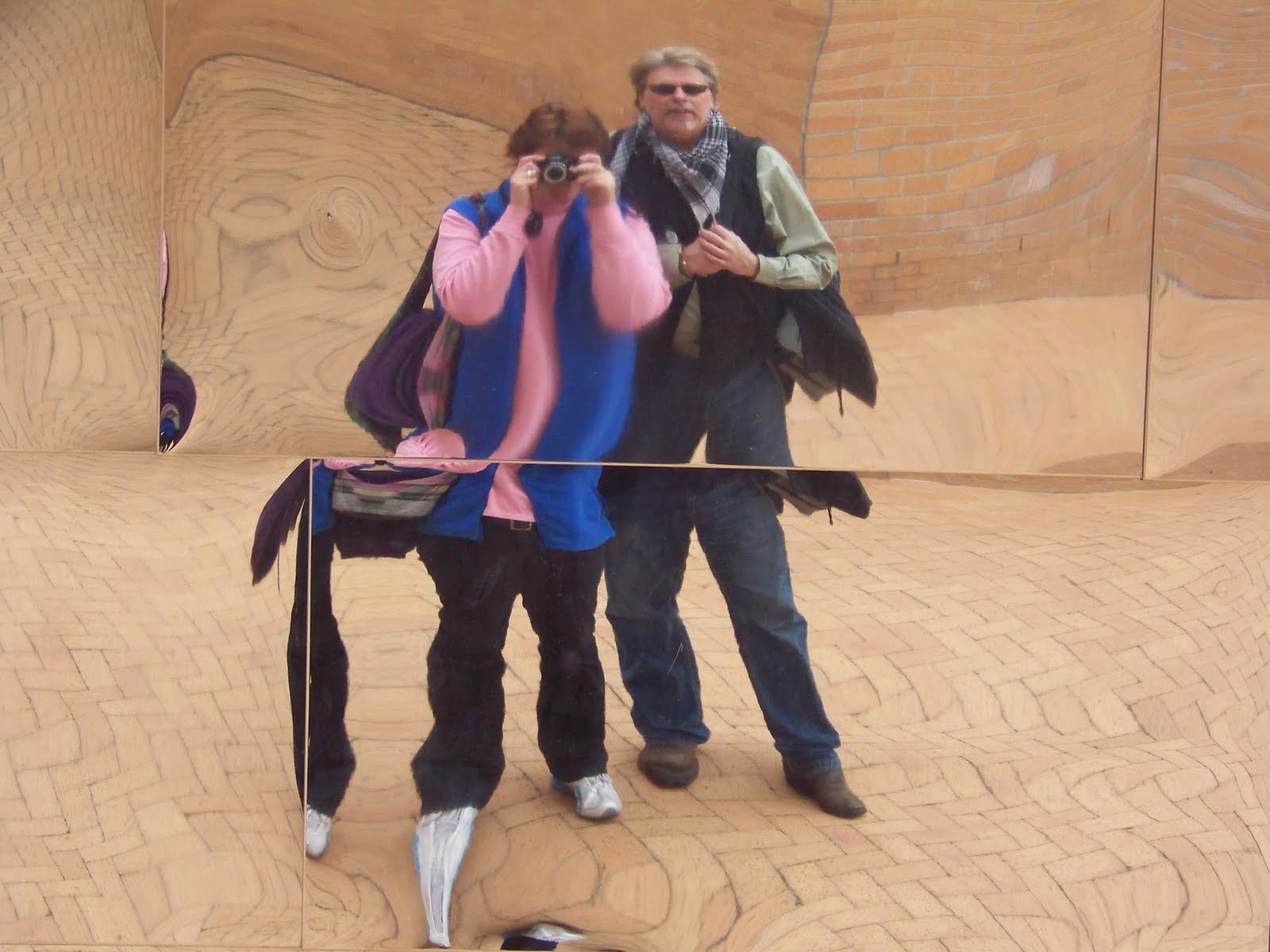
• Dare I say even… in the mirror?
We live in a time when 20% of our neighbors identify themselves as “spiritual but not religious.”Religion has fallen on bad times – and probably for very good reasons – like being obsessed about rules and judgment instead of joy and God’s grace. To live in a small but grace-filled way in our ordinary, everyday existence is one of the most important things you can do for God.
• It shows you trust God’s Spirit to be with you even when you don’t feel it.
• It documents to others that there is a love deeper than our facts and everything that is obvious; a love that heals our wounds and strengthens us when we are at our weakness.
• And it provides a little shade or comfort – like that old mustard weed – for others who are at their lowest, too.
So what I’d like for you to do – as we sing you this little tune from Bono and U2 – is to take one of the ancient archeological signs recently rediscovered in Turkey from one of our ushers now and affix it to your bathroom sacramental resource. So that every day – and sometimes more than once a day – you might be awakened to God’s grace within you: in this, you will be prayerful and playful - humble and graceful – and that is really good news for today - or any day, yes?
Tuesday, July 12, 2011
Monday, July 11, 2011
Two quick stories...
Yesterday a woman at church told me, "I feel such joy in this place!" Well, I do, too, but I'm the pastor so I wondered what she meant. And, as the Spirit would have it, she told me. "I had a dream a while ago about being invited to a party where I wore some beautiful shoes. But the people at the party didn't want to have fun - they made me uncomfortable about my beautiful shoes - so I had to take them off and go barefoot."
She then told me about becoming a Christian only a short time ago and being a part of a church that was more about rules than Christ's joy. "But after being with you in worship now I know... there IS a place I can wear my party shoes!"
I wanted to weep. I think I could - maybe should - retire right now because it doesn't get much better than this. Second story: we had a house guest with us over the weekend - a dear church member and friend - with whom we shared food and feasting and story-telling and LOTS of music. Her presence brings joy to the world inspite of TONS of sorrow. And maybe the Spirit is moving in such a way that she might rejoin us at some time. It was a little bit of heaven when she sang "One Voice" with two other women in our band on Sunday. Another moment of gratitude where I had to say, "ok, maybe I have been blessed enough for one day - or one life - or one ministry."
I give thanks today for these sweet signs of God's on-going grace in a broken and wounded world. "At times our own light goes out and is rekindled by a spark from another person. Each of us has cause to think with deep gratitude of those who have lighted the flame within us.” — Albert Schweitzer
She then told me about becoming a Christian only a short time ago and being a part of a church that was more about rules than Christ's joy. "But after being with you in worship now I know... there IS a place I can wear my party shoes!"
I wanted to weep. I think I could - maybe should - retire right now because it doesn't get much better than this. Second story: we had a house guest with us over the weekend - a dear church member and friend - with whom we shared food and feasting and story-telling and LOTS of music. Her presence brings joy to the world inspite of TONS of sorrow. And maybe the Spirit is moving in such a way that she might rejoin us at some time. It was a little bit of heaven when she sang "One Voice" with two other women in our band on Sunday. Another moment of gratitude where I had to say, "ok, maybe I have been blessed enough for one day - or one life - or one ministry."
I give thanks today for these sweet signs of God's on-going grace in a broken and wounded world. "At times our own light goes out and is rekindled by a spark from another person. Each of us has cause to think with deep gratitude of those who have lighted the flame within us.” — Albert Schweitzer
What was said to the rose that made it open was said
to me here in my chest.
What was told the cypress that made it strong
and straight, what was
whispered the jasmine so it is what it is, whatever made
sugarcane sweet, whatever
was said to the inhabitants of the town of Chigil in
Turkestan that makes them
so handsome, whatever lets the pomegranate flower blush
like a human face, that is
being said to me now. I blush. Whatever put eloquence in
language, that's happening here.
The great warehouse doors open; I fill with gratitude,
chewing a piece of sugarcane,
in love with the one to whom every that belongs!(Rumi a la Coleman Barks)
Saturday, July 9, 2011
Feasting...
Today yet another feasting idea rose to the surface of a conversation making it clear that not only is "feasting at Christ's open table" at the heart of my theology, but it might also need to become part of the core of my ministry in this community.
Last week, after feasting with our children for our birthdays, daughter number one said, "You know, Dad, not that I need to tell you more what you should do at church but... (always the ubiquitous BUT) what do you think about hosting a free community feast - with fancy china and the whole nine yards - once each quarter? Nothing to do with worship - hosted at the church - but just a chance for people to be together and return thanks?" And when I said, "Are you telling me that after TALKING about feasting for so many years - and discussing it theologically - I should just DO it?"
She smiled her beautiful and sincere smile and said, "Well, yeah... and know what else? I would come and help you with it!" OMG, I wanted to cry tears of gratitude right on the spot - I have BIG Irish emotions sometimes, right? - but I just said, "I think that makes a truckload of sense. Let me see what I can work on, ok?" And she just nodded.
Then today, telling one of my dear friends and colleagues about our recent trip to Istanbul, HE said, "So how are you thinking about working with the immigrant and foreign students who are all over the place at our local community college? Your international focus - pulse your worship and commitment to the arts - is a natural: what are you doing?" And when I said, "Not very much..." he challenged me to think bigger. And it hit me: a hundred years ago local congregations used to reach out to out-of-town students by sponsoring/welcoming them into their homes during the holidays. Why not reclaim that? And then ask the student to work with me on an art/music show about their experience in the US? To which he said,
"THAT, my man, is JUST what is missing!"
For the past four years we have been learning about hospitality - and feasting - and I wonder if now isn't the time for all this learning and work to start bearing bold and radical fruit? My other daughter, the great family baker, is another inspiration. And thinking about her led me to this poem by Joy Mead:
Because bread won't be hurried
we have to learn to let be,
to do nothing, to be patient,
to wait for the proving.
Because bread won't be hurried
and is a life and death process,
we find out in its making
that time is not a line
but a cycle of ends and beginnings,
rhythms and seasons,
growth and death,
celebration and mourning,
work and rest,
eating and fasting,
because bread won't be hurried.
In a pyramid in Egypt
a few grains of what
lay surrounded by death
- dormant for thousands of years.
They waited quietly
until the time was right,
until the life impulse
was awakened by the good earth,
warmed by the sun
and ready to dance
in bread tomorrow.
The feast - the Eucharist - baking bread - and making music all make sense in our faith community. They all make use of my gifts and commitments, too: man, are things starting to come together? Maya Angelou's most recent book, Hallelujah: The Welcome Table, cuts to the chase like this:
Food served is always more than just food served. That is to say, it is more than just fuel for the body. Depending upon who has prepared the food and who has served it and with what spirit, it can uplift the--and around the world, in every culture, food is used to flirt, to be coy, a raise in the employment or to search for employment. It can bring warring factions together.
Food can be used to apologize. So I use it with my respect for the ingredients and I love that it is--there's a science in cooking. I love knowing what heat under certain circumstances will do to certain foods. And then I love preparing it carefully and presenting it beautifully and sharing it generously with my table mates. You know, people are talking, aba dabba, dabba, dabba, and then they swallow something and there's--then someone says, `Mm, mm, mmm,' and I know I've put--I mixed things just right!
Last week, after feasting with our children for our birthdays, daughter number one said, "You know, Dad, not that I need to tell you more what you should do at church but... (always the ubiquitous BUT) what do you think about hosting a free community feast - with fancy china and the whole nine yards - once each quarter? Nothing to do with worship - hosted at the church - but just a chance for people to be together and return thanks?" And when I said, "Are you telling me that after TALKING about feasting for so many years - and discussing it theologically - I should just DO it?"
She smiled her beautiful and sincere smile and said, "Well, yeah... and know what else? I would come and help you with it!" OMG, I wanted to cry tears of gratitude right on the spot - I have BIG Irish emotions sometimes, right? - but I just said, "I think that makes a truckload of sense. Let me see what I can work on, ok?" And she just nodded.
Then today, telling one of my dear friends and colleagues about our recent trip to Istanbul, HE said, "So how are you thinking about working with the immigrant and foreign students who are all over the place at our local community college? Your international focus - pulse your worship and commitment to the arts - is a natural: what are you doing?" And when I said, "Not very much..." he challenged me to think bigger. And it hit me: a hundred years ago local congregations used to reach out to out-of-town students by sponsoring/welcoming them into their homes during the holidays. Why not reclaim that? And then ask the student to work with me on an art/music show about their experience in the US? To which he said,
"THAT, my man, is JUST what is missing!"
For the past four years we have been learning about hospitality - and feasting - and I wonder if now isn't the time for all this learning and work to start bearing bold and radical fruit? My other daughter, the great family baker, is another inspiration. And thinking about her led me to this poem by Joy Mead:
Because bread won't be hurried
we have to learn to let be,
to do nothing, to be patient,
to wait for the proving.
Because bread won't be hurried
and is a life and death process,
we find out in its making
that time is not a line
but a cycle of ends and beginnings,
rhythms and seasons,
growth and death,
celebration and mourning,
work and rest,
eating and fasting,
because bread won't be hurried.
In a pyramid in Egypt
a few grains of what
lay surrounded by death
- dormant for thousands of years.
They waited quietly
until the time was right,
until the life impulse
was awakened by the good earth,
warmed by the sun
and ready to dance
in bread tomorrow.
The feast - the Eucharist - baking bread - and making music all make sense in our faith community. They all make use of my gifts and commitments, too: man, are things starting to come together? Maya Angelou's most recent book, Hallelujah: The Welcome Table, cuts to the chase like this:
Food served is always more than just food served. That is to say, it is more than just fuel for the body. Depending upon who has prepared the food and who has served it and with what spirit, it can uplift the--and around the world, in every culture, food is used to flirt, to be coy, a raise in the employment or to search for employment. It can bring warring factions together.
Food can be used to apologize. So I use it with my respect for the ingredients and I love that it is--there's a science in cooking. I love knowing what heat under certain circumstances will do to certain foods. And then I love preparing it carefully and presenting it beautifully and sharing it generously with my table mates. You know, people are talking, aba dabba, dabba, dabba, and then they swallow something and there's--then someone says, `Mm, mm, mmm,' and I know I've put--I mixed things just right!
Friday, July 8, 2011
Random thoughts on my Sabbath...
A few days ago, Di and I had a date at a local club: we had an incredible dinner, drank the best Spanish red wine and listened to some of the local guitar players during an "open mike" sequence. It was a ton of fun... and got me thinking about a few things (odd as that may strike some!?!)
+ Once again, I was reminded of the "generational sound" that each player articulated. The young 30-something guys tended to sound like Dave Matthews or the Goo Goo Dolls unplugged, the 60-something guys veered closer to John Prine and there was a little bit of Jewel, Sarah McLachlan, Bare Naked Ladies and just a touch of Sister Hazel thrown in, too. One young man was bold enough to offer a righteous take on Leonard Cohen's classic, "Hallelujah," in that perfect Jeff Buckley iteration. I know that when I go solo, I err on the side of U2, Bill Withers or Dave Von Ronk. It was fun to hear the sounds of each generation in the singers and I give thanks for how deeply music flows through our veins.
+ During one particularly painful set, however, the words of Bob Dylan came back to me: And I will know my song well before I start singing... Man, I've been there before - that's part of the beauty of open mike nights, right - to give you a chance to learn from your mistakes? I can still remember times in my high school band, Creepin' Jesus, we thought it would be fun to try out a new song for the first time in the middle of a gig. The simple songs worked but once we tried Sly and Family Stone's "Everyday People" - and once Spooky Tooth's "Waitin' for the Wind" - live without any practice. Let's just say "train wreck" would be generous. In so many ways, Bobby still rings true: I will know my song well before I start singing...
+ I think that works for more than music, too: yesterday a few clergy and I were sharing about how we have matured into our respective ministries. And one person said something like, "I found out I just have to be fully my real self.. then trust and possibilities start to appear." Amen, sister, amen! We can't fake it (forever), we can't steal from others forever either. At some point, we have to be real and grow into what that means over a life time of ministry. I will know my song well before I start singing. Same applies to jazz improvisation, I've learned: gotta practice, practice, practice and feel, feel, feel before you're ready to go public in prime time. Anything less sounds like it.
Philip Toshio Sudo puts it like this in his little book, Zen Guitar:
It has been said that in modern life we will each have our fifteen minutes of fame. If that is so, when the spotlight swings your way, do not shy from it. Step into it and show what you're made of. Prepare yourself, because in this world of instant celebrity, privacy is a thin veneer. One chance occurrence - tragedy or good fortune - can propel you in front of the nation. You must be ready for this at any moment.
And the way you prepare yourself is to live life the same regardless of who's watching - with integrity. Be who you are and do what you do and you will have no need to put on airs for people. Your actions will be appropriate to the occasion because they'll always be true. So whether you are living in the spotlight or alone in the wood, show true humility and grace and you will know what it means to play Zen Guitar.
Here's Bill Frisell doing "A Hard Rain's a'Gonna Fall" the tune from which cometh the Dylan advice
+ Once again, I was reminded of the "generational sound" that each player articulated. The young 30-something guys tended to sound like Dave Matthews or the Goo Goo Dolls unplugged, the 60-something guys veered closer to John Prine and there was a little bit of Jewel, Sarah McLachlan, Bare Naked Ladies and just a touch of Sister Hazel thrown in, too. One young man was bold enough to offer a righteous take on Leonard Cohen's classic, "Hallelujah," in that perfect Jeff Buckley iteration. I know that when I go solo, I err on the side of U2, Bill Withers or Dave Von Ronk. It was fun to hear the sounds of each generation in the singers and I give thanks for how deeply music flows through our veins.
+ During one particularly painful set, however, the words of Bob Dylan came back to me: And I will know my song well before I start singing... Man, I've been there before - that's part of the beauty of open mike nights, right - to give you a chance to learn from your mistakes? I can still remember times in my high school band, Creepin' Jesus, we thought it would be fun to try out a new song for the first time in the middle of a gig. The simple songs worked but once we tried Sly and Family Stone's "Everyday People" - and once Spooky Tooth's "Waitin' for the Wind" - live without any practice. Let's just say "train wreck" would be generous. In so many ways, Bobby still rings true: I will know my song well before I start singing...
+ I think that works for more than music, too: yesterday a few clergy and I were sharing about how we have matured into our respective ministries. And one person said something like, "I found out I just have to be fully my real self.. then trust and possibilities start to appear." Amen, sister, amen! We can't fake it (forever), we can't steal from others forever either. At some point, we have to be real and grow into what that means over a life time of ministry. I will know my song well before I start singing. Same applies to jazz improvisation, I've learned: gotta practice, practice, practice and feel, feel, feel before you're ready to go public in prime time. Anything less sounds like it.
Philip Toshio Sudo puts it like this in his little book, Zen Guitar:
It has been said that in modern life we will each have our fifteen minutes of fame. If that is so, when the spotlight swings your way, do not shy from it. Step into it and show what you're made of. Prepare yourself, because in this world of instant celebrity, privacy is a thin veneer. One chance occurrence - tragedy or good fortune - can propel you in front of the nation. You must be ready for this at any moment.
And the way you prepare yourself is to live life the same regardless of who's watching - with integrity. Be who you are and do what you do and you will have no need to put on airs for people. Your actions will be appropriate to the occasion because they'll always be true. So whether you are living in the spotlight or alone in the wood, show true humility and grace and you will know what it means to play Zen Guitar.
Here's Bill Frisell doing "A Hard Rain's a'Gonna Fall" the tune from which cometh the Dylan advice
Thursday, July 7, 2011
Listening to the rhythm of the world...
This afternoon our "quartet" met again - two ministers and two rabbis - but one rabbi was missing en route to be at his brother's wedding. (I know this sounds like some cheesy religious joke but it is a wonderful gathering that I have come to cherish!) We gather every six weeks or so to check in, talk about our way of doing God's work with an ear for listening to what we share and what is very different in our work and traditions. It has been invigorating, challenging and very helpful since we started about 8 months ago.
So, having just come back from Istanbul, they wanted to know what I had experienced. And I blathered on about theology, multi-culturalism, politics and all the stuff I've been writing about since our return when the rabbi said, "So what about the music?" Indeed, what about the music?!? "Well, one of the things that was most fascinating," I said, "was that on the traditional saz - the stringed instrument of Turkish folk music - there are movable frets. And, if that isn't wild enough, there are four clearly different tones between our traditional notes. Like they have four distinct notes in between G and G#."
+ That stopped us in our tracks: incredible! How completely different and mind-blowing and wild. A conversation about how that can even be ensued as well as some talk about how the traditional Jewish liturgy is filled with Arabic sounds and poetry.
+ Then the conversation jumped to how certain sounds - and tone clusters - have been banned and/or denigrated by the Christian Church. What came to be know as "diabolus in musica" - the devil in music - is what we would call a "flatted 5th" - something that sounds dissonant to Western music but very much a part of Hebraic, Arabic, Jazz and Blues. My rabbi buddy said, "I've thought about this for a long time... and the fact that because we ache for resolution - and this flatted 5th is NOT resolved - but could be by moving equally in either direction is the REAL challenge." Right? Going up or down from the flatted 5th resolves the dissonant tension - both are equally correct - but how can that be in a worldview with only right and wrong answers? Isn't that too ambiguous? Mysterious? (see http://en.wikipedia.org/wiki/Tritone)
Darbuka from Tessa Kelly on Vimeo.
+ And then there is the whole encounter with different rhythms that are totally natural to some and totally bizarre and challenging to others. As we were talking, the choir master at the Christian church began to play a chorale - very ordered and dignified and beautiful - filled with harmonies and nuance. Put this next to one of the Turkish hand drummers, however, and the contrast is mind-blowing!
Dave Brubeck worked hard at bringing the complex Turkish rhythms into his American jazz as "Blue Rondo a la Turk" shows (a playful nod to Mozart's "rondo alla turc.") And Mickey Hart, once and always drummer for the Grateful Dead, has shared and explored the "drumming at the edge of magic" in his written work as well as his "Planet Drum" recordings. Same with Yo yo Ma and his "Silk Road" project.
So many metaphors and images and insights in these musical encounters, yes? The pulse of creation is so varied - and connected - and challenging all at the same time. One culture is enriched and deepened by embracing some of the energy, sounds and pulses of another but must simultaneously be en guard against stealing, ripping off as original or watering down the uniqueness of that which is mysterious, too. Mickey Hart puts it like this:
A better way of speaking about the beginning might be to say that fifteen or twenty billion years ago the blank page of the universe exploded and the beat began - since what emerged from that thick soup of neutrinos and photons were rhythmic pulses vibrating through empty space, keying the formation of galaxies, solar systems, planets and us.
John Bird notes in his Spirituality of Music: About 17,000 years ago, on the limestone wall of a cave in southwestern France, someone painted the image of a dancing figure dressed in the skin of an animal and playing an early form of a drum. Popularly known as The Dancing Sorcerer, the pictograph is one of our earliest records of the the human commitment to music and dance. Dance has been with us for a long, long time... we have to dance; it's in our very guts - and in our spirits. It is sacred - so dance we do: every culture, every race, every age has danced... and does dance... and will dance.
Funny how some of the most popular songs we played in Turkey - and the most well received, too - were things like my version of James Brown's "I Feel Good" or Benny's "Superstition." They loved our jazz, to be sure, but they shook their booties and DANCED to "Shake, Rattle and Roll." My rabbi friend said that it grabbed them with beauty and awe in a mysterious way just like their rhythms grabbed me.
Ludwig Van got it right: music is the mediator between the spiritual and the sensual life! And what a blessed and veried life it is, too!
Superstition in Sultanahmet from Tessa Kelly on Vimeo.
So, having just come back from Istanbul, they wanted to know what I had experienced. And I blathered on about theology, multi-culturalism, politics and all the stuff I've been writing about since our return when the rabbi said, "So what about the music?" Indeed, what about the music?!? "Well, one of the things that was most fascinating," I said, "was that on the traditional saz - the stringed instrument of Turkish folk music - there are movable frets. And, if that isn't wild enough, there are four clearly different tones between our traditional notes. Like they have four distinct notes in between G and G#."
+ That stopped us in our tracks: incredible! How completely different and mind-blowing and wild. A conversation about how that can even be ensued as well as some talk about how the traditional Jewish liturgy is filled with Arabic sounds and poetry.
+ Then the conversation jumped to how certain sounds - and tone clusters - have been banned and/or denigrated by the Christian Church. What came to be know as "diabolus in musica" - the devil in music - is what we would call a "flatted 5th" - something that sounds dissonant to Western music but very much a part of Hebraic, Arabic, Jazz and Blues. My rabbi buddy said, "I've thought about this for a long time... and the fact that because we ache for resolution - and this flatted 5th is NOT resolved - but could be by moving equally in either direction is the REAL challenge." Right? Going up or down from the flatted 5th resolves the dissonant tension - both are equally correct - but how can that be in a worldview with only right and wrong answers? Isn't that too ambiguous? Mysterious? (see http://en.wikipedia.org/wiki/Tritone)
Darbuka from Tessa Kelly on Vimeo.
+ And then there is the whole encounter with different rhythms that are totally natural to some and totally bizarre and challenging to others. As we were talking, the choir master at the Christian church began to play a chorale - very ordered and dignified and beautiful - filled with harmonies and nuance. Put this next to one of the Turkish hand drummers, however, and the contrast is mind-blowing!
Dave Brubeck worked hard at bringing the complex Turkish rhythms into his American jazz as "Blue Rondo a la Turk" shows (a playful nod to Mozart's "rondo alla turc.") And Mickey Hart, once and always drummer for the Grateful Dead, has shared and explored the "drumming at the edge of magic" in his written work as well as his "Planet Drum" recordings. Same with Yo yo Ma and his "Silk Road" project.
So many metaphors and images and insights in these musical encounters, yes? The pulse of creation is so varied - and connected - and challenging all at the same time. One culture is enriched and deepened by embracing some of the energy, sounds and pulses of another but must simultaneously be en guard against stealing, ripping off as original or watering down the uniqueness of that which is mysterious, too. Mickey Hart puts it like this:
A better way of speaking about the beginning might be to say that fifteen or twenty billion years ago the blank page of the universe exploded and the beat began - since what emerged from that thick soup of neutrinos and photons were rhythmic pulses vibrating through empty space, keying the formation of galaxies, solar systems, planets and us.
John Bird notes in his Spirituality of Music: About 17,000 years ago, on the limestone wall of a cave in southwestern France, someone painted the image of a dancing figure dressed in the skin of an animal and playing an early form of a drum. Popularly known as The Dancing Sorcerer, the pictograph is one of our earliest records of the the human commitment to music and dance. Dance has been with us for a long, long time... we have to dance; it's in our very guts - and in our spirits. It is sacred - so dance we do: every culture, every race, every age has danced... and does dance... and will dance.
Funny how some of the most popular songs we played in Turkey - and the most well received, too - were things like my version of James Brown's "I Feel Good" or Benny's "Superstition." They loved our jazz, to be sure, but they shook their booties and DANCED to "Shake, Rattle and Roll." My rabbi friend said that it grabbed them with beauty and awe in a mysterious way just like their rhythms grabbed me.
Ludwig Van got it right: music is the mediator between the spiritual and the sensual life! And what a blessed and veried life it is, too!
Superstition in Sultanahmet from Tessa Kelly on Vimeo.
Tuesday, July 5, 2011
Apprentices of grace...
NOTE: Here are my sermon/worship notes for Sunday, July 10, 2011. This is the second in a series exploring some of the meanings of "the unforced rhythm of grace." This week I have found great insight from WorkingPreacher.com and give thanks to their careful exegetical work. I also have found wisdom from Philip Yancey and the Wailin' Jennys. If you are in the area, why not stop by at 10:30 am on Sunday.
When we were in Istanbul, Turkey with the Jazz Ambassadors just a few short weeks ago, one of the things that grabbed me whenever I heard it was the daily call to prayer: the “adhan” – Ø£َذَّان – is chanted five times each day by the muezzin to invite the faithful to prayer.
• Not everyone in Istanbul is a practicing Muslim, of course, and officially the government is secular so people don’t rush to the nearest mosque or kneel for prayer on the streets as they do in some places.
• Still, the call to consciously remember that we are God’s beloved was striking to me; so much so, that I bought a set of Muslim prayer beads to use in my own devotions.
The prayer is simple and to the point:
Allahu Akbar – God is great – Ash-had al-la ilaha illa llah – I bear witness that there is no God but the One God. I bear witness that Muhammad is the Messenger of God. Come, now, for prayer: come now to blessing for prayer is better than sleep. God is the greatest – and there is no god except the one true God.
I think the words of St. Paul in the 8th chapter of Romans might serve a similar clarifying role for Christians if we were to chant them five times a day: There is now no condemnation for those who are in Christ Jesus.
No condemnation – nada – zip – null set on steroids: NO condemnation for those who are in Christ Jesus. And that’s what I want to explore with you today under the heading “apprentices of grace.” You may recall that last week I shared some thoughts with you about why people are both so confused and resistant to embracing the gift of God’s radical grace. My conclusion is that most of us want to be in charge of everything in our lives – even our souls – so we feign ignorance and confusion when in fact we are just being stubborn and selfish.
Not that letting go to God is easy; it is simple but never easy because it is counter-intuitive and counter-cultural. Look we live in America – land of the bottom line where utilitarianism is king – and everything depends of our own personal initiative. So this grace business is NOT easy.That’s why Jesus speaks to us about becoming apprentices, so let’s give up talking about disciples and students for a season ok?
• Those words have too much baggage and don’t really help us grasp that when it comes to the unforced rhythms of grace we have to be trained.
• In fact, we have to be trained well beyond the confines of mere information and facts; we have to be formed by the Spirit into those who give substance to Jesus in our generation.
And that’s where Paul’s insights for today might be helpful when he proclaims: There is now NO condemnation for those who are in Christ Jesus. So, here’s what I want to try to talk about today in light of becoming apprentices for grace:
• First, what Paul is getting at when he uses words like flesh, spirit and sin? My experience over the years tells me that we really don’t understand what the old apostle is trying to tell us – so let’s see if we can clarify his message – in pursuit of grace.
• Second, the parable Jesus uses also needs a little bit of commentary – especially when it comes to God’s extravagant abundance – so let’s see if we can grasp its deeper wisdom.
• And third, I want to ask you to affirm and rededicate yourself to a religion of NO condemnation with a body prayer.
So, pray with me now that I might be able to express something of God’s extravagant grace with you during this message:
Lord of heaven and earth, source of light and darkness and compassion, may the words of my mouth and the meditations of each of our hearts be acceptable in thy sight through the grace of our Lord Jesus Christ. Amen.
We start with the words and heart of St. Paul in Romans 8 who tells the early church – as well as you and me – that there is NO condemnation for us by God if we are in Christ Jesus. There is no judgment – there is no separation – there is no chance of Hell – there is no possibility of rejection or refusal by the Lord in this life or the next. There is NO condemnation…
In the words of Lutheran theologian, David Lose, God loves us so profoundly that we are offered forgiveness, restoration, welcome, embrace, comfort and security by the Lord over and over again just as a loving parent welcomes back and errant child. In fact, according to St. Paul, that is why Jesus came to the world:
… Not to suffer in our stead. Not to show us how to live so that we merit God's love. Not to satisfy some weird sense of justice that makes it possible for God to love us only if blood is shed. And definitely not to have the crap kicked out of him for sin so that we can feel eternally and simultaneously guilty and grateful. No. Jesus came to show us through his cross just how much God already loves us. And to show us through his resurrection that his love is more powerful than anything – than death, our sin, our confusion, and even our sense of being condemned.
The Cross and the Resurrection – always together no matter how often we try to pull them apart– the Cross and the Resurrection speak to us of God’s unfailing, radical and unconditional grace in Jesus Christ. That’s the first truth Paul is trying to communicate with us because, then as now, most of the time, we don’t believe it.
How did Thoreau put it? The mass of men lead lives of quiet desperation and go to the grave with the song still in them? I think that’s true no matter what we say on the outside about trusting our faith in Christ Jesus; I think most of us hold on to some guilt – or shame – or fear – or disappointment – or something that was done to us that wounded and broke us so that we don’t feel worthy of God’s love.
And because we don’t sense that we can accept the gift of grace and healing – we don’t and leave the gift unclaimed. We want to be like the old Irish peasant that Brennan Manning described kneeling by the side of the road praying. When the local priest noticed him he stopped and said, “You must be very close to God.” To which the old man said after a moment of silence passed, “Yes, he’s very fond of me.” Man, we want that – we ache for it – but most of the time we don’t claim it because that’s not how our world works.
Like city dwellers who no longer notice the polluted air, we breathe in the atmosphere of ungrace unawares. As early as preschool and kindergarten we are tested and evaluated before being slotted into advanced, normal or slow tracks. Test papers come back with errors – not correct answers – highlighted in red. Ford Motor Company grades employees on a scale of 1 (clerks and secretaries) to 27 (chairman of the board). You must be at least Grade 9 to qualify for parking space;Grade 13 brings with it such perks as a window, plants and an intercom system. Grade 16 brings offices equipped with private bathrooms. Justice departments and mortgage companies cannot operate by grace. A sports franchise rewards those who complete passes, throw strikes or make baskets and has no place for those who fail. Fortune Magazine annually lists the five hundred richest people… but no on knows the names of the fin hundred poorest. (Philip Yancey)
See why I think we might want to adapt a call to consciousness five times each day in the church that chants and reminds us that:
• In Christ Jesus there is NO condemnation from God?
• Are you with me on that? And let me push a little deeper with the words of St. Paul in Romans 8 because so often they contribute to tripping us up rather than setting us free – and that wasn’t Paul’s intent. Paul himself had been liberated from guilt and empowered to live a new life of joy and integrity by Christ’s Spirit so he really wasn’t interested in rebinding anyone with a notion of fear or shame. But all too often small hearts – and imperfect English and Latin translations of New Testament Greek – create problems. Take the verse:
For those who live according to the flesh set their minds on the things of the flesh, but those who live according to the Spirit set their minds on the things of the Spirit. To set the mind on the flesh is death, but to set the mind on the Spirit is life and peace. For this reason the mind that is set on the flesh is hostile to God; it does not submit to God’s law—indeed it cannot, and those who are in the flesh cannot please God.
• What do you hear in this admonition?
• What message is being communicated to you?
For most of us we sense a condemnation of the physical and the elevation of the so-called spiritual in these words, but that is not only a misreading of St. Paul it violates the heart and soul of Jesus.
Do you recall how the gospel of John begins? In the beginning was the Word – that is, Jesus – and the Word was with God and the Word was God… And then verse 14 proclaims: And the Word became flesh and lived among us… full of grace and truth.
This is the theological foundation for the incarnation – that belief that in Jesus God took on human form – real flesh and blood – to bring blessing to ALL flesh and blood.
• Another way of saying is this is God was embodied to show us that flesh and blood can be worthy of God’s grace and that it can be a temple of the Lord.
• So we need to put away any notion that Paul – or Christianity – or even religion hates the body or treats it with shame. If God can be embodied… then our flesh can be sacred, too.
But sometimes it isn’t, right? Sometimes we get caught up in addictions or obsessions – or wounds or fears or sins – and just focus on our lowest nature. Our reptilian brain that is all about fight or flight – survival of the fittest – being effective and efficient and productive – and when this happens we block or interrupt the Spirit of grace God has given to us since before the beginning of time.
So Paul invites us to refocus – reclaim – even re-member the presence and promise of the Spirit and set our minds on it. Like the call to prayer five times each day in the Muslim world, we need a lot of help moving beyond our most base and fearful habits. That’s the first insight: St. Paul wants to teach us about experiencing the spirit of grace in our everyday, ordinary flesh and blood minds.
• He is NOT about scolding and shaming; rather, he seeks to remind us that if we only live like animals, we will die like animals.
• That’s part one – any questions?
Part two from the gospel of Matthew underscores the abundance of God’s grace – the extravagant blessing that always reject condemnation – in the parable of the sower. Now if you are anything like me, most of your life you’ve heard this story interpreted from the perspective of the people and the soil: some seed fell on good soil and produced while other seeds fell on poor soil and faded and all the rest.
And I think those words have some value …I know that some of us burn out and fade at times and others of us seem to major in burning out and fading.So there is some truth in this interpretation. But what really grabs me is thinking about God as the sower and the whole meaning of the seeds.
• Apparently God has a never ending supply of seeds and throws them out here and there without ever looking at who is going to be effective or efficient, right? Apparently this isn’t about good or bad or even helpful and faithful.
• God just throws the seed out all over the place – and keeps throwing out the seed – so that the potential for new life can happen all over the place – even in the most unlikely places?
• Like grass growing through the cracks of concrete: ever see that? Or trees sprouting up top of a stone ridge in the middle of nowhere? Or flowers in the desert?
In Christ’s spirituality, born of a mystical, prophetic and poetic Judaism, Jesus understood that God’s love is greater than all obvious usefulness, right? When a whole bull was being sacrificed on the altar, did the priests – or anyone else – pull out the best steaks to eat at a later time? Not at all – the whole animal was wasted – burned as an offering to God’s amazing grace.
• What about Sabbath? Twenty four whole hours are to be wasted when we could be productive and effective and efficient. Wouldn’t just an hour or two on a Sunday be better?
• What’s more, sometimes when we think things aren’t going to bear fruit God’s mysterious ways are more creative and extravagant than we could ever imagine.
Consider, for a moment those birds that ate the seeds: weren’t they fed?
Perhaps those seeds did fulfill a purpose – perhaps not the purpose of the sower – but a purpose of seeds. And what about those seeds, like wild asparagus, that are spread (and fertilized) naturally by ingestion and later expulsion by bird?. Perhaps the other seeds in our parables fulfilled some other purposes besides that of producing a crop for the sower. (Stoffregen, The Text This Week)
Part two of my thinking for today is that God’s grace is greater, more abundant and more creative than ANY limitation we can come up with – and the Lord’s parable of the sower adds support to that conclusion.
So, now before I ask you to reconnect and commit to God’s grace with a body prayer, let me pause to see if I have been clear. Do you have any questions or concerns so far?
• Ok, then I need a sacred prop for the conclusion of today’s message – a holy vessel to help us embody our prayer – so will my trusted servant please bring my blessed trash can into the center of the chancel?
• Inside your worship bulletin, you should all find two small blank sheets of paper, yes? That wasn’t an accident – it is a sacred tool for this next prayer.
• And after you write it down, then get up, walk over to the trash can and throw it away, saying as you do so: There is therefore now no condemnation for those in Christ Jesus.
• Beloved, Jesus and Paul and the very wisdom of our tradition insists that this moment – not just heaven – but right now is shaped by mercy, not guilt; by God’s promise and presence not by disappointment; by what God the abundant sower of grace has done and never by just what we have done with our lives.
So consider this an upside down altar call – a time to cast off your fears and all the rest – and renew your commitment to grace. We’ll sing something to encourage you, but now is the time to embody your commitment to praying and living in the Spirit of Christ’s grace…
Here’s one last thing: the other sheet of blank paper, let’s use that, too:
Let’s write on that what you are now free to do since you don't have the threat of inadequacy and condemnation overshadowing you. What deed might you dare, what challenge will you accept, what act of courage or generosity might you attempt knowing that you are beloved by God?
And here’s the blessing: whether you succeed or fail you have already been pronounced worthy. There is NO condemnation now… so write something down, fold that piece of paper and take it with you into the week ahead, a living remembrance of God's promise not only to be with you but to use for the sake of the people and world God loves so much. (Lohse, WorkingPreacher.com)
For this is the good news for today: let those who have ears to hear… hear.
When we were in Istanbul, Turkey with the Jazz Ambassadors just a few short weeks ago, one of the things that grabbed me whenever I heard it was the daily call to prayer: the “adhan” – Ø£َذَّان – is chanted five times each day by the muezzin to invite the faithful to prayer.
• Not everyone in Istanbul is a practicing Muslim, of course, and officially the government is secular so people don’t rush to the nearest mosque or kneel for prayer on the streets as they do in some places.
• Still, the call to consciously remember that we are God’s beloved was striking to me; so much so, that I bought a set of Muslim prayer beads to use in my own devotions.
The prayer is simple and to the point:
Allahu Akbar – God is great – Ash-had al-la ilaha illa llah – I bear witness that there is no God but the One God. I bear witness that Muhammad is the Messenger of God. Come, now, for prayer: come now to blessing for prayer is better than sleep. God is the greatest – and there is no god except the one true God.
I think the words of St. Paul in the 8th chapter of Romans might serve a similar clarifying role for Christians if we were to chant them five times a day: There is now no condemnation for those who are in Christ Jesus.
No condemnation – nada – zip – null set on steroids: NO condemnation for those who are in Christ Jesus. And that’s what I want to explore with you today under the heading “apprentices of grace.” You may recall that last week I shared some thoughts with you about why people are both so confused and resistant to embracing the gift of God’s radical grace. My conclusion is that most of us want to be in charge of everything in our lives – even our souls – so we feign ignorance and confusion when in fact we are just being stubborn and selfish.
Not that letting go to God is easy; it is simple but never easy because it is counter-intuitive and counter-cultural. Look we live in America – land of the bottom line where utilitarianism is king – and everything depends of our own personal initiative. So this grace business is NOT easy.That’s why Jesus speaks to us about becoming apprentices, so let’s give up talking about disciples and students for a season ok?
• Those words have too much baggage and don’t really help us grasp that when it comes to the unforced rhythms of grace we have to be trained.
• In fact, we have to be trained well beyond the confines of mere information and facts; we have to be formed by the Spirit into those who give substance to Jesus in our generation.
And that’s where Paul’s insights for today might be helpful when he proclaims: There is now NO condemnation for those who are in Christ Jesus. So, here’s what I want to try to talk about today in light of becoming apprentices for grace:
• First, what Paul is getting at when he uses words like flesh, spirit and sin? My experience over the years tells me that we really don’t understand what the old apostle is trying to tell us – so let’s see if we can clarify his message – in pursuit of grace.
• Second, the parable Jesus uses also needs a little bit of commentary – especially when it comes to God’s extravagant abundance – so let’s see if we can grasp its deeper wisdom.
• And third, I want to ask you to affirm and rededicate yourself to a religion of NO condemnation with a body prayer.
So, pray with me now that I might be able to express something of God’s extravagant grace with you during this message:
Lord of heaven and earth, source of light and darkness and compassion, may the words of my mouth and the meditations of each of our hearts be acceptable in thy sight through the grace of our Lord Jesus Christ. Amen.
We start with the words and heart of St. Paul in Romans 8 who tells the early church – as well as you and me – that there is NO condemnation for us by God if we are in Christ Jesus. There is no judgment – there is no separation – there is no chance of Hell – there is no possibility of rejection or refusal by the Lord in this life or the next. There is NO condemnation…
In the words of Lutheran theologian, David Lose, God loves us so profoundly that we are offered forgiveness, restoration, welcome, embrace, comfort and security by the Lord over and over again just as a loving parent welcomes back and errant child. In fact, according to St. Paul, that is why Jesus came to the world:
… Not to suffer in our stead. Not to show us how to live so that we merit God's love. Not to satisfy some weird sense of justice that makes it possible for God to love us only if blood is shed. And definitely not to have the crap kicked out of him for sin so that we can feel eternally and simultaneously guilty and grateful. No. Jesus came to show us through his cross just how much God already loves us. And to show us through his resurrection that his love is more powerful than anything – than death, our sin, our confusion, and even our sense of being condemned.
The Cross and the Resurrection – always together no matter how often we try to pull them apart– the Cross and the Resurrection speak to us of God’s unfailing, radical and unconditional grace in Jesus Christ. That’s the first truth Paul is trying to communicate with us because, then as now, most of the time, we don’t believe it.
How did Thoreau put it? The mass of men lead lives of quiet desperation and go to the grave with the song still in them? I think that’s true no matter what we say on the outside about trusting our faith in Christ Jesus; I think most of us hold on to some guilt – or shame – or fear – or disappointment – or something that was done to us that wounded and broke us so that we don’t feel worthy of God’s love.
And because we don’t sense that we can accept the gift of grace and healing – we don’t and leave the gift unclaimed. We want to be like the old Irish peasant that Brennan Manning described kneeling by the side of the road praying. When the local priest noticed him he stopped and said, “You must be very close to God.” To which the old man said after a moment of silence passed, “Yes, he’s very fond of me.” Man, we want that – we ache for it – but most of the time we don’t claim it because that’s not how our world works.
Like city dwellers who no longer notice the polluted air, we breathe in the atmosphere of ungrace unawares. As early as preschool and kindergarten we are tested and evaluated before being slotted into advanced, normal or slow tracks. Test papers come back with errors – not correct answers – highlighted in red. Ford Motor Company grades employees on a scale of 1 (clerks and secretaries) to 27 (chairman of the board). You must be at least Grade 9 to qualify for parking space;Grade 13 brings with it such perks as a window, plants and an intercom system. Grade 16 brings offices equipped with private bathrooms. Justice departments and mortgage companies cannot operate by grace. A sports franchise rewards those who complete passes, throw strikes or make baskets and has no place for those who fail. Fortune Magazine annually lists the five hundred richest people… but no on knows the names of the fin hundred poorest. (Philip Yancey)
See why I think we might want to adapt a call to consciousness five times each day in the church that chants and reminds us that:
• In Christ Jesus there is NO condemnation from God?
• Are you with me on that? And let me push a little deeper with the words of St. Paul in Romans 8 because so often they contribute to tripping us up rather than setting us free – and that wasn’t Paul’s intent. Paul himself had been liberated from guilt and empowered to live a new life of joy and integrity by Christ’s Spirit so he really wasn’t interested in rebinding anyone with a notion of fear or shame. But all too often small hearts – and imperfect English and Latin translations of New Testament Greek – create problems. Take the verse:
For those who live according to the flesh set their minds on the things of the flesh, but those who live according to the Spirit set their minds on the things of the Spirit. To set the mind on the flesh is death, but to set the mind on the Spirit is life and peace. For this reason the mind that is set on the flesh is hostile to God; it does not submit to God’s law—indeed it cannot, and those who are in the flesh cannot please God.
• What do you hear in this admonition?
• What message is being communicated to you?
For most of us we sense a condemnation of the physical and the elevation of the so-called spiritual in these words, but that is not only a misreading of St. Paul it violates the heart and soul of Jesus.
Do you recall how the gospel of John begins? In the beginning was the Word – that is, Jesus – and the Word was with God and the Word was God… And then verse 14 proclaims: And the Word became flesh and lived among us… full of grace and truth.
This is the theological foundation for the incarnation – that belief that in Jesus God took on human form – real flesh and blood – to bring blessing to ALL flesh and blood.
• Another way of saying is this is God was embodied to show us that flesh and blood can be worthy of God’s grace and that it can be a temple of the Lord.
So Paul invites us to refocus – reclaim – even re-member the presence and promise of the Spirit and set our minds on it. Like the call to prayer five times each day in the Muslim world, we need a lot of help moving beyond our most base and fearful habits. That’s the first insight: St. Paul wants to teach us about experiencing the spirit of grace in our everyday, ordinary flesh and blood minds.
• He is NOT about scolding and shaming; rather, he seeks to remind us that if we only live like animals, we will die like animals.
• That’s part one – any questions?
And I think those words have some value …I know that some of us burn out and fade at times and others of us seem to major in burning out and fading.So there is some truth in this interpretation. But what really grabs me is thinking about God as the sower and the whole meaning of the seeds.
• Apparently God has a never ending supply of seeds and throws them out here and there without ever looking at who is going to be effective or efficient, right? Apparently this isn’t about good or bad or even helpful and faithful.
• What about Sabbath? Twenty four whole hours are to be wasted when we could be productive and effective and efficient. Wouldn’t just an hour or two on a Sunday be better?
Perhaps those seeds did fulfill a purpose – perhaps not the purpose of the sower – but a purpose of seeds. And what about those seeds, like wild asparagus, that are spread (and fertilized) naturally by ingestion and later expulsion by bird?. Perhaps the other seeds in our parables fulfilled some other purposes besides that of producing a crop for the sower. (Stoffregen, The Text This Week)
Part two of my thinking for today is that God’s grace is greater, more abundant and more creative than ANY limitation we can come up with – and the Lord’s parable of the sower adds support to that conclusion.
So, now before I ask you to reconnect and commit to God’s grace with a body prayer, let me pause to see if I have been clear. Do you have any questions or concerns so far?
• Ok, then I need a sacred prop for the conclusion of today’s message – a holy vessel to help us embody our prayer – so will my trusted servant please bring my blessed trash can into the center of the chancel?
• Inside your worship bulletin, you should all find two small blank sheets of paper, yes? That wasn’t an accident – it is a sacred tool for this next prayer.
Now what I would like you to do is write down on one piece of paper something that makes you feel horrible or insecure or unloved by God. It could be, “the one regret or misdeed or misfortune that you wear like a snail does its shell, the one part of your life that forever threatens condemnation.” (Lohse) It is your call.
• And after you write it down, then get up, walk over to the trash can and throw it away, saying as you do so: There is therefore now no condemnation for those in Christ Jesus.
• Beloved, Jesus and Paul and the very wisdom of our tradition insists that this moment – not just heaven – but right now is shaped by mercy, not guilt; by God’s promise and presence not by disappointment; by what God the abundant sower of grace has done and never by just what we have done with our lives.
Here’s one last thing: the other sheet of blank paper, let’s use that, too:
Let’s write on that what you are now free to do since you don't have the threat of inadequacy and condemnation overshadowing you. What deed might you dare, what challenge will you accept, what act of courage or generosity might you attempt knowing that you are beloved by God?
And here’s the blessing: whether you succeed or fail you have already been pronounced worthy. There is NO condemnation now… so write something down, fold that piece of paper and take it with you into the week ahead, a living remembrance of God's promise not only to be with you but to use for the sake of the people and world God loves so much. (Lohse, WorkingPreacher.com)
For this is the good news for today: let those who have ears to hear… hear.
Saturday, July 2, 2011
Today is my birthday...
Today is my birthday - 59 - which sits pretty well with me. My 40s were tough - seems I hated each birthday more than the other as they pushed me towards 50 - and I was grouchy and out of sorts and worse. I hurt those I loved - and sometimes didn't care. But my 50s have been very different - more gentle - a little less anxious and a whole lot more grace-filled. I know that for most of my life I inwardly identified with the outsider, contrarian misfit - something like young Springsteen singing, "Growin' Up"- the puer aeternus on rock and roll.
But that started to run out of steam at some point, yes? Who wants a 50 year old white guy carrying on like some blissed-out, smart-assed hipster? I was starting to bore myself... so for a time I was inwardly unmoored. Floating. Something I hated for a while until I discovered that I liked to wander. I found more joy just by showing up than having to be the host of everything. What's more, there was a whole lot more wonder and hope in listening to others than all the shouting and carping I was used to doing. Growin' up, indeed.
Two Robert Bly poems give some shape and form to this change. We went to his reading once at the Tucson Poetry Festival and, as fate would have it, he sat next to me. What a trip! So I introduced myself and we chatted about church and poetry and growing up - he sent me a note about a month later that I still cherish - and then he got up to read. Two hours later - literally - he asked the crowd if he should wrap it up and everyone moan OMG NO. Time had vanished - or at least stood still - so he smiled quietly and read for another 45 minutes.
Both poems come from his book, Morning Poems:
It's morning. The brown scoops of coffee, the
wasplike
Coffee grinder, the neighbors still asleep.
The gray light as you pour gleaming water -
It seems you've travelled years to get here.
Finally you deserve a house. If not deserve
It, have it; no one can get you out. Misery
Had its way, poverty, no money at least;
Or maybe it was confusion. But that's over.
Now you have a room. Those light-hearted books:
The Anatomy of Melancholy, Kafka's Letter
To His Father, are all here. You can dance
With only one leg, and see the snowflake falling
With only one eye. Even the blind man
Can see. That's what they say. If you had
A sad childhood, so what? When Robert Burton
Said he was melancholy, he meant he was home.
I get that - now. Dancing with one leg seeing the snow with one eye - living more fully with a broken heart. And I laugh out loud when he says, "Those light-hearted books..." Once, about a 100 years ago, Dianne asked me, "Don't you know any happy songs?" Apparently I didn't at the time and used music to help me find out what I was really feeling - and it was anything but joy. Now, most of the time, even with one leg I can dance.
I like this poem, too: "Things to Think."
Think in ways you've never thought before.
If the phone rings, think of it as carrying a message
Larger than anything you've ever heard,
Vaster than a hundred lines of Yeats.
Think that someone may bring a bear to your door,
Maybe wounded and deranged; or think that a moose
Has risen out of the lake, and he's carrying on his
antlers
A child of your own whom you've never seen.
When someone knocks on the door, think that he's
about
To give you something large: tell you you're
forgiven,
Or that it's not necessary to work all the time, or that
it's
Been decided that if you lie down no one will die.
That's almost perfect, I think: forgiven... it's not necessary to work all the time... it's been decided that if you lie down no one will die. Still brings tears to my eyes. Di and I sat this morning sipping tea on the deck taking in the late morning sun. We practiced a song, too - our version of Eva Cassidy's "Songbird" - as two of our friends are getting married this afternoon. I am blessed to do the ceremony for Brian and Robyn. Brian plays in our church band, "Between the Banks," and is a beautiful musical partner and Robyn is a gentle and quiet healer.
What a tender birthday gift - being the celebrant at their wedding - and then tomorrow (actually later tonight) our children will gather here to join us for some birthday stuff tomorrow after worship. Maybe a baseball game if the rains hold up, certainly some feasting and lots of laughter. This is a much better way to embrace a birthday than all the agitation and addictions I used to hold so close. The poet, John O'Donohue, brings it all home.
Blessed be the mind that dreamed the day
The blueprint of your life
Would begin to glow on earth,
Illuminating all the faces and voices
That would arrive to invite
Your soul to growth.
Praised be your father and mother,
Who loved you before you were,
And trusted to call you here
With no idea who you would be.
Blessed be those who have loved you
Into becoming who you were meant to be,
Blessed be those who have crossed your life
With dark gifts of hurt and loss
That have helped to school your mind
In the art of disappointment.
When desolation surrounded you,
Blessed be those who looked for you
And found you, their kind hands
Urgent to open a blue window
In the gray wall formed around you.
Blessed be the gifts you never notice,
Your health, eyes to behold the world,
Thoughts to countenance the unknown,
Memory to harvest vanished days,
Your heart to feel the world's waves,
Your breath to breathe the nourishment
Of distance made intimate by earth.
On this echoing-day of your birth,
May you open the gift of solitude
In order to receive your soul;
Enter the generosity of silence
To hear your hidden heart;
Know the serenity of stillness
To be enfolded anew
By the miracle of your being.
Sounds like a plan, yes?
But that started to run out of steam at some point, yes? Who wants a 50 year old white guy carrying on like some blissed-out, smart-assed hipster? I was starting to bore myself... so for a time I was inwardly unmoored. Floating. Something I hated for a while until I discovered that I liked to wander. I found more joy just by showing up than having to be the host of everything. What's more, there was a whole lot more wonder and hope in listening to others than all the shouting and carping I was used to doing. Growin' up, indeed.
Two Robert Bly poems give some shape and form to this change. We went to his reading once at the Tucson Poetry Festival and, as fate would have it, he sat next to me. What a trip! So I introduced myself and we chatted about church and poetry and growing up - he sent me a note about a month later that I still cherish - and then he got up to read. Two hours later - literally - he asked the crowd if he should wrap it up and everyone moan OMG NO. Time had vanished - or at least stood still - so he smiled quietly and read for another 45 minutes.
Both poems come from his book, Morning Poems:
It's morning. The brown scoops of coffee, the
wasplike
Coffee grinder, the neighbors still asleep.
The gray light as you pour gleaming water -
It seems you've travelled years to get here.
Finally you deserve a house. If not deserve
It, have it; no one can get you out. Misery
Had its way, poverty, no money at least;
Or maybe it was confusion. But that's over.
Now you have a room. Those light-hearted books:
The Anatomy of Melancholy, Kafka's Letter
To His Father, are all here. You can dance
With only one leg, and see the snowflake falling
With only one eye. Even the blind man
Can see. That's what they say. If you had
A sad childhood, so what? When Robert Burton
Said he was melancholy, he meant he was home.
I get that - now. Dancing with one leg seeing the snow with one eye - living more fully with a broken heart. And I laugh out loud when he says, "Those light-hearted books..." Once, about a 100 years ago, Dianne asked me, "Don't you know any happy songs?" Apparently I didn't at the time and used music to help me find out what I was really feeling - and it was anything but joy. Now, most of the time, even with one leg I can dance.
I like this poem, too: "Things to Think."
Think in ways you've never thought before.
If the phone rings, think of it as carrying a message
Larger than anything you've ever heard,
Vaster than a hundred lines of Yeats.
Think that someone may bring a bear to your door,
Maybe wounded and deranged; or think that a moose
Has risen out of the lake, and he's carrying on his
antlers
A child of your own whom you've never seen.
When someone knocks on the door, think that he's
about
To give you something large: tell you you're
forgiven,
Or that it's not necessary to work all the time, or that
it's
Been decided that if you lie down no one will die.
That's almost perfect, I think: forgiven... it's not necessary to work all the time... it's been decided that if you lie down no one will die. Still brings tears to my eyes. Di and I sat this morning sipping tea on the deck taking in the late morning sun. We practiced a song, too - our version of Eva Cassidy's "Songbird" - as two of our friends are getting married this afternoon. I am blessed to do the ceremony for Brian and Robyn. Brian plays in our church band, "Between the Banks," and is a beautiful musical partner and Robyn is a gentle and quiet healer.
What a tender birthday gift - being the celebrant at their wedding - and then tomorrow (actually later tonight) our children will gather here to join us for some birthday stuff tomorrow after worship. Maybe a baseball game if the rains hold up, certainly some feasting and lots of laughter. This is a much better way to embrace a birthday than all the agitation and addictions I used to hold so close. The poet, John O'Donohue, brings it all home.
Blessed be the mind that dreamed the day
The blueprint of your life
Would begin to glow on earth,
Illuminating all the faces and voices
That would arrive to invite
Your soul to growth.
Praised be your father and mother,
Who loved you before you were,
And trusted to call you here
With no idea who you would be.
Blessed be those who have loved you
Into becoming who you were meant to be,
Blessed be those who have crossed your life
With dark gifts of hurt and loss
That have helped to school your mind
In the art of disappointment.
When desolation surrounded you,
Blessed be those who looked for you
And found you, their kind hands
Urgent to open a blue window
In the gray wall formed around you.
Blessed be the gifts you never notice,
Your health, eyes to behold the world,
Thoughts to countenance the unknown,
Memory to harvest vanished days,
Your heart to feel the world's waves,
Your breath to breathe the nourishment
Of distance made intimate by earth.
On this echoing-day of your birth,
May you open the gift of solitude
In order to receive your soul;
Enter the generosity of silence
To hear your hidden heart;
Know the serenity of stillness
To be enfolded anew
By the miracle of your being.
Sounds like a plan, yes?
Friday, July 1, 2011
Farewell, Big Man...
I was away - and very busy - when the death of Clarence Clemons, the Big Man of the saxophone in Bruce Springsteen's E Street Band, was announced. In fact, we were on a van heading towards the Asian side of Istanbul to play our final gig with the Jazz Ambassadors. My heart felt wounded.
Clarence and Bruce have been my close friends in the Spirit of music since 1978 with the release of "Darkness on the Edge of Town." I had listened to the band before that - really liked parts of "The Wild, the Innocent and the E Street Shuffle" from 1973 like "New York Serenade," "KItty's Back" and "Incident on 57th Street" (and parts of the first album, too, like "For You" and "Spirit in the Night") - but I didn't get hooked until "Darkness." My brother Phil - often ahead of the my musical curve in those days - kept raving about this young, soulful punk from New Jersey with an attitude - celebrating "Thunder Road" and all the rest - but I was a musical dinosaur in those days. Living in San Francisco after leaving the Farm Workers union, going to college with a little baby, I was practicing Dave Von Ronk and Mississippi John Hurt licks, god dammit: I didn't have time for any smartass hipsters from New Jersey.
But "Darkness" got under my skin - everything about it haunted me - from the opening power chords of "Badlands" (which still brings tears to my eyes after all these years" to the aching laments of "Racing in the Streets" - it is a masterpiece of modern blues with just a hint of hope. It is powerfully class conscious, too: "Factory" speaks of the daily grind in the "work, the working,its just the working life;" "Adam Raised a Cain" in either the electric or wooden version rages against the burden of both working class angst and father/son conflict and the urban romanticism of "Streets on Fire" and "Darkness" itself are full to overflowing with passion and longing and hurt and determination to rise above it all. God, I love that record.
Then came that incredible double-album from 1980, "The River" that came out in the early days of my seminary work, and I was over the top. That record was PERFECT - the blues, jazz, attitude, straight ahead rock and roll, songs of romance, songs of sex, songs of losing, songs of class with an awareness of racism and so much more - it blew my mind. And through the heart of it all was this friendship and musical partnership born of Bruce, Clarence and also Little Steven. These guys were immigrant kids embracing Motown with respect and gusto.
Look at the cover to "Born to Run" - as a few others have noted recently and over the years - these guys were doing more for race relations for those of us born in the USA than most of us realized. There is love in Springsteen's eyes, there is a devil-may-care smile, too as he rests his arm on the Big Man's shoulder listening to the wail of the sax. Clarence (and Bruce) restored the saxophone to its righteous place in rock and roil and kept the affectionate tension between Black and White alive in attitude and music, too. Clarence was part King Curtis and Jr. Walker with a healthy mix of Motown and Memphis groove.
But that's not all, he could be a tender jazz man, too as his heart-breaking intro to "The River" from the reunion tour of 1999 makes clear.
He could also be meditative and evocative as well as his "Peacemaker" from 1995 documents. Together with Bruce and the E Street Band they were part Young Rascals meets Motown, part Van Morrison meets the Byrds, part 60s girl groups meets Woody Guthrie with a little bit of Sam and Dave and Big Joe Turner meets Elvis, too. Clarence put his work with Springsteen like this:
One night we were playing in Asbury Park. I'd heard The Bruce Springsteen Band was nearby at a club called The Student Prince and on a break between sets I walked over there. On-stage, Bruce used to tell different versions of this story but I'm a Baptist, remember, so this is the truth. A rainy, windy night it was, and when I opened the door the whole thing flew off its hinges and blew away down the street. The band were on-stage, but staring at me framed in the doorway. And maybe that did make Bruce a little nervous because I just said, "I want to play with your band," and he said, "Sure, you do anything you want." The first song we did was an early version of "Spirit In The Night". Bruce and I looked at each other and didn't say anything, we just knew. We knew we were the missing links in each other's lives. He was what I'd been searching for. In one way he was just a scrawny little kid. But he was a visionary. He wanted to follow his dream. So from then on I was part of history.
He is a force who cannot be replaced - the E Street Band will continue but it will be very, very different. For our last gig in Istanbul I felt called to do "Shake, Rattle and Roll" in a very phat and loopy way - kinda like the Boss and Clarence did it to open the Rock and Roll Hall of Fame back in Cleveland - and it was one of the highlights of the night. Charlie, our Big Man, played the hell out of it in Clarence's honor and I gave it my propers, too. Rest in peace, dear man, you will be missed.
Clarence and Bruce have been my close friends in the Spirit of music since 1978 with the release of "Darkness on the Edge of Town." I had listened to the band before that - really liked parts of "The Wild, the Innocent and the E Street Shuffle" from 1973 like "New York Serenade," "KItty's Back" and "Incident on 57th Street" (and parts of the first album, too, like "For You" and "Spirit in the Night") - but I didn't get hooked until "Darkness." My brother Phil - often ahead of the my musical curve in those days - kept raving about this young, soulful punk from New Jersey with an attitude - celebrating "Thunder Road" and all the rest - but I was a musical dinosaur in those days. Living in San Francisco after leaving the Farm Workers union, going to college with a little baby, I was practicing Dave Von Ronk and Mississippi John Hurt licks, god dammit: I didn't have time for any smartass hipsters from New Jersey.
But "Darkness" got under my skin - everything about it haunted me - from the opening power chords of "Badlands" (which still brings tears to my eyes after all these years" to the aching laments of "Racing in the Streets" - it is a masterpiece of modern blues with just a hint of hope. It is powerfully class conscious, too: "Factory" speaks of the daily grind in the "work, the working,its just the working life;" "Adam Raised a Cain" in either the electric or wooden version rages against the burden of both working class angst and father/son conflict and the urban romanticism of "Streets on Fire" and "Darkness" itself are full to overflowing with passion and longing and hurt and determination to rise above it all. God, I love that record.
Then came that incredible double-album from 1980, "The River" that came out in the early days of my seminary work, and I was over the top. That record was PERFECT - the blues, jazz, attitude, straight ahead rock and roll, songs of romance, songs of sex, songs of losing, songs of class with an awareness of racism and so much more - it blew my mind. And through the heart of it all was this friendship and musical partnership born of Bruce, Clarence and also Little Steven. These guys were immigrant kids embracing Motown with respect and gusto.
Look at the cover to "Born to Run" - as a few others have noted recently and over the years - these guys were doing more for race relations for those of us born in the USA than most of us realized. There is love in Springsteen's eyes, there is a devil-may-care smile, too as he rests his arm on the Big Man's shoulder listening to the wail of the sax. Clarence (and Bruce) restored the saxophone to its righteous place in rock and roil and kept the affectionate tension between Black and White alive in attitude and music, too. Clarence was part King Curtis and Jr. Walker with a healthy mix of Motown and Memphis groove.
But that's not all, he could be a tender jazz man, too as his heart-breaking intro to "The River" from the reunion tour of 1999 makes clear.
He could also be meditative and evocative as well as his "Peacemaker" from 1995 documents. Together with Bruce and the E Street Band they were part Young Rascals meets Motown, part Van Morrison meets the Byrds, part 60s girl groups meets Woody Guthrie with a little bit of Sam and Dave and Big Joe Turner meets Elvis, too. Clarence put his work with Springsteen like this:
One night we were playing in Asbury Park. I'd heard The Bruce Springsteen Band was nearby at a club called The Student Prince and on a break between sets I walked over there. On-stage, Bruce used to tell different versions of this story but I'm a Baptist, remember, so this is the truth. A rainy, windy night it was, and when I opened the door the whole thing flew off its hinges and blew away down the street. The band were on-stage, but staring at me framed in the doorway. And maybe that did make Bruce a little nervous because I just said, "I want to play with your band," and he said, "Sure, you do anything you want." The first song we did was an early version of "Spirit In The Night". Bruce and I looked at each other and didn't say anything, we just knew. We knew we were the missing links in each other's lives. He was what I'd been searching for. In one way he was just a scrawny little kid. But he was a visionary. He wanted to follow his dream. So from then on I was part of history.
He is a force who cannot be replaced - the E Street Band will continue but it will be very, very different. For our last gig in Istanbul I felt called to do "Shake, Rattle and Roll" in a very phat and loopy way - kinda like the Boss and Clarence did it to open the Rock and Roll Hall of Fame back in Cleveland - and it was one of the highlights of the night. Charlie, our Big Man, played the hell out of it in Clarence's honor and I gave it my propers, too. Rest in peace, dear man, you will be missed.
Subscribe to:
Posts (Atom)
rejoice, o virgin theotokos...
Today, in Western Christianity, is the Feast of the Assumption of Mary into Heaven, and in the Eastern Church, the Dormition of the Theotoko...
-
One of the most complex challenges I experience doing ministry in this ever-shifting moment in history has to do with radical Christian love...
-
After four hard and beautiful days with family in anticipation of my father's death, we are home. It was time well spent. As one friend ...


