Friday, September 15, 2017

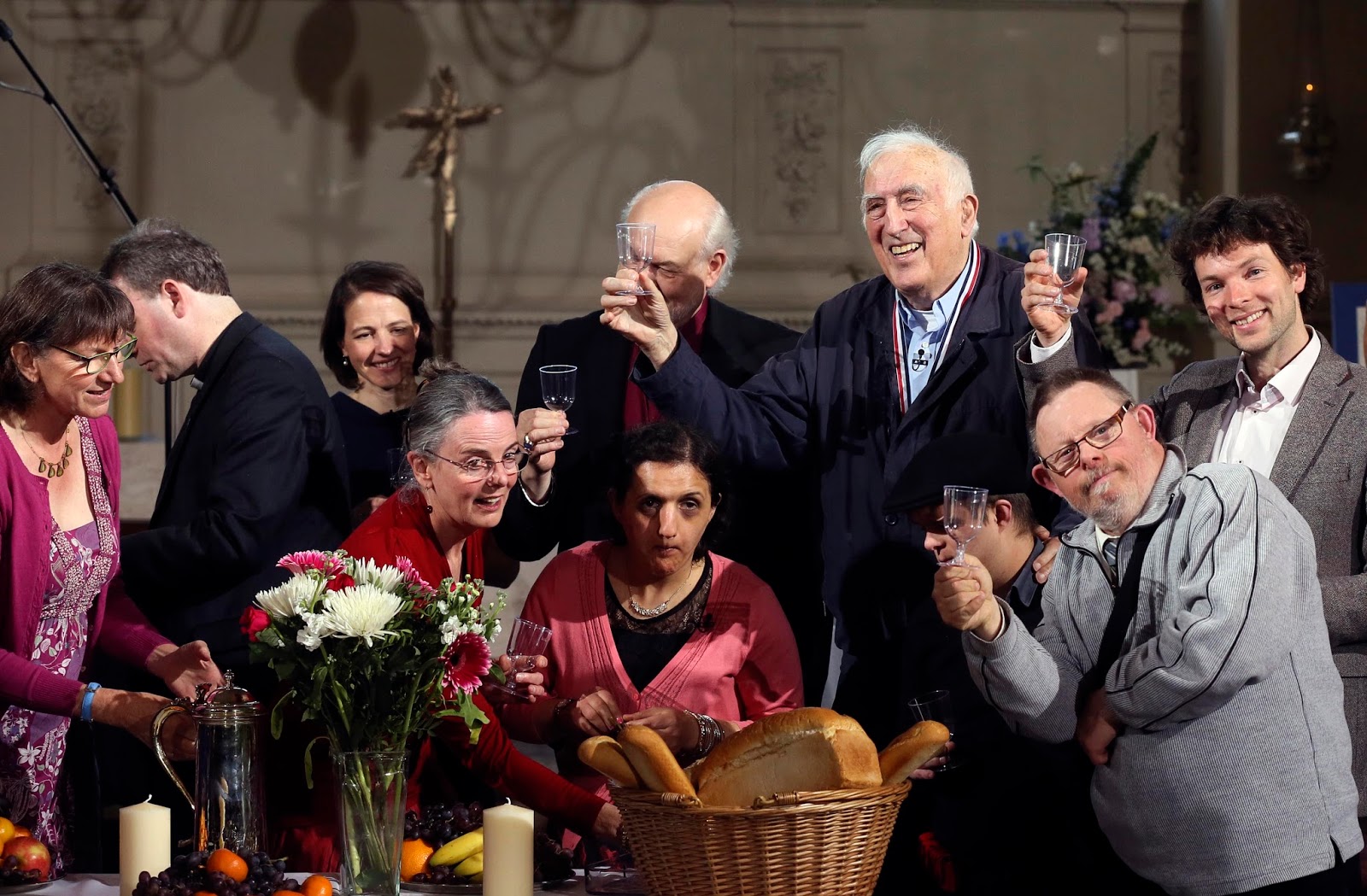
reflections on jean vanier at 89: part two

"When the student is ready, the Buddha appears" has long been an aphorism that speaks to me:  it is without judgment, avoids preachy or pious words, and suggests that I don't have to have life figured out all at once. My call is to simply continue on the journey. In time, when I am able to grasp a new way of be-ing, another layer of insight will be revealed. But not until the time is right for my soul. A Sufi story about the trickster-holy fool, Nasrudin, puts this truth in a humbling way:

Hussein told the Mullah, "I have terrible pain in my eye. What do you advise?" Nasrudin though for a moment and then said, "Pull it out." With shock and bewilderment, Hussein said, "You can't be serious." To which the Mullah replied, "Well, last month my tooth hurt horribly for weeks, until I couldn't bear the pain anymore. So I had the tooth pulled out - and then I felt much better. So, if it worked for my tooth, it should work for your eye, too, right?"

The first is gentler, to be sure, but no less compassionate than the second. Both are reminders that we are here to ripen. That wisdom is not one-size-fits-all. That binary thinking is a trap that encourages ignorance and arrogance. In true Christian formation the whole point of "missing the mark" is not judgment but rather discernment on the road to tenderness. The second century St. Irenaeus was clear: we were created incomplete on purpose. Through our failures, pain, brokenness and all the other ups and downs of living, we learn what we don't know so that we might be healed. Incrementally we become more like God: open, whole, compassionate, humble and creative.  Sadly, the Western Church has suffered under the influence of St. Augustine's Manichean heresies since the early 5th century CE.  To be sure, the saint from Hippo was brilliant, but so driven by his previous sexual obsessions and an ugly addiction to duality, that he re-framed the Jewish story of Adam and Eve in Genesis as "the fall." In the East, dear Irenaeus was far wiser:

Irenaeus incorporates Genesis 2 (like Augustine), but comes up with a very different explanation and theory for the enigma of sin in the world. Essentially, this perspective says that the story of Adam and Eve is really an allegory for all humankind rather than a literal history (the Hebrew term "adam" means simply "mankind"). Following from this thought there was no original state of perfection (unlike Augustine), and therefore no "fall from grace," but rather a developing of the human person and the culture over time to reach this perfect state. He also cites a different reason for our human tendency toward sin. Since we have been born into a world full of sin, it is only natural that we will sin. Individuals, societies and systems within societies constantly sin. When we, as children, are surrounded by these actions we cannot help but succumb to them ourselves, which further perpetuates the system of sin. This is the "original sin" Irenaeus speaks of.
(Thom Parker @ http://www.unewsonline.com/2005/04/14/ theteachingsofirenaeusoriginalsinasahopefuldevelopment/

In other wards, humanity is ripening, maturing and "developing toward a state of perfection." (NOTE:  Perfection here means maturity rather than without brokenness.) Jesus shows us what holy human maturation looks like - and this is where our journey can take us if we are quiet, aware, open and willing to live into the blessings of the Buddha when she appears on the road. 

One of the reasons I continue to find the earthy and ordinary teachings of Jean Vanier so compelling is because he has learned how to ripen.  He trusts that he doesn't need to know everything. More over, experientially he has lived into the wisdom of compassionate community where whatever gifts he doesn't possess are likely to be found in another. "Some people have a true gift of discernment. They can seize what is essential in a complicated discussion or a confused story. They are quick to understand what is really needed and at the same time, if they are practical, they can suggest the first steps towards putting people on the road to healing. Some people in a community who do not have an important position may have this gift of light for us. We must learn to listen to them."
(Community and Growth, p. 253)

Too often, however, the gifts of another remain hidden under a basket - unrealized - until we're small enough to honestly ask, "I need your help. Can you help me?" Vanier underscores that wisdom and spiritual maturity are born of being small and vulnerable. When we accept this truth like a small child, we can then ask for help and unlock the holy gifts others were born to share. "All of us have a secret desire to be seen as saints, heroes, martyrs. We are afraid to be children, to be ourselves." (Community and Growth) In The Heart of L'Arche: A Spirituality of Every Day, Vanier puts it like this: A poor person is one who is in need. It could be physical need or emotional or spiritual need. In this, we each know poverty:

The poor person is one who is in need, who recognizes this need and who cries out for help. Weakness is frequently considered a defect. Yet are we not all weak and needy in some way? We all have our vulnerabilities, our limits and our disabilities. When we recognize our weaknesses, we can ask for help; we can work together. We need each other. It is obvious that the weak need the strong, but, as we are discovering in L'Arche, the strong also need the weak. (p. 14)

What a relief, yes? What a blessing, too. To be liberated from striving for strength - or perfection - or measuring up to another's demands and/or standards? Instead, the way of the heart treasures and honors our weakness for as St. Paul observes, "In our weakness, God is made strong and grace becomes sufficient" for all. It has taken me 65 years to honor this truth. I have yearned for it all of my life, but only now know it to be part of the bread of heaven.

Thursday, September 14, 2017

the paradox of humility and healing: thoughts about Vanier on his 89th birthday (part one)

Jean Vanier, founder of the L'Arche Communities, turned 89 this past Sunday. For the past two years I have been slowly and seriously reading his extensive works. Not only have I been attracted to his non-doctrinaire approach to living into the love of Jesus, but his "spirituality of tenderness" gives shape and form to my own maturation. In a video, "Belonging: the Search for Acceptance," Vanier says:

Power and strength can separate people; whereas weakness and recognition of weakness and the cry for help brings people together. When you are weak, you need people. It's very easy. When you are strong you don't need people, you can do everything on your own. So, somewhere the weak person calls people together. And when the weak call forth the strong, what happens is they awaken what is most beautiful in a human person--compassion, goodness, openness to another and so on. Our weakness brings people together... We have to find a spirituality which is not running away form suffering but entering into suffering and discovering a presence of God, and a presence of people, in pain.

Talk about upside-down, paradoxical, mystical insights about the kingdom of God! As he observes elsewhere, the call of Jesus is to love others - often those who outwardly seems unlovable - without trying to change them. In Hans S. Reinders fictionalized account of Vanier's life and work, The Second Calling, there is a lengthy retelling of how this wisdom became embodied in L'Arche. It seems there was a wounded young woman who was beyond Vanier's ability to love as Christ commands. He could neither fix her nor tolerate her agony. In despair, he consults the Prioress of an urban convent saying: "I hated this girl's chaos, the complete reign of impulse governing her life. So when I was trying to be truthful about my feelings, I could not find anything in her behavior that I actually appreciated." To which the old nun replied, "Which means you're a romantic." (p. 339)

The exchange that follows in the novel is clarifying: the nun tells Vanier that his moral impulse to help this young woman is not a problem, but his inner naiveté
is. In fact, believing he can be all things to all people is at the root of his woe. To know that others will affect us differently, she continues, is one thing: "to accept it willingly is quite another."

That takes an effort, a painful effort. I can tell you from personal experience. In your case, given your position... it means to accept that the community is not you, nor is it dependent on you... (Your perspective currently) puts you in the center of the universe, the typically romantic posture I might add, which certainly is not where you belong. God has blessed you with friends who can do what you cannot do. Don't you see what that means? God wants your work to succeed! The good Lord has put money into your work... that would never have arrived if the community's success was only dependent upon you!

In time the humbling revelation arrives that what God wants from Vanier is not only to accept help from others, but to honestly ask for it. God's servant cannot fix or help this wounded woman by himself. She needs gifts Vanier doesn't have. Romantics believe they can fix everything and grow disheartened and resentful when things don't work out. Asking for help, however, is the way to healing - a healing that includes everyone involved.  Small wonder The Second Calling starts with this quote from Vanier's Community and Growth:

Those who come close to people in need do so first of all in a generous desire to help them and bring them relief; they often feel like saviors and put themselves on a pedestal. But once in contact with them, once touching them, establishing a loving and trusting relations with them, the mystery unveils itself. At the heart of the insecurity of people in distress there is a presence of Jesus. And so they discover the sacrament of the poor and enter the mystery of compassion. People who are poor seem to break down the barriers of powerfulness, of wealth, of ability, and of pride; they pierce the armor the human heart builds to protect itself...This is the second calling, when we accept that we cannot do big or heroic things for Jesus... We feel useless; we are no longer appreciated.

In a word, we experience and embrace humility and then the living presence of Christ is revealed in the most unexpected places and people. "Little did I know that I was on the road to an amazing discovery, a goldmine of truth, where the weak and the strong, the rich and the poor would be brought together in community and find peace, where those who were rejected could heal and transform those who rejected them." (Vanier, Our Life Together) Incrementally over the past 40 years I have tasted this new wine. Now I am ready to take another step in cherishing it.

Wednesday, September 13, 2017

and mary pondered all these things in her heart...

Today a colleague and friend asked me:  "Where is your Christianity going?" Wow, what a honkin' GREAT question! Where, indeed?!? There is MUCH more to say and ponder when it comes to a well-formed answer and I trust that in the months to come the Spirit will bring more clarity. (BTW just as this question was articulated, what should be playing on the coffee house PA but Sam and Dave's "Soul Man!") For tonight, I think that part of the answer is to be found in a button I have been wearing of late...

I love the Blessed Virgin Mary. In my overly intellectualized Reformed world, she is everything that is missing from my tradition: she is female, intuitive, fleshy, earthy, mystical and filled not only with Jesus, but more questions than answers. In Luke's gospel (chapter 1: 26-38), the angel Gabriel visits a young Palestinian Jewish woman from Nazareth. 

In the sixth month the angel Gabriel was sent by God to a town in Galilee called Nazareth, to a virgin engaged to a man whose name was Joseph, of the house of David. The virgin’s name was Mary. And he came to her and said, “Greetings, favored one! The Lord is with you.”But she was much perplexed by his words and pondered what sort of greeting this might be. The angel said to her, “Do not be afraid, Mary, for you have found favor with God. And now, you will conceive in your womb and bear a son, and you will name him Jesus. He will be great, and will be called the Son of the Most High, and the Lord God will give to him the throne of his ancestor David. He will reign over the house of Jacob forever, and of his kingdom there will be no end.” Mary said to the angel, “How can this be, since I am a virgin?” The angel said to her, “The Holy Spirit will come upon you, and the power of the Most High will overshadow you; therefore the child to be born will be holy; he will be called Son of God. And now, your relative Elizabeth in her old age has also conceived a son; and this is the sixth month for her who was said to be barren. For nothing will be impossible with God.” Then Mary said, “Here am I, the servant of the Lord; let it be with me according to your word.” Then the angel departed from her.

After the birth of Jesus, when the shepherds came and paid the baby Messiah homage, the text concludes: Mary treasured their words and pondered them in her heart.  She didn't fully comprehend what birthing Jesus meant. But she didn't thwart the movement of the holy within and among her; she pondered it in her heart and lived from her heart. Clearly that is where I have been headed and now more so than ever before. Mary isn't part of the religious tradition I inherited. The path of my formation was saturated in sanitized anti-Catholicism. Those early New England Congregationalists believed that even a Cross in our Sanctuary was idolatrous. But like many trained in an aesthetically anemic spirituality, once I was on my own I was all over icons, candles, prayer beads and incense like "white on rice!" Indeed I have come to claim a sacramental spirituality at my core rather than just an intellectual one. An increasingly inter-faith mystical path, too. After the High Holy Days, this conversation will continue - and I can't wait.

Tuesday, September 12, 2017

returning thanks over nearly 40 years...

In looking backwards over the course of nearly 40 years of serving the church, a few accomplishments stand out. I had the privilege of visiting the former Soviet Union and Eastern Europe four times including a tour I led with 50 of my Saginaw teens and their parents and another I organized under the auspices of the National Council of Churches and the Ohio Conference of the United Church of Christ. I was twice elected to the Cleveland Board of Education as part of an interracial reform team and served as its Vice President. It was my joy and honor to preside as the Moderator of the Southwest Conference of the United Church of Christ, pastor the first Open and Affirming congregation in the United Church in the Arizona, and participate in the historic General Synod that came out in support of marriage equality. In Cleveland, Tucson and Pittsfield I worked to launch faith-based community organizing efforts in concert with the Gamaliel Foundation, IAF and the Inter-Valley Project. And I give thanks to God that I have been able to encourage seven different adults to enter into full-time, ordained Christian ministry.

Each and all of these experiences have been blessings. But there are four very different encounters that have given my life in ministry meaning and depth - and for each of them I will be eternally grateful. The first was putting together a folk band, the Saginaw Rounders, that worked to revive Pete Seeger's commitment to group singing. I loved each of the members of that small troup and am grateful that through Facebook we've reconnected. This song has been embedded in my memory and always makes me think of those good times.


The second involves being connected to Fr. Jim O'Donnell's Oasis House in Cleveland. His ministry of quiet presence and prayer gave me a model I have yearned to incarnate. His wise counsel saved my soul when I was crashing and burning amidst divorce. And his association with both Jean Vanier and Henri Nouwen opened my heart to a new way of living. His transformation of wounded, urban neighborhoods took place parcel by parcel, person by person. I aspire to go deeper into this ministry of presence in whatever time remains for me in this world. Sally Rogers' take on Bob Franke's masterpiece, "Thanksgiving Eve" will always evoke this blessing for me.


The third was our band in Tucson: Stranger. They were soul mates. They were my micro faith community while I served a larger congregation. And their creativity, love and courage showed me how to marry popular culture with spirituality and worship. Together we fashioned Good Friday experiments that used sound, sight and silence in radically new ways.  Our weekly Eucharists enriched my love of this holy sacrament. And the beauty and energy of playing with Don E, Linda, Kim, Dianne, Brian, Erik, Sean, Thomas, Ina and Elie not only kicked up my love of music but kicked up my chops, too. Leaving this band - and all they represented - broke my heart. It was necessary but agonizing and I miss them nearly every day. This was our go to standard...


And the fourth was our Pittsfield band:  Between the Banks. We started small - two voices and an acoustic guitar. Then Jenna joined as a vocalist. Then Brian on guitar. In time Eva, Sue and Jon became integral in the spirituality of our creativity - and Carlton, Dave and Elizabeth, too. As a small ensemble with tight four part harmonies, this band kicked ass.  We could rock out with David, go blue-eyed soul with Brian, be totally jazz when C brought in Charlie, Andy and Jon (on drums) or pure spirit when we channeled the Wailin' Jennys. Over the years we raised thousands of dollars for emergency heat in the Berkshires as well as serious bucks for our eco-justice mission partners. We played Coltrane for Good Friday one year and Paul Winter for an early November concert another.  The music and camaraderie was sublime. When we were cookin' we attracted other artists and locals who had grown weary of traditional worship. I will love these people forever.  For me, Herbie Hancock's remake of Peter Gabriel's "Don't Give Up" defined this era.


One old salt said to me: You don't get many chances to work with truly holy people in your career. It happens once, maybe twice, so cherish it when you find it. As I look over my time in ministry, I've been blessed by sacred encounters in each of the four churches I have served. I am grateful when we taste the kingdom like this and sad when it departs. But such is the ebb and flow of death and resurrection, yes? 

Sunday, September 10, 2017

where are the poetic and passionate eco-justice songs?

Not many good, poetic and passionate "eco-justice" spirituality songs out there, are there? Yes, Marvin Gaye nailed it in "Mercy, Mercy Me (The Ecology)." Everyone digs Joni Mitchell's "Big Yellow Taxi," too. U2's "Beautiful Day" has potential but only obliquely (much as I love this tune.)

So I'm wondering tonight where are the moving anthems to feed our soul? The subtle and poignant songs that clarify and compel us beyond guilt, shame or inertia? Are there works of art out there that move beyond rhetoric and polemics? Paul Winter's "Missa Gaia" is a complex collection of beautiful songs, but I submit that it needs a context: the opening and closing cuts play with "For the Beauty of the Earth" and could be stand alone selections but radiate more insight when heard within the "Earth Mass" setting. Bob Dylan's "License to Kill" moves in the right direction, but is more of a blunt object than a work of art. Another leap in the right direction is the Pretenders "My City Was Gone." It is totally funky with a ton or irony and heart, as well. Tom Paxton's "Whose Garden Was This" once moved me but no longer has much juice. And Pete Seeger's war horse, "Garbage" doesn't stand the test of time.

 \
To my way of thinking, the three best so far include Cat Steven's "Where Do the Children Play,"  Neil Young's "After the Gold Rush" as interpreted by Patti Smith, and St. Lou Reed's "Last Great American Whale." Each song incorporates poetry with passion, conviction with creativity, with a healthy dose of compassion thrown in for good measure. I can listen to these songs repeatedly, savoring the melody or lyric, because there is nuance here instead of a sledge hammer.
  
Pound for pound, I find Lou Reed's work the most demanding both artistically and politically. Neil Young evokes a new world order in outer space after the apocalypse. Yusuf Islam evoked pathos for the coming generation. But St. Lou just tells us a story - and stories are what allows people into the emotions and experience of an artist. Stories transcend the fervor of a topical rant. They endure. 

In "Last Great American Whale" our old denizen of the dark, God rest his soul, is one part self-deprecating trickster, one part Old Testament prophet, and one part Jersey kid in the Village backed up with a garage band. When this first came out, Reed made it clear that we should "stick a fork in ourselves because America was done." In 2017, his tale of right wing vigilantism elevates this song to essential quality: his warning was prescient, his poetry was proactive and his delivery remains timeless.  Ignore this song at your own peril.

If you know three better than this, please let me know, ok? I am aching to expand the canon.

Saturday, September 9, 2017

lucie and james some five years later...

One of the biggest changes I have experienced in the last five years involves learning to love, cherish and accept a hairy, messy, often messed-up and totally neurotic comedian friend by the name of Lucie. When my daughters spoke about her as a pup - a farm mutt who was the runt of the litter not far from Plainfield, MA - I was not interested. They told me of this sweet little dog during the "roast" for my 30th anniversary of ordination.

Let the record be clear: I've always liked dogs, but have rarely understood them. What's more, I like my independence more than pets and did not want to get tied down yet again. Been there, done that. But when we all went to visit the farmhouse one afternoon, (NOTE: this is ALWAYS a mistake if you really don't want a new pet; once you arrive for a visit, you WILL leave with an animal!) this little shepherd-hound mutt befriended me and won over my hard heart. Thirty minutes and forty dollars later, a quiet little beast was asleep in the back of my car. 

She was a sweetheart. She would go to sleep on my foot and always wanted to get in the car with me when I went shopping. She was kind of nutty during a winter of house-breaking - and could be bratty and a bit aggressive with women - but with me she was my "little buddy." Looking backwards, she was always socially awkward and afraid of new guests. But I didn't really notice. Lucie was just being Lucie. This trait intensified as the years multiplied, however, and she became more and more anxious. To me she was simply a comedian who loved to snuggle and wrestle and go running through the fields, the snow and the woods. Around others... something different.

The first real clue that she was in trouble out in public came when we tried to include her in a blessing of the animals liturgy. She became totally wiggy: she was afraid, snappish and unsettled. It was worse the following year so she and St. Francis remained strangers. During my sabbatical in Montreal, she became unglued. She howled and fretted on the five hour drive to Montreal. She flipped out every time she had to go to the park to do her business. She's a strong little miss and could almost pull you over trying to run away from the big city buses. And when she completely melted-down and moaned in terror in the hotel room in Ottawa during the Jazz Festival, it was time to consult a professional. Sadly, he told us that nothing could be done in the short term - except maybe give her beer before going out - so Lucie acquired a vigorous taste for Labatt's Blue. It was then decided that Lucie was best at home in the country.

I learned a lot about myself during Lucie's Montreal meltdown - a lot I didn't really like. Especially how impatient and angry I become whenever I'm confronted with a wild ass animal howling and trying to escape on a city street as people stare in horror. Part of this is my socialization as an American man: the only emotion we're trained to express is anger. So fear becomes anger. Confusion becomes anger. Shame, grief and all the rest come out as anger, too. Lucie showed me that in spades as she broke down over and over. If the sabbatical was to continue, it was me that had to change because Lucie wasn't - and didn't - and couldn't. She needed support. Love. Space.

It was almost as if the Spirit was saying to me: So you are writing and thinking about a "spirituality of tenderness" but sometimes you want to kill this dog who is your friend. Guess what? You're the one with inner work to do, brother, so get to it!  So true. A lot of tears were shed that summer. Jean Vanier, who I was just starting to read in earnest, wrote that being with another in love means truly wrestling with our own demons and learning to move through our capacity and inclination for violence and fear. I am still on that journey five years later - although now, at least, I know it is happening - and am slightly better when Lucille flips out.

This afternoon, after a long hard day of being Lucie, she fell asleep on my legs as she often does late in the day. It is a time of refreshment and reassurance for us both. Today, I give thanks to God for my furry mentor, Lucie. I continue to HATE all the hair she leaves around the house, but I cherish her precious being more than ever and the peace she brings to my heart.


Friday, September 8, 2017

becoming smaller so that...

When it comes to the realm of false equivalencies, while 45 is a master, he is not alone. Context, experience and living from the heart trump so-called objectivity every time. Every person is unique, every soul is both wounded and beautiful. Applying a one-size-fits-all solution upon any one is arrogant, foolish and often unintentionally mean-spirited. A volume I purchased while away in Quebec, Experiencing Spirituality: Finding Meaning through Storytelling, makes this point precisely. It is the follow-up to A Spirituality of Imperfection by Ernest Kurtz and Katherine Ketcham first published in 1992. I cherished that book - and 22 years later they were ready to add their unique life experiences for our consideration. The story that spoke to me involves the mystical fool of Islam, Nasrudin:

Hussein told the Mullah, "I have terrible pain in my eye. What do you advise?" Nasrudin though for a moment and then said, "Pull it out." With shock and bewilderment, Hussein said, "You can't be serious." To which the Mullah replied, "Well, last month my tooth hurt horribly for weeks, until I couldn't bear the pain anymore. So I had the tooth pulled ouot - and then I felt much better. So, if it worked for my tooth, it should work for your eye, too, right?"

I've been there and done that - maybe you have, too?  Assuming my experience entitles me to share what amounts to wisdom without context, I've offered up solutions, commentary and even moral judgment when listening carefully and quiet reflection was in order. Robert Bly and others have suggested that men tend to do this more than women - given our mono-minded nature and a socialization geared toward problem-solving - we often hear people in general (and women in particular) asking us for an answer. In a bottom-line culture, addicted to market place metaphors, we're all too willing to share what we think will "fix" things before moving on to something else. Truth be told, however, most of the time what another needs from us is not answers, but space to be heard. Listening, I continue to learn, is far more precious than commentary without context. 


This past week, returning from a week away in quiet reflection and rest, I became aware once again of all the different ways my full-time colleagues are engaged in ministry. In broken times such as these, there is so much to be done. And they are responding powerfully with creativity, compassion and verve. Not so for me given my part-time context: there is only so much I can accomplish in 20 hours.  I can listen. I can be present and prayerful in hard times. I can celebrate Eucharist and teach the faithful about the time-tested tools of contemplation and spiritual commitment. I can write (on my own time) and even use social media to connect people to public acts of justice. But long term programming?  Not so much any more.

Candidly, there is some grieving for me as I practice accepting this new reality. It goes with the territory.  And I suspect that it means at least these two truths:

+First, with age and change, I am being called to practice what John the Baptist once said in the gospel according to St. John.  When Jesus came upon the scene, the man of the desert confessed, "I must be less so that he can become more." It is time for others to be bold and engaged in social transformation. I have had 35 years of ordained ministry and nearly 40 years of service to the church given my internships at seminary. They were all full-time. They were all action oriented. They were all a combination of grace and feet of clay. Now, as my old way of serving comes to a close, letting go is my charism. I can be supportive. I can be collaborative. I can even listen carefully and, if asked, share my experiences. But now is the season where I am to become less so that others can become greater.

+ Second, this change in pastoral leadership necessitates a profound shift in the way our congregation works, too.  Will it be as complicated for them as it is for me? I don't know. We'll see. My hunch is that learning to be a community of collaboration and solidarity rather than a fount of leadership will likely be a real challenge for our community.  For over 250 years we have been first - and now we're not.  Such a change makes sense for us. It is modeled on Christ's call to live as loving servants in a downward trajectory. And suggests finding new ways to partner with others as allies in supporting the beloved community. Without full-time pastoral leadership, this more humble path is a necessity - and none of us are well-practiced in it. And I can't offer a whole lot of insight about how to do this as a congregation because my grieving and practices as a retiring pastor are different from their world as a church engaged in the world.  I am becoming less but they remain a vibrant albeit different community of faith in a small community.     

These next few months leading up to Advent/Christmas will be fascinating. As Jesus says to Peter after the Resurrection:  "When you were young, you went where you wanted and did what you desired. But now that you are older, you must let another lead you and gird your waist as you are led into those places where you do not want to go."  And so the journey continues and away we go...

Thursday, September 7, 2017

a barmen declaration for white christians in 21st century america...

On September 6, 2017 a "Theological Declaration on Christian Faith and
White Supremacy" was released in the United States for circulation, conversation and conversion born of repentance
. Taking their lead from the Barmen Declaration of 1934 (read this @ http://www.sacred-texts.com/ chr/barmen.htm) during the early days of Germany's descent into Nazi ideology and violence, the current declaration "represents an unprecedented gathering of Christian faith leaders from across the U.S. calling for a return to the liberating work of the Gospel and a rejection of racism and colonization." (read the full text @ https://www.redletterchristians.org/theological-declaration-on-christian-faith-white-supremacy/.) Two thoughts come to me upon critical reflection on this important public witness:

+ First, there is always a place in the public life of Christ's Body, the Church, for theological clarity. To be sure, few contemporary Christians will ever know about this document - and fewer still will read it. Nevertheless, it stands as an insightful call to repentance at a moment in time that aches for light in the darkness. Not many in Germany knew about or read Barmen either and it became a rallying cry for the faithful throughout the world. Writings such as these focus our moral attention; give voice to the Christian convictions we share beyond aesthetic, liturgical, and historical differences; and awaken both courage and conscience when fear dominates our culture. I am grateful for the hard work my sisters and brothers in faith have given in drafting this document and urge your support. 

+ Second, the creation of such a document challenges believers to leave the safety of abstract commitments so that the Word of God's love can become flesh in our era. At a fundamental level, this declaration invites repentance - metanoia - an inward change of heart resulting in an outward change of ethical direction. Repentance moves us towards justice and away from self-centered habits born of privilege and power. In our era, one manifestation of a new life in Christ for White people of faith involves bringing white supremacy to the Cross so that it dies. The paradox of crucifixion and the promise of the Paschal Mystery where God's grace brings renewal beyond death are not disembodied theological doctrines. They are entering the way of the Lord through the narrow gate of trust. 

The following words come directly from the declaration and underscore what the ethics of Jesus mean for so many of us at this moment in time.

+ Jesus “is the head of the body, the church,” in whom “all the fullness of God was pleased to dwell.” (Colossians 1:18-19) Our faith is rooted in the incarnation, life, death, and resurrection of Jesus Christ, and his teachings claim authority in life and in death.We reject as false doctrine any other claim on our lives—whether contrived of state or reason—that violates Jesus’ ethic of the equal and inestimable dignity of all people, each created in the very image of God and as such equally created with the divine call and capacity to sustain, protect, and serve the world.

+ “For ‘In God we live and move and have our being’; as even some of your own poets have said, ‘For we too are his offspring.’” (Acts 17:28)

Our identity as the beloved of God belongs equally to one as to all—to deny or privilege the uniqueness of any person is to malign the image of God in the whole. We reject as false doctrine any hierarchy of human being that declares in word or deed the supremacy of any person or people group over and against other people or people groups. In this current context, we renounce white nationalism, white separatism, white supremacy, neo-Nazism, and any and all other movements that abide by the logics of domination and colonization.

+ “But speaking the truth in love, we must grow up in every way into him who is the head, into Christ, from whom the whole body, joined and knit together by every ligament with which it is equipped, as each part is working properly, promotes the body’s growth in building itself up in love.” (Ephesians 4:15-16) Our responsibility is to encourage and strengthen one another in love to the full work and witness of Jesus who loved, esteemed, healed and served all. This is what it means to be the global Church in God’s world. We reject the false doctrine that the work of Jesus is malleable to the political constructs of dominance and colonization; and therefore we actively, meaningfully, and tangibly resist any and all governing policies that fail to serve the basic needs, protect the inherent dignity, and cultivate the capacity of all to sustain, protect, and serve the world.

+ “You know that the rulers of the Gentiles lord it over them, and their great ones are tyrants over them. It will not be so among you; but whoever wishes to be great among you must be your servant.” (Matthew 20: 25-26) 
Our human call is always to sustain, protect, and serve—not to dominate. To seek power and glory is contrary to the call of the shalom/Kingdom/kin-dom of God. If we have moved about this world oblivious to or ignoring the pain of those subjugated under narratives of domination from which we have benefited, we repent of our sin and complicity. We confess that we have demonstrated allegiance to the colonizing systems of this world, rather than to the ways of Jesus. We acknowledge those who have suffered under oppression and exploitation, however subtle or overt, and continue to be wounded by the wrongful use of power in governance as a result of our sins of omission and commission. We reject as false doctrine any teaching that the human vocation is to exploit land, people groups, or other nations for the amassing of wealth. We also reject as false doctrine the belief that the Church has the call or right to confer upon any persons or people group unique title, favor, or powers to dominate others, as if from God.

+ 
“There is no longer Jew or Greek, there is no longer slave or free, there is no longer male and female; for all of you are one in Christ Jesus” (Galatians 3:28) Our allegiance to the way of Jesus requires that all external constructs contrived by human efforts that seek supremacy are anathema to the shalom Kingdom/kin-dom of God. We are all equal members of one Lord, one faith, one baptism—and yet, as citizens, we are subject to the governance and structures that often oppress, subjugate, and exclude. We reject as false doctrine active support for or passive complicity with any effort to subjugate, exploit, disenfranchise, disadvantage, or purge any image of God in or from our society.

+ “From now on, therefore, we regard no one from a human point of view; even though we once knew Christ from a human point of view, we know him no longer in that way. All this is from God, who reconciled us through Christ, and has given us the ministry of reconciliation; that is, in Christ, God was reconciling the world to God’s self, not counting their trespasses against them, and entrusting the message of reconciliation to us.” (2 Corinthians 5:16-19) Our faith dictates that the work of Jesus is the reconciliation of all of creation back to God and each other. This divine work disrupts and dismantles all human ideologies and structures of subjugation and oppression, in the world and in the Church, which has often been a primary force of social control, oppression and exploitation. We reject as false doctrine any political, social or religious teaching that esteems any person as greater or less than any other who is equally full and created in the image of God, endowed by their Creator with sacred, inviolable dignity; worthy of full protection of the law and full capacity to flourish.

The declaration closes with a vow, born of baptism and shaped by incarnation, that is unambiguous. It has been simmering since the rise of the Tea Party and their overtly racist actions against President Obama and many people of color. It is informed by Charlottesville, of course, but also by the witness of Black Lives Matter. It deserves our embodied commitment.

In full recognition of these convictions and in full rejection of these errors, we resist and renounce all efforts to purge, subjugate, exploit, and disenfranchise those created in the very image of God. Any attempt to do so is a violation of God in creation, fully revealed in Jesus the Christ. We invite all who will to accept this declaration of sacred worth to remember and uphold these abiding truths in all matters of church, civic engagement, and in the larger body politic. We implore all who read and hear these words to acknowledge your place in the history of oppression and take tangible action to return to the unity of all Creation, bound together in faith, hope, and love incarnated in Jesus Christ.

Wednesday, September 6, 2017

fear of the Lord (and the forest) is the beginning of all wisdom: creation sunday one

This Sunday we're entering into the new/old liturgical Season of Creation. It is, of course, much older than the Church, or any of the organized religions, having been observed by creation in all its forms since the beginning of time. It has roots in our heritage in ancient Judaism, too whether that is the lunar festivals or feasts and fasts built around the harvest cycle. The Celtic and Norse earth-based holidays have a home in the Season of Creation as do the wisdom traditions of Australia. In this, it is a very old practice.

In Christianity, however, the Season of Creation began when the Ecumenical Patriarch Dimitrios I of Constantinople declared September 1 to be Creation Day. The European Christian Environmental Network "chose the four Sundays of September to be an appropriate time to celebration creation and to come to terms with the current environmental crisis." (The Season of Creation Preaching Commentary, p. 7) The Catholic Bishops of the Philippines joined ranks in 2003 and the Episcopal Church began to explore participation, too. Our small faith community joined the festival four years ago - and I cherish the chance it gives us to move beyond anthropomorphism and all its subtle lies.

This week we are listening to the wisdom and gift of the forest in creation. One of the appointed texts is the start of the second creation narrative in Genesis 2. Two of the insights that have come to me in trusting the forest to be a font of holy wisdom include:
+ First, how the very enormity of our ancient, old growth forests teach me never to sentimentalize the heart of the Lord.  Encountering the forest in all its wild darkness is akin to Rudolf Otto's writing about the numinous as the mysterium tremendum et fascinans—a mystery before which we both tremble in awe and find ourselves fascinated by – a living reality of power outside of ourselves that both attracts and repels us. This mystery is simultaneously beautiful and terrifying. It is enormous and beyond our ability to comprehend.  And as the Psalmist and wisdom master of Proverbs reminds us, such fear is the beginning of all wisdom. Yirat Adonai, in Hebrew, is not a cringing or cowering fear, it is a respectful awareness of a power greater than our comprehension. Yirah – translated as fear – is much more about sacred devotion before the mystery of the holy. The Jewish sage, Maimonides, taught that “yirat was more a fear of greatness, analogous to respect for an exalted person, who would do us no harm. He categorized the fear of God as a positive commandment, as the feeling of human insignificance deriving from contemplation of God's "great and wonderful actions and creations.” I love entering the head of a forest but the rest terrifies me - with good reason - as the forest teaches us to take fear seriously.

+ Second, the forest and its trees are part of the Genesis 2 creation myth.  Most of the time when we read this story, the concentration is on Adam and Eve and sin. Some Biblical scholars, however, suggest that this is too self-absorbed. There is a larger story being told about the creation of the entire world. And what really grabbed me this week is where the story says that God made us all of the same substance to be part of the same family of care and awe. When God creates human beings it is not in isolation: no plants had yet been formed and no other life existed SO… God created humans from Earth’s fertile soil – from the same arable land that the plants will soon grow within – to nurture one another. Human beings, in this ancient creation story, are not only connected to plants by their nature and substance – humans from the hummus – but we have a shared vocation. 

 “The first mission God gives to humans, before the command to love the Lord or our neighbors, is to care for the plants. We are to till the garden, care for it, keep it and protect it."  How do we put it in the Ash Wednesday and funeral liturgy: ashes to ashes, dust to dust? Note that the dust from which we came and to dust we shall return in Hebrew is aphar or top soil. Now, if our first calling it is to care for creation’s plants, our second is to do so in a way that advances the image of God. Theodore Hiebert puts it like this: Our English words farm and till the ground again are incomplete. "The ancient Hebrew avad literally means to serve rendering caring for creation as a unique and compassionate partner." To live as a servant is the very core of Christian formation. Jesus is not subtle when he makes a connection between ripening in faith and servanthood. When asked by his disciples at the Last Supper, what then shall we do? Jesus replied: you will love one another as I have loved you. And the context for this command was the Maundy Thursday foot-washing.

While hiking in the woods - not the forest, mind you, but the woods - in Quebec recently, I came upon this:  a green man. It was on the way to a hidden water fall. The next day I came upon another.  Clearly, the time is now for me to honor with holy awe the way of the Lord as revealed in God's first word of creation.
 

Tuesday, September 5, 2017

jean d'arc and the sound of angels...

So I'm a grandpa for the second time. I used to think my own grandfathers were SOOO old back in the day. Not so much any more. My precious granddaughter decided to arrive early - seven weeks early - so we were all caught unawares. Isn't life grand? It is filled with reminders that we are not in control. Tonight I return thanks to God that all are well.

After a week in the hills of Quebec's Eastern Townships, sitting each morning in the late summer sun reading Scripture and letting it soak into my old heart, I feel rested. Dare I say focused, too?  Without Internet or smart phones, beyond any distractions but my own monkey mind, I found myself reading and re-reading these words from Jean Vanier:

God has given L’Arche as a gift to this particular time in history. Today, so much emphasis is put on technology, on scientific knowledge and on individual success that people, forgetting the importance of the heart and of faithful relationship, sink into depression and despair. Society often seeks to eliminate people who are weak, before their birth or through euthanasia, arguing that they are a nuisance and cost too much. Through L’Arche, God reminds us of the essential purpose of human life: out of love, we have been created to love. We are called to use all our energies and gifts to create a more just and loving society, where each person, whatever their culture, religion, abilities or disabilities, has a place. 


In an interview with Krista Tippett, Vanier noted that the best way of doing this consistently involves practicing the ten foot rule.  We can only really impact and touch those who are closest to us. Anxiety, fretting, fuming, and fussing about the wider world is not only a waste of time, but a bad use of the love God asks us to share with those we can really touch. We might pray and grieve for others, but then it is time get back to work and grow where we're planted. Clearly, that is one of the insights I am being asked to practice as this fall dawns. Vanier, in another essay, wrote:

Jesus invites his disciples not to seek importance or power, even for the sake of doing good to others, but rather to take the lowest place, to serve others like a slave. ‘God has brought down the powerful from their thrones, and lifted up the lowly,’ says Mary in her Magnificat.

After Antonia's birth - and my time away in the sacred solitude - I started to sense that this will be a year where I am pushed towards owning more of this holy albeit hard humility.  For decades Leonard Cohen's song, "Joan of Arc" has reduced me to a pool of tears or ashes - now more so than ever before. And when Judy Collins renders this song - especially the lines "She said, I'm tired of the war, I want the kind of work I had before, A wedding dress or something white to wear upon my swollen appetite. Well, I'm glad to hear you talk this way, You know I've watched you riding every day. And something in me yearns to win such a cold and lonesome heroine. And who are you? she sternly spoke to the one beneath the smoke. Why, I'm fire, he replied, and I love your solitude, and I love your pride" - my heart almost stops beating. It is perfection. It breathes an invitation to surrender. Call it acquiescence or acceptance, if you like, but letting go to a greater mystery nonetheless is the request. 

I, too, am tired of the war - the inner war of striving - the outer war that must push and organize, cajole and encourage. It is clear that this has now become my season not simply to rest, but rather to be. To be real. To be loving. To be quiet. To be tender. To be present and engaged with those 10 feet around me. 

The first time I heard Judy Collins and her early 70's entourage add their unique chorus to Cohen's agonizing account of Jean d'Arc's surrender to the cruelty of the world, I heard the sound of angels breaking through the madness for a moment. They gave expression to the the holy promise of grace - and it was enough. It still is and captures exactly what my heart feels as I move ever downward.


Now the flames they followed Joan of arc
As she came riding through the dark;
No moon to keep her armor bright,
No man to get her through this very smoky night.
She said, I'm tired of the war,
I want the kind of work I had before,
A wedding dress or something white
To wear upon my swollen appetite.

Well, I'm glad to hear you talk this way,
You know I've watched you riding every day
And something in me yearns to win
Such a cold and lonesome heroine.
And who are you? she sternly spoke
To the one beneath the smoke.
Why, I'm fire, he replied,
And I love your solitude, and I love your pride.

Then fire, make your body cold,
I'm going to give you mine to hold,
Saying this she climbed inside
To be his one, to be his only bride.
And deep into his fiery heart
He took the dust of joan of arc,
And high above the wedding guests
He hung the ashes of her wedding dress.

It was deep into his fiery heart
He took the dust of Joan of arc,
And then she clearly understood
If he was fire, oh then she must be wood.
I saw her wince, I saw her cry,
I saw the glory in her eye.
Myself I long for love and light,
But must it come so cruel, and oh so bright?

Monday, September 4, 2017

I chose the one less traveled...

While in the Eastern Townships of Quebec on a recent vacation, a place I cherish, I visited Lac Brom (aka Knowlton), home of author Louise Penny. If you know her work, it involves Chief Inspector Armand Gamache, a Quebecois police officer, who solves mysteries in this unique neck of the words by listening carefully to all the clues and evidence, taking in the advice of all the necessary experts and then following the wisdom of his heart. In the local book store, I purchased a volume that began with a poem by Robert Frost. It expresses how I feel as I pause to hear the Holy Spirit speaking through the wisdom of my heart.

Two roads diverged in a yellow wood,
And sorry I could not travel both
And be one traveler, long I stood
And looked down one as far as I could
To where it bent in the undergrowth;

Then took the other, as just as fair,
And having perhaps the better claim,
Because it was grassy and wanted wear;
Though as for the passing there
Had worn them really about the same,

And both that morning equally lay
In leaves no step had trodden black.
Oh, I kept the first for another day!
Yet knowing how way leads on to way,
I doubted if I should ever come back.

I shall be telling this with a sigh
Somewhere ages and ages hence:
Two roads diverged in a wood, and I –
I took the one less traveled by,
And that has made all the difference.


Two thoughts are at work in my heart tonight as this wee vacation comes to a close. First, I have some pastoral and artistic work here that needs closure. There are still people I have been called to love and accompany through grief and celebration. There are still some songs to sing and calluses to cultivate, too. Second, right around the corner, there is a new world of grand-parenting, writing, going with the bass groove to new places and connecting with the L'Arche community that is calling me towards the road less traveled. This year alone my precious Louie came too close to crossing over to question the sacred NOW. Anna, too. I must 
honor the beautiful, tender and sacred soul she is yet to become while I still have health and vigor to do so. This will be a full month of discernment to be sure.

let's be still for a spell...

Someone's going to slam me as some kind of neo-con for this, but here goes. A few days back there was a reel posted on FB with a message...