Sunday, April 2, 2023

making time for everything to hurt: palm/passion sunday 2023

Today we mark both Palm AND Passion Sunday: talk about tension and paradox. Both have always been a part of Lent but NOT always in this combination. If you’re a life-long Prod like me, you grew up with Palm Sunday as a distinct and moving worship experience unto itself followed by the grandeur of Easter. And even though the world is changing faster than we can comprehend, we tend to believe that what we once knew has always been; so, let’s consider the back story of today’s liturgy so that we can embrace it’s wisdom.

· Passion Sunday is relatively new to Protestants – it came into being after the 1969 Vatican II reforms of the Roman Catholic Church. For twelve hundred years before that, Western Catho-lics celebrated Passion Sunday on the Fifth Sunday of Lent – last week – and then Palm Sunday today. They were united in 1983 when the Western ecumenical church agreed to partner with Rome and make a significant liturgical change.

· The reason this came about has long been misunderstood: modern believers say it had to do with simplifying worship schedules. In a frenetic era, many found it complicated to be at Palm Sunday and then Wednesday, Thursday, Friday, and Saturday of Holy Week, too. So popular wisdom claims that Palm Sunday merged with the Passion narrative to give busy people a break. But nothing could be further from the truth: both Roman Catholic and traditional Protestant scholars agreed to this change fundamentally as an act of spiritual formation. This day is ALL about discipleship and deep experiential education – not convenience.

Contrasting the Palms with the Passion, Hosannas with cries of Crucify, is NOT about scheduling: The Passion gospel intended for today takes at least 11 minutes to read aloud. It’s 81 verses, 1,961 words on three single-spaced pages; too long for one setting no matter HOW busy our lives have become. No, this liturgical shift intuitively evokes an intellectual and spiritual tension for us that challenges all our psychological, spiritual, personal, and political certainties. Putting the Palms side by side with the Passion shows us that:

The one betrayed and deserted in the passion is none other than the one hailed as the long-aw-aited divine monarch. We’re supposed to feel an emotional whiplash as we descend from “Hos-anna!” to “Crucify him!” (For) Holy Week is a kind of choreography or symphony, with distinct movements unfolding over time: from “Hosanna in the highest!” to “Surely not I, Lord?” to “Take, eat; this is my body” to “Let this cup pass from me” to “I do not know the man!” to “Let him be crucified!” to “My God, my God, why have you forsaken me?” to “He is not here; for he has been raised.” And these truths require time and space to be felt and understood.

One colleague put it like this: rather than reduce our time in worship, now we must give it MORE in order to reclaim the counter-culture call of Christ on our daily lives. She wrote that our culture:

Want to hurry people through their suffering. Like Job’s friends, we can only tolerate their discomfort for so long before we begin to give advice, offer solutions, and speak for God. The hardest thing I do as a pastor is sit with others in their suffering without trying to hurry them along. I must choke back easy platitudes. I feel a crawling under my skin, a resistance deep in my chest when called on to simply be present. I want to fix it. But there is no fixing the woman who is preparing for her 38th back surgery or the parishioner whose cancer has returned. And they aren’t asking me to. It takes discipline, courage, and time to sit in the chair and listen, without patronizing pity, and just bear witness to the unsolvable suffering. (Melissa Earley, Christian Centurey)

The exuberance at the start of Palm Sunday is linked to the grief of Christ’s passion later because:

· Pedagogically it confirms the inward/outward struggle to put on the whole mind of Christ: those who yearn for lives of integrity and a world shaped more by compassion than cash must come to terms with our own contradictions and wounds that contribute to the suffer-ing we all ache to change.

· Further, the unity of Palms and Passion makes it clear that the Jesus was NOT a helpless pawn entrapped by either Empire or religion: he was NOT the unwitting sacrificial lamb offered up to an angry, jealous deity as payment for human sin.

Rather, as Cynthia Bourgeault teaches, Jesus willingly wagered his life to show us that trusting God’s love in our flesh – relinquishing our broken selves to holy and human compassion – could simultaneously empty our hearts and minds of our addiction to control and then fill us full (or be fulfilled) by inner peace. Acceptance, you see, is the key to serenity within and without because INNER peace is a game changer. Fr. Thomas Keating wrote: “The effectiveness of action depends on the source from which it springs. If it’s coming out of the false/broken self with its shadow side, it’s severely limited. If it’s coming out of a person immersed in God’s grace, it’s extremely effective for the contemplative state, like the vocation of the Blessed Virgin Mary, is how Christ comes into the world.” Fr. Richard Rohr adds that this upside-down truth drives intellectuals and activists like us wild:

Jesus does not directly attack the religious and institutional systems of sin of his time until his final action against the money changers in the temple. His primary social justice critique and action often disappoints radicals and social activists (because) his social program is more a quiet refusal to participate in almost all external power structures or domination systems. His primary action is a very simple lifestyle, which kept him from being constantly co-opted by those very structures we know as institutional sin. He avoided the monetary system as much as possible by using “a common purse.” His three-year ministry, in effect, offers free healing and healthcare for any who want them. He consistently treats women with a dignity and equality that is almost unknown in a patriarchal culture. At the end of his life, he consciously surrenders to the punitive systems of both empire and religion by letting them judge, torture, and murder him. He is finally a full victim of the systems he refused to worship… (because he trusts that God’s love is greater than all our brokenness.)

· This spirituality and social action plan is all about learning how to live with sacred tension: earlier this week when yet another six people were murdered at a school – including three precious children – most of us reeled and wept and fumed. All over the Internet were cries of THIS MUST END. But like the current crop of know-nothing politicians carping about cutting government spending without any clue how to do so, ours are cries of impotence, too – more a chorus of compassionate broken hearts howling for a way to heal the horrors that are beyond our control. Carrie Newcomer wrote:

the truth is polls show that the majority of Americans do support common sense gun laws, limiting or outright banning military style weapons. The majority of Americans do love their children and are asking their legislators to do the right thing. What we do not have are legislators who are willing to listen to the majority of their constituents and do the right thing. What we do have are legislators who are willing to exchange the precious lives for NRA contributions. I am bewildered and righteously angry that a certain segment of our legislators seem to feel that their sole avenue for “protecting” our children is to ban books from public and school libraries that honor our diverse racial, cultural and sexual orientations in this country, to ban the teaching of the true and real complicated history of the country (which is the first step in healing and moving forward as an educated nation), and to institute whole rafts of laws that discriminate, endanger and humiliate people of diverse sexual orientation . These are often the same legislators who wear AK15 pins on their lapels as they boldly proclaim themselves to be “pro-life”. This is an odd disconnect at best and terrible hypocrisy at worse.

We tie ourselves in knots when we ignore the Serenity Prayer because inner peace requires accepting our limitations to fix what is so obviously broken and THEN mustering the courage and tenacity to fix what can be repaired. We CAN and MUST make a difference – we CAN help one another, too – we’re NOT inept or inconsequential – we’re just limited and can’t give to others what we ain’t got!

· That’s the paradox of mature spirituality documented sacramentally today: it accepts limitations, honors boundaries, cultivates inward equanimity in order to concretely make a difference wherever and whenever we can. But not in all places at all times. North Americans are particularly infected with illusions of omnipotence and magical thinking: we middle-class, white intellectuals are deeply confused about this because so much of our outward lives are efficacious. We work hard, we’ve adequate resources to purchase what we need or want when we want it. So, letting go – relinquishing control – messes with our minds. It is truly a counter-cultural spiritual discipline we must return to repeatedly because we still believe we can think ourselves into a new way of being; when we must LIVE our way into a new way of thinking.

· My old buddy, the late Michael Daniels of blessed memory, used to tell me this constantly back in Cleveland after he got clean and sober. “You’re too damn smart for your own good,” he’d chide me. “You still think you can plan, work, and think yourselves into serenity even as your life careens out of control.” And he was right so what I’m about to say is not an abstract critique it’s just one beggar telling another where to find bread.

The fusion of Palms with the Passion reminds us that Jesus didn’t live in the Garden of Eden – and neither do we. He lived in occupied Palestine under the boot-heel of Roman greed and violence. As Howard Thurman would remind Dr. King: Jesus took the time to train his friends in contemplation before sending them into the world to confront suffering and injustice.

He required that they master a measure of inward peace born of grace before trying to redress the pain of oppression all around him. Consequently, Jesus regularly slipped away into the quiet of nature to reclaim his grounding. It wasn’t automatic for him – and if JESUS needed quiet time to practice calming his soul – well, let’s just say that we do, too. That’s the wisdom and rhythm of Holy Week: Palms AND Passion – joy as well as sorrow – the journey of letting go as well as receiving the unexpected gift of spiritual rest. “Peace, I give you” Jesus says in St. John’s gospel, “but not as the world gives it.” Somewhere along the line, this was misplaced in our tradition. Later it was all but discarded and lost but:

· The charism of Holy Week presumes 40 days: it’s about slowing down with silence, study, and prayer. The rich liturgies of Holy Week take time to carry us to Maundy Thursday and the foot-washing before the Last Supper, the agonizing emptiness of Christ’s death on the Cross on Friday, and the ecstatic festival of light and baptism on Saturday night’s Easter Vigil.

· Do you know that for the first 300 years of Christianity there was NO sunrise service? No, on the Saturday night before Easter Sunday adults who had already spent three years in training for their new life in Christ were stripped naked, fully immersed in the baptismal waters of a symbolic death, rose again to a new life of grace, were reclothed in garments of white before finally feasting upon Holy Communion for the first time. (SALT Project)

Slowly and carefully Christians were formed – not born; trained in their habits not just their minds. Do you recall how St. Paul put it in his training manual for new believers?

Here’s what I want you to do, God helping you: Take your everyday, ordinary life—your sleeping, eating, going-to-work, and walking-around life—and place it before God as an offering. Embrac-ing what God does for you is the best thing you can do for the Lord. Don’t become so well-adjust-ed to your culture that you fit into it without even thinking. Instead, fix your attention on God’s love and you’ll be changed from the inside out. Readily recognize what God wants from you and respond to it quickly. Unlike the culture around you, always dragging you down to its level of im-maturity, God brings out the best in you, develops well-formed maturity in you, so that you are NOT squeezed into the conformity of the status quo. Peterson, Message, Romans 12)

The reclamation of this counter-cultural commitment is now upon us because let’s face it: the old ways are not working in culture, in church, in our civic or business spheres. Our Lenten small group study was taken by the way Barbara Brown Taylor describes our need for a FIFTH gospel in this era where:

The good news is that dark AND light, faith and doubt, divine absence and presence, do not exist at opposite poles; they exist with and within each other, like distinct waves that roll out of the same ocean and roll back into is again. As different as they are, they all come from and return to the same source. And if I can trust that – if I can give my heart to it and remain conscious of it – then faith and trust become a verb, my active response to the sacred reality that the best of rel-igions in the world point to. (Learning to Walk in the Dark)

Take the ritual of foot-washing: most of us still think it’s just a Catholic thing – and for hundreds of years OUR way of doing church was mostly NOT what the Catholics do. We differentiated ourselves by subtraction: THEY do THIS, so WE do NOT. WE do Tenebrae – the service of shadows – on Maundy Thursday instead of foot-washing to distinguish ourselves from them. Same for Good Friday and the Easter Vigil: that’s what THEY do. Our tradition took the Wednesday Tenebrae out of the Catholic monasteries, moved it to Thursday, mostly ignored Friday and Saturday and replaced the Saturday night Easter Vigil of Baptism with a sunrise service on Easter morning. I submit to you that this mash up unintentionally eliminated the extended time we need for quiet introspection from most Reformation congregations. Our jumbled, rewritten rituals still have beauty and power – I love them – but they fail to help us savor what’s at stake in a mature spirituality that knows from the inside out how to negotiate the rigors of paradox within the tensions of contemporary life.

Let me tell you: there’s NO worship liturgy in the whole Christian tradition that leads us more into the power and beauty of patient humility and an honest assessment of our limitations than foot washing. I didn’t grow up with it, but after the United Church published our official worship book in 1986, I’ve used it faithfully. To kneel before another as a servant, not a leader; to let an-other hold my grubby, weird foot and gently wash and dry it before sharing Holy Communion in community is ALL about learning how to receive grace – liturgy, after all MEANS practicing the work of the people – because we’re not very good at this. Part of the human condition wants control. We like to GIVE gifts – initiate and guide life – but receive them quietly? Humbly? Not so much.

· Back in the early days of the pandemic when we realized that lock down was going to go on for more than a week or two, we shared a few Lenten prayer times with our family in Brook-lyn on Zoom – including a simple foot-washing ceremony with our grandchildren aged 3 and 5. I told the story from St. John’s gospel of Jesus offering his disciples an alternative to their bickering by putting a towel around his neck (that’s what these stoles represent, ok?), kneel-ing in humility and patiently washing their feet. Then I washed Dianne’s foot and invited our children and grandchildren to do the same – which they did. Five-year-old Lou washed mom-ma’s foot, 40-year-old poppa washed three-year-old Anna’s foot. It was slow, quiet and ten-der.

· Afterwards, as we talked and shared a closing prayer, we noticed Anna was still kneeling on the floor with her baby dolls: she was washing their feet. We quieted down to listen to what she was saying and heard: this is what Jesus asked us to do for one another. It was reverent. Simple. And exactly what Lent is supposed to evoke: a humble sharing born of trust that nourishes loving connections and a bit of patience for life’s paradox. No doctrine. No theology. No unrealistic expectations. Just simple acts of love honoring one another’s flesh.

As we go through the portal of Holy Week together this year, it feels to me like many of us know that the old ways of being church are over: young people confess that the faith they inherited from their elders is worn out. Wisdom keepers like Karen Armstrong say that “we’re living through a time of global transformation where religions are taking stock of what enmity has cost them and turning towards new wisdom about what it means to be fully human.”

Dr. Taylor writes that “we’re currently in the midst of that great rummage sale the Christian church seems to hold every 500 years” to decide what should stay and what should go. My prayer for you – my prayer for me – my prayer for all of us is that we give Holy Week this year time to take us deeper into the tension of a mature spirituality that loves the darkness as well as the light. That knows how to let go at least as well hold on. We don’t need more theology, doctrine, catechisms, abstract spiritual concepts, or academic study: we need more practice in patience, trust, acceptance of our limitations, more tender-ness for one another and ourselves, more silent contemplation, and more openness to the inward journey so that we can stay the course outwardly with one another like Magdalene did with Jesus.

She couldn’t stop Empire from executing Jesus. She couldn’t bring him back to life or change the minds of those addicted to patriarchy and violence any more than we can shake our legislators free from the idolatry of the NRA. But she could stand silent witness so that Jesus was not alone in the agony of his Passion. Magdalene embodied for Jesus what Jesus had earlier incarnated for her: open-hearted solidarity, walking with her through the darkness, teaching her how to trust that even in uncertainty there is a love greater than our fear, and doing so at the speed of the soul.

We’re living through a darkness that we cannot control or fix right now. So much of what we once took for granted is unraveling. Beyond the insanity of cancel culture, we haven’t yet begun to ack-nowledge the centuries of arrogance and the legacy of genocide that are, as Malcolm X prophesied, the chickens of racism and gun violence coming home to roost as we murder one another with abandon. Oh my God, there’s so much to confess, relinquish, and forsake in a culture that refuses let us grieve thoroughly. Holy Week is meant to give back to us the time we need to let go, accept and trust the counter-cultural humility, patience, and courage of Jesus. You know, Jesus doesn’t own a monopoly on this path: he came NOT to be called Christ but to give grace away as a fully conscious human being. So, let’s continue what we started in Lent: learning to walk in the dark together.

· To practice the inner peace Jesus promised. To learn from Mary Magdalene how to stand witness in solidarity with sisters and brothers so that no one need be alone when everything else seems to be falling away.

· To consciously lay aside all jargon, doctrine, dogma, and creeds so that we can discover that becoming fully human is what God’s heart yearns for in each and all of us. Dr. Taylor wrote:

What is saving my life now is the conviction that there is no spiritual treasure to be found apart from the bodily experiences of human life on earth. My life depends on engaging the most or-dinary physical activities with the most exquisite attention I can give them. My life depends on ignoring all touted distinctions between the secular and the sacred, the physical and the spiritual, the body and the soul. What is saving my life now is becoming more fully human, trusting that there is no way to God apart from real life in the real world. To make bread or love, to dig in the earth, to feed an animal or cook for a stranger—these activities require no extensive commentary, no lucid theology. All they require is someone willing to bend, reach, chop, and stir.

Most of these tasks are so full of pleasure that there is no need to complicate things by calling them holy. And yet these are the same activities that change lives, sometimes all at once and sometimes more slowly, the way dripping water changes stone. In a world where faith is often construed as a way of thinking, bodily practices remind the willing that faith is a way of being real in our everyday, ordinary, walking around lives. As the journey ripens, young Amanda Gorman reminds us:

Everything hurts,
Our hearts shadowed and strange,
Minds made muddied and mute.
We carry tragedy, terrifying and true.
And yet none of it is new;
We knew it as home,
As horror,
As heritage.
Even our children
Cannot be children,
Cannot be.

Everything hurts.
It’s a hard time to be alive,
And even harder to stay that way.
We’re burdened to live out these days,
While at the same time, blessed to outlive them.

This alarm is how we know
We must be altered —
That we must differ or die,
That we must triumph or try.
Thus while hate cannot be terminated,
It can be transformed
Into a love that lets us live.

May we not just grieve, but give:
May we not just ache, but act;
May our signed right to bear arms
Never blind our sight from shared harm;
May we choose our children over chaos.
May another innocent never be lost.

Maybe everything hurts,
Our hearts shadowed & strange.
But only when everything hurts
May everything change.

Monday, March 13, 2023

reflections on the woman at the well for lent III...

The bard of Vermont, the late Frederick Buechner, changed the way I speak of living faithfully:

If you keep your eyes peeled to it and your ears open… your life will show you something of God’s grace… there is no event so commonplace, but that God is present within it, always hiddenly, always leaving you room to recognized God or not, but all the more fascinatingly because of that, all the more compellingly and hauntingly. So, listen to your life. See it for the fathomless mystery it is. In the boredom and the pain of it no less than the excitement and gladness: touch, taste, and smell your way to the holy and hidden heart of it because in the last analysis ALL moments are key moments and life itself is grace.

In addition to his natural born gifts as a writer, he ripened into what my friends in
the African Amercan community of Cleveland used to call mother wit: wisdom distilled from real life experiences. These words still give shape to my soul: “You never know” Buechner says, “what may cause them.”

The sight of the Atlantic Ocean can do it, or a piece of music, or a face you've never seen before. A pair of somebody's old shoes can do it. Almost any movie made before the great sadness that came over the world after the Second World War, a horse cantering across a meadow, the high school basketball team running out onto the gym floor at the start of a game. You can never be sure. But of this you can be sure: whenever you find tears in your eyes, especially unexpected tears, it is well to pay the closest attention. They are not only telling you something about the secret of who you are, but more often than not God is speaking to you through them of the mystery of where you have come from and is summoning you to where, if your soul is to be saved, you should go to next.

In the Sermon on the Mount Jesus calls this being wise as serpents and gentle as doves. This affirms that there’s always a connection between our inward journey and our outward encounters. Those with eyes to see recognize that Jesus consistently links the personal to the political, our private epiphanies to our public personas, and the mystical movements of our soul with the hard work of engaging the world with love.

Activists as well as contemplatives tend to favor one path over the other – that’s just human nature – part of living into the unique charisms God gives to us at birth. To mature, however, to become our truest selves who consciously incarnate the holy, creative, and unique blessings of God into our ordinary days is a balancing act. A mystical dance that requires intentionality, imagination, trust, and accountability. It’s so easy to lose our place in this dance which is why the Hopi people crafted this word – “Koyaanisqatsi” – it means life out of balance. Activists afflicted by this disequilibrium fail to nourish the inward disciplines of humility, beauty, and awe and wind up cranky and cynical; while contemplatives who don’t practice putting themselves out on the line from time to time atrophy into self-righteous, privileged, navel-gazers who are so heavenly focused as to be no earthly good. Ours was designed to be a both/and spirituality honoring flesh AND spirit, action and contemplation, social change AND grace-filled prayer, serpents as well as doves.

Today’s story of Jesus meeting a Samaritan woman at a well in the center of town helped me make this truth my own. I’ll tell you how in a sec, but three key features in the story warrant our attent-ion:

· First is the symbolic dismantling of two spiritual taboos: one against a male religious teacher speaking with a woman in public, the other against Jews and Samaritans interacting in inti-mate ways like sharing drinking water. St. John goes out of his way to call attention to the scandalous dimensions of this dialogue that rattles both the woman at the well and later the disciples: “Two fault lines of social division — gender and religious/ethnic sectarianism — are brought front and center” as Jesus links the inward with the outward aspects of faith. (SALT Project)

· Second is St. John’s use of contrast: last week in chapter three, a pious Jewish man, a Pharisee and religious leader, came to Jesus in Jerusalem only to leave baffled because Jesus spoke metaphorically while Nicodemus heard “literally and prosaically.” Today, 30 miles outside of Jerusalem, Jesus initiates contact with a woman – an outsider despised by traditional Jews – who catches a glimpse of God’s grace in the poetry Jesus shares and experiences inner renew-al while old Nicodemus stays stuck in bewilderment. This gospel is saturated with good people missing the point because they’re focused on tradition instead of imagination.

· And third, once the Samaritan woman connects her life with the poetic promise of Christ’s deeper message – once she recognizes God’s grace already in her heart– she starts multiply-ing the miracle of forgiveness throughout her community. As Jesus asked: she goes home and tells her loved ones what’s she’s experienced – and the story ends like this:

Many in that Samaritan village came to trust the way of Jesus because of what the woman told them. In fact, they invited Jesus to stay with them for two days and kept saying to the woman: we no longer believe only because of what you told us, but now we’ve seen and heard it ourselves and KNOW that the wisdom of Jesus brings healing.

It would seem that Jesus has NO interest in simply preserving rituals – Jewish or
Samaritan – just because they’re old; rather, he actively dismantles the ancient habits that bind and oppress us so that we might live as ambassadors of compassion. Priests, gender, buildings, tradition, power, and the status quo matter far less to the holy than setting people free. Do you recall how the prophet, Micah, put it: THIS is what the Lord requires: to DO justice, to SHARE compassion, and to walk HUMBLY with God and one another.

That’s the story’s context. My connection is that 30 years ago in November, I was elected to the Cleveland Board of Education. With the encouragement, resources, and chutzpah of the city’s mayor, Michael R. White, an inter-racial team of parents was recruited to be a reform slate called to fix a system rife with cronyism, waste, and patronage. We also needed to negotiate a way out of an obsolete federal desegregation order. Once upon a time it made sense given the city’s legacy of racial separation and hatred. Now it just bussed one group of Black children from the East Side of town to another mostly Black neighborhood 45 minutes away on the West Side – and vice versa.

Most of the city’s middle-class families of both races, you see, had long left for the suburbs creating a student population that was 80% low income and African American. What began as a righteous act of reparation was now an expensive, exhausting, and frustrating failure. Cleveland’s mayor, a young Black educator himself, knew first-hand that change was essential, so he enlisted a commun-ity coalition to get us elected – and we won – all of us. Here’s a picture from the front page of the Cleveland Plain Dealer on election night where our slate won and I became the Vice-President of the Board in charge of Personnel. What a trip! One additional word of context:

· While it was an honor and privilege to be welcomed and supported so profoundly by the city’s African American community – a blessing I continue to cherish – big city politics are ugly, dangerous, and soul-sapping. Somebody ALWAYS wants something for nothing. Mayor White war-ned me: Don’t make any NEW friends after election night, ok? Our labor lawyer was explicit: Take a good look at yourself in the mirror and come to terms with what you CAN and CANNOT live with because to make big things happen, you must be ruthless.

· He was right and in time I realized being ruthless meant I was becoming someone I hated: I was combative, snarky, always on the defensive, my first marriage fell apart as I started to believe our own press releases, and… I was burning out. Unbalanced action has its costs, ok? Bertolt Brecht described it well in a poem where the rising forces of Hitler’s fascism were in combat with the city’s progressive advocates for justice:

In my time streets led to the quicksand. Speech betrayed me to the slaughterer. 
There was little I could do. But without me the rulers would have been more secure. This was my hope. So, the time passed away which on earth was given to me. For we knew only too well: even the hatred of squalor makes the brow grow stern. Even anger against injustice makes the voice grow harsh. Alas, we who wished to lay
The fountains of kindness could not ourselves remain kind. So, when at last it comes to pass t
hat man can help his fellow man: do not judge us too harshly…

… to which I always add: because we became what we hated. I was an spiritual activist with an untethered mind. Two years into this fray a concerned friend introduced me to Fr. Jim O’Donnell, a retired Diocesan Roman Catholic priest, who’d set up a ministry of presence in one of the East Side’s worst housing projects. Patiently collaborating with Habitat and others, Fr. Jim and Sr. Maggie renewed four city blocks that had once been burned out but now boasted beautiful community gardens, new homes, and a bit of safety and stability in a tough place.

I began going to Thursday night Eucharists and eventually asked Fr. Jim to serve as my spiritual director. After one overnight of solitude I mentioned being moved to tears by the tale of a WWII vet who found new purpose after going to confession. Jim smiled and said, “Maybe it’s time for YOU to do likewise?” I must have gasped out loud: “Hold the phone, Father. I love liturgy, retreats, and all these smells and bells; but confession is for Catholics – and I am NOT that.”

“Suit yourself man,” he replied, “Just know that the spirit blows where it will, and you might be surprised where its leading if you just stepped outside your comfort zone.”We lovingly argued over that for a bit but I gave in and set up a time for confession. Well, the day came to meet Fr. Jim, and wouldn’t you know it, I came down with a wicked head cold and had to cancel. Jim was amused as set up a new time which I quickly forgot about, too – and missed yet an-other appointment. Trying to get back on track, Jim said, “You can run but you can’t hide, man. God is calling so try to get here this time.”

Which I did: we sat together in a small room as I tip-toed to-wards opening my heart. And before I knew it, I was sobbing and shaking, trembling and caving-in on myself until all my inner junk came out and only silence filled the room. Jim eventually put his hand on my shoulder saying: “James, child of God, by the love of Jesus I remind you that ALL your wounds, all your sins, and all your brokenness have been forgiven. Pick up your life and walk.”

A sweet serenity started to swell up inside me – something akin to a fourth and fifth step in AA – until Jim added: “And now for your penance…” I freaked: “Stop with all this Catholic talk ok? Con-fession was one thing but penance. Really?” To which Jim said: “Your penance is to do what Je-sus asked of the woman at the well…” I froze, unable to think, wondering what the hell DID Jesus ask of the woman at the well? And then it hit me: he simply asked her to go back to her community and tell others what she’d experienced. Let them see firsthand what it looked like to be liberated by love: forgiven, unburdened, and renewed. I literally jumped out of my chair, hugged that old Irish Catholic priest, and shouted: Hell YES. I can do THAT! And walked out of my first confession like I was floating on air.

Precious people of God: THAT’s what religion is SUPPOSED to do! Grace helps us
get rid of our inner garbage that keeps us from loving others and shows us how to live as our truest selves. It’s about restoring balance, living in ways that honor the bounty of life – even in times of suffering and confusion – and joyfully share its blessings. Not abstractly. Not rhetorically. Not doctrinally. But with flesh and blood acts of holy, human tenderness. Take the music we’re about to absorb: not only is it as 12 minute encounter with beauty for beauty’s sake; it’s also a sensual reminder of what balance and love can bring to the world. Its soul food shared that we might live as living bread and wine for the world. You matter. Your love matters. Concentration camp survivor Viktor Frankl tell us that:

Once a woman called him in the middle of the night to calmly inform him she was about to commit suicide. Frankl kept her on the phone, talked her through her depression, giving her reason after reason to carry on living. Until finally, she promised she would not take her life, and kept her word. When later they met, Frankl asked which reason had persuaded her to live? "None,” she told him. “What then influenced you to go on living,” he pressed? “It was your willingness to listen to me in the middle of the night. A world in which there was even one person ready to share another's pain seemed to me to be a world in which it was worthwhile to live.”

That one person might be you: so let those with ears to hear, hear.

Saturday, March 4, 2023

bridge ministry and following the small strands of synchronicity...

Some know that by holding onto and trusting the small strands of synchronicity of these days, I am now serving a very part-time ministry as the "interim bridge pastor" of First Congregtational Church in Williamstown, MA. This blessing was negotiated in December and runs for the five months between February and June 2023. I had NO idea (or even interest) in doing pastoral ministry again. After 5 full years of retirement, I was in a groove. But as St. Paul used to say, "Now we see as through a glass darkly, later we shall see face to face... all we know for certain is three truths abide: faith, hope, and love - and the greatest of them is love." The mystery of faith, hope, and love rings true to me in the abstract and now resonates in my flesh as a sacramental reminder that God is God and I am not! This poem by William Stafford gets it right:

There’s a thread you follow. It goes among things that change. But it doesn’t change. People wonder about what you are pursuing. You have to explain about the thread. But it is hard for others to see. While you hold it you can’t get lost. Tragedies happen; People get hurt or die; and you suffer and get old. Nothing you do can stop time’s unfolding. You don’t ever let go of the thread.

After a month of engagement, a few insights are taking shape and form:

+ First, this historically important congregation is intentionally exploring how to ripen into a church for the 21st century. They have a LONG and noble history of social activism and engagement with the wider community. They have financial resources, big hearts, creative minds, and souls saturated in compassion. What none of us know in any of the branches of Christianity, however, is what the Spirit is saying to the bewildered Body of Christ in the West. There are clues, of course, like listening to the wounds of a broken culture; grieving what is dead or dying; trusting that waiting is a key charism of this era; and knowing that when we are fully empty, then the Spirit will engage our imaginations. One of our tradition's wisdom keepers, Walter Brueggemann, put it like this:

The prophet engages in futuring fantasy. The prophet does not ask if the vision can be implemented, for questions of implementation are of no consequence until the vision can be imagined. The imagination must come before the implementation. Our culture is competent to implement almost anything and to imagine almost nothing. The same royal consciousness that make it possible to implement anything and everything is the one that shrinks imagination because imagination is a danger. Thus every totalitarian regime is frightened of the artist. It is the vocation of the prophet to keep alive the ministry of imagination, to keep on conjuring and proposing futures alternative to the single one the king wants to urge as the only thinkable one.”
(The Prophetic Imagination)

The challenge is to learn to trust the emptiness - and the darkness. What will be revealed is currently a mystery. Our call, therefore, is learn to walk in the darkness and practice active waiting. Paradoxical, I know, but rushing into action without the Spirit's guidance and inspiration is just another self-help distraction that will run out of gas.

+ Second, most of us raised in the United Church of Christ - and especially those sisters and brothers of the Congregational Way - are not comfortable with waiting. In our personal and public lives we are women and men who know how to get things done; learning to trust the mystical wisdom of waiting does not come easily. Like any spiritual commitment, it takes practice. And I am realizing that OUR practice has something to do with building up our mystical muscle memory. Liturgy is not just an order of worship or container to guide us through an hour on Sunday morning. It is literally the "work of the people" It is our time-tested way to regularly practice a new way of being so that over time our minds catch up with our flesh. How did  Douglas John Hall, systematic theolgian from Canada, put it: 

Jesus says that in his society there is a new way for people to live: we show wisdom by trusting; we handle leadership by serving; we handle offenders by forgiving; we handle money by sharing; we handle enemies by loving; and we handle violence by suffering. In all things we have a new attitude: toward nature, toward politics, toward sexuality, towards the oppressed; and towards every other living thing. Because, in the Jesus society, we repent - change our direction in life - not by feeling bad, but by living and then thinking different.

In my new role, I try to emphasize this truth in both my Sunday morning refletions as well as in my pastoral work which includes our Lenten study of Barbara Brown Taylor's book, Learning to Walk in the Dark. She cuts to the chase saying: 

“There’s no established path to follow. There’s simply taking small steps beyond our comfort zone as we open ourselves to the reality all around us… (not-icing) what patterns are being revealed, what our dreams are telling us, what symbols catch our attention?”

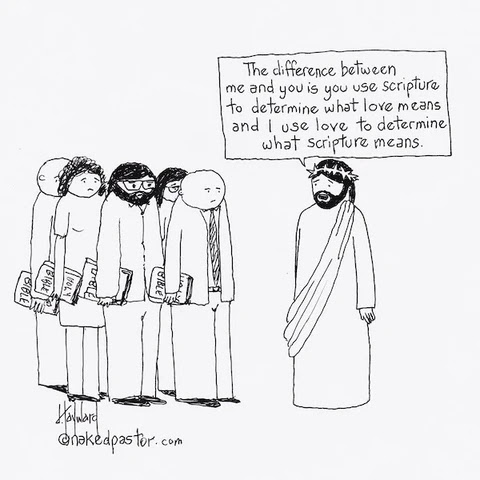
+ And third we all have found a useful resonance in a quote shared by the visual artist, the Naked Pastor, who crafted this cartoon:


Lent is the right time for this journey into faith, hope, and love. I am grateful for the chance to wander with this community in the wilderness as they prepare to welcome their new settled pastor in July. I have already been blessed by their openness and gentle sense of humor. And I look forward to discerning where the Spirit may be leading us as we practice letting go. Walter Brueggeman's Easter prayer gives us a fitting guide to sojourn into the darkness of Lent.

On our own, we conclude: there is not enough to go around
we are going to run short
of money
of love
of grades
of publications
of sex
of beer
of members
of years
of life

we should seize the day, seize our goods, seize our neighbours goods
because there is not enough to go around

and in the midst of our perceived deficit
you come: you come giving bread in the wilderness
you come giving children at the 11th hour
you come giving homes to exiles
you come giving futures to the shut down
you come giving easter joy to the dead
you come – fleshed in Jesus.

and we watch while the blind receive their sight
the lame walk, the lepers are cleansed, the deaf hear
the dead are raised, the poor dance and sing

we watch
and we take food we did not grow and
life we did not invent and
future that is gift and gift and gift and
families and neighbours who sustain us
when we did not deserve it.

It dawns on us – late rather than soon-
that you “give food in due season
you open your hand
and satisfy the desire of every living thing.”

By your giving, break our cycles of imagined scarcity
override our presumed deficits
quiet our anxieties of lack
transform our perceptual field to see
the abundance………mercy upon mercy
blessing upon blessing.

Sink your generosity deep into our lives
that your muchness may expose our false lack
that endlessly receiving we may endlessly give
so that the world may be made Easter new,
without greedy lack, but only wonder,
without coercive need but only love,
without destructive greed but only praise
without aggression and invasiveness….
all things Easter new…..
all around us, toward us and by us
all things Easter new.

Finish your creation, in wonder, love and praise. Amen


Sunday, February 5, 2023

EPIPHANY 5: Salt and Light – Incarnation as Fulfillment

There was a meme floating around FB a few days back that included this poem by Ganga White:
What if our religion was each other? 
If our practice was our life and prayer was our words?
What if the Temple was the Earth? If forests were our church?
If holy water—the rivers, lakes, and oceans? 
What if meditation was our relationships?
If the Teacher was reality? If wisdom was self-knowledge?
And if love was the center of our being?

I’d seen it before and was mildly taken by it then, but last week – for some reason beyond me – it spoke to my heart. Like the mystics tell us: When the student is READY, the BUDDHA will appear. Clearly, I was ready for this tenderhearted and stripped-down summary of what sounds to me like the heart of the Sermon on the Mount. It is, of course, a deconstructed summary – and while that may be a challenge for some traditionalists, using broadly ordinary words to describe our spiritual practices and impulses is one of the charisms of this age. As we learn how to reclaim awe in each day, renew our trust in the unforced rhythms of grace revealed to us in nature, and practice once again nurturing generous and sacramental eyes to see, ears to hear, and hearts to feel the holy right now: a new/old spirituality of compassion begins to be reborn within and among us. The artist and spiritual universalist, Iryna Dalton, restated an insight I first heard from Pope Francis:

Nothing in nature lives for itself: the rivers do not drink their own water, the trees do not eat their own fruit, the sun does not shing on itself, and flowers do not spread their fragrance just for their own enjoyment. Living for others is the rule of nature. We are all born to help each other. No matter how difficult it is: life is good when you are happy, but much better when others are happy because of you.


During the three weeks leading up to Lent, those of us living into the sacramental wisdom of this season mark two of our oldest traditions: One is Candlemas – or St. Brigid’s Feast Day or even Celtic Imbolc – that marks the final festival in this cycle of light. Church historian, Diana Butler Bass, tells us that: “Two months ago, Advent began with lighting candles in anticipation of the birth of Jesus. The Nativity is accompanied by angelic beams shining upon the Holy family in a manger. Epiphany celebrates the star directing seekers to Christ’s birthplace. As Epiphany unfolds in January, God’s light expands, inviting the first disciples to “come and see” what the light has revealed. The final movement in the arc of light is Candlemas, one of our oldest festivals, that commemorates Mary’s purification 40 days after the birth of Jesus and the presentation of the Christ Child to the elders in the Temple.” Dr. Bass adds:

Christian feast days are, of course, theological. But they are laden with cultural meanings as well. In the Roman world, and throughout Europe where Christianity would flourish, early February was an important time in the cycle of seasons. The Presentation of Jesus falls half-way between the winter solstice and the spring equinox – the time when many of Europe’s ancient tribal people believed the earth woke up to new life. It marked the lengthening of each days — and was asso-ciated with fertility, the lambing season, and the returning of light. Linking Mary’s ritual cleans-ing and Jesus as the Light of the World with the primal seasonal celebrations of Mother Earth’s brighter days created the celebration of Candlemas. Where, on February 2, it became the practice to bring candles to the church to be blessed — and then walk home through towns or villages in candlelit processions. (The Cottage: Candlit Faith)

I don’t know what it’s like where you live but in my neck of the woods the shift towards the light is already becoming clear. It MAY be cold as a brass toilet seat in the Yukon, God knows it is here, but each day is becoming a little longer and lighter. That’s one part of our preparation for Lent.

The other is revisiting the Sermon on the Mount in the appointed gospel readings. I grounded last week’s reflection in the Beatitudes – the blessings that open this sermon – paying special attention to: You are blessed when you’re at the end of your rope; because with less of you, there’s more room for God and God’s grace. Today, in the second installment, Jesus tells us that our deepest ful-fillment – and the heart of true religion – means living as salt and light for the world. Let each day bring nourishment to creation, not by jumping through the hoops of conformity, but by turning our ordinary words into prayers, treating one another with intentional care, and trusting that self-giv-ing love is at the core of existence. Let your lives be a celebration of the sacrament of incarnation, Jesus tells us. So, listen carefully for something sacred in St. Matthew’s text as he links humor and humility to the heart of God’s unforced rhythms of grace.

Jesus told his disciples and the crowds: let me tell you why you are here. You’re here to be salt-seasoning that brings out the God-flavors of this earth. If you lose your saltiness, how will people taste godliness? You’ve lost your usefulness and will end up in the garbage. Here’s another way to put it: You’re here to be light, bringing out the God-colors in the world. God is not a secret to be kept. We’re going public with this, as public as a city on a hill. If I make you light-bearers, you don’t think I’m going to hide you under a bucket, do you? I’m putting you on a light stand. Now that I’ve put you there on a hilltop, on a light stand—shine! Keep open house; be generous with your lives. By opening up to others, you’ll prompt people to open up with God, this generous Father in heaven. Now, please get this right: don’t suppose for a minute that I have come to demolish the Scriptures—either God’s Law or the Prophets. I’m not here to demolish but to com-plete. To fulfill. I am going to put it all together, pull it all together in a vast panorama. God’s Law is more real and lasting than the stars in the sky and the ground at your feet. Long after stars burn out and earth wears out, God’s Law will be alive and working. So trivialize even the smallest item in God’s Law and you will only have trivialized yourself.  But take it seriously, show the way for others, and you will find honor in the kingdom. Unless you do far better than the Pharisees in the matters of right living, you won’t know the first thing about entering the kingdom.

You may recognize this reading as part of the late Eugene Peterson’s rendering of Scripture he called The Message: there are times when I think Peterson misses the mark a bit in this work but when it comes to the Gospels, the letters of St. Paul, and some of the Psalms? Man, it’s pure gold. My all-time, most beloved and cherished passages of Scripture comes from Peterson’s reworking of St. Matthew, chapter 11 that reads:

Are you tired? Worn out? Burned out on religion? Come to me. Get away with me and you’ll recover your life. I’ll show you how to take a real rest. Walk with me and work with me—watch how I do it. Learn the unforced rhythms of grace. I won’t lay anything heavy or ill-fitting on you. Keep company with me and you’ll learn to live freely and lightly.


The assurance is that we shall live freely and lightly as we consciously become one with the un-forced rhythms of grace. What a promise, yes? You shall live freely and lightly… surrounded and saturated with pain. In a world just as broken as it is beautiful. During an era that will test your heart, soul, mind, and strength. And still, you shall live freely and lightly as seasoned light bearers! Today’s text tells us how Jesus believes this accomplished. You see, St. Matthew is painting Jesus to be the NEW Moses – God’s human/holy liberator who leads us AWAY from oppression and INTO blessings – in both our spiritual and material concerns.

Remember that initially St. Matthew’s community was a part of first century Judaism who exper-ienced Jesus as the Anointed fulfillment of Torah. Tradition was vital for these Jewish-Christians who began their journey of faith grounded in the rituals of the Temple, but by the time our text was written in about 90 CE, were living in exile in Antioch, Syria. The closing words of this lesson are intended to evoke continuity between the OLD Moses and the NEW: “Please get this right: don’t suppose for a minute that I have come to demolish the Scriptures – neither Torah nor the Prophets.”

I’m not here to demolish but to complete. To fulfill. I am going to put it all together, pull it all together in a vast panorama. God’s Law is more real and lasting than the stars in the sky and the ground at your feet. Long after stars burn out and earth wears out, God’s Law will be alive and working. So, trivialize even the smallest item in God’s Law and you will only have trivialized your-self. But take it seriously, show the way for others, and you will find honor in the kingdom. Unless you do far better than the Pharisees in the matters of right living, you won’t know the first thing about entering the kingdom.

It’s easy for 21st century people to miss the clues St. Matthew shares with us concerning Jesus as the NEW Moses, but his original audience would have picked up on this right away. St. Matthew’s text starts with a genealogy of Jesus so that we know he hails from the seed of Father Abraham: a TRUE son of Israel. The birth narratives of Moses and Jesus both occur in the context of persecution, tumult, fear, and danger. Both stories go on to say that following each birth, a paranoid despot slaughters all the male Hebrew children under two to safeguard his power. Both babies experienced exile in Egypt, regularly retreated into wilderness as adults to seek clarity from the Lord, and chose to ascend sacred mountains first to receive Torah and later to articulate the blessings at the heart of the living God. Jesus is even transfigured by the radiant light of God on a mountain much like Moses was after he communed with YHWH in prayer. It is vital for St. Matthew’s community to trust God’s continuity between the old Moses and the new one named Jesus.

Even the message we now call the Sermon on the Mount has Jesus obliquely referencing Moses al-beit in a subversion of scriptural literalism. On the mountain, Moses first received and then shared the commandments while Jesus begins with blessings. Moses articulates Torah, the law, while Jesus emphasizes charis, God’s grace. Both have their place – both are simultaneously true and distinct – and both incarnate unique spiritualities that can lead us into the heart of God’s love although in qualitatively different ways. For the first century community of St. Matthew – and perhaps for you and me as well – Jesus teaches that we can live into the fulfillment of Torah by consciously being salty and enlightening. So, let’s be clear about that word fulfillment lest we get off track. Bible scholars insist that in the ancient world of the Gospels, fulfillment was a key spiritual concern:

The Gospel writers often write of scripture being “fulfilled” in and through contemporary events… and Jesus says he has come to “fulfill” the law. In both cases, the underlying notion is that when something is “fulfilled,” it’s truly embodied, incarnated, filled out, brought to life, and made whole or complete. When we “fulfill a responsibility,” for example, we perform it: we give it form like an arm sliding into a perfectly tailored, beautifully embroidered sleeve. To “fulfill the law,” then, is to embody its essential features, to “fill out” and exemplify its meaning, spirit, and sub-stance (in an embodied manner.)
(SALT Project notes.)

Do you recall the first miracle story in the chapter two of St. John’s gospel? At a
wedding in Cana of Galilee, Mary asks Jesus to turn water into wine so that the feast might continue. That story is ALL about fulfillment! When the wine runs out halfway through the weeklong festivities, Jesus asks the household servants to take the six stone containers that usually held water for the Jewish rit-uals of purification and fill them full of water. When they are filled full – or ful-filled – Jesus asks the wine steward to taste the contents: “People usually serve the good wine first” proclaims the stew-ard, “then, when the party really gets rolling and the guests have started to feel no pain do we bring out the cheaper stuff – but you have kept the good wine until last!”

See where this is going? Not only can the feast now move to its completion, so too the gospel as it takes what has become empty and fills it full of possibilities and joy. St. John uses this story to say the NEW way of Jesus is just as life-giving as the old way of Moses who cracked a stone open in the desert so that HIS people might continue their journey of faith, too. What we DON’T want to say in the 21st century, however, is that the NEW way of Jesus supplants the OLD – our ancestors did that in spades – and set in motion an anti-Semitism that is STILL vicious, deadly, and destructive. This text, you see, was taking shape and form during a time when one group of Jews was arguing with another. The Jewish Christians of the Johanine community, along with their Samaritan and Gentile friends, were disagreeing with their sisters and brothers in a Temple-based Judaism.

+  Despite their differences, these believers wanted to remain a part of the wider Jewish com-munity even when the more conservative rabbis disagreed. Once the Temple was destroyed, however, the wounded Jewish community became increasingly hostile towards those who questioned their authority.

+ While the Jewish Christians were relatively powerless and beleaguered, these doctrinal argu-ments – while sometimes ugly – were essentially what happens within all large and diverse families disagree. They shout. They challenge. They sometimes play dirty and say things they wish they could take back, too. And for a few generations that’s what happened.

When Christianity rose to become the religion of the Roman Empire, however, the original meaning of these words not only shifted and evoked unintended consequences, they gave birth to the hate we call anti-Semitism. What started as a shouting match between spiritual family members event-ually became an attack designed to denigrate and destroy Judaism. For fifteen hundred years the Church has insisted that the way of Jesus overrules and supplants the path of Torah – a heresy that was only acknowledged as such during the closing days of Vatican II.

The reason I keep sharing this contextual background is because overruling, supplanting, and de-stroying the way of Moses was NEVER a part of the ministry, word, or heart of Jesus. What he tells us now is what he said then: if you want to fulfill the heart of Torah then be salty as you bring illu-mination to those all around you. Please notice that the words of Jesus are NOT theological or creedal words – they simply describe a way of living in the world that incarnates Torah. That makes grace tangible. That points to the presence and love of God in our flesh. These words are the anti-thesis of the anti-Semitism that has killed our Jewish cousins for millennia and tarnished the soul of Christ’s body forever.

So, what IS sacred saltiness and insight all about? Jesus asks us to trust that being created by God means that we are always the Lord’s beloved – women and men who not only experience inward blessings and assurances, but the ability to share those blessings outwardly, too in the simplest and most humble manner: as salt and light. It’s been said that even in small quantities salt and light make a difference. “A pinch of salt brings flavors alive for salt is one of the only spices that en-hance the other flavors in our food. And light — maybe a single candle — can illuminate a room, light up a landscape, and be seen from more than a mile away.” (SALT Project)

What’s more, both salt and light have very simple and earthy purposes: salt is meant to be salty and light is meant to dispel the darkness. When the saltiness is diminished, we get rid of it. Same, too, with candles or flashlights or batteries that no longer shine – which is a clue for us about OUR identity as God’s beloved. Salt and light show us:
“who we are and what we’re meant to do. Like salt and light, God made us small in ways that can make a big difference for a larger whole. We were created to spice things up — not to overpower, but to enliven, enhance and even celebrate all the other flavors. Likewise, God made us to shine, as only we can: becoming a flame that can light up an entire room, dispel the fears of darkness, or help guide a lost traveler home.”
(SALT Project)

And here’s the kicker: these blessings are proof of grace because nobody has to WORK to become salt or light. As the Lord’s beloved, as Lady Gaga likes to say, we were BORN this way. Salt and light are part of our essence – all we must do is claim them as gifts. One poet said, “All we have to do is actually BE salty and luminous.” Or to put it another way: we must simply BE ourselves. Jesus tells us we’re ALREADY salt and light – living souls made to bless the world. “We may FEEL small and in-significant, but like a pinch of salt or a spark of light, we can make a tremendous difference. So, get out there and be who you are!”

+ Notice that he never tells us that if we DO these good things we will be blessed. Instead, he says you are already blessed – you were made to be a blessing – so go out and live your dest-iny – with vigor! For THIS is how Torah is fulfilled: by being fully your truest and most loving self and sharing that blessing.

+ At first this may sound different from the ways the rabbis put it. But don’t be worried, what I am telling you, Jesus says, is at the core of what Moses taught: it’s a way of being the fills Torah full. I’m not about abolishing or changing the law! I’m about getting to the heart of it and fully living it out!

What Jesus is preaching, you see, is precisely what the prophet Isaiah proclaimed 500 years earlier: the ancient poet is telling those about to leave their exile in Babylon that practicing the feasts and fasts of our tradition in order to manipulate or buy God’s love is a dangerous dead-end. Chapter 58 of Isaiah is clear: Day after day my people seek me, they want to know my ways as if they were a
nation that practiced justice and compassion…they want God on their side when they cry out:

Why do we fast, but you do not see? Why do we humble ourselves, but you do not notice?” So, listen: you serve your own interest on your fast day and oppress all your workers. You fast only to quarrel and to fight so understand that THIS fast falls on deaf ears. Is such the fast that I choose a day to humble oneself? Is it just to bow down the head like a bulrush and lie in sackcloth and ashes? Will you call this a fast, a day acceptable to the Lord? NO! Is not this the fast that I choose: to lose the bonds of injustice, to undo the straps of the yoke, to let the oppressed go free, and to break every yoke? To share your bread with the hungry and bring the homeless poor into your house; when you see the naked, to cover them and not to hide yourself from your own kin? THIS is how your light shall break forth like the dawn and your healing shall spring up quickly.


+ To fulfill Torah – to live into God’s presence with gratitude and integrity – is to claim our gifts as salt and light for the world. It’s to trust that small IS holy – that our simple gifts of love, humor, tenderness, clarity, kindness, truth-telling, and peace-making enhance the lives of others and bring a bit of light in the darkness, too.

+ And our unique charism is being our own special salt and light for the world in our sacred and salty way. We are to BE who we truly are – not fake being another – or jumping through someone else’s hoops – or trying to pass in any way, shape ,or form. Conformity, St. Paul tells us in Romans 12, is deadening to our imaginations, flesh, and souls.

Don’t become so well-adjusted to your culture that you fit into it without even thinking. Do not be conformed nor squeezed into the mold of this brokenness. Instead, fix your attention on the blessings God’s has created within you and you’ll be changed from the inside out. Recognize what God asks of you and respond to it. Unlike the culture around you, always dragging you down to its level of immaturity and the lowest common denominator, God brings the best out of you, de-velops well-formed maturity in you as salt and light. So, take your everyday, ordinary life—your sleeping, eating, going-to-work, and walking-around life—and place it before God as an offering – for this is the heart of it all.

Every day I see places where salt and light could make a huge difference. In his most recent New York Times column, David Brooks writes that with the growing presence of AI – artificial intelligence – we MUST commit to sharing our uniquely human insights and experiences with verve and grace:

A.I. churns out the kind of impersonal bureaucratic prose that is found in corporate communica-tions or academic journals. You’ll want to develop a voice as distinct as those of George Orwell, Joan Didion, Tom Wolfe and James Baldwin, so take classes in which you are reading distinctive and flamboyant voices so you can craft your own… Machine thinking is great for understanding the behavioral patterns across populations. It is not great for understanding the unique individ-ual right in front of you. If you want to be able to do this, good humanities classes are really use-ful. By studying literature, drama, biography and history, you learn about what goes on in the minds of other people. If you can understand another person’s perspective, you have a more valuable skill than the skill possessed by some machine vacuuming up vast masses of data about no one in particular. (NYTimes)

This morning, Tish Harrison Warren wrote in the Times about the staggering witness for racial just-ice and revolutionary nonviolence embodied by the late Rev. Fred Shuttlesworth. A fierce and fiery ally of Dr. King’s, Shuttlesworth was MLK’s perfect foil: Blunt where King was soothing, driven where King was leisurely, and most important, confrontational where King was conciliatory. When a white mob met him with baseball bats, chains, and brass knuckles and beat him senseless while he tried to enroll his black children into Birmingham’s regional high school, the good Reverend recalls hearing something that said: “You can’t die here. Get up. I have a job for you to do.” In the hosp-ital later that day, a reporter asked Shuttlesworth what he was working for in Birmingham. He responded: “For the day when the man who beat me and my family with chains at Phillips High School can sit down with us as a friend.” (NYTimes) He was a living testimony to being salt and light as he lived freely and lightly beyond the oppression of American apartheid.

My friends in Montreal called my attention to the work of Deanna Smith, Black slam poet and spoken-word artist, who brings poetry to everyday working adults and children as a way to build bridges. She recalls “performing a poem about her grandmother called Generations. It touched on themes of Black history and identity. After the sharing, a “self-described "old Irish white guy" came forward saying: "We haven't had the same kind of experiences, but what you said really touched me and I'm so glad that I came. That, she says, is the power of poetry. I was like, wow: that's what it’s all about. It's about storytelling and reminding each other that we have all these different lives and all these different experiences, but we're not so different. It's such a powerful exchange when people who don’t know each other find common ground.” (CBC Montreal) Talk about sharing our salt and light! I hear the contemporary poet, mystic, and Christian theologian, Maren Tirabassi, celebrating the gift of salt and light – and the dangers of cynicism, too – in her re-statement of today’s Scripture.

How often we are the salt in the wounds of the earth, flaunting our prosperity, hoarding it, and destroying the tastes of the wind, the ground, the sea, by the trampling of those great boots we call our needs. Or, with halogen beams on our out-of-control trucks, we careen up the highest hills searching the biggest city, and singing, "this big light of mine I'm going to make it shine so no one sees anything else for miles and miles around." We have missed the lamp-lighting in the valley places where kindness dwells, not so everyone looks at our light, but that by our little light a child reads a book, an elder feels safe from rustling outside the window, or sirens in the streets, and partners in love cook potatoes, slice apples, bake bread with a dash of salt, so all those who are hungry may come in and eat. (Tirabassi, Facebook)

Following the law and filling it full in the mind and life of Jesus means staying true to our inner essence – staying open-minded about how this is realized – and trusting grace to trump karma every time. As we ready out hearts for Eucharist, let me close as I started:


Saturday, January 21, 2023

random reflections in january...

My, my, it seems that I haven't posted HERE in nearly a month. That's what happens when family holiday plans change because of wacky weather, a partner with respiratory problems gets really sick, a trip to the ER become essential, AND band practices take place, too! There have been a few FB postings - including some tributes to David Crosby - but life has clearly interupted my writing groove and will continue to do so until probably July. So, allow me the chance to share a few random reflections:

+ David Crosby: The genius doctor of vocal harmonies and clean guitar work. I was an early fan of both Buffalo Springfield and The Byrds - two 60's bands that specialized in Americana with searing guitars and close 3 part harmonies. Both bands could duplicate the precision of the Beatles but with a clearly country/folk vibe. And as much as I came to cherish the edginess of the Airplane and Dead, they were both awesome in concert, almost every night I returned to either The Byrds or Buffalo Springfield to carry me into la la land. (Ok, there was some Tim Buckley added to that mix, too.) The killer opening riff The Byrds created for Dylan's "Mr. Tambourine Man" - and their close harmonies on the chorus - set the standard for my generation - and they kept getting better and better. One of my favorites is this reworking of Dylan's "Lay Down Your Weary Tune Lay Down."
When Cros was fired from The Byrds - a reality that would happen again and again because he had a wicked, opinionated tongue - the whole Laurel Canyon groove was taking shape. With Buffalo Springfield imploding, both Steve Stills and Neil Young were searching for new options. At Joni Mitchell's house they started making uniquely beautiful and poignant songs and when Willy (Graham Nash of The Hollies fame) made the scene, he rounded out their harmonies. I still listen to that first CS&N album and marvel at what their voices, souls, and fingers created. From time to time Neil Young would enter - and then leave - the picture adding his eclectic songs and super-charged lead guitar. 
Cros produced Joni's first album, Songs for a Seagull, put out one of the all-time most beautiful solo recordings, If I Could Only Remember My Name, and kept on rocking through all the ups and downs his wounded soul and broken heart had to experience on their way towards equanimity. His departure for the grand band in the great beyond leaves a hole in my life and I'm going keep playing his songs til I join him (which, I pray, won't be for another 15+ years!)

+ Harmonicas:  I sometimes play the blues harp with my acoustic songs. Now that Dave and I are working as a duet - in addition to our big band The Remnants - I've wanted to use them more. Especially on a few early Beatles' tunes. Sadly, for months they've been AWOL. I recall bringing them home in a small bag after we played Andy and Laurie's barn part last October but after that... who knows? I've been searching for them in earnest these past two weeks and have looked everywhere. After going through the basement, my gig bags, our bedroom, and car vigorously yesterday I had concluded they were gone forever. As I was walking back to my study I picked up a brown paper bag that's been sitting by my bed stand for months and was about to toss it out when I noticed a battery powered light inside. And when I pulled it out, what else was there, but my five missing blues harps! They've been two feet away from me for nearly three months and I never once moved that freakin' bag. I'm grateful to find them and chagrined at my distraction.

+ Lucie: For some unknown reason, our 10 year old buddy, Lucie, has decided that she's a lap dog again. Every night for the past week while Di and I watch one or another European mystery, Lucille comes off the sofa with Di, walks around the room twice, and then stands in front of me until i boost her onto my lap. She is no light weight at 70+ pounds. Once firmly planted on my lap, she snuggles in, licks me a few times, and then promptly goes to sleep until our TV adventures come to a close. Who knows why she's so inspired? Who knows how long this obsession will last? It's fun in a weird way for the old girl to be so close so I guess I'll just enjoy it til she's done.

+ Synchronicity: About three years ago I rediscovered the writing of Christine Valters Paintner at the Abbey of the Arts. In one of her books on Celtic spirituality she mentioned that the way Celtic monks made a pilgrimage was different from the rest of Europe. While most peregrinations are linear, with a defined goal in mind, not so for the Celts who chose to wander without clarity until they felt in their hearts a place of resurrection and renewal. Paintner calls this "following the thin thread of synchronicity" in our lives. That phrase brought clarity to my own spirituality. 

Last Tuesday, my partner in music, Dave, and I went to listen to a few local musicians at club in town. During a break, it was worked out for us to sit in next week and play a few tunes, and that felt like enough. 
Oddly, however, as I was getting ready to leave one of my favorite local politicians stopped me and asked if I might join a few of his friends at the back of the club for a conversation. It was lively and insightful. During our chat, one man asked, "Why did you decide NOT to move on to Canada? I thought you were already gone!" The short version is that one of our daughters asked us to stay put; all the rest of their extended family is out on the West Coast and she wanted her grandchildren to know their grandparents while we are still reasonably healthy. I concluded, "As clergy, I moved my family all over the country not once or twice but four different times. So when she asked me to stay put, as much as I wanted to hang in Canada with my L'Arche friends, I kept hearing a line of Scripture where John the Baptist says about Jesus, "I must decrease so that he may increase." That kept going through my head and heart so here we remain." As I was saying my goodbyes, one of the men in this conversation said (with tenderness in his eyes): "You are doing the right and beatiful thing, man. My grandparents were life savers for me during a time when life was hell. So, keep trusting your heart because being there for them could be a matter of life and death." 

Wow... who could have imagined? Talk about paying attention to that small thread of synchronicity, yes? Today I give thanks for it all and leave you with another gem from Cros who "found" the middle harmony here and holds it ALL together.

to free your heart of ballast...

One part of our time away for reflection and rest comes to a close tonight - and we are both so grateful. It has been slow and reasonably ea...