These days are filled with acts grounded in love: not so much deep forethought as sincere affection and compassion for those I cherish. These days feel like the darkness. I know the vernal equinox has come and gone and the sun rises higher in the sky everyday. Still, so much is not clear. Wendell Berry says:
To go in the dark with a light is to know the light. To know the dark, go dark. Go without sight, and find that the dark, too, blooms and sings,
and is travelled by dark feet and dark wings.
In another place he adds:
It may be that when we no longer know what to do,
we have come our real work,
And that when we no longer know which way to go,
we have come to our real journey.
The mind that is not baffled is not employed.
The impeded stream is the one that sings!
So I hang with a few trusted musical friends, teach elementary school children to play the ukulele, and hoist a brew in a local dive bar talking with people I've never met before like long, lost friends about what we might hold in common. I sing and play quiet songs of trust with those without ego as we share a common but still unspoken trust in the mystical presence of Jesus. I walk in the wetlands with my wacky dog, Lucie, and watch my loved one hobble through her pain towards strength. I cherish my children - and grandchildren. I pray for my beloved friends in L'Arche and my brother's eye surgery. I cook simple meals each evening evening, send a few emails during the day to stay connected, watch the evening PBS news with tears, and pretty much leave the all the rest in the hands of the One I know as Lord.
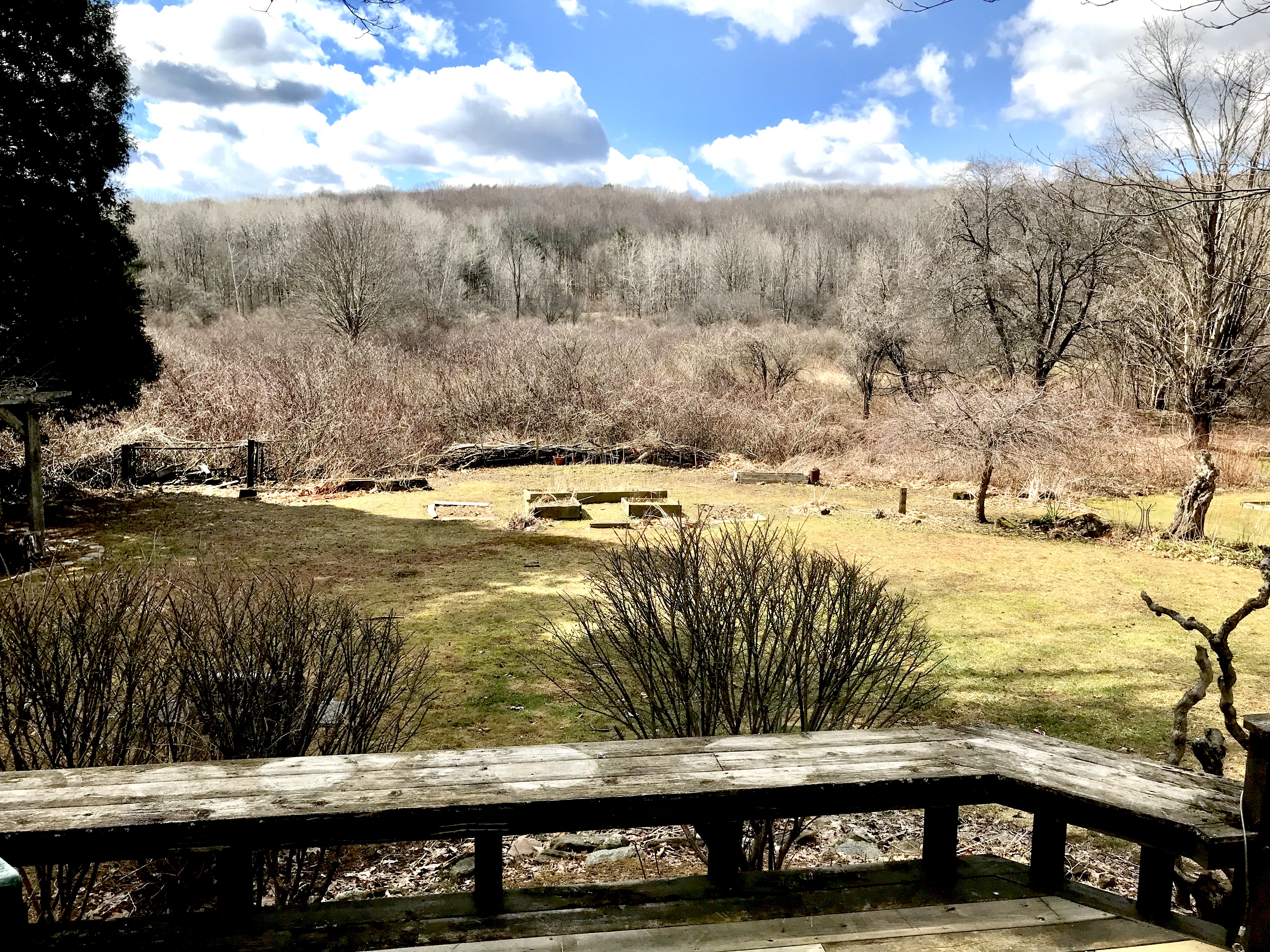
Today is a quiet day here in the Berkshire hills. Well, to be honest, for me and mine, everyday is a quiet day here in these Berkshire hills. With the exception of a few late winter romps in the back with our grandchildren, I have not walked around to look at the ground since late October. So on this quiet day, I am simply going to go and see what's happening all around me on the outside of our home. There are twings and branches to pick up for sure - not raking or serious cleaning until we've had a least a week above 50F - and that's not likely to be any time soon. The little critters and insects need this covering to help them prosper. No clearing out our garden beds yet either.
But given the recent winds, there's dead wood that needs to go. Probably a few other types of debris as well. I'm curious if any of the early wild flowers will return this year. It's time to rehang the outdoor windchimes, repair the arbor, measure the new raised garden beds for their soon to be created wooden frames, and slowly and quietly let it all soak in. It is ctime to get out of my head for a spell. Two recent quotes have nourished this notion that I'm about to re-enter a season of incarnation rather than mere intellectual abstraction.
The first comes from Alejandro Frid's reflection in YES Magazine re: resilence. He writes: "The world will unravel but you will not."
These words reflect the worldview that has overtaken me while working at the front lines of conservation science alongside undying Indigenous knowledge. In a world of accelerating climate disaster, political doublespeak, and horrific colonial legacies, the conviction that we can remain our essential selves throughout the unraveling is what gets me up in the morning. Most entities—biological, cultural, personal, planetary—can absorb shocks and still maintain their essence. This is what we call resilience.We log a forest, but given enough time and a stable climate, a community of trees returns that supports myriad organisms, from lichens to goshawks to fungi. This new community does not replicate the one before, yet the interrelationships that define it advance legacies and adaptations from the ancestral forest. (YES @ https://www.yesmagazine.org/issue/personal-journeys/2022/02/16/climate-scientist-indigenous-resilienceutm_medium=email&utm_campaign=YESDaily_%2020220324&utm_content=YESDaily_%2020220324+CID_fe53857eeb44b79d3a9033ef009547bc&utm_source=CM&utm_term=Read%20the%20full%20story)
The second hails from David Whyte's words about courage in the Network for Grateful Living newsletter.
COURAGE is a word that tempts us to think outwardly, to run bravely against opposing fire, to do something under besieging circumstance, and perhaps, above all, to be seen to do it in public, to show courage; to be celebrated in story, rewarded with medals, given the accolade, but a look at its linguistic origins is to look in a more interior direction and toward its original template, the old Norman French. Courage is the measure of our heartfelt participation with life, with another, with a community, a work; a future. To be courageous is not necessarily to go anywhere or do anything except to make conscious those things we already feel deeply and then to live through the unending vulnerabilities of those consequences. To be courageous is to seat our feelings deeply in the body and in the world: to live up to and into the necessities of relationships that often already exist, with things we find we already care deeply about: with a person, a future, a possibility in society, or with an unknown that begs us on and always has begged us on. To be courageous is to stay close to the way we are made. Courage is what love looks like when tested by the simple everyday necessities of being alive.
Now that the Vernal Equinox has come and gone, her hint of warmer days still lingers and encourages me to put my winter spirituality to bed. The cold and dark calls us to attend to the inward truths for to everything there is a season. As our extended New England darkness prepares to retire, however, I can feel that my flesh is eager to let it go. I suspect that's part of what our up-coming benefit concert is about: reconnecting to the values, people, and commitments of love in public. So, too, the ukelele class with Conte elementary school children. This small, after school gathering allows me the space to make some music with Andy, meet new people whose lives would rarely intersect with my own, and do so in the context of something I love. Whyte puts it like this:
The French philosopher Camus used to tell himself quietly to live to the point of tears, not as a call for maudlin sentimentality, but as an invitation to the deep privilege of belonging and the way belonging affects us, shapes us and breaks our heart at a fundamental level. It is a fundamental dynamic of human incarnation to be moved by what we feel, as if surprised by the actuality and privilege of love and affection and its possible loss. Courage is what love looks like when tested by the simple everyday necessities of being alive. We become courageous whenever we live closely to the point of tears with any new possibility made known inside us, whenever we demonstrate a faith in the interior annunciations and align ourselves with the new and surprising and heartfelt necessities of even the averageexistence.
It will be sloppy, muddy, and damp. There's probably a few piles of dog shit laying around, too. But the sun is out, the rain is waiting, and my soul says winter is dying: long live the spring.
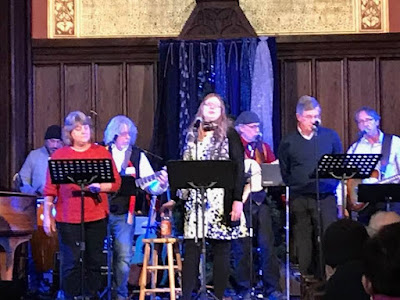
In about six weeks, a small cadre of musician and poet friends will present a live music/poetry event at the historic First Church of Pittsfield. It will be the first live music I've played since November 2019. It feels good.
A few discrete but somehow interrelated thoughts are swimming around inside of me about this gathering:
+ First, after such a long hiatus, making music in an ensemble of friends feels like embodied prayer. I played my last gig in a pub as bass player in Famous Before We're Dead. That whole experience fed my soul. I was reunited with a dear friend I've known since 8th grade, we had a shared musical history emcompassing the past five decades of beauty, we experienced a sense of adventure in the creation of original music and getting it out before the wider public, and it was just a gas to play live with people I loved and for people who resonated with what we were exploring. It was a privelege to play with my "Famous Brothers" and I would do it again in a heart beat should the opportunity arise. At about the same time, however, I realized I needed to step back for a spell as I found myself artistically stuck. It takes me a LONG time to write original song and poetically satisfying lyrics. I have a few that work, but I'm no McCartney, Hiatt, or Mitchell. Additionally, as as old dude making music, I found memorizing lyrics was no longer my forte. At the time I didn't have the cash for an IPad that could be mounted to my mic stand so it was just an old school music stand for me - and in some places there was barely room for the three of us to stand let alone store our gear. Other tensions existed, I'm sure, but I simply sensed the need for a break about the start of the New Year. So when we all got slammed by the plague, it created a natural albeit forced musical sabbatical.
Some 28 months later it felt like time to get back to my roots. The Beatles' "Get Back" documentary was an unintended parable: they realized it was time to let go of their esoteric psychedlia and get back to where the once belonged. The influence of Bob Dylan's old musical comrades-in-arm, newly named The Band, was everywhere in 1968. Artists like Clapton gave up their bizarro hipster costumes and hair in favor of simple jeans and cowboy boots. Jimi Hendrix covered "All Along the Watchtower" with verve and originality. And roots rock players in The Byrds, Buffalo Springsfield, The Flying Burrito Brothers and CSN&Y were flying high. Artists all over creation were returning to the grit of the genre's founders. Elvis had a revival. Nostalgia became profitable as bands like Sha Na Na Na captured some of the Doo Wop groove. And that's what playing with my new/old local musical friends feels like: these are artists I've worked with closely over the past 15 years. We know how to watch, listen, and support one another. Our vocalists intuitively know how to create stunning close harmonies. It is just a stone, cold gas when it sounds so sweet and comes together with so little effort - which is more often than not. We've enough time to take the rough edges off our emerging set list that includes Mellancamp and the Foo Fighters, Springsteen and Marvin Gaye, Dylan and Motown plus a few originals by well-seasoned local performers.
+ Second, the reason for gathering has been a work in progress and has finally taken shape and form. Last summer, in the halcyon glow of vaccinations, we thought we might be able to do an end of summer show. Hopes were quickly dashed by late August and the whole idea was put on ice. After boosters, however, we started pondering the possibilities. I was approached by a local pastor to consider helping raise fund for the interfaith effort to resettle 31 Afghani refugees in Berkshire County. It felt like a karmic debut so I reached out to my old mates and we started simply sitting around our living and playing tunes that made us smile. I put out feelers to other artists to see if they might join us if it was safe. And after the New Year, we began slowly working on a few songs. Who knows if freakin' Omicron is going to jinx us again, but as we all learn to live with a new variant we're going forward with joy. The show is becoming an encounter with Americana - part of the invisible hand of synchronicity and grace - that owes a ton of debt to T Bone Burnett. Not only his resurrected Robert Plant/Allison Krause CD, "Raising the Roof," but his life-long commitment to sharing and re-inventing American roots music is alive and well among us. It is also a blessing to do this fundraiser for Jewish Family Services, the agency in-charge of resettlement, at the historic First Church in town. In a time when anti-semitism is all too alive and well, this gig became a way of expressing solidarity on a number of fronts - and that makes my heart sing.
+ Third, while most of our tunes will be "covers" rather than original compositions, each fits into the whole to evoke an audible mosaic. Some performers are artists who make music to share their original compositions. I cherish the work of Joni Mitchell, Carrie Newcomer, Bob Dylan, Marvin Gaye, Lou Reed and others who have songs and poetry bubbling up that can't be contained. Others - Joe Cocker, Joan Baez, and Eva Cassidy come to mind quickly - have a different gift - interpretation - and that is a sacred charism, too. There is NO better rendition of either "With a Little Help from My Friends" or "Feelin' Alright" than what Cocker brings to the table. Same goes for Cassidy's take on "Woodstock." What I have discovered in putting together this show is that it is steeped in the various sounds of Americana. It's was as if the Spirit was guiding us towards music that expressed the ups and downs of our country at a time when we are struggling for its soul.
Say what you will about Facebook - and there is much to say - it continues to be a forum for helping some of us stay connected. I know I'm not saying anything new or creative. It is clear that FB is not used with any regularlity by most folk under 40 and never by those in the Gen Z demographic. So be it - most of my friends, family, and colleagues are Boomers and Gen Xers who live all over creation and still enjoy posting pictures of our children, grandchildren, pets, travel experiences, and the random personal update, too. I confess to enjoying viewing those notes from people I once knew well. Smiles as well as tears happen often each week. And I can't count the times I've learned of births, deaths, divorces, and life achievements through this imperfect platform.
Reconnecting with high school friends has been wonderful. Two weeks ago I saw the name of a former colleague show up on a friend's post. "Could this be the same person I knew 40 years ago in Costa Rica?" I wondered. And, after a quick note of inquiry on Messenger, a long neglected connection was confirmed. I've been able to reach out to those in distress when I don't have a phone number. I have joined multiple spirituality and the arts groups and native seed gardening sites that daily share small gifts of beauty and wisdom with the world. And how about those Beatles fan clubs that post live concert clips of the Fab Four from fifty years ago? My bed time ritual would not be complete without a quick blast from the past.
What's more, I continue to learn how not to respond to political arguements that require in-person conversations to say nothing of trust and vulnerability. As in most of life, I am a slow learner and have lost more than a few contacts in those early days of FB. Eventually, the sting of cruel words and unkind generalizations suggested that it was best to let hyperbole and zeal roll off my virtual back and disappear into the ethernet. In this regard, FB has been yet another way to practice the Serenity Prayer! To that end, I've found it wise to also give up on snark and fact check more often. This is especially important now in the age of genuinely fake news and QAnon madness.
Please understand that I have my issues with Facebook. Some creep stole the identity of a beloved friend and caused profound economic and emotional pain. My blog site (when love comes to town) has been officially banned from FB for nearly seven years for some still unknown reason. The FB police have locked me out of making any links to that blogger site. I eventually quit trying to appeal this foolishness and simply repost my reflections on my personal page and add a few of the graphics. (NOTE: If you want to see the real thing, however, you can google it noting its on blogger and called When Love Comes to Town like the U2 song of the same name.) I also hate some of the political and emotional manipulation that crooks and political hacks have come up with to influence our elections and all the rest. As noted, it is a highly imperfect forum but one that still works for me in a limitted and selective way.
I know that if I want or need to be in touch with younger associates and musicians then texting and/or Instagram is the way to go. Even something as retrograde as an email can do the trick, too. And, shock of all shocks, the phone still has its uses, yes? This poem, American Sonnet, by Billy Collins evokes some of the same truths I've experienced using FB. Like most of the rest of reality, including picture postcards, it ain't perfect but it gets part of the job done.
We do not speak like Petrarch or wear a hat like Spenser and it is not fourteen lines like furrows in a small, carefully plowed field
but the picture postcard, a poem on vacation, that forces us to sing our songs in little rooms or pour our sentiments into measuring cups.
We write on the back of a waterfall or lake, adding to the view a caption as conventional as an Elizabethan woman’s heliocentric eyes.
We locate an adjective for the weather. We announce that we are having a wonderful time. We express the wish that you were here
and hide the wish that we were where you are, walking back from the mailbox, your head lowered as you read and turn the thin message in your hands.
A slice of this place, a length of white beach, a piazza or carved spires of a cathedral will pierce the familiar place where you remain,
and you will toss on the table this reversible display: a few square inches of where we have strayed and a compression of what we feel.
(Thanks to my FB friend Pam for her picture of me during a FB livestream event.)
It has always been my joy to be a dad to our daughters. I have a small clay sculpture from ages past that says, "Any man can become a father; only some can be a dad." And now I have the double joy of being a grandad (or as I'm better known here: Gwad. When young, precocious Louie was trying to get his mouth around grandad, it first came out like a Welsh word: grwaadd. And quickly was simplified into "Gwad." And now that Anna is a part of the brood, we didn't even try to make a change. So, Gwad it is!) The Brooklyn crew was up in our hills this weekend for a whiteout snow fall. On Saturday we were out in the backyard throwing snowballs, making little snow villages and running around in the cold. On the Sabbath we took a long walk in the snowy woods - and as fate would have it I got to bring up the rear by walking at the speed of Anna.
For the past year this has become the natural course of things whenever we take a hike: everyone else has a different pace and Anna's moves with intentional slowness. She likes to pick things up to explore them. And then take a leisurely seat on a wood stump before chasing a butterfly or jumping off a rock. She is oblivious to time as most of us know it and moves through her young life accordingly. Her brother, Lou, is on a quest to learn new things. He doesn't race through the day, he has time to notice the sun, moon, stars, leaves and snow prints. It's just that there's so much to take in that is awesome - and he wants to embrace and understand it all - so he's off in a flurry. Anna, on the other hand, isn't so interested in analysis. She's an experiential gal who likes sto savor the day: she eats with creative apblom, she moves gracefully but without undue haste, and she speaks and dances as if time does not exist. Moving at the speed of Anna is a blessing and just the right way to honor Sabbath space.
Another aspect of moving at the speed of Anna happens after the family heads
home. The following day I usually devote to cleaning. It is a weekly embodied prayer that restores the semblance of order into my small world. I genuinely enjoy washing floors and clothes. Like Kathleen Norris notes in The Quotidian Mysteries:“The ordinary activities I find most compatible with contemplation are walking, baking bread, and doing laundry." Ordinary Mondays involve ordinary acts of cleaning. But on those Mondays following a weekend visit from the Brooklyn tribe, I start my cleaning oblation with a walk through the house to see what is hiding where? Sometimes a pink unicorn peeks out from under my desk. There are a host of articial butterflies lurking in the most unusual spots. To say nothing of candles, dog supplies, tea mugs, and various books and blankets piled into our assortment of small wicker baskets that are strewn about here and there. Step into the guest bathroom for a quick clean and behind the shower curtain is Anna art drawn on the walls with bathtub marker (who knew?) It is a fascinating way to both slow down and discover a little bit of what the world might be like through the eyes and heart of this wonderful little person who, indeed, moves at the speed of Anna. Kathleen Norris gives all of this her wise interpretation:
The Bible is full of evidence that God's attention is indeed fixed on the little things. But this is not because God is a great cosmic cop, eager to catch us in minor transgressions, but simply because God loves us--loves us so much that the divine presence is revealed even in the meaningless workings of daily life. It is in the ordinary, the here-and-now, that God asks us to recognize that the creation is indeed refreshed like dew-laden grass that is "renewed in the morning" or to put it in more personal and also theological terms, "our inner nature is being renewed everyday". Seen in this light, what strikes many modern readers as the ludicrous details in Leviticus involving God in the minuitae of daily life might be revisioned as the very love of God.
First born grandchild, Lou, is a whole other story: brilliant and talented with a mind like a computer that retains EVERYTHING (and I mean everything!), this child has perfect pitch, is a math/science wizzard, reads voraciously and retains even the most arcane factoids because, "who knows, Gwad, I might need to know that sometime." Indeed. We are into playing and practicing music these days: Lou has been singing in the Trinity Wall Street youth choir for a few years and is now taking dance and ukelele lessons. His music teachers run a hip shop in Brooklyn called Jalopy that specializes in bluegrass stringed instruments. So, in addition to "When the Saints" and "You Are My Sunshine," we're now grooving to "Rolling in My Sweet Baby's Arms" and "Shady Grove." He's usually a half mile ahead of Anna and myself on our hikes although somethimes he holds back to ask me questions about erosion or Nor'Easters. He, too, is the delight of my heart and moves to the beat of his own unique drum. He's never been one to move at the speed of Anna though and these days I want to savor as much time with both of these angels as possible.
Now a certain quietude has returned to our little home in the hills. The snow from two recent storms has melted. The floors have been vacuumed and washed with a coat of polish on the kitchen. Lucie is back to sleeping on the sofa in the sun room and the errant toys are back in their natural homes. I'm making Hungarian Chicken Paprikash solo tonight - no little helping hands - as I try to keep in touch with the joy of moving according to Ms. Anna. We won't see these treasures until Easter weekend so this weekend past must serve as part of my Lenten fast where making a place for Sabbath rest happens every day.
This weekend I participated in a funeral Mass for a colleague as part of a pick-up choir. There were over 50 of us singing, weeping, celebrating, and sight-reading 30+ minutes of opening choral music prior to supporting the necessary liturgical chants, psalms, and antiphons. A precious friend and former colleague directed the ensemble and played organ, too. Artistically, it was a challenge that worked out well. It was also a sacred obligation of friendship, commitment, and solidarity.
The deceased was a beloved musician in our small community. Seven years ago, he played the pipe organ for our celebration and performance of Paul Winter's "Missa Gaia." He directed a choir in the hill towns of Western Massachusetts and supported the Spanish and English masses at St. Mark's Roman Catholic Church. He was, by all accounts, a real mensch! It was wonderful to be singing in a real choir again. As much as I have come to cherish our quiet, live-streaming time of weekly contemplation, to be a part of the whole was soul food. And, as I knew I would, I found myself weeping tears of grief as well as joy - especially during a setting of "On Eagle's Wings."
Those tears erupted again yesterday during my reflection on the Transfiguration as prelude to the Lenten fast. They took me completely by surprise and, as I have learned to do, I simply let them flow. The wisdom keeper, Frederick Buechner, has been my guide on this practice and he got it so right when he wrote:
YOU NEVER KNOW what may cause them. The sight of the Atlantic Ocean can do it, or a piece of music, or a face you've never seen before. A pair of somebody's old shoes can do it. Almost any movie made before the great sadness that came over the world after the Second World War, a horse cantering across a meadow, the high school basketball team running out onto the gym floor at the start of a game. You can never be sure. But of this you can be sure. Whenever you find tears in your eyes, especially unexpected tears, it is well to pay the closest attention. They are not only telling you something about the secret of who you are, but more often than not God is speaking to you through them of the mystery of where you have come from and is summoning you to where, if your soul is to be saved, you should go to next.
Freely flowing tears have long been a sacred charism for me although I fought them for decades. As a young boy I openly wept over flowers. As an adolescent, I found myself crying during certain hymns in church. Or over poems or songs that opened my heart. I spontaneously wept when JFK was murdered. So, too, with MLK. And I was a total mess watching the tribute to Robert Kennedy during the Democratic National Convention of 1968. Tears flowed when our daughters were born, when we celebrated their birthdays, as I watched them dance or play live music or when they joined me in singing Springsteen songs in the car. At times they were tears of wonder and gratitude; they could easily become tears of regret or fear; and more times than I care to recall they were tears mixed with confession and prayers for forgiveness. For most of my adult life, I fought with these tears - holding them back or wrestling them silent through agonizing acts of the will - mostly because I associated tears with weakness. That's in the cultural air breathed by men of the industrialized West; but also an acquired phobia within violent households.
But some 25 years ago, at the quiet request of my beloved, I started honoring my tears as a gift from God. A charism of deep connection, if you will. I'm still practicing acceptance, but trust I'm learning. At least a little bit. When they showed up again yesterday during our "Small is Holy" reflection, I was stunned. Afterwards, I gave thanks to the Lord, but I must confess at being bewildered in the moment: they were real but completely unexpected. As I sat with this truth in the twilight yesterday I became aware of layer upon layer of sorrow: the funeral, the ecstasy of singing live music again, the agony and fear over the war in Ukraine, pandemic weariness, resistance to the frigid air, worries over Lucie as she ages, concern for Di's health, missing my friends in L'Arche Ottawa, and probably tons more that I cannot yet find words to describe. Small wonder they bubbled over as I was full to overflowing.
Fr. Ed Hays helped me make a measure of peace with my tears when he called them a "sacrament" - a visible and outward sign of an inward and spiritual grace. Jesus wept. Jeremiah and Isaiah, too. Peter and Magdalene wept as did the mother of our Lord. I am in good company - and expect LOTS more tears as Lent 2022 ripens. Psalm 126 puts it like this:May those who sow in tears reap with shouts of joy. Those who go out weeping, bearing the seed for sowing, shall come home with shouts of joy, carrying their sheaves. I am going to use this "Kyrie and Jesus Prayer" from Ukraine as part of my personal quiet time this Lent. You might find it refreshing, too.
Last week brought our "Beatitudes for the Weird" series to a close. Here is the live stream from my weekly Sunday evening: "Small is Holy" on FB. Here, too, is my written text celebrating Krista Tippett and Padraig O'Tuama as two advocates for revolutionary grace. This coming Sunday, Transfiguration Sunday in my tradition, we'll consider the symbolism of the mystical mountain time before the descent into the silence of Lent. Please join me if you can @ 4 pm.
Every week, as I sit down at this desk to ponder why the words of ancient Scripture might matter to me and maybe you, I almost always experience the surprise of grace: it could be the grace of Jesus in the text or the grace of the sunlight upon the snow just outside my window; sometimes it’s the grace of a poem recently found or wonderfully rediscovered, the grace of a song or two that speaks to my heart, or simply the grace of silence. At the start of this week, knowing I would be wandering within the wisdom of Krista Tippett and Padraig O’Tuama, I found myself singing once more a song Mary Chapin Carpenter wrote back in 2011 called, “Why Shouldn’t We?” I heard it first in a motel somewhere along the road – and loved it. But, as too often occurs, I lost track of it only to have it pop back into consciousness 11 years later as a gentle answer to one of my prayers. It goes in part like this:
We believe in things that we cannot see:
Why shouldn't we? Why shouldn't we?
Hands that heal can set a chained man free:
Why shouldn't we? Why shouldn't we?
We believe in things they say we cannot change:
Why shouldn't we? Why shouldn't we?
We had heroes once and we will again:
Why shouldn't we? Why shouldn't we?
So come on darling, feel your spirits rise;
Come on children, open up your eyes
God is all around, Buddha's at the gate,
Allah hears your prayers, it's not too late
And we believe in things that can't be done:
Why shouldn't we? Why shouldn't we?
Lift up your heart, put down your gun:
Why shouldn't we? Why shouldn't we?
Come on darling – come on children -
God is all around, Buddha's at the gate,
Allah hears your prayers, it's not too late – why shouldn’t we?
I think the refrain, why shouldn’t we, expresses the heart of Jesus in St. Luke’s gospel for today: Why shouldn’t we act beyond our reptilian minds and learn to love our enemies? Why NOT be a person of grace rather than retaliation? What would it look like to imagine and then incarnate our deepest dreams of freedom, solidarity, and? You may say I’m dreamer… but I’m NOT the only one who wonders what’s so funny about peace, love, and understanding. Why shouldn’t we, indeed. Poet and theologian, Padraig O’Tuama, put it like this in his poem: the facts of life.
That you were born - and you will die.
That you will sometimes love enough - and sometimes not.
That you will lie – if only to yourself. That you will get tired.
That you will learn most from the situations you did not choose.
That there will be some things that move you more than you can say.
That you will live – that you must be loved.
That you will avoid questions most urgently in need of your attention.
That you began as the fusion of a sperm and an egg of two people who once were strangers – and may well still be. That life isn’t fair.
That life is sometimes good and sometimes better than good.
That life is often not so good. That life is real and if you can survive it, well, survive it well with love and art and meaning given where meaning’s scarce. That you will learn to live with regret.
That you will learn to live with respect.
That the structures that constrict you may not be permanently constraining. That you will probably be okay.
That you must accept change before you die but you will die anyway.
So, you might as well live and you might as well love.
You might as well love. You might as well love.
This evening I want to share three essential take-aways with you from the appointed text as amplified and adorned by the insights Krista Tippett and Padraig O’Tuama. They are two of my go-to wisdom keepers who, alongside Alana Levandowski, Richard Rohr, Parker Palmer, and Carrie New-comer, I often turn to in my quest to keep my heart and mind open. Their humor, humility, honesty, and humanity shine like a candle in the night for me.
And I’ve found that I need their guidance and integrity to help me stay grounded within the God’s grace. Once, while driving home from L’Arche Ottawa at about this time of year, I heard Ms. Tippett interview the lyric poet, Gregory Orr. His work was new to me while his anguish was all too familiar. In the middle of their conversation, as I cruised through the washed out frozen greys and browns of winter along Interstate 81 in upstate NY, Orr offered this qualification to his agnosticism which I heard not as negation but rather a brilliant contemporary proclamation of faith: “To be alive: not just the carcass, but the spark” he said. “That’s crudely put, but if we’re not supposed to dance... why all this music?”
Oh, Precious Lord: do words get any BETTER than that? I think NOT. Since that
day I’ve been indebted to Krista Tippett’s weird, blessed calling to celebrate the linkage publicly and creatively between science, spirituality, and the arts. Both she and O’Tuama give shape and form to Carpenter’s refrain: Why Shouldn’t We? So, pray with me now as I use a prayer from the Corrymela com-munity that O’Tuama once shepherded: God of our comforts, O God of our discomforts: give our eyes the sense to see when we've had too much. And give our arms the strength to share a load no one should carry. You came to us when we didn't care and now we fear you'll go. May your peace not come with easy security, but with questions that really dig in and make us whole. In the spirit of all that is holy: Amen.
There are three grace-filled insights from today’s gospel according to St. Luke that strike me as simultaneously radical in practice and revolutionary for culture. Sadly, over the years they’ve been obscured, diminished, and domesticated by sentimentality and bourgeois piety. But they once turned the world upside down in South Africa under apartheid and did much the same thing when incarnated in our own Civil Rights movement during the 60’s – so why shouldn’t they do so again? You see, matter how rigorously we’ve tried to render these words tame, reducing them to an emasculated Golden Rule or guide to a fair and balanced return on investments, God refuses to repeal the revolutionary, nonviolent love that is the essence of grace in lives lived authentically. When Jesus told us to, “Be merciful, that is generous with compassion, as our spiritual Father is merciful,” he was NOT asking us to play nice. He was advising us to quit keeping score so that our world might be saturated with blessings instead of blood lust and revenge. I want to start at the conclusion of this text and work backwards to describe the interrelated truths woven in to the tapestry of a grace-filled spirituality.
· First, Jesus insists that living into the way of the Lord is NOT about fairness: “If you do good to just those who do good to you, where’s the grace in that” he asks? Let’s be clear that he did NOT say, “where’s the credit in that” as contemporary English Bibles put it. That reduces revolutionary love to a commodity that can be doled out according to equity. Rather, Jesus speaks of charis – GRACE – the compassionate tenderness God freely distributes beyond all calculations and quid pro quos. Grace is NEVER fair and ALWAYS trumps karma for grace is love “above and beyond gratuitous giving.”
· We tend to limit the focus of grace to, “the unmerited, saving love of God” – which it is – but it is also “at the same time, the love Jesus calls us to live out, not as gods or angels, but as ‘child-ren of the Most High,’ human beings created in God’s image.” That means when we live and love without keeping score, “being merciful, just as God is merciful, we’re embodying what theologians call, ‘the imago Dei” as our flesh incarnates God’s spirit. And just so that we don’t miss this truth, Jesus restates it three times: “If you love only those who love you, what grace – charis – have you?”, or better still, “what grace is there in that? Like a drumbeat, he says: What grace is there in that? What grace is there in that? What grace is there in that?” (SALT resource)
Telling those who gathered then – and those who gather now – that grace is how God’s children take on the image of their heavenly Father and Mother, Jesus said that that loving gracefully is how we practice charis – and the more we practice the better the image of God’s Charis” becomes flesh within and among us. Bible scholars want us to know that this is Christ’s “critique of reciprocity (for even sinners take care of their own!) Being “fair” is precisely what God’s love is not… God’s love goes above-and-beyond reciprocity.” The educators at the SALT Project suggest that in this passage Jesus is: Recommending an “unfair” kind of love, an extravagance that benefits not the one who benefits you, but the one who opposes you; or indeed, that gives more to a thief than the thief takes in the first place! There’s a playful spirit of hyperbole darting in and out of these ideas, as if they’re designed to evoke a kind of absurd, ecstatic state of generosity, a state of pure mercy, a state of grace.
Social scientist, Peter Steinke, offers some perspective on the subversive nature of gracious love writing that: when human beings first experience a threat, “self-preservation has more relevance for survival than self-awareness. ”Long before we could ever talk or think, we called on automatic processes for survival. We call on them again and again. Besides, they act faster than the thinking processes. When we are anxious, we act before we think. The Automatic Pilot joins forces with the House of Emotion and dominates. In a reptilian regression our behavior is not mediated through the neocortex. Anxious, we are apt to lose objectivity and civility. We are in a position to be neither responsible nor loving… (for) reason and love are best served in times of calm. In periods of intense anxiety, what is most needed is what is most unavailable: the capacity to be imaginative."
Or to use the words of Jesus: our commitment to live as children of the Most High, humble and human fonts of compassion baptized into the heart of grace,” who strive to live beyond naked self-interest. That’s one of the reasons, I believe, both Krista Tippett and Padraig O’Tuama share weekly radio broadcasts and podcasts. They know we all need times of quiet contemplation, sanctuaries of serenity, where we can calmly listen to the ideas of radical love, think about them, and then discern ways to practice and implement them into our everyday, ordinary walking around lives. In her first book, Speaking of Faith, Tippett wrote: “For every shrill and violent voice that throws itself in front of microphones and cameras in the name of God, there are countless lives of gentleness and good works who will not. We need to see and hear them, as well to understand the whole story of religion in our world.”
In the first interview I heard between Ms. Tippett and O’Tuama, he spoke of walking the 14 stations of the cross every day for years: “I find in them the hope to live courageously when everything, even your own self, fails. In the midst of the difficulty of the time the Stations recollect, I find echoes of a life lived well, a life that was open to the surprise of the unexpected, the truth of a story. I also hear echoes of the impulses towards my own violence and blame mechanisms.” So, every day, he practiced looking for grace in the suffering of the world, owning the agony as well as the solace, and feeling from the inside out what it meant to consciously become a child of the Most High God. O’Tuama incrementally discovered while walking the stations of the cross that this was a spiritual discipline beyond words. An embodied prayer. Each of the 14 traditional stations of the cross do have stories to go with them, of course, words from, “the journey of Jesus from his condemnation to his death,” but they are presented with “images that give us stopping points for our consideration.”
“This points to a need in people,” O’Tuama notes, “to put chapters and stopping points to stories of devotion and meaning. To freeze the frame like this helps the person to put themselves at the heart of a text or in an unnoticed corner of the story or even an ignored point of view. By taking the stories of our tradition and putting personal stations to them... a dialogue between the individual and the story takes place and something called prayer emerges in the thin places between the person and the story. We encounter the heart,” he adds, “the place where the wisdom we didn’t know can greet us… and we can greet that which we call God.” One of the prayers O’Tuama crafted for his retelling of the stations of the cross says: O God of the accused and the accusing, who made the mouth, the ear, and the heart of all in conflict. May we turn ourselves towards that which must be heard, because there we will hear your voice. Amen.
Serendipitously, I discovered that the prayers we use for our L’Arche Ottawa Good Friday stations of the cross are from O’Tuama. His witness is akin to the spirituality of L’Arche where the practice of refusing reciprocity and replacing it with gracious love if foundational. That’s the first insight.
A second has to do with practicing this spirituality of refusing to keep score. Jesus wants us to know that grace simultaneously encourages inner integrity and self-respect within people who have long been abused, hurt, oppressed and/or subjugated; and releases extravagant love into cultures too long driven by possession and violence. Grace is both an antidote to cruelty and greed as well as a spiritual discipline that strengthens self-esteem, inward resolve, and humble dignity. In St. Luke’s gospel, Jesus answers the question: how then shall we live saying:
Love your enemies: do good to those who hate you, bless those who curse you, pray for those who abuse you, and offer those who strike, beg, or steal not retaliation but rather a startling form of assertive, flip-the-script giving. Here’s my other cheek, not just the first one; here’s my shirt, not just my coat (knowing that most people in Jesus’ audience wore just those two garments, a coat and a shirt); and here’s what you stole from me — keep it, it’s yours (Luke 6:29-30).
Without qualification, Jesus teaches us to: “love our enemies, do good, and lend, expecting nothing in return” (Luke 6:35). And this last idea, “expecting nothing in return,” is the key as, “Jesus challenges his listeners to love not as a strategy for gain, a quid quo pro, but rather for the sake of love itself, for the sake of the beloved” and one another. (SALT Bible resource)
You may know that Padraig O’Tuama, an out gay theologian and poet, once worked as the director of the Corrymela Community in Belfast, Ireland’s oldest peace and reconciliation community. It was founded in 1965 just before the so-called “Troubles” erupted again in public. Corrymela physically brings together people who have long mistrusted and even hated one an-other. The intent was: “not to seek to undo the differences but… slowly in the gathered space of cups of tea, shared meals, fireplaces, discussions, debates, disagreements, arguments and prayer to find new ways to name old pains.” O’Tuama put it like this: Listening is a sacrament when the topic is important, when strife divides people in small places, the sacrament of listening is vital. So many people in so many places in the world have difficult relationships with difference. We seek to practice the art of hospitality in the places of hostility and in so doing practice kindness in places most in need of kindness… we do this being shaped by the witness of Jesus who uncovered the hollow heart of victimization.
As a young, gay Irishman, O’Tuama knew what victimization meant from the inside out: both his Roman Catholic culture, and the evangelical sect he lived with for a period of time, loved his wit, his intellect, humor, and love but hated his sexuality. They even forced him to undergo sexual conversion therapy which is cruel, violent, and abusive all in the name of God’s love. In time, O’Tuama cried bullshit: bullshit on abusive religion, bullshit on the violence inflicted on the vulnerable in the name of love, and bullshit on all the spiritual traditions that degraded Christ’s commitment to grace. He distilled his new trust for Jesus alongside his rejection of religion in a poem from his book “readings from the book of exile.”
I used to need to know the end of every story
but these days I only need the start to get me going.
God is the crack where the story begins.
We are the crack where the story gets interesting.
We are the choice of where to begin – the person going out?
The stranger coming in?
God is the fracture, the ache in your voice,
God is the story flavored with choice.
God is the pillar of salt full of pity,
accusing God for the sulfurous city.
God is the woman who bleeds and who touches.
We are the story of courage or blushes.
God is the story of whatever works,
God is the twist at the end and the quirks.
We are the start, and we are the center,
we’re the characters, narrators, inventors.
God is the bit that we can’t explain –
maybe the healing, maybe the pain.
We are the bit that God can’t explain,
maybe the harmony, maybe the strain.
God is the plot, and we are the writers,
the story of winners, the story of fighters,
The story of love, and the story of rupture,
the story of stories, the story without structure.
And here’s the thing: Padraig O’Tuama was able to go on to the work of reconciliation and peace-making in troubled Ireland, South Africa, and throughout Europe because his wounds had been cherished by the presence of Jesus from the inside out, and, because he consciously practiced welcoming the revolutionary love of Jesus as normative for all the Creator’s children. O’Tuama learned what both Walter Wink and Howard Thurman taught: that Jesus practiced a nonviolent third way of love that brought choice and dignity to people living under the bootheel of Roman occupation and fortified individuals with God’s grace. Remember that in the time of Christ ancient Israel become a vassal state of the Empire where soldiers daily used and abused their power to humiliate and break the spirit of peasant farmers.
O’Tuama, Wink, and Thurman maintain that Jesus wasn’t speaking hypothetically when asked: how do I love my enemy? He knew his people had been degraded by Roman occupation troops. His answers, therefore, assert a grace-filled moral jiu jitsu that resurrect inner dignity and incarnate outward freedom into what once looked like a no-win situation:
· Specifically, Jesus taught that if a soldier struck you across the face in an act of degradation you could retaliate – and be imprisoned. You might ignore decide to ignore the violence and internalize the shame. Or you could offer your other cheek as an act of resistance born of inward integrity.
· The same follows for the command to carry the pack of a soldier in the occupation’s army - one of many indignities relished by the mercenaries. Jesus advised loving non-cooperation that refused both denial and retaliation with grace. You have no power over me. You may order me to carry your gear for a mile but I choose to carry it for two because I am a child of the Most High God living into the image of my calling.
This was part of the spirituality shared with the resistance movement of South Africa that contributed to the collapse of apartheid. It is what Dr. King and others shared, too as they trained the real freedom convoys to dismantled Jim Crow segregation throughout the American South. And this is what Padraig O’Tuama incarnated in his recovery from the religious poison of homophobia as one of Northern Irelands healers and peacemakers: he practiced sharing love with himself so that he could share grace with others. Krista Tippett does much the same thing with her ON BEING radio projects. She vigorously searches and researches living examples of real people incarnating grace in this time and space. Serendipitously, her show this weekend welcomes two American Buddhists discussing how to love our enemies. She put it like this in her third book, Becoming Wise:
Spiritual humility is not about debasing oneself, but about approaching everything and everyone with a readiness to see goodness and to be surprised. This is the humility of a child, which Jesus lauded. It is the humility of the scientist and the mystic. It has a lightness of step, not a heaviness of heart. That lightness is the surest litmus test I know for recognizing wisdom when you see it in the world or feel its stirrings in yourself. The questions that can lead us are already alive in our midst, waiting to be summoned and made real. It is a joy to name them. It is a gift to plant them in our senses, our bodies, the places we inhabit, the part of the world we can see and touch and help to heal. It is a relief to claim our love of each other and take that on as an adventure, a calling. It is a pleasure to wonder at the mystery we are and find delight in the vastness of reality that is embedded in our beings. It is a privilege to hold something robust and resilient called hope, which has the power to shift the world on its axis.
Tippett moved beyond the rigidity of her Southern Baptist literalism to celebrate compassion. O’Tuama deep sixed the fear, shame, and violence of Irish homophobia as foundational to real conflict resolution. I see them as celebrants of a 21st century spirituality which refuses to keep score. It chooses dignity over debasement and love over the multiplicity of ways hatred can infiltrate our hearts, traditions, and culture. Tippett often says: Hope, like every virtue, is a choice that becomes a habit that becomes a spiritual muscle of memory. I believe she’s on to something when she says:
The spiritual energy of our time, as I've come to understand it, is not a rejection of the rational disciplines by which we've ordered our common life for many decades - law, politics, economics, science. It is, rather, a realization that these disciplines have a limited scope. They can't ask ultimate questions...they don't begin to tell us how to order our astonishments, what matters in life, what matters in a death, how to love, how we can be of service to each other. These are the kinds of questions religion arose to address and religion’s traditions are keepers of conversation across generations about them. Perhaps that’s why I’ve been helped by a gentle notion from Buddhist psychology, that there are “near enemies” to every great virtue—reactions that come from a place of care in us, and which feel right and good, but which subtly take us down an in-effectual path. Sorrow is a near enemy to compassion and to love. It is borne of sensitivity and feels like empathy. But it can paralyze and turn us back inside with a sense that we can’t possibly make a difference. The wise Buddhist anthropologist and teacher Roshi Joan Halifax calls this the “pathological empathy” of our age. In the face of magnitudes of pain in the world that come to us in pictures immediate and raw, many of us care too much and see no evident place for our care to go. But compassion goes about finding the work that can be done. Love can’t help but stay present.
There is a playful, tender invitation in today’s words from Jesus that encourages us NOT to make his insights into LAWS in the narrow sense – never “a dour list of “thou shalts” and “thou shalt nots” – but more like a “provocative artist painting pictures of love, icons” of the stations of the cross that we can embody every day.” Krista Tippett and Padraig O’Tuama show us that God is kind to the ungrateful and gracious to all whether we deserve it or not. They contend that because we are made in the image of God, nourishing and practicing gracious love is how that image matures within us. This embodied prayer is not only how we experience intimacy with the holy now, but how Thy will is done on earth as it is already done in heaven. My affirmation of faith today is clear:
As my "Blessed Are the Weird" series on"Small is Holy" (https://www.facebook.com/Be-Still-and-Know-913217865701531) comes to an end, I've been wondering if it was time to bring my live streaming to a close. It started with the pandemic lockdown two years ago and has been a place for a small group of friends to check-in for spiritual encouragement and reflection.
I'm a believer that to "every thing there is a season," so I've been wondering whether or not this season has come and gone? I have learned a great deal. I have enjoyed being in virtual community with a number of dear friends. And, I choose to believe that for these past two years the "Small is Holy" gig met a small need. With so much of the Western world coming to grips with covid as an endemic rather than pandemic, however, I've had to ask myself: is there value in continuing every Sunday evening at 4 pm? I certainly DON"T want to overstay my welcome nor do I want to keep plugging away at what might become Jimmy's vanity project.
So, as I am want to do these days (after learning the hard way NOT to rush into quick decisions) I've been sitting with the questions for a few weeks. Yesterday, some clarity of sorts broke through the haze. First, I sensed it might be satisfying to use the SALT Project's Lenten series focused on Wendell Berry's Sabbath Poems as a shared practice. And second, the reason for doing so is NOT to be productive nor utilitarian. Instead, like this Charles Schultz PEANUTS meme suggests, it's to be present and tender-hearted even as the nation lurches towards some type of normalcy (as well as chaos!)
As I wrote in my little song of the same name:
Thinking big and acting strong led me into all that's wrong Hitting bottom taught me well strategies to get through hell. Touch the wound in front of you – that’s all you can really do. Keep it close, don’t turn away, make room for what’s real today. Small is me, small is you, small is holy and rings true. Small is hard, small reveals the way our hearts can be healed.
So, dear friends, if you'd like a little company for your Lenten journey, it you are interested or curious about the Sabbath Poems of Wendell Berry, or if you simply want a little quiet reflection, silence, song, and prayer at the close of the day each Sunday: let's give it a go. Be in touch and I'll send you the SALT Project's study guide. I've purchased the rights to share it with a select group of friends. I hope you'll join me.
One of those unexpected AHA moments reached up and smacked me this weekend when I realized that I will turn 70 in July. For years, Di and I have been talking about doing a 60/70 road trip. We spent an extended time in Canada for the 50/60 event. We took six weeks in the UK at the 25th anniversary of my ordination. We had planned a Nova Scotia and PEI journey for our 25th wedding anniversary until COVID put the kibosh on that adventure. (We compensated two years later with a late summer visit to Montreal and then a few days in the Eastern Townships over Thanksgiving.) All of which is to say that the idea of making this sojourn was not startling. No, what knocked me on my butt was the realization that this hallowed time was now upon us and COVID or not, ready or not, our birthdays were a'coming.
We were watching one of our nightly European mysteries on TV when the subject came up again. We were kicking around ideas when all of a sudden I blurted: "Wait a minute, that's THIS year! OMG!" Having dinner with our daughter and son-in-law the next day added gravitas to this awakening. They tenderly smiled at my surprise, wondered how we were planning to mark the occasion, and then served us a stunning Middle Eastern supper. Tentatively, we are now thinking again about trying to get up to Nova Scotia and PEI: we can drive, take our time, and be reasonably assured that the contagion will be in check by late August. It's a grand time to be there as we discovered some 15 years ago. And while we both would love to visit London and Scotland again, that seems unlikely for a ton of reasons. One more encounter with the way aging asks us to make peace with letting go of another small part of our former lives.
This relinquishing is inevitable given health, mobility, and finances. If COVID has taught me anything it has something to do with acceptance, yes? This time two years ago life was full and then, over night, it came to a crashing halt. We talked about this at supper this weekend with our children, too. We had just returned from Tucson, been to Ottawa a few times in January and February, and then celebrated our daughter's birthday at a favorite local Mexican restaurant. Then, BAM, lockdown. Who knew it would essentially be a two year endurance test? Especially those of us over 60. Or with health conditions. Or those who could not work from home? The late Sr. Macrina Wiederkehr - author, retreat leader, and vocation director at St. Scholastica Monastery in Ft. Smith, AK - put it like this in her poem, "The Sacrament of Letting Go."
Slowly She celebrated the sacrament of
Letting Go… First she surrendered her Green Then the Orange, yellow, and Red… Finally she let go of her Brown… Shedding her last leaf She stood empty and silent, stripped bare Leaning against the sky she began her vigil of trust… Shedding her last leaf She watched its journey to the ground… She stood in silence, Wearing the color of emptiness Her branches wondering: How do you give shade, with so much gone? And then, the sacrament of waiting began The sunrise and sunset watched with Tenderness, clothing her with silhouettes They kept her hope alive. They helped her understand that her vulnerability her dependence and need her emptiness her readiness to receive were giving her a new kind of beauty. Every morning and every evening she stood in silence and celebrated the sacrament of waiting.
This never comes easily to any of us. My AA friends insist that acceptance is a life-long learning event that humbles and reshapes everything we once considered to be true. We can fight it, ignore it, challenge it, deny it, live into it begrudgingly, or embrace it. Whatever we choose, and it's probably a bit of all of this and more, the promise of God's peace and serenity within only comes through making peace with the sacrament of letting go. The last episode of "Afterlife," the Ricky Gervais show about grieving, expresses this with depth and tenderness. (I recommend watching the whole arc unfold over three seasons.)
It's now clearly time for the 60/70 road trip to take on its own wonderful life as we start to plan, save, do some modest physical training for long walks, and all the rest.



.jpeg)