Saturday, June 12, 2010

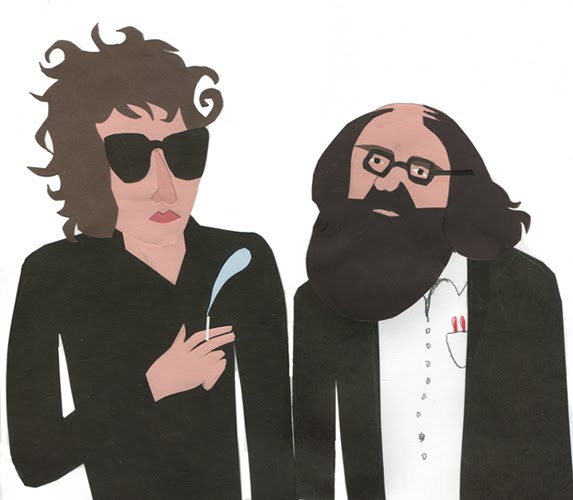
Dylan and the Beats - part one

Sometime during the documentary, "The Life and Times of Allen Ginsberg," writer Norman Mailer says: "Allen was all about the 'politics of ecstasy'... and this changed everything." (CORRECTION: I JUST GOT A NOTE FROM THE FILM'S DIRECTOR WHO REMINDED ME THAT IT WAS TIMOTHY LEARY - NOT NORMAN MAILER - WHO SPOKE OF THE POLITICS OF ECSTASY. PLEASE FORGIVE...)I believe this is what inspired Bob Dylan to return to his first love - rock and roll - after creating a monster career as a "protest folk singer" in the early 60s. James Miller, in his most excellent book, Flowers in the Dustbin: the Rise of Rock and Roll 1947-1977, writes:

It was on a meandering, month-long trip from New York to San Francisco in quest of America, by way of Harlan Country, Kentucky (to meet coal miners), Hendersonville, North Carolina (to speak with poet Carl Sandburg), New Orleans, Louisiana (to celebrate Mardi Gras), Dallas, Texas (to see where President Kennedy had been shot), and Denver, Colorado (to look up the folk singer Judy Collins), that Bob Dylan experienced - again - the rush of musical excitement he had first felt, years before, in high school listening to Little Richard. It was February, 1964. Dylan, twenty-two, was the most widely admired, young folk singer and songwriter in America, thanks to "Blowin' in the Wind" - a song of wistful longing and defiant hope, sung the previous summer at the civil rights March on Washington led by the Reverend Dr. Martin Luther King, Jr. On the road, Dylan meant to consort with the ghost of Walt Whitman, the muse of Allen Ginsberg, the wayward spirit of Jack Kerouac... in search of America.

Instead, he discovered something else... blaring from his car radio: the Beatles! Dylan said, "We were driving through Colorado, we had the radio on and eight of the Top Ten songs were Beatles songs... they were doing things nobody was doing. Their chords were outrageous, just outrageous and their harmonies made it all valid. You could only do that with other musicians... and it started me thinking about other people and forming a rock and roll band." It was that Beat spirit and the politics of ecstasy at work: the joy, the hope, the possibilities of humanity and the bold sensuality of rock and roll as filtered through an insistent back beat that knocked Dylan on his ass and gave him a reason to play music again.

He had been ready to throw in the towel: the political correctness of the New York radical unions and leftists had rendered him physically exhausted, intellectually sterile and emotional vacant. Jumping through the hoops of one political cause after another was NOT what drew him to music back when it was fresh. Again, Miller is so right:

... like John Lennon and Paul McCartney, Bob Dylan had grown up with Elvis Presley and Chuck Berry and doo-wop rhythm and blues. While still in high school... he had formed a rock band... in the fall of 1959, when he went off to college at the University of Minnesota in Minneapolis, he discovered a bohemian student milieu similar to what Lennon hand found at the Liverpool College of Art and Keith Richards had found at Sicdup College of Art: a world of cheap wine, beat poetry and coffeehouse music - mainly jazz and folk.

So, Dylan took up what was happening - he listened and absorbed the Beats - and created identity after identity after identity: first it was an art student, then a hobo a la Woody Guthrie, then a protest singer rallying the idealism of America until it burned him out. He was experimenting - searching for integrity and ecstasy - not bull shitting. And when he heard the Beatles' "I Want to Hold Your Hand" the world was suddenly filled with possibilities again and he knew he had to give it a shot.

A uniquely American shot, if you please. He was VERY conscious of creating a new American poetry of rock and roll within the politics of ecstasy. Listen to his first attempt on Another Side of Bob Dylan - clearly his first rock and roll album (albeit without a band) - as he sings "All I Really Want to Do." He is a wild man. Same with "It Ain't Me, Babe." He took it to another level on Bringing it All Back Home where one side was Ginsberg meets LSD on an acoustic guitar. While side two was Walt Whitman and Arthur Rimbaud in a blender fueled by a bank of Fender amps and guitars. All of it, however, grounded in American folk and blues, yes?

Tomorrow I hope there will be time to go into more detail re: the electric connections between Dylan and the Beats because they are profound and under-represented. For now Mikal Gilmore's words will have to suffice in his brilliant essay about Ginsberg:

As much as Presley, as much as the Beatles, Bob Dylan or the Sex Pistols, Allen Ginsberg helped set loose something wonderful, risky and unyielding in the psyche and drams of our times. Perhaps only Martin Luther King Jr.'s brave and costly quest had a more genuinely liberating impact upon the realities of modern history, upon the freeing up of people and voices that much of established society wanted kept on the margins.

(NOTE: I just LOVE the sincere tenderness of Ginsberg talking about the first time he heard Dylan here; he is one of my saints - broken and wounded to be sure - but also so totally human and alive.)

Just as Dylan would later change what popular songs could say and do, Ginsberg changed what poetry might accomplish: how it could speak, what it would articulate and whom it would speak to and for. Ginsberg's words - his performances of his words and how he carried their meanings into his life and actions - gave poetry a political and cultural relevance it had not known since the 1840s' Transcendentalists (Ralph Waldo Emerson and Henry Thoreau among them) or since the shocking publication of Walt Whitman's 1855 classic, Leaves of Grass. Indeed, in Ginsberg's hands, poetry proved to be something a great deal more than a vocation or the province of refined wordsmiths and critics. Ginsberg transformed his gift for language into a mission - trying to save and heal the spirit of America - as he wrote... And in the process, he not only influenced subsequent writers like Bob Dylan, John Lennon, Lou Reed, Patti Smith and Jim Carroll, but his effect could also be found in Norman Mailer's Advertisements for Myself, in the writings and deeds of Czechoslovakian president Vaclav Havel, in the lives and exploits of the 1960s insurrectionists like Timothy Leary, Tom Hayden and Abbie Hoffman. And one can also hear Ginsberg's effect on later-generation artists such a s Sonic Youth, Beck, U2 and several of our finer hip-hop poets.

What's more - and Ginsberg himself was clear about this - Dylan was the artist who very intentionally picked up his challenge to save and heal the soul of America through the politics of ecstasy. And when he strapped on the electric guitar... well, that is a whole other story still to come!

Thursday, June 10, 2010

More on my obsession with the Beats...

In Garrison Keillor's anthology, Good Poems, he writes: "Anybody who would rather read T.S. Eliot's Ash Wednesday instead of the love poems of Rexroth must be on the take. And yet Rexroth was never mentioned in the halls of the English Department when I was there, nor was Ferlinghetti, that great-hearted, God-gifted man. His City Lights bookstore has always been a mecca in San Francisco. His friend Allen Ginsberg, on the other hand, a good man, admirable in so many ways (especially for Kaddish), was something of a gasbag, not big on rewriting, and reading his Collected Poems is like hiking across North Dakota. I stopped just beyond Fargo."

I think that is only partially right: Ginsberg could be a gasbag and would have benefited greatly from an editor - and (always and... NEVER but) - and his vision of what was essential in poetry unlocked the mythic spirit of the sacred bard in Bob Dylan and rock and roll music has never been the same! For this Ginsberg and his Beat cohorts deserve more credit than they have achieved - and for the next few days I am going to explore the Dylan/Beat connection more fully.

Tonight, however, after a full and satisfying day, I am content with Rexroth even as I anticipate Dylan who wrote:

You are driving to the airport
Along the glittering highway
Through the warm night,
Humming to yourself.
The yellow rose buds that stood
On the commode faded and fell
Two days ago. Last night the
Petals dropped from the tulips
On the dresser. The signs of
Your presence are leaving the
House one by one. Being without
You was almost more than I
Could bear. Now the work is squared
Away. All the arrangements
Have been made. All the delays
Are past and I am thirty
Thousand feet in the air over
A dark lustrous sea, under
A low half moon that makes the wings
Gleam like a fish under water -
Rushing south four hundred miles
Down the California coast
To your curving lips and your
Ivory thighs.

Tomorrow, my lover and I will garden for most of the day, and then I will explore part one of my Beat/Dylan connection cuz I think the old man STILL gets it right.

Wednesday, June 9, 2010

A creative soul...

One of the genuinely exciting things about being in ministry with the folks in Pittsfield is their CREATIVITY! For example, a crew decided that for Pentecost we needed to have a bold visual image of God's love coming upon us. So Sue and Dianne gathered up all the ideas and turned it into this descending dove made from prayer requests...
It is so sweet that I don't want to take it down! I guess we'll keep it up for the rest of June. Last night at band practice, another creative group fashioned a truly beautiful collection of songs for this Sunday's celebration of Sunday School teachers. There are full participation songs - using bells and feet and animal sounds - along with a setting of Psalm 84 that uses an old Scottish folk song as the foundation. Additionally, there will be rounds, a reworking of Jewel's tune, "Hands" and some moving new hymns from around the world.

And then there is the crew who got so excited by Greg Mortenson's ministry a la Three Cups of Tea, that they are putting on a silent auction at the end of the month - June 28th to be precise - so that we might raise money to support education for girls in Afghanistan. And there is energy afloat to refashion our Christian Education ministry, too, so that we are able to connect better with children and young families. Later this summer we will start our Open and Affirming conversation. And our new website will be launched before the end of the month. Incredible...

These next three years will be fascinating: we've overcome many of the initial fears and worries about survival, dealt boldly with some of the financial problems (and have more work to do) and are now exploring ways of unleashing the creative spirit of the congregation. And all under the inspiration of Christ's invitation to welcome and embrace one another as sisters and brothers on a journey. I think this song from Pentecost - Message in a Bottle - gets it right...

Tuesday, June 8, 2010

Faith formation sunday...

NOTE: Here are my weekly Sunday notes for worship on June 13, 2010. This week is a celebration of our Sunday School teachers and their unique ministry of faith/spiritual formation. We will honor them - and also award a third grader a Bible - during worship. If you are in town, please know you are always welcome at the table of Christ's love with us.

Today is an ordinary but uniquely sacred day in the life of our con-gregation – Teacher Recognition Sunday – a time set aside to show honor and respect for those adults who have been called by God to pass on the faith to our children. Teaching Sunday School, you see, is not for every-one.

• Some people love children and the Lord but are simply unable to connect or communicate with children. Others have a burning passion to spread the faith, but are not comfortable with little ones. And still others have no patience or presence with children and need to be kept as far away from talking about the faith to our children as possible.

• Because, you see, Christian faith is always just one generation away from extinction, right? Some people don’t believe this – they think that as long as you were baptized once sometime in the dark, distant past – you are forever a disciple of Jesus.

• And in some vague and abstract way there is some truth to this but it is also true that unless our faith is lived – unless the Words of our tradition become FLESH – something is missing.

So we take the training of young disciples very seriously. This is faith formation work, beloved, essential for keeping the love of Jesus alive and well in our part of the world. Now there are three ingredients when it comes to authentic faith or spiritual formation – story telling, open discussion and questioning as well as action and reflection – and I want to talk about why each of these ingredients matters for our children as well as the mission of the church.

And I thought it might be fun to actually use this morning’s gospel reading from Luke – one of the great stories in our tradition – so that together we experience and celebrate the importance of faith formation. I would like everyone – children, teens and adults – to help me out with this for a few minutes because everybody here is important. Valuable. Unique and specially loved by God. And what you have to say might just wind up being what someone really needs to hear. So, let’s try this together.

Now the first part of faith formation is called story-telling – sharing both the words and mood of the Bible accurately with one another – and why is that important?

• First, it gives us a common language, yes? It is very tough to communicate values and compassion to one another without a common language. That’s why most of the people around the world still gather in the evening – often around a fire or in a warm and safe place – and pass on the stories of their people.

• It gives us a shared starting place for faith – common ground for building upon – and sadly American’s don’t do this very well any more. In a quest to overcome some of our bigotry and racism we are often more tuned-in to diversity than shared stories – what makes us different rather than what we hold in common.

• And while I support the celebration of diversity, without a common language rooted in stories… we have thrown the baby out with the bathwater.

The first reason we tell one another stories is to create and claim a common language. And the second is that stories are easier to remember than facts. Indeed, stories put facts into a context and help us share knowledge and collaborate creatively. Business guru, John Kotter, has said: “Stories stick in the brain in a holistic way, better than charts, numbers and concepts. As a result the probability that the message will have an impact on behavior goes up.”

So let’s tell one another the highlights of today’s story involving Jesus, a party, some expensive perfume and how some people react to the love on an uninvited guest.

One of the Pharisees asked Jesus over for a meal. He went to the Pharisee's house and sat down at the dinner table. Just then a woman of the village, the town harlot, having learned that Jesus was a guest in the home of the Pharisee, came with a bottle of very expensive perfume and stood at his feet, weeping, raining tears on his feet. Letting down her hair, she dried his feet, kissed them, and anointed them with the perfume. When the Pharisee who had invited him saw this, he said to himself, "If this man was the prophet I thought he was, he would have known what kind of woman this is who is falling all over him."

Good stuff, in part one of this story, don’t you think? What are the highlights of this story for you so far…?

• Now there are two other parts to the story of Jesus: what he tells Simon – one of his disciples – and what the other guests say about the way Jesus treated the woman.

• Can you tell me what Jesus said to his friend Simon?

• And what about the reaction from the other guests at the party: how did they respond to Jesus and the woman?


Part one of faith formation is telling the story and building a common language: part of our ministry to children and young families is all about telling and retelling the stories of the Bible. Not only has our culture forgotten them, many in the wider church don’t know them all that well either.

Part two has to do with talking about the story – asking hard questions, too – so that we can figure out why this story matters. So, let’s cut to the chase:

• What do you think Simon thought of the woman in this morning’s story?

• What about Jesus: what did he think about her?

• What about the other guests: what did they think about the woman who poured expensive perfume on the feet of Jesus?

Now, let’s go deeper: what does this story tell us about what Jesus thinks of you and me? Any ideas? And going deeper still…

• Who do you find it difficult to accept or love?

• Are the people or groups of people that you don’t like?


• What is the challenge for us in this story?


It isn’t easy making the love and acceptance of Jesus real, is it? There’s nothing automatic about it: it takes practice and commitment and encouragement. That’s why we have Sunday School – and church, too.

Are you still with me? Part one is story-telling – Part two is talking and questioning the story – and Part three is putting the story into practice and seeing how it works. And there are a lot of ways to put this story into practice, here’s just one that comes from the creative work of Ann Scull: (find her @ http://seedstuff.blogspot.com/2007/06/proper-6-ordinary-11-pentecost-3-c-june.html)

Do you see the three tables at the front of the church? Each one has a bowl on it – and a sign – inviting you to do something as a result of today’s story.

• The first bowl is filled with salt water: if there is something you want to ask God for today, then go to that bowl, dip your finger into the salt water and make the sign of the cross on your cheek or forehead asking God in prayer for whatever it is you need.

• At the second bowl, there is lightly scented oil – maybe a little like the perfume the woman poured upon the feet of Jesus – so if there is something you would like to thank God for then go to that bowl and make a cross on the back of your hand.

• And at the third bowl there is a bunch of handy wipes – something to help you clean up in preparation for work – so if you sense that God is calling you to serve the church of the wider community in some way… get washed up and ready to go into action, ok?

Is that clear? Salt water to ask God for something in prayer – scented oil to return thanks to God – and handy wipes to get ready for action. As you come forward – and take your time and help one another, too – we’ll play a tune or two to keep things moving.

(As the people come forward, play “Hands” by Jewel)


The story for today ends with these words:

Jesus went forward according to plan, travelling to town after town, village after village, preaching God's kingdom, spreading the Message. And the Twelve were with him… including some women who had been healed of various evil afflictions and illnesses: Mary, the one called Magdalene, from whom seven demons had gone out; Joanna, wife of Chuza, Herod's manager; and Susanna—along with many others who used their considerable gifts to provide for the company and keep the ministry growing.

Today we give thanks to God for those who keep the ministry growing by nourishing the faith of our children.

Monday, June 7, 2010

The rhetoric of the road trip...

NOTE: In part two of my reflection on why the Beats matter in the 21st century, it is necessary to offer a tip of the hat to Jack Kerouac. His rhetoric of "the road trip" not only impelled many of us to explore this wild and great land in our younger days, but also gave shape and form to a musical metaphor that evokes something of the longing within every soul, freedom and the quest/journey towards spiritual wisdom.


Before I understood what was going on, I LOVED "Born to Be Wild" by Steppenwolf. From the opening crack of the drums to the thundering guitar riff this song screamed: LET ME BE FREE! My high school band played it with abandon. I danced my ass off to it every chance I could get. And it still makes me smile whenever it pops up on rotation on the local radio. It is no wonder that Dennis Hopper (may he rest in peace) and Peter Fonda insisted that this song set up their rock and roll masterpiece: Easy Rider (which hasn't aged well but was THE rock and roll Western of the 60s.)

Jack Kerouac was the MAN who made "Born to Be Wild" possible: his 1957 book of wandering, adventure, spontaneous roadtrips and the joy of living - On the Road - has been called the "most beautifully executed, the clearest and most important utterance" of Kerouac's generation. (NY TIMES) It evokes what many of us have discovered during either a roadtrip or a pilgrimage: there is much to be discovered about the soul - good, bad and troubling - when you start a journey without a clear or final destination. What's more, if you are open to the wisdom of the road, you will find blessings you didn't know were waiting for you as well as answers to questions you hadn't yet formed.


Clearly Kerouac gave a jazz shape and form to the archetypal story of the hero's quest: Dean Moriarity and Sal Paradise are the bebop cousins of Frodo and Samwise in Tolkien's Lord of the Rings trilogy. What's more, Kerouac's rhetoric of the roadtrip paves the way for countless folk and rock and roll journeys into the core of life's meaning.

+ Sometimes these pilgrimages are joyful: the entire legacy of the Grateful Dead comes to mind along with songs like Cat Steven's "On the Road to Find Out," Canned Heat's "On the Road Again," "Route 66" in all its incarnations, the Allman Brothers' "Midnight Rider," America's "Ventura Highway," B52's "Love Shack," the Beatles' "Why Don't We Do It in the Road," Chuck Berry's "Back in the USA" and "You Can't Catch Me," Springsteen's "Rosalita" and "Stand On It," Johnny Cash's "I've Been Everywhere," Commander Cody's "Hot Rod Lincoln," Sheryl Crow's "All I Want to Do" and "Everyday Is a Winding Road," Taj Mahal's "Six Days on the Road," Kathy Mattea's "455 Rocket," James Taylor's "Country Road," "U2's "Where the Streets Have No Name," ZZ Top, "Jesus Left Chicago."

+ And sometimes the road is much harder: think Springsteen's "Thunder Road," "Drive All Night" or "Racing in the Street," Jackson Browne's "Runnin' on Empty" and "The Pretender," Harry Chapin's "Taxi," Dire Straight's "Telegraph Road," countless tunes by the Doors including "The End," Dylan's "Highway 61 Revisited," "Don't Think Twice It's Alright," and "Tangled Up In Blue," the Eagles' "Hotel California," Steve Earle's "Guitar Town" and "Transcendental Blues," Creedence, "Lodi," Green Day's "Boulevard of Broken Dreams," Roseanne Cash's take on "Movin' On," Hendrix's version of "All Along the Watchtower," Kristofferson's "Me and Bobby McGhee," Beatles' "Long and Winding Road," Lucinda William's "Car Wheels on a Gravel Road," or Bob Franke's "Hard Love" and For Real."


Without the Kerouac words and mythology of the road - often a barely paraphrased version of Neil Cassady's drug inspired monologues - contemporary rock and roll would be hard pressed to find a way to evoke the challenge and promise of contemporary living. Fortunately, the most creative rock artists have not remained bound by the often self-centered limits of Kerouac's ramblings. Joni Mitchell, Bob Franke, U2 and Bruce Springsteen along with Mary Chapin Carpenter, Lucinda Williams and Lou Reed have taken the image of the road and teased out new meanings and insights... and they aren't finished with it yet. (Dig this incredible remake of the Boss Man's "Open All Night" a la the Seeger Sessions where Springsteen mixes beat-style poetry with a whole lotta jazz. God do I love this song...)

Sunday, June 6, 2010

Random shots in San Francisco...

During my recent sojourn to San Francisco, I had the chance to visit a variety of my favorite places in all of creation. The first was Jack Kerouac Avenue - a tiny little street connecting North Beach with Chinatown - that Lawrence Ferlinghetti had renamed to honor one of the Beat giants...

Along the street are quotes from some of the Beat poets as well as insights from some of the poets of China. On either side of Jack Kerouac Avenue you will find City Lights Books and Vesuvio. City Lights, of course, is known as both the publisher of Ginsberg's "Howl" as well as being the first American all paperback book store. It is a cultural landmark and a treasure to visit.

Constantly risking absurdity
and death
whenever he performs
above the heads
of his audience
the poet like an acrobat
climbs on rime
to a high wire of his own making
and balancing on eyebeams
above a sea of faces
paces his way
to the other side of the day
performing entrachats
and sleight-of-foot tricks
and other high theatrics
and all without mistaking
any thing
for what it may not be
For he's the super realist
who must perforce perceive
taut truth
before the taking of each stance or step
in his supposed advance
toward that still higher perch
where Beauty stands and waits
with gravity
to start her death-defying leap
And he
a little charleychaplin man
who may or may not catch
her fair eternal form
spreadeagled in the empty air
of existence

(Ferlinghetti)

Next door - and across Kerouac Avenue - is one of the Beat's favorite watering holes: Vesuvio. There are posters lining the walls of the great poets and writers of our era - from Blake and Yeats to Joyce, Woolf and a host of others. Vesuvio's is also one of the hangouts for Paul Kantner from the Jefferson Airplane (who still holds court from time to time.)The Airplane are still one of my favorite bands - sometimes too full of themselves (a flaw known to most of us, yes?) - but also adventurous, creative, beautiful and always lots of fun.

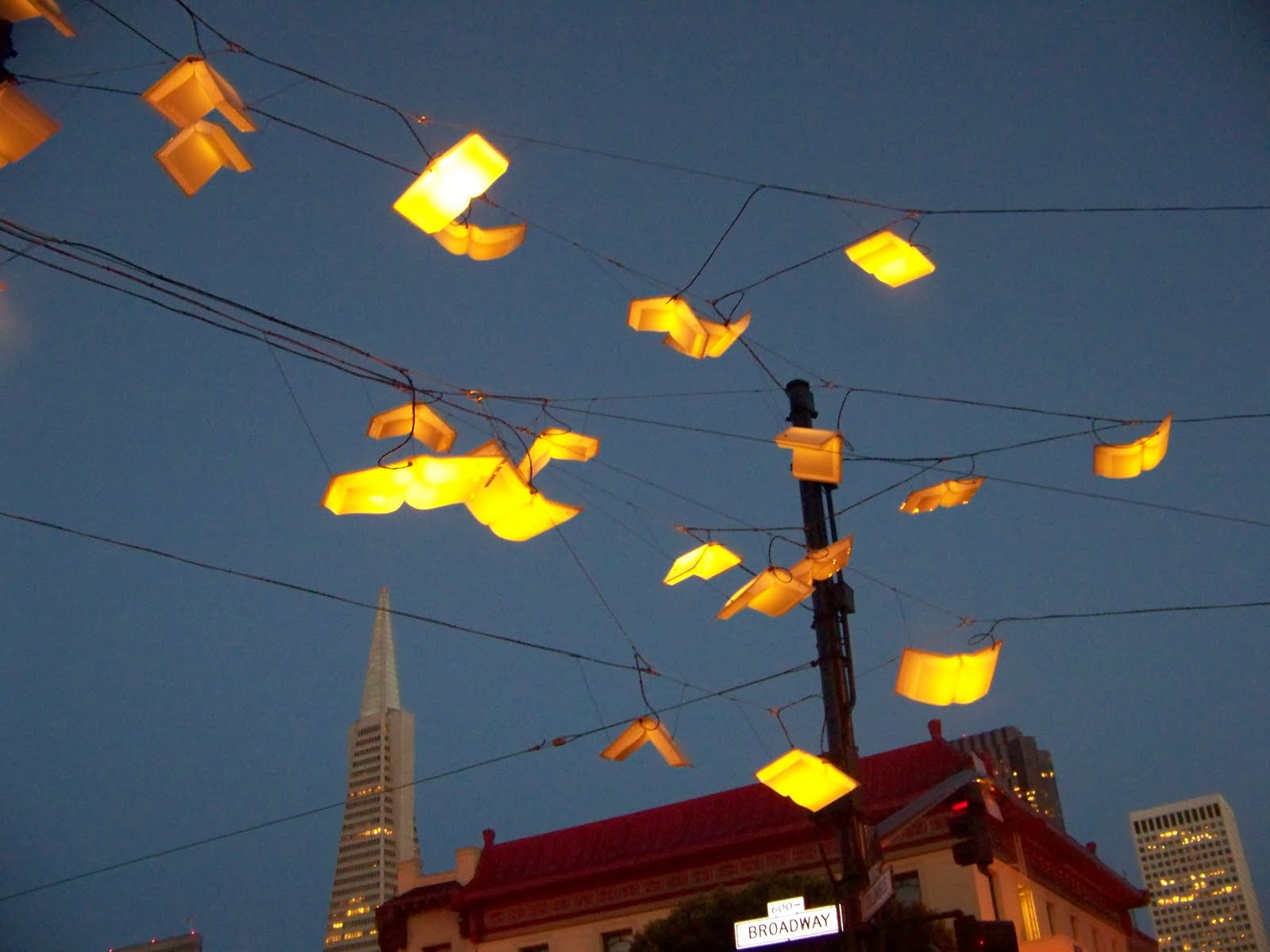
Another fascinating place just on the edge of Chinatown and North Beach is this work of art: flying and illuminated books. This area is saturated in the printed word and I think the city celebrates this heritage in a stunning way with this sculpture in neon.

Cool black night thru redwoods
cars parked outside in shade
behind the gate, stars dim above
the ravine, a fire burning by the side
porch and a few tired souls hunched over
in black leather jackets. In the huge
wooden house, a yellow chandelier
at 3 A.M. the blast of loudspeakers
hi-fi Rolling Stones Ray Charles Beatles
Jumping Joe Jackson and twenty youths
dancing to the vibration thru the floor,
a little weed in the bathroom, girls in scarlet
tights, one muscular smooth skinned man
sweating dancing for hours, beer cans
bent littering the yard, a hanged man
sculpture dangling from a high creek branch,
children sleeping softly in their bedroom bunks.
And 4 police cars parked outside the painted
gate, red lights revolving in the leaves.
(Ginsberg)

And last, but never least, is The Saloon, probably the oldest standing bar in San Francisco and home to blues/rock bands for generations. Whenever I am im town, I insist - which doesn't take too much encouragement - that my brother, sister-in-law and I head down to the Saloon to shake our booties. Seems to me I spent a WILD 50th birthday in this place and we shut it down a few times on this trip, too. Heard two exceptional new blues band this go 'round - one night there were 3 dueling guitar players - and the other a rock and soul quartet that was inspirational.

Saturday, June 5, 2010

The Beats - going deeper - and why they matter...

NOTE: I am working on an extended posting about the importance of the Beat poets - particularly Allen Ginsberg - as an inspiration for a new art form in rock and roll music. Yesterday, I set out the overall design of my concerns; today I will attempt to create an artistic and historical context.

INTRODUCTION
As our awareness of the ecological disaster in the Gulf of Mexico matures, aided by photographs of endangered pelicans and plunging international stock markets, the words of Allen Ginsberg's poem, "Howl," cry out for a new hearing: "I saw the best minds of my generation destroyed by madness..."

There is madness and fear everywhere: America's addiction to oil and conspicuous consumption is driving two wars in the Middle East. This addiction not only blinds us to the destruction we create but has convinced us that our way of living is sustainable. We have lost a common moral language and no longer know how to speak of greed or the common good. Within this vacuum, the politics of fear have ascended as evidenced by the fury of the Tea Party movement and the acrimony of the recent Arizona immigration law.

Fine tuning the economy seems irrelevant. Public inquiries into the root causes of the BP catastrophe feel insulting. For this is an apocalyptic moment - a time of collapse and potential rebirth - that demands a moral reckoning: "a national discussion... about the fundamental moral issues at stake, and perhaps even a national reflection on our whole way of life based on oil dependence and addiction." (Jim Wallis, Sojourners, June 3, 2010)

In 1956, Ginsberg prophesied to the nation in "Howl." He unleashed both the oft unspoken moral judgement against greed that is necessary for social healing and a wave of artistic creativity that took shape and form in the maturation of rock and roll. Reclaiming the passion of the Hebrew prophets for social justice and compassion - and reclaiming a name for the idolatrous enemies of Israel - Ginsberg wailed:

What sphinx of cement and aluminum bashed open their skulls and ate up their brains and imagination?
Moloch! Solitude! Filth! Ugliness! Ashcans and unobtainable dollars! Children screaming under the stairways! Boys sobbing in armies! Old men weeping in the parks!
Moloch! Moloch! Nightmare of Moloch! Moloch the loveless! Mental Moloch! Moloch the heavy judger of men!
Moloch the incomprehensible prison! Moloch the crossbone soulless jailhouse and Congress of sorrows! Moloch whose buildings are judgment! Moloch the vast stone of war!

Moloch the stunned governments!Moloch whose love is endless oil and stone!
Moloch whose soul is electricity and banks! Moloch whose poverty is the specter of genius! Moloch whose fate is a cloud of sexless hydrogen!

Here is something of the descent into brokenness and excess celebrated by Rimbaud; here, too, is Baudelaire's sensual and troubling honesty about our dark shadow.

It's Ennui! — his eye brimming with spontaneous tear
He dreams of the gallows in the haze of his hookah.
You know him, reader, this delicate monster,
Hypocritical reader, my likeness, my brother!


Here is the sacrament of erotic human love honored in Rexroth and Yeat's mystical encounter with all that is holy within the depths of our humanity:

I met the Bishop on the road
And much said he and I.
'Those breasts are flat and fallen now,
Those veins must soon be dry;
Live in a heavenly mansion,
Not in some foul sty.'

'Fair and foul are near of kin,
And fair needs foul,' I cried.
'My friends are gone, but that's a truth
Nor grave nor bed denied,
Learned in bodily lowliness
And in the heart's pride.

'A woman can be proud and stiff
When on love intent;
But Love has pitched his mansion in
The place of excrement;
For nothing can be sole or whole
That has not been rent.'


And here is Walt Whitman embracing William Carlos Williams as Langston Hughes looks on with words of challenge and encouragement:

Let America be America again. Let it be the dream it used to be. Let it be the pioneer on the plain Seeking a home where he himself is free.

(America never was America to me.)

Let America be the dream the dreamers dreamed-- Let it be that great strong land of love Where never kings connive nor tyrants scheme That any man be crushed by one above.
(It never was America to me.)


And within all of this, too, is Ginsberg's ode to bebop and the immediate, intuitive and improvisational spirit of true soul music. "Howl" is a written and oral celebration of the sounds of Charlie Parker, Dizzy Gillespie and Thelonius Monk. It is an authentic jazz jeremiad about the totality of our humanity: sound and silence, shadow and light, debasement and enlightenment, fear and joy, politics and spirit, heaven and earth. Because, you see, Ginsberg loved - truly loved - God's creation and God's people. All of them - the wounded and the whole - the sinners and the saints - never just the winners but always the losers, too. Beautiful losers to borrow the words of another Hebrew prophet/poet Leonard Cohen, devoted to the blessings of real life.

Ginsberg was searching for a path of healing and hope amidst the darkness of America - a way beyond the madness that destroyed the best minds of his generation - a way of compassion that is still haunting. Like a Buddhist bluesman, an ancient Jewish prophet or an urban hipster on a quest for enlightenment, his lament continues to wail and moan:

(I watched those) who threw their watches off the roof to cast their ballot for Eternity outside of Time, & alarm clocks fell on their heads every day for the next decade,
who cut their wrists three times successively unsuccessfully, gave up and were forced to open antique stores where they thought they were growing old and cried, who were burned alive in their innocent flannel suits on Madison Avenue amid blasts of leaden verse & the tanked-up clatter of the iron regiments of fashion & the nitroglycerine shrieks of the fairies of advertising & the mustard gas of sinister intelligent editors, or were run down by the drunken taxicabs of Absolute Reality, who jumped off the Brooklyn Bridge this actually happened and walked away unknown and forgotten into the ghostly daze of Chinatown soup alleyways & firetrucks, not even one free beer...
the madman bum and angel beat in Time, unknown, yet putting down here what might be left to say in time come after death,
and rose reincarnate in the ghostly clothes of jazz in the goldhorn shadow of the band and blew the suffering of America’s naked mind for love into an eli eli lamma lamma sabacthani saxophone cry that shivered the cities down to the last radio with the absolute heart of the poem of life butchered out of their own bodies good to eat a thousand years.


As I read the NY Times - and weep over the destruction, the lies and the fear our addiction has wrought in the Gulf Coast, in the Middle East and Asia, within our First Nation lands, in the hearts and bodies of women and men and GLBTQ and children and animals and water, soil and air - I give thanks to God for Allen Ginsberg. He was broken and vile, holy and human, just like us all. He set our language and imagination free in ways that still reverberate through the best of rock and roll.

Friday, June 4, 2010

I saw the best minds of my generation...

Ok, so I have been obsessing on the Beat poets for a few weeks. Yes, yes, I know that I have been reading a lot of Ginsberg and Kerouac and Burroughs - and visiting their old San Francisco haunts, too - and spending a lot of my vacation time thinking about why they strike me as so important - especially in 2010. What's more, it has become quite clear to me that their influence has been sadly minimized and even neglected in much of what passes for rock and roll critique.

Clearly, Mikal Gilmore gets it right in Stories Done his reflections on the outcasts of the 60s. Writer Kate Stephenson has written a chapter called "A Revival of Poetry as Song: Allen Ginsberg, Rock-and-Roll and the Return to the Bardic Tradition." And there is an insightful posting quoting Rick Danko of the Band sharing his thoughts about Ginsberg, Dylan and rock and roll. But not a great deal more that I have been able to find. (NOTE: if you know of other resources that are valuable, PLEASE share them, ok?)

So, I want to turn this current obsession into something creative and maybe even satisfying; which means I am going to write an extended essay called "The Madness of the Best Minds of My Generation: Beat Poets and the Art of Rock and Roll." (If I knew how to make a flow chart on blogger I would outline it visually. Because I don't, however, let me lay out my ideas like this.) The essay would have four parts:

I. Introduction
A. The foundation for my hunch is Ginsberg's poem "Howl."

1. It was influenced by Blake, Rimbaud, Baudelaire, William Carlos Williams, Langston Hughes and Walt Whitman

2. It was critiqued by Kenneth Rexsroth of San Francisco as "too stilted and academic"

3. Finding his own "bebop" and "spiritual" voice - helped along by Jack Kerouac - "Howl" is shared in North Beach in 1956

B. The poem is an oral and written version of "bebop art: immediate, intuitive and improvisational.

C. It is equally "incarnational" in a prophetic way in that it explores EVERYTHING within the human experience: shadow and light - debasement and enlightenment - spirituality and sexuality - economics and matters of the heart. In this, Ginsberg is connected to the prophets of the Old Testament.

II. The popular culture expression of the Beats was clearly Jack Kerouac's book: On the Road.

A. This experiment in jazz prose was inspired by the rapping monologue's of Neil Cassady who later went on to drive the Merry Prankster bus for Ken Kesey during his electric kool-aid acid tests.

B. Kesey, Kerouac and Cassady influence/shape the early experience of the Grateful Dead - the hou
se band for the acid tests - who later befriend Bob Dylan.

III. The rock and roll musicians of the 60s - as well as key artists of subsequent generations - not only embrace the wisdom and wildness of Ginsberg and Kerouac, they build upon the Beat foundation to create a new art form. At its heart this new genre includes a poetry saturated with everyday language, social critique and spiritual challenge.

A. The leader of the pack is clearly Bob Dylan who makes his first rock album - without a band - with Another Side of Bob Dylan. This record embraces the Ginsberg influence and plays with it.

1. Dylan continues the experiment with: Bringing it All Back Home, Highway 61Revisited and Blonde on Blonde.

2. Dylan returns to this experiment again on Blood on the Tracks as well as Desire and the Rolling Thunder Review - which includes Ginsberg.

B. The Beatles are connected not only through Dylan but Lennon's exploration of poetry.

1. Examples would include the shift in their music after 1965 - Rubber Soul - as well as Revolver and Sgt. Pepper with parts of the White Album, too. Ginsberg records some of his Blake material at Apple but it is never released. (He also works with Dylan, too.)

2. John Lennon's solo work builds on this Beat foundation.

3. Paul McCartney eventually records and performs with Ginsberg.

C. Other 60s rock musicians who begin to experiment with the new art form of poetry, music and the movement of the body would include: Joni Mitchell, Nico and the Velvet Underground, Jefferson Airplane, Grateful Dead, The Doors, Pearls Before Swine, Marvin Gaye, Simon and Garfunkel, Gil Scott-Heron and the Last Poets, Leonard Cohen.

D. Musicians from the 70s: Bruce Springsteen, Television, Patti Smith, Voidoids, Talking Heads, the Clash, Bruce Cockburn, Tom Waits

E. Musicians from the 80s: U2, REM, Natalie Merchant and 10,000 Maniacs, Ani DeFranco, NWA, Cowboy Junkies, Sarah McLachlan

F. Musicians from the 90s: Eminem, Jay Z, Beck, NIN, Arcade Fire, Nirvana, Michel Franti , Radiohead, Arrested Development

IV. Closing observations

A. Rock and roll reclaimed and reinvented poetry through the inspiration and witness of the Beats.

B. This new art form embraced new technologies in addition to marrying words with music and often visuals and body movement, too.

Well, that's my working outline: thoughts, ideas, criticisms, questions? There is a Beat theme through all of these artists - and it is grounded in an incarnational commitment to freedom - that Ginsberg nailed in part two of "Howl."

What sphinx of cement and aluminum bashed open their skulls and ate up their brains and imagination?
Moloch! Solitude! Filth! Ugliness! Ashcans and unobtainable dollars! Children screaming under the stairways! Boys sobbing in armies! Old men weeping in the parks!
Moloch! Moloch! Nightmare of Moloch! Moloch the loveless! Mental Moloch! Moloch the heavy judger of men!
Moloch the incomprehensible prison! Moloch the crossbone soulless jailhouse and Congress of sorrows! Moloch whose buildings are judgment! Moloch the vast stone of war! Moloch the stunned governments!
Moloch whose mind is pure machinery! Moloch whose blood is running money!


Thursday, June 3, 2010

Thoughts on grace and peace...

NOTE: After a week away in San Francisco, I am back home getting into the church groove again. As you can tell, my thoughts are still exploring a LOT of BEAT images and poetry as I wrestle with preaching/teaching my way through Paul's letter to the Romans this summer. I will be using some of the lectionary texts but emphasizing insights from St. Paul, too. So, here we go on a 16 week adventure. If you are in town on Sunday at 10:30 am, please stop by for worship.


When I was away visiting my brother in San Francisco last week, I spent a great deal of time revisiting the legacy of the Beat poets. I don’t mean the beatniks – they were a shallow caricature of the Beat poets – but rather those writers and thinkers who tried to capture the innovation, rhythm and existential abandon of bebop jazz musicians like Coleman Hawkins, Charlie Parker, Dizzy Gillespie and Thelonious Monk.

• Do you know that groove? It is wild music that plays with rhythm, melody and harmony all at the same time – joyfully breaking rules – while exploring the hidden off beats or the dissonant notes of a song that are always waiting to be discovered by those daring enough to push the limits.

• It is a style of music that was revolutionary when it arrived: it demanded maximum creativity and innovation including the willingness to improvise furiously as well as listen carefully to both the sounds being created by your comrades in music and those yet untapped, captive sounds still inside your soul that lay waiting to be set free.


The Beats celebrated liberation in thought, word and deed, aching to be as expressive in their realm as were their jazz co-conspirators before them. And of all the Beat poets I found myself most curious about Allen Ginsberg – clearly the heart and soul of the movement – who was simultaneously brilliant and disgusting, socially enlightened and self-absorbed, generous and compassionate but also undisciplined, arrogant and emotionally wounded in a hundred tragic ways. In other words, he was a regular human person much like you and me with the exception being that Ginsberg’s brokenness was usually made painfully transparent while we try to keep ours under wraps.

And that may be one of the reasons why he was such a soiled genius: as the Cold War heated up in the 1950s and American paranoia boiled over into McCarthyism and Southern lynching, Ginsberg exposed the social tensions just below the surface like a bebop artist playing with a song’s melodic structure. In his 1956, he put it like this in his masterpiece, “Howl,” that begins:

I saw the best minds of my generation destroyed by madness, starving hysterical naked,
dragging themselves through the negro streets at dawn looking for an angry fix,
angelheaded hipsters burning for the ancient heavenly connection to the starry dynamo in the machinery of night,
who poverty and tatters and hollow-eyed and high sat up smoking in the supernatural darkness of cold-water flats floating across the tops of cities contemplating jazz,
who bared their brains to Heaven under the El and saw Mohammedan angels staggering on tenement roofs illuminated,
who passed through universities with radiant cool eyes hallucinating Arkansas and Blake-light tragedy among the scholars of war,
who were expelled from the academies for crazy & publishing obscene odes on the windows of the skull,
who cowered in unshaven rooms in underwear, burning their money in wastebaskets and listening to the Terror through the wall…

Ginsberg breathed new energy and jazz-based improvisation into the prophets of the Old Testament, giving birth to first the even more challenging creations of Bob Dylan and then inspiring artists like Bruce Springsteen, the Police and the best hip hop and rap artists of our era to marry social criticism and spiritual transformation with poetry and art.


And this, writes M. Craig Barnes who is the professor of Leadership and Ministry at Pittsburgh Theological Seminary, is also the work of the pastor:

To be of service to the Holy Spirit, who is at work in human lives, the pastor can never reduce ministry to servicing parishioners’ complaints about the church… (rather) the work of the pastor is much like the poet… who has been blessed with a vision that allows them to explore and express the truth behind (and below) reality. Poets see the despair and heartache as well as the beauty and miracle that lie just beneath the thin veneer of the ordinary, and they describe this in ways that are recognized not only in the mind, but more profoundly in the soul… What a congregation needs is not a strategist to help them form another plan for achieving a desired image of life, but a poet who looks beneath even the desperation to recover the mystery of what it means to be made in God’s image.

It may well be true that the best minds of our generation are still being destroyed by madness, but what is our still-speaking God saying through that curse? And where is God’s light in this present darkness? And where is the holy within our humanity or the marriage of heaven with earth in our generation?

Well… I am going to suggest that one way to explore all of this involves using the counter-cultural Christian commitments of St. Paul. His wisdom and passion for Jesus – his mystical encounter with grace – and the clarity of his poetry and prose are unique in the Bible. Not perfect, but still essential.

• When the Roman Empire was collapsing all around him in 430 of the Common Era, Augustine of Hippo spent time with Paul’s letter to the Romans and began to find a way through the darkness.

• One thousand years later, when John Calvin was trying to articulate a way of making God’s grace and justice real for the 16th century, he, too, turned to wisdom of Paul in Romans.

• And when Karl Barth was searching for both solace and challenge in post WWI Germany – as well as during the rise of Hitler – it was St. Paul’s letter to the church in Rome that was his inspiration.

So, in our own era of ecological disaster and war upon war upon war – in the midst of a season of economic chaos and profound social pain – I can think of no better nor time-tested book of the Bible to consult in our quest to be faithful than Paul’s letter to the church of Rome. And like our Reformation forbearers, I’m going to work through the whole book of Romans – all 16 chapters – each week of this summer. For I affirm what Eugene Peterson has said about Romans:

As we read Paul’s Letter to the Romans we find ourselves immersed in a classic work of spiritual formation. We note the absence of large abstract truths, on the one hand, and individual anecdotes, on the other. What we find, instead, is a working model of what continues to aid in the formation of souls by the power of the Spirit: submission to Scripture, embrace of mystery, metaphorical language and the insistence on community.

And so let me begin with one essential insight from chapter one of Romans: right out of the gate Paul speaks to us of both grace and peace from God as a key component to the counter-cultural community of Christ in any era. “Grace to you and peace from God our Father and the Lord Jesus Christ.”

This may not seem all that interesting to the casual reader – and clearly Paul is using a traditional form of greeting at the start of his letter – but remember the poet goes below the obvious to what is truly meaningful. And the combination of the words grace and peace are as revolutionary as bebop jazz or Beat poetry.

You see, with two simple words Paul is speaking about a new kind of community – one in which the wisdom of Greek Hellenism is integrated with and embraced by Hebrew justice – all of which is implied in the two words grace and peace.

Grace, literally charis in Greek, speaks of God’s abiding and healing forgiveness amidst human sin and failure. It is a gift that cannot be earned – nor is it deserved – and more often than not it is bewildering to most of us, yes? Think of the story of the Prodigal Son in Luke’s gospel: Chapter 15 tells the story of a young man who collects his inheritance before his father dies, heads out to the big city for some fast and wild living and then winds up broke and busted.

• After a period of time – filled with muck and slop and failure – the wounded young man realizes that working as a slave for his father would be better than wallowing in the mud with the pigs. So, he goes home hoping not for forgiveness – which he doesn’t deserve – but merely for a place to flop.

• And two things happen, right? His father embraces him – throws a feast – and forgives him NOT because of anything the child has done but rather because that is what a father’s love does. AND the older brother – who has always been loyal and faithful (but also resentful, too) – explodes with anger because the slacker has been shown grace rather than justice. He doesn’t deserve ANYTHING and now he has been given everything!

Most people hate this story – we tend to identify with the older son – and rebel against the promiscuity of the father’s forgiveness. Which is, of course, why Jesus told it: it is just like what he said to the thief beside him on the cross, yes? Today you will be with me in paradise. You don’t deserve it, you can’t earn it but that is the blessed truth of God in God’s fullness. Today’s psalm puts it like this:

Sing praises to the LORD, O you his faithful ones, and give thanks to his holy name. For his anger is but for a moment; his favor is for a lifetime. Weeping may linger for the night, but joy comes with the morning.

Grace is at the heart of God’s presence in our lives through Christ – and Paul wants us never to forget this.

Same, too, with God’s peace: literally shalom, a Hebrew concept, is not just the absence of conflict, but true social justice – the right relations between people as well as people and our environment. Peace is about healing and hope, compassion and renewal; like Marcus Borg once said, the social justice of God’s shalom is the outward expression of God’s grace in the world. No wonder Paul insisted upon integrating grace with shalom. Biblical scholar, Paul Achtemeier, writes that at the very start of Paul’s letter to the Romans:

There is a symbolism which ought not to be missed, for Paul’s combination of greetings signals what is also one of his chief concerns later in this letter – a theme throughout his mission as a whole – namely the universal applicability of the gospel. As in this greeting, so in the gospel, Hebrew and Greek (that is gentile) lose their absolute distinction and without either disappearing are combined into a new expression of God’s compassionate and redeeming love.

That’s probably a good place to stop for today: the marriage of grace and peace – charis and shalom – compassion and social justice. Both are essential for those who live according to the Spirit of Christ. Both give shape and form to Jesus in history. And both are necessary for the formation of the soul of a faith community.

Too often Christians try to play it their own way: some favor forgiveness and in inward journey while others emphasize the work of social justice and ache to change the world. Paul tells us to stop – stop dividing the love of God – stop insisting on one way or the other – stop because you are both right. The love of God in Jesus is all about grace and peace – so let those who have ears to hear, hear.

Wednesday, June 2, 2010

Back home in the Berkshires...

It is wonderful to be back home after an 8 day visit with my brother and his wife in San Francisco. Taking the "red eye" home from California wore this old guy out - no sleep in a five hour flight packed tight as sardines - and then another connecting flight, too. Nevertheless, it was sweet to spend time with Phil and Julie in one of the truly great and creative American cities. I LOVE San Francisco - and Phil and Julie, too - and we took in TONS of music, did LOTS of dancing (at least I did) and had hours of good and loving conversation. And while I am a wee bit frazzled tonight - and will share some thoughts tomorrow - two ideas have been swimming around my head all week.

First, after seeing the Sun Kings again - a great Beatles cover band that just does the music without the schtick - I was stunned at how wonderful it can be when four generations of Beatles' fans get together. Phil, Julie and I saw this group for the first time about 6 years ago at a street fair in North Beach and their 60 minute set embodied the heart of my doctoral dissertation. They were no less energizing this past Sunday in Marin County where children, yuppies, hippies, gays, straights and outsiders and insiders found a way to connect with one another for a moment within the sweet, sweet music. It is almost as if the Beatles' music is another language that brings people together beyond our usual divisions. (And these cats NAIL the tunes as this clip shows so that the beauty, joy and wonder of the music can grow...)


Second, whatever the outcome of my brother's diagnosis - and it is still too early to know how the cancer treatment is working - I wouldn't trade this time together for anything in all creation. We had fun just being with one another. We've always been close and while we've gone our own ways as adults, the time we share now is precious. So, we walked around some of our favorite places in the city. We talked about how our lives have changed over the years. He took me to our favorite watering hole/music venue as well as his new favorite place for breakfast. And we made each day count. My prayers are with him...

And now it is time to call it a night: there is church work to get reconnected with tomorrow, pastoral visits and meetings as well as another sermon to explore and write. I give thanks to God for this treasured time away - and rejoice that I am back home in the Berkshires with my sweetheart.

rejoice, o virgin theotokos...

Today, in Western Christianity, is the Feast of the Assumption of Mary into Heaven, and in the Eastern Church, the Dormition of the Theotoko...