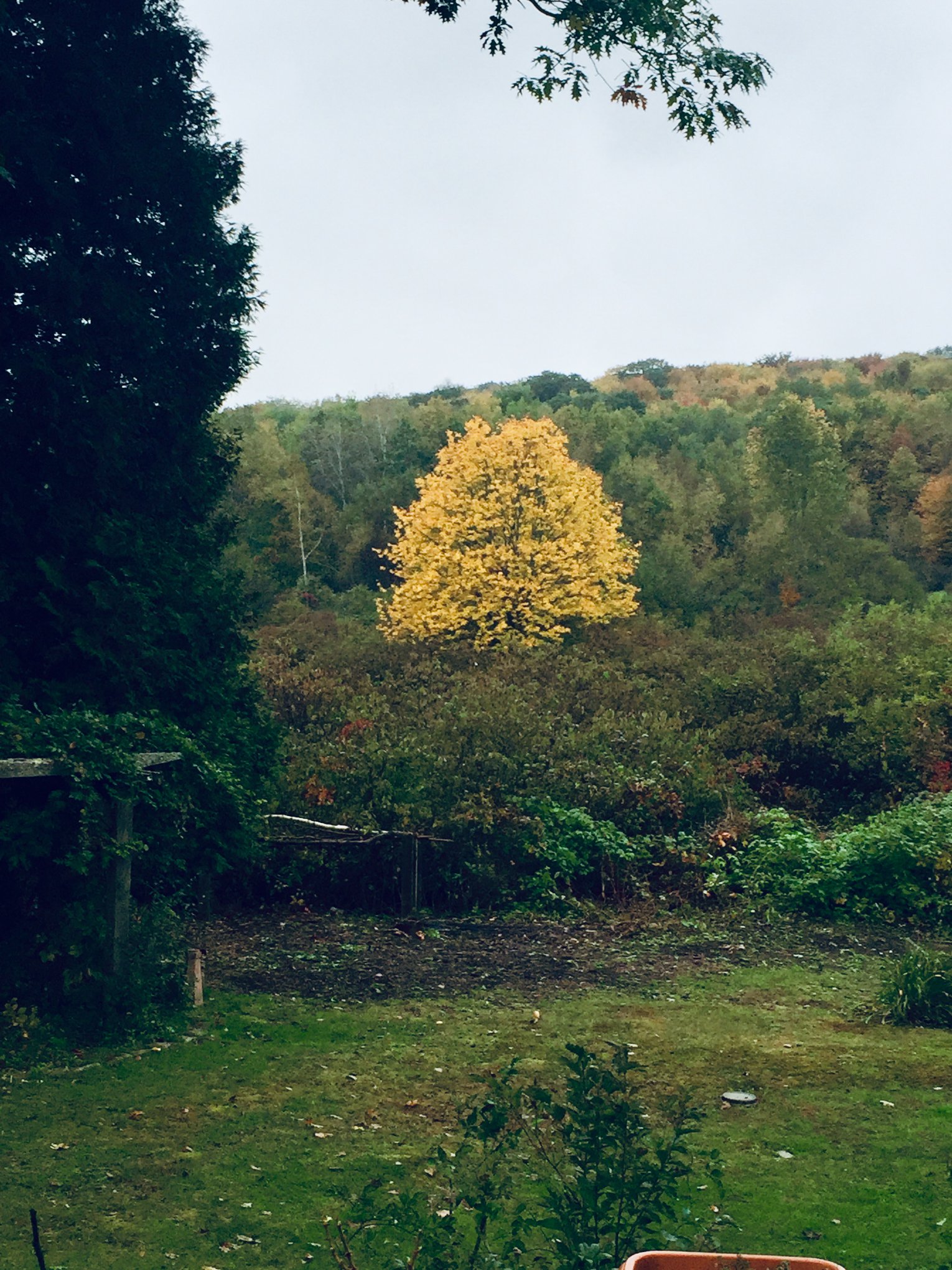
Monday, September 21, 2020

walking slowly through the contagion as autumn arrives...

Post-bubble observations on our short trip to Brooklyn: being away from the security of our garden home for the first time in 6+ months has been eye-opening. That RBG of blessed memory passed from this realm during our away time added another layer of gravitas to the whole experience. Like Parker Palmer I, too believe that we shall find the best political response in the days to come. Cold, cruel, and calculating strategies - while necessary - are not what the heart calls for right now. Indeed, they strip away even more of our wounded humanity. Just look at how Senator McConnell and 45 act: vulgar, ruthless, and cruel. And while I have little room for the whining of the Democrats who cry, "Not fair. Not fair!" (as if anything in the rough and tumble realm of politics is fair) I sense it is best to simply grieve one of the noble yet flawed souls of our generation and let that be enough for the time being. 

This is not the end of the world. It is a sign that our system is 
wounded: hope and integrity should never come down to the well-being of a single person. AOC was clear that RNG's death points out some of the flaws in our imperfect union as well as the emotional and strategic fragility of so many good-hearted people.I get tears right now. Disappointment and shock resonate with me, too. But not the exaggerated apocalyptic wailing I have witnessed since Friday night. So, let us do our own personal and collective grief work and listen for the wisdom of time-tested elders who have faced even greater woes. As I noted in last night's abbreviated "Small is Holy" live stream: there is much to be learned from our First Nations, black and brown neighbors, and allies in the LGBTQ community re: facing challenges with integrity, realism, compassion, as we trust that God's way is always greater than our limited perspective. Just take a listen to the way the Poor People's Campaign Choir renders "Hold On" for a clue concerning what is necessary at this moment in time.

While we were in Brooklyn last weekend enjoying the blessings of our children and grandchildren, a few truths about our new reality took on shape and form for me. While buying hummus and tahinni at our favorite Sahadi's - and a few spinach pies, too - the young clerk moved with slow and careful deliberation. This was partially due to his gloves and mask, but not entirely: he clearly wanted to get his work done in a safe, healthy, and clean manner. As I watched him move at what felt like a snail's pace, however, I became aware of just how riddled with impatience I am. I returned thanks to God for this feeling silently because it showed me yet again my profound addiction to speed. For decades I've preached the restoration of mindfulness - the necessity of slowing down as one counter-cultural way of sharing soul food with our hungry hearts and cultivating compassion - and there I was feeling as if my time was being wasted by a conscientious young man doing his best to keep us both safe. Yes, grasshopper, the Buddha DOES arrive when the student is ready! Taking another deep breath I felt a bit of gratitude as this retail Bodhisattva ministered the healing of humility to my inner restlessness. 

Our daughter said that "planning" is the biggest change she and her small family have felt in this new era of contagion: do we have the proper outside protective gear; am I ready for the demands of tomorrow; what is essential for teaching on-line; how can we keep the young ones engaged, happy, and safe in isolation; who is doing what shopping when; where is the car parked (given the family moratorium on mass transit); has our bubble been kept well enough for our folks to visit; and when was the bathroom thoroughly cleaned as a precaution for their arrival? None of us live in the realm of spontaneity any longer. No one can really just get up and go for where these old ways prevail, the virus is spiking and people are dying. The way of love now requires much more time, creative and insightful planning for all ages, and the necessity of doing more with less.


Taking a road trip after 6+ months of isolation felt like a genuine treat. Our
old safety valve of "getting out of Dodge" for brief adventures has been on hold like the rest of America. Watching the different terrains roll by was joy-filled. Noticing the use of masks throughout rural NY was encouraging. Same too with the PPE on the streets in Brooklyn. Slowly street life is returning for the young. It is not yet clear that this will be a blessing. For while most folk were well covered and protected, they were hardly practicing social distancing. Our son-in-law said there are a lot more street vendors lining the avenues than before the lock down. I was awed by the various face masks on sale - works of art as well as cut-rate paper masks as well - everything from the Virgin of Guadalupe to GO BIDEN. There is a peculiar genius in all of this as hard-working people find a way to make the best of the contagion. I saw this in Poland back in the days of Marshall Law under communism: the official state was cold, grey, and harsh while ordinary people sold wildly colored flowers on the street and turned postage stamp back yards into bold gardens filled with color and vegetables. The down-side of this in our realm is the outrageous prices being charged to the insurance companies for covid testing: for a quick test some fees are $1400 each. We never miss the opportunity to turn a disaster into a way to grab a quick buck.

Our outing to the beach as a delight. Besides baking in the sun, Riis Park was essentially empty. Our grandchildren could play freely in the sand while the adults soaked up the beauty and sounds of the sea. Our Brooklyn family has mastered the art of beach fun with appropriate chairs, well-planned picnics, and a willingness to chill in one spot for four hours at a time. It was restorative for me to play 
with Louie and Anna,. Same, too for feasting and gabbing with Jesse and Mike. and I learned a little more about our new reality while walking these old streets with new eyes. Riding home, the leaves in NY State and Western MA are starting to turn. Apparently we had a frost while away because our basil plants on the deck are now thoroughly wilted. We hustled the peppers and other vulnerable friends inside after picking Lucie up from the kennel. And now we are started to settle back in for another long haul of solitude as the fall ripens. My heart drifts towards Mary Oliver's insights in her "Song for Autumn."

Don’t you imagine the leaves dream now
how comfortable it will be to touch
the earth instead of the
nothingness of the air and the endless
freshets of wind? And don’t you think
the trees, especially those with
mossy hollows, are beginning to look for

the fires that will come—six, a dozen—to sleep
inside their bodies? And don’t you hear
the goldenrod whispering goodbye,
the everlasting being crowned with the first
tuffets of snow? The pond
stiffens and the white field over which
the fox runs so quickly brings out
its long blue shadows. The wind wags
its many tails. And in the evening
the piled firewood shifts a little,
longing to be on its way.

Tuesday, September 15, 2020

maybe leaving the bubble?

From the We Shall See Department: perhaps we will venture beyond our very safe bubble this week? For 6+ months we have not gone beyond our well defined safety zone. We have ONLY visited with family keep strict social distancing guidelines and masks and/or making certain our safety bubble was intact for at least two weeks (plus some covid testing!) Now, it may come to pass that we venture more outside of all of this and take a small Sunset Park flat for a few days to see the family before NYC school starts. I don't know if it will come to pass. There are SO many variables. We'll know by this time tomorrow whether or not we get to reconnect with these dear souls
If it all shakes out, I will post a message re: Sunday's live cast on Face Book. Rather than try to do the gig live from Brooklyn, I think I will simply delay the whole thing until later on Sunday when we return home. But that is up in the air, too. It will be the first time NOT doing "Small Is Holy" in 6+ months, too. should that come to pass. Stay tuned, dear ones, and know I will keep you up to date.

Monday, September 14, 2020

approaching the equinox...

Today is totally fall in New England: blustery but warm winds, sunshine,
plants ripening into reds and browns in the wetlands, end of the season wildflowers waving in the breeze, and my first pot of Pumpkin Chai from David's Teas! About 8 years ago, we discovered this brew while wandering about in MontrĂ©al. It is only sold during the autumn so I savor it. When mixed with a bit of maple syrup and milk as per the maker's instructions, it becomes pure ambrosia. I look forward to this moment every years as the season's true kick off. 

Christopher Hill, in his wise and delightful book Holidays and Holy Nights: Celebrating Twelve Seasonal Festivals of the Christian Year, reminds those who care that just as the monastic day "is about responding to the nature of the hour, not working to a schedule," so too the Christian Year. "The proper question is not, what time is it? Rather, we should ask, what is it time for - work or leisure, community or solitude, waking or rest, praying, eating, reading?" This is how our tradition redeems the culture's obsession with its clocks: time "becomes a servant of the holy human pattern."

Within the flow of seasons, we in the north are approaching the autumnal equinox - September 22 - one of two cross quarter points as the sun travels between the summer and winter solstices. Like her spring sister, this equinox evokes balance as both day and night are equal in length. As summer becomes autumn on its way into winter, however, we can't help but be aware of our limitations. In spring, we are awash in possibilities. Soil and air trumpet fecundity. Our souls seem to search for yet another May-pole to prance around as crocuses and daffodils proclaim the triumph of new life. The energy of the fall equinox is qualitatively different. We hear the heavens singing: "hello darkness my old friend..." The leaves are turning along with the light. The harmony of the equinox invites questions about our own inner balance and limitations. Are we heading in the right direction? Are we living as our best selves? If not, what might be changed?

The Christian Year is not divorced from this journey of the sun. Hill notes that the "life cycle of Christ in the liturgy is orchestrated to the sun in its rising, from its lowest point at the winter solstice almost to its highest (in years with a late Easter, the feast of Pentecost can fall within two weeks of the summer solstice.)" What follows for almost six months is called "ordinary time" from time that is measured or "ordinal." He adds:

This season is also called 'the green season' - the time of ripening. The color of the liturgical vestments is green. The great work has been accomplished. God and nature are joined, and redeemed creation is fruitful... and reaches a kind of peak at the August Feast of the Transfiguration, when the Pope crushes ripe grapes into the chalice at St. Peter's and Orthodox priests bless the orchards sill heavy with fruit. After that, the festivals of Michaelmas and All Hallows sanctify the harvest, the fall, and the rising dark in preparation for the new beginning. (p. 23)

As I cut the grass today, even amidst our current drought where outdoor water use is being rationed and our garden is hurting, the earth is still quietly inviting us to prepare for change. Paul Winter, wise soul and brilliant musician who has helped thousands unite the seasons of the sun with the wisdom of tradition, is hosting his first Autumn Equinox festival. For 40 years he and a cadre of artists, musicians, and dancers have graced the Cathedral of St. John the Divine in NYC with their Winter Solstice celebrations. They've done something similar for 25 years at the Summer Solstice, too. And who can forget the glory they have brought to this corner of creation with their St. Francis Day extravaganzas! It made my heart sing when I read the following note on FB:

On Saturday, September 19, we will celebrate the Autumn Equinox with a live stream concert from our barn here in the hills of Northwest Connecticut. The concert will be at 12 noon, EDT. The Autumn Equinox, marking the midpoint between the Summer and Winter Solstices, has traditionally served as a reminder to bring some balance into our lives.

Our theme will be "A Salute to the Multiculturalism of the Americas." The performers will include musicians from Brazil and the United States. This program will be the rhythmic complement to the more contemplative music of our early morning live streams this summer.

Having done now 40 annual celebrations of the Winter Solstice, at New York's Cathedral of St. John the Divine, and 25 of the Summer Solstice (the 25th having been presented in our barn this June), this will be our first-ever "musical party" marking the Autumn Equinox. The players will be announced soon.  The live stream will be free, but donations toward our production costs will be gratefully accepted. RSVP by clicking the link below, and get a link to the stream sent straight to your inbox.
RSVP: https://buff.ly/3i23ZZA
Facebook Event: https://bit.ly/2GPtiAz

With gratitude for living music,
Paul
Paul's wisdom, creativity and generosity moved me - especially after wrestling with the predictions of our nation's wisest scientists that we should be prepared to be in some form of lock down in the US for another 12 - 14 months. (go to:

This is reality. This is our new truth. And reality is the will of God even knowing it can be better. This is where we've been called to enter into the fullness of life on earth as it is... and to find our own ways of incarnating love and justice and beauty in the core of this chaos. Hill writes: "In summer we celebrate our at-homeness in the world. Michaelmass (September 29) balances that feeling. In autumn we feel our not-at-homeness, the sense of wanting something else, something we can't name. We feel like wayfaring strangers." Even while sheltering in place, these feelings invite us to ask God for greater courage to face and enter the approaching darkness. Maybe the music will help bring some balance to you. I know I need some help... 

Sunday, September 13, 2020

Land Sunday: Season of Creation 2


In preparing my reflection for your consideration this week, I wanted to evoke both the deep and healing wisdom of our spiritual tradition at its best alongside the sobering and sometimes soul-shattering realities we see all around us if we’re paying attention. Spirituality that is transformative is always paradoxical, both/and rather than either/or. And I give the wisdom tradition primacy now because in times like these too often our fears and emotions drown out the healing insights offered by incarnational spirituality. And to be clear, when I speak of the wisdom tradition, I’m celebrating the spirituality of Mary Magdalene as well as Mary the mother of Jesus.

+  I’m engaged in what Cynthia Bourgeault calls the perennial tradition that spans generations and faiths, what Matthew Fox calls deep ecumenism, what Richard Rohr calls an alternative orthodoxy, what Gandhi and King called soul force, and what the mystics of Judaism, Islam, Christianity, Buddhism and the Seik faith trust as a humble, grounded, embodied solidarity that connects heart with mind and soul and humanity with all of creation.

+  If you love poetry, you’re part of the wisdom tradition. If you honor nature, same again. If you resonate with Joan Chittister, Henri Nouwen, Howard Thurman, Fannie Lou Hamer, Helen Keller, Thomas Keating, Parker Palmer, Carrie Newcomer, Mary Oliver, Gertrud Mueller-Nelson, Wendell Berry, Rumi or the new/old advocates of Celtic spirituality in the 21st century: you are a part of this wisdom tradition whether you name it as such or not.

Eco-theologian and spiritual director, Steven Chase of Collegeville, MN, puts it like this. When we live in profound harmony with nature, not dominating or exploiting but taking time to listen and respond to the heart of creation as conscious co-creators with God, then we start to see the world as it truly is – born of original blessing, not original sin – a relationship where God creates, shares joys and sorrows with us all and calls it good: very, very good. St. Paul celebrated this truth in the opening verses of Romans 1:

Ever since the creation of the world God’s eternal power, divine nature and holy love, invisible though they are, have been understood and seen through the things God has made in nature. What can be known about the sacred has been revealed in creation. So, we are without excuse (if we’re paying attention.)

Chase goes on to quote Freeman House, a naturalist who has given his life to caring for the wild salmon of the Columbia River watershed. After years of being silent in the presence of creation, House has concluded that when nature and spirit embrace, it “affects how we see and hear and feel. (Indeed, this solidarity shapes) how we perceive reality. Together,” he writes, “this embrace forms empathy” which House defines as “the practice of cumulative attentiveness… and reciprocal perception.”

That is SO insightful: empathy is the spiritual practice of cumulative attentiveness and reciprocal perception. It is listening and silence, presence and patience, give and take beyond the bounds of traditional anthropocentrism – and trust, deep, soul-cleansing trust. I can’t help but recall how my mentors in spiritual direction put it: contemplation, they said, cultivates a non-anxious presence by taking a long, loving look at what is real. Wisdom ripens not through desire – and never only by just accumulating facts – but by learning to rest in reality without rushing to judgment or getting lost in our emotions. A contemplative being practices living and loving the movement of God’s life, death, and resurrection in real time, connecting heart and soul and mind with the ordinary in patient and tender ways. My friend in Brooklyn, Pam, recently sent me this quote from Michael Dowd in EarthSpirit: A Handbook for Nurturing an Ecological Christianity that teaches us that: “The human is that being in whom the universe… has reached such a degree of complexity that the universe is now able to consciously reflect on itself… The child entranced by the immensity of the ocean is Earth enraptured by itself… The worshiper singing praises to God is the universe celebrating the wonder of the divine Mystery whence it came and in which it exists.”

St. John the Evangelist tells us that al of this occurs because of love: we are able to love and listen and learn to respond tenderly in solidarity from the heart because since before the beginning of time we were loved. Indeed, all of creation was formed by love for love – and our contemplative practices help us tap into the source. This is the wisdom tradition I call to our attention: ordinary women, men, and children committed to taking a long, loving look at reality so that we might see creation as God sees it. Even in the pandemic we can look at life through the lens of love. Even in our racial reckoning and political dysfunction we can move patiently. Tenderly. With a cumulative attentiveness that nourishes a reciprocal perception and connection.

My heart tells me this is where we need to start whenever we consider reality. What we now see all around us is traumatizing and exhausting. Church historian, Diana Butler Bass, recently wrote that unless we have pushed out heads so deeply into a hole that our feelings and fears are denied completely, the wounds of this moment are telling us that “the wheels have already come off our bus! Have you noticed,” she asks people of faith, “That the earth is burning? That innocent people are being killed in the streets because of their skin color? That millions of men and women are out of work? That a pandemic is raging, and thousands and thousands are dead who would otherwise be alive? Have you noticed that black and brown people are telling white America that their lives are in jeopardy if the status quo continues?”

I would add: have you noticed how every day, just when we think we’ve seen it all and reality can’t get any worse, it does? Without exaggeration, these facts on the ground feel apocalyptic. Even the staid and linear journalists at the NY Times make passing references to the end times. So, I want you to consider five simple words that might help us stay grounded in the heart of wisdom even as we enter the fray of reality. Jesus taught them to his disciples in a prayer some know as either the Lord’s Prayer or the Our Father and they are: “on earth as it is.” Often we add “in heaven,” but let’s stay right with on earth as it is for a bit. (This idea comes from Steven Chase in his reflections on Nature as Spiritual Practice.)

In the new liturgical Season of Creation today is Land Sunday. And if we take a long, loving look at our land on earth as it is, we see both the suffering as well as the “solace, healing, and guidance” that is taking place on the land. Fires have broken out all over the world: in California and Oregon, in Lebanon and Lesbos, in the Amazon, Australia, Arizona, and even Siberia. At the same time, pumpkins and apples are being harvested, sweet corn is still coming from our fields, and some of the best blueberries I’ve ever eaten are available at roadside stands all over my community. So, as I listen to both the suffering and the solace, I hear the land saying that our shared well-being is connected to the compassion we choose to bring to the earth as it is right now. The land is ask us to renew our reverence for the sacred trust God set in motion in the beginning. Without sentiment-ality or false optimism, I hear the land asking us to return to the time-tested insights described in Scripture so that we might reclaim a life-giving partnership between that can sustain us all.

Bible scholar, Ched Meyers, writes that when we revisit the Biblical stories of our origins they offer us vivid warnings about what life on earth looks like when we violate the sacred partnership God shared with humanity and the land in the beginning. The early pre-historical myths of ancient Israel in chapters 1-11 of Genesis describe “the change of consciousness that propelled the rise of civili- zation” from a tribe of wandering Arameans living in harmony with the land to a more complex culture filled with farming, exploitation, disequilibrium, and injustice. Meyers notes that:

The forbidden fruit (in the mythological Garden of Eden) symbolizes the primal human conceit that we, by employing our ingenuity, our technology, and our social organization, can improve on a creation that may be good, but is not good enough (for our insatiable desires.) From this view, the creation and fall story represents an ancient warning tale: it was produced by Israel’s sages, working with and editing older, ancient Near Eastern sources, probably gathered during the exilic period (when Israel was in bondage to Babylon.) In the aftermath of a failed Israelite monarchy these wise elders attempted to understand their historic experiences of royal exploitation, civil war, erosion of the wilderness traditions, and their eventual conquest and dispossession. (Ched Meyters, Seasons of Creation)

In other words, the wisdom tradition of post-exilic ancient Israel explored how they were brought to the brink of extinction anthropologically: they knew that “something had gone fundamentally wrong with the human journey… and their trauma… was a symptom.” Meyers believes that these stories are “a sort of searching, post September 11th type of reflection – except that the Hebrew sages of old had the courage to look at the contradictions of their own experience, rather than avoiding self-examination by scapegoating their enemies” like we did in the USA. – and all too often still do nearly 20 years later. In the beginning, the story tells us, humanity shared an intimacy with the land on earth as it is – not a romantic or idealized fantasy – but a gritty, working partnership that honored the land with four relational names: mother, sustainer, altar, and home.

When our stories of origins tell us that humans were formed from the topsoil of the land – the star dust I spoke of last week or adam ha adama (Hebrew for an earth person arising from the soil) – “the text is unembarrassed and straightforward as it confesses that we are birthed from the earth along with all flora and fauna.” In this, the land becomes our mother from which all new life begins. “Old indigenous cultures (and First Nations people) know this, as do the new biological sciences, but our Western Christian tradition has ignored this wisdom for far too long.” (Meyers, The Season of Creation: Land Sunday, p. 83) As a young man, I recall arguing with my father who worked for Exxon/Mobil in real estate. He was telling me that when the corporation purchased a plot of land, they owned not only the physical turf but also rights to the air and space above the ground, too. Oh what an argument between father and son erupted then about arrogance, greed, and living out of balance with God’s sacred trust. Our modern sensibilities have forgotten that the spirituality of our creation stories insist that the land is our Mother.

These same stories also suggest that when people live in partnership with the land, God calls it a garden. The land becomes our sustainer – saturated with all the bounty and delight the Lord seeks to share – so long as the sacred balance is maintained. The vocation that guarantees abundance is for human beings to live as caretakers treasuring the land as a gift on earth as it is. “Plenty is contingent upon human beings serving and preserving creation… to neglect our part in stewardship and take too much of the divine gift is to reckon with disaster.” (Meyers, p. 84) Tom Hayden wrote about the Vietnam War citing a quote from Sitting Bull in 1877 where our First Nations leader said of white America: “The love of possession is like a disease with them…” Our Enlightenment ignore-ance has trained us in “natural scarcity and the presumption that the Earth has no intrinsic value until we re-engineer it into a commodity.” We have forgotten that in the beginning our stories say that Mother Earth can be our sustainer IF we are willing to share.

Another name our early stories give us for the earth is altar: In the beginning, worship on earth as it is took place in nature. It still does. It is not an accident, you know, that “Torah’s first account of an encounter with God outside of Eden occurs when Abram defects from empire and enters the marginal desert of Canaan. He arrives at an oak tree – elon moreh in Hebrew meaning a teacher and oracle giver – where God first tells him that he will come into a new land flowing with milk and honey and become the father of a great nation.” In gratitude, Abram constructs the Bible’s first altar on the land. This is an archetypal recognition that organically we experience awe and holiness in nature. How many contemporary men choose the golf course over church on Sunday mornings: not only is it quiet, but it is outdoors and beautiful. “No work of human hands, much less technol-ogy,” writes the poet, “can improve on creation where nature is the MOST appropriate setting for true worship.” (Meyers, p. 84) I know I have felt increasingly grounded and alive learning to garden over the past few years – and we’ve started to build a small family altar outside under the arbor. The land in harmony with humanity is an altar for us all even if our era has forgotten this truth.

And the land is also known as “our home” in our creation stories. Much of the Hebrew Bible tells a story of what happens when God’s people choose empire over solidarity: there is exile, there is homelessness, there is confusion, alienation, and spiritual loss. The exodus tells us of a people dispossessed who are promised a home after generations of bondage. Same for the various other exiles where the hubris of humanity casts them out of their own homes for a season of suffering. Meyers writes: “The biblical narrative begins with a myth about a garden-home that is lost – it includes a myriad of tales about homelessness and restoration – and concludes with a myth that the garden-home can be restored.” Revelations 22 reads: Then the angel showed me the river of the water of life, bright as crystal, flowing from the throne of God and of the Lamb, through the middle of the street of the city. On either side of the river is the tree of life with its twelve kinds of fruit, producing its fruit each month; and the leaves of the tree for the healing of the nations. Nothing accursed will be found there anymore for we will see God face to face and living in harmony with God’s holiness.

Intimacy with the land, balance and partnership with nature, getting over ourselves long enough to reclaim the earth as it is as Mother, Sustainer, Altar, and Home has not become a matter of life and death on earth as it is. My soul trusts these old stories to offer time-tested correctives to our current reality. Ched Meyers concludes his study of our origin stories by reminding us that "our descent into vanity has been increasing exponentially by the century for ten millennia: First, the natural world has been increasingly demystified and subjected to ever more intense technological exploitation; second, hierarchical social formations, economic stratification, and war have pro-liferated; and third, human spiritual life and ecological competence have atrophied resulting in growing alienation from both nature and spirit." Remember how T.S. Eliot put it?

The endless cycle of idea and action, endless invention, endless experiment,
Brings knowledge of motion, but not of stillness;
Knowledge of speech, but not of silence; knowledge of words, and ignorance of the Word.
All our knowledge brings us nearer to our ignorance, all our ignorance brings us nearer to death,
But nearness to death but no nearer to GOD. Where is the Life we have lost in living?
Where is the wisdom we have lost in knowledge? Where is the knowledge we have lost in information?


If we take a long, loving look at our reality we know that we’ve lost our capacity to move within creation as a partner sharing wonder. We’ve forgotten how to patiently practice an empathy of cumulative attentiveness and reciprocal perception. And we have discarded our child-like joy at finding the holy in flowers, trees, water, rivers, oceans, and mountains. St. Joni Mitchell wasn’t kidding when she implored that “… we’ve GOT to get back to the garden” in her song, “Wood-stock.” None of this, I understand, is going to quickly put out the fires currently spreading over Mother Earth. I suspect that things will get worse before they get better for that seems to be the arc of how sacred wisdom is reclaimed in human history.

And yet, while I grieve, I trust that reclaiming our partnership with God and the land is integral to renewing salvific empathy and compassion action on earth as it is. Like all spiritual truth, this starts small so that we might experience the reality of holiness. One of my seminary mentors, the late Dorothee Soelle, framed our challenge like this: Upon seeing the beauty of a flower, which of these five reactions speaks to your soul? Do you say: A) Ahhh? B) Oh, beautiful – I want it, but will let it be? C) Oh, beautiful – I want it and will take it? D) Oh, beautiful – I can sell it? Or E) So what? Be-coming the change we need begins by listening to what the land is already saying to our souls about the suffering as well as the solace. Naomi Shihab Nye subtly invites us to listen in her poem, “Shoulders.” 

A man crosses the street in rain, 
stepping gently, looking two times north and south,
because his son is asleep on his shoulder. 
No car must splash him. 
No car drive too near to his shadow.

This man carries the world's most sensitive cargo, 
but he's not marked. 
Nowhere does his jacket say FRAGILE, 
HANDLE WITH CARE.
His ear fills up with breathing.
He hears the hum of a boy's dream deep inside him.

We're not going to be able to live in this world
if we're not willing to do what he's doing
with one another. 
The road will only be wide. 
The rain will never stop falling.

The healing of the earth as it is starts when we pause. When literally and figuratively we get grounded. When we listen to the land, when we choose beyond the evidence, beyond our pain and training, beyond our culture to trust again that the way of God as revealed in Jesus is transformative. The wisdom traditions of all our spiritualities teach that trust and silence, patience and befriending the land in the presence of the Spirit, pausing to return to what is true is how we return to our home, to our gardens, to our Mother in the earth. I suspect this part of what today’s gospel would have us know, too.

Jesus is telling those who wrestle with fear and doubt that the only sign we’ll be given is that of Jonah. For there is no sign that captures the sacred paradox better than the sign of Jonah. Matthew 12 puts it like this where Jesus says: Just as Jonah was three days and three nights in the belly of the sea monster, so for three days and three nights the Son of Man will be in the heart of the earth.” He is speaking to us of loss – and renewal. Darkness – and light. With an eye towards metaphor it helps me to know that the words of Scripture literally say that until Jesus endures his “three day journey into the heart of the Earth” – en te kardia tes ges in Biblical Greek – new life will not arrive for him or creation. (Meyers, p. 94) Jesus enters the land, the very heart of the earth as it is, insisting that “unless the seed disappears deep into the Earth, it will not rise again.” He says much the same thing in those seed parables, too.

Fr. Thomas Keating insists that those seed stories teach us that God’s presence is NEVER like the massive Cedars of Lebanon, and always more like those scrappy, sometimes unclean, and so very, very ordinary mustard seeds. In this we can see that our renewal will NOT be “other worldly” or grandiose, but small and grounded in the soil of the earth as it is. One wise old soul said: Jesus understood that only the old wisdom of the Earth can counter the pathologies of our new imperial civilizations – wherever and whenever they occur. (Meyer. P. 96)

When we remember how to love a particular place – a plot in our back yard, a discrete garden or a distinctive place in your city or community – when we choose to carry it in our soul like the man with his son upon his shoulder, then… then we are seeing and living with the eyes and heart of the Lord and renewing the ancient partnership of trust. One of the blessing the pandemic is giving to me – one that recognizes that I am a reluctant and obstreperous student – is learning how to love just where I am. Honoring and listening to my little slice of earth as it is encourages me to grow where I have been planted like Merton advised. And physically cultivating this wee small vegetable and flower garden, finding ways to effectively shoo away the voles and slugs and pay careful, helps me listen to the solace and the suffering all around me.

Sr. Joan Chittister says there are two realities that militate against consciously contributing to our healing the earth just as it is. The idea that we can do everything, and, the conclusion that we can do nothing. Both temptations are insidious: one leads to arrogance; the other to despair. Our little garden, our quiet walks listening to the wetlands and the trees, our tiny family and our precious friends push me beyond either temptation. Their living, loving, physical presence inspires me to renew my covenant with the earth as it is each day – not forever, just one day at a time – trusting that in concert with God’s goodness this will be enough – and here’s why. Time and again, my life has ripened and changed in ways I could never have imagined or predicted. I just read something similar from the singer Carrie Newcomer, who said about her life as an artist: What has happened has always been more interesting and creative than I could have hoped. This experience with uncertainty has affirmed again and again that I do not need to know exactly what awaits ahead, I only need to follow the thread, lay my ear to the ground and sense what is rumbling. I don't have to have a search light illuminating a mile down the road, I only need a small flashlight to light my next step. What I have learned is if I am true—the way is true. (FB posting)

To stay grounded, in what is true, I need a song – and as I was doing some cleaning this week that song came to me. It was a tune I used to sing with our daughters when they were small and life seemed much simpler. Once upon a time we sang it so often it had to be retired for a few decades, but now I can dust it off for it feels right. I first heard it at Carnegie Hall over Thanksgiving weekend back in 1980 when Pete Seeger and Arlo Guthrie played that hallowed hall. They helped me see that in many of the so-called children’s songs, there was a wise, old gentle wisdom that adults could stand to reclaim if we ever wanted to find our way back to the garden. So, while we can’t sing it in a group together yet like Pete and Arlo, I’d like to invite you to sing it with me now as preparation for sharing the bread of life and the cup of blessing born of the earth and human labor. It goes like this…

Inch by inch, row by row, gonna make this garden grow
Gonna mulch it deep and low, gonna make it fertile ground
Inch by inch, row by row, please bless these seeds I sow
Please keep them safe below 'Til the rain comes tumbling down

Pullin' weeds, pickin' stones, we are made of dreams and bones
Need a place to call my own 'cause the time is close at hand
Grain for grain, sun and rain find my way in nature's chain
Tune my body and my brain to the music of the land…

Thursday, September 10, 2020

liturgy for land sunday in the season of creation: september 13

In anticipation of celebrating Land Sunday on September 13th during the live streaming reflections at https://www.facebook.com/Be-Still-and-Know-913217865701531/here is this weeks liturgy for our virtual Eucharist.

Celebration of the Eucharist for Creation
The live streaming starts at 9:55 am with various recorded tunes and continues until 10:03 to give people a chance to log on, get grounded and be fully present. After the morning reflections, we will use this liturgy to celebrate Eucharist together. Please have some bread and wine/grape juice for the sacrament.

Inch by inch, row by row, gonna make this garden grow
Gonna mulch it deep and low gonna make it fertile ground
Inch by inch, row by row, please bless these seeds I sow
Please keep them safe below til the rain comes tumbling down


Great Thanksgiving

Leader: The Lord is with you.
People: And also with you.
Leader: Lift up your hearts.
People: We lift them to the Lord.
Leader: Let us give thanks to the Lord our God.
People: It is right to give God thanks and praise.
Leader: It is right…

Holy, holy, holy Lord, God of power and might,
Earth, sea and sky are full of your glory: Hosanna in the highest. Blessed is the One who comes in the name of the Lord: Hosanna in the highest.

Leader: Yes, blessed is the One who comes in the name of the Lord… all this we ask through Jesus Christ: by him, with him and in him, in the unity of the Holy Spirit, all honor and glory are yours, Almighty God, now and forever. Amen.

Our Father in heaven, hallowed be your name: your kingdom come, Your will be done on earth as it is in heaven. Give us today our daily bread; And forgive us our sins and we forgive those who sin against you. Save us in the time of trial and deliver us from evil; for the kingdom, the power and the glory are yours, now and forever. Amen.

Words of Remembrance and Communion
Leader: Among friends, gathered around a table, Jesus took bread… These are the gift of God for the whole people of God. Take them in remembrance of Christ’s death and resurrection that you may feed on him in your hearts by faith and thanksgiving: come, for all things are now ready. Come to the table to unite with all in need, come to the table for the forgiveness of sins, come to the table for the gift of assurance in a season of doubt, and come to the table to renew your commitment to compassion and solidarity.
Unison: Lamb of God, you take away the sins of the world, have mercy on us. Lamb of God, you take away the sins of the world, have mercy on us. Lamb of God, you take away the sins of the world, grant us peace.

Leader: The body of Christ, the bead of heaven, broken for you. Take and eat.
People: Amen.

Please share the bread at this time

Leader: The cup of blessing poured out for you in grace: take and drink.
People: Amen

Please share the cup at this time


Glory to our Creator, and to the Christ and to the Holy Spirit:
As it was in the beginning, is now and ever shall be;
World without end. Amen.


Monday, September 7, 2020

reclaiming a sacred sense of time...

"We in the West are oriented to the future," writes Christopher Hill in one of my
favorites books, Holidays and Holy Nights: Celebrating Twelve Seasonal Festivals of the Christian Year. "We strive to be ever new, to regenerate the world." And then he adds what I believe is the deep wisdom of his text.

But we've lost something, too. We have gone along with a flow of events that has somehow ended up making us too busy to respond to that buried sense of the heart that says there must be more: more meaning, more color, deeper excitement. We live in a world where so many authoritative voices - the successful, the influential, even the scholarly - say that commerce and power are all there is: a world where we work fifty-hour weeks for years, then get five days off. We are all Bob Cratchitis these days, chained in our money-changing cubbyholes for hours that even Ebeneezer Scrooge would hesitate to demand. (p. 4)

In my Christian tradition, when the seasons of nature line up with the feasts and fasts of the community - and both connect deeply to an organic human/family need - true sacred time is experienced. Many of us know this when Christmas arrives in the north. Easter, too. But for most of the rest of the year, the days that once honored authentic sacred time are now forgotten. Or discarded. Or so manipulated by commerce that they mean nothing to our hearts. Hill rightly notes that "for most of human history, people experienced time very differently. The pattern was not a line, but a circle or a cycle." During the contagion, some of us have been able to watch, sense and maybe even celebrate that autumn is starting to arrive. The signs are everywhere: the fields are aflood with golden rod - the sun leaves us sooner every evening - the light is now slant. As we drove along the Massachusetts Turnpike yesterday afternoon, small patches of red and orange peeked through the trees. Sharing an ice cream cone later that day with our children took us to a lake shore where revelers - masked and not - were vigorously soaking up the sun's setting glory. 

As I enjoyed the sweetness of my butter-crunch waffle cone I was aware that one cycle is coming to a close as another is starting to ripen. Young women and men were strutting about with as much exposed skin as was legal because in less than 30 days we'll all be covered by sweaters and long-johns. Middle aged men and women were hoisting various Octoberfest brews and carrying on in public in ways that will soon be long forgotten. Even we grandparents, carefully masked and practicing our quaint social distancing, smiled to watch the ancient mating rituals manifest themselves yet again by the water's edge. Taking stock of it all, I felt ever so grateful to be alive. Thomas Merton wrote in his Seasons of Celebration that, "Christ has given a special meaning and power to the cycle of the season."

Our seasons are good and their very nature have a capacity to signify our life in God. Jesus has made this ebb and flow of light and darkness, activity and rest, birth and death, the sign of a higher life, a llife which we live in him.

Most of this happens unconsciously. We "know" in our bones that something is shifting, and we act accordingly, even when we can't give the feeling a name. I love this time of year but find myself saddened, too because so many of the traditions that once gave shape, form and meaning to the cycles of life have been tossed away. Hill writes that "many of the resources that once expressed the meaning of the year - parish life, local customs, even the rituals of professional life - have disappeared... But our DNA hasn't changed."

The dim meaning is still there, even when the customs and traditions have gone. Spring, fall, summer, and winter are still telling us something we can't quite grasp, like music heard in another room... As did our ancestors, we feel the vague but huge significance and look for a way to say something about it, to be a part of it. We cling to this yearning in sweet, sill observances - Labor Day picnics, opening day at the ball park, trick-or-treating, Thanksgiving turkeys, Christmas pageants, summer vacations.

But the old holy days and holy nights are more potent. More clarifying. More useful, too as they become soul food for our spiritual hunger. They give us words to help us grasp what is happening within and among us. They also connect us to a story greater than self. In the Season of Creation, that new liturgical experience between September 1 and the Feast Day of St. Francis in early October, we are invited, encouraged, and instructed to pay attention to the signs of the Lord as they are incarnated in nature. In addition to calling our attention to climate change, the Season of Creation invites us to join nature beyond our addiction to anthropomorphic arrogance. Last week, we were asked to honor the trees. This week we'll try to listen to what the land is saying both about praising God and crying out in grief, rage, and lament. 

Right now, in our quiet hills, we are experiencing a drought of sorts. Nothing like the horror our sisters and brothers in California know as Mother Nature burns. One PBS commentator said that California has become our future given climate change. That is a terrifying and sobering insight. And while we in the Berkshires are not there yet, the plants in our garden and the herbs on our deck are parched. Our grass is dead. And the reds and browns of autumn have arrived earlier than usual. So much of reality is shifting right now...

Padraig O'Tuama asks those who listen to "Poetry Unbound" from the program-ming of On Being: "What rituals do you use to anchor yourself?" The poem to encounter is Faisyal Mohyuddin's "Prayer."

you cleanse       the uncovered
regions             of your body
then stand        at the foot
of prayer          prayer mats facing

the qibla          unfasten
your cluttered  mind
from the          hold of secular
trances            bow down

before                                         the cascading
glow of God’s mercy                  submit
to a centripetal                          course towards the gates
of a more perfect the cascading    emptiness

here                            now
you can plunge          into the most
chamber of the          secluded
soul                            commune
with your share         of the universe's

initial burst of                    eternal light
housed within the lamp    of mystery
waiting                               to be
beheld light                        five times a day


Saturday, September 5, 2020

celebrating the ordinary blessings of these strange days...

Each day that unfolds in our wee garden sanctuary nestled in the rolling Berkshire
hills is filled with oh so ordinary things: making tea, sweeping floors, cooking supper, sitting in the stillness, throwing the tennis ball for Lucie (and cleaning up her messes), reading, writing, washing clothes, and gathering groceries. Most nights we watch some esoteric European mystery on TV (currently we're in Sweden) and then something light and harmless. We check in from our solitary pursuits each morning for tea, at noon for a light lunch and then at supper time: it is our way of "praying the hours" and marking time with a quiet and shared tenderness. Once each week I venture out into the wider world to collect things we need from library books and paper products to red wine and light bulbs. On Sundays, I reach out to a small, virtual community of friends and strangers to share thoughts, prayers, songs, poems, spiritual reflections on this moment in our collective solitude, and maybe a bit of peace. These are such trying times.

In some ways I resonate with Camus who said there are three responses we can make to absurdity: 1) We can end it and take our lives; 2) We can struggle to find meaning within in\t through spirituality; or 3) We can embrace the absurdity as all there is and strive to be conscientious anyway. He, mostly, opted for number three while I continue to wrestle with option two. One way that helps me is framing each day and season with the wisdom of liturgical time. I have been fortified of late by the insights of a relatively new sacred timetable: The Season of Creation. For five weeks beginning with the first Sunday in September and closing on the Feast Day of St. Francis in early October, we're invited to listen to the spiritual insights of creation. This week is Forest Sunday where we start by joining "all the trees of the forest who sing for joy." (Psalm 92: 12)
During these five weeks, my "Small Is Holy" live-streaming will include celebrating Eucharist with those who choose to join in the feast. I have added the simple order of Eucharist at the close of this posting for those who may not have seen other options. (You might want to go to Be Still and Know on Face Book @ https://www.facebook.com/Be-Still-and-Know-913217865701531/) In so many ways, celebrating communion - even virtually - helps us practice not only opening our hearts to God's grace, but trusting that a love greater than ourselves is alive and moving in history. I have used texts from the Book of Common Prayer to honor various copyrights and will improvise other prayers. If you sense this might be of value, please join us @ 9:55 am for opening music. This week I will be sharing a few contemporary covers of Joni Mitchell's "Woodstock." The liturgy we will us is as follows.

Celebration of the Eucharist for Creation

The live streaming starts at 9:55 am with various recorded tunes and continues until 10:03 to give people a chance to log on, get grounded and be fully present. After the morning reflections, we will use this liturgy to celebrate Eucharist together. Please have some bread and wine/grape juice for the sacrament.

Seek ye first the kingdom of God, and God’s righteous.
And all these things shall be added unto you: allelu, alleluia.
Ask and it shall be given unto you, seek and ye shall find,
Knock and the door will be opened unto you: allelu, alleluia

Great Thanksgiving
Leader: The Lord is with you.
People: And also with you.
Leader: Lift up your hearts.
People: We lift them to the Lord.
Leader: Let us give thanks to the Lord our God.
People: It is right to give God thanks and praise.
Leader: It is right…

Holy, holy, holy Lord, God of power and might,
Heaven and earth are full of your glory: Hosanna in the highest.
Blessed is the One who comes in the name of the Lord:
Hosanna in the highest.

Leader: Yes, blessed is the One who comes in the name of the Lord… all this we ask through Jesus Christ: by him, with him and in him, in the unity of the Holy Spirit, all honor and glory are yours, Almighty God, now and forever. Amen.

Our Father in heaven, hallowed be your name: your kingdom come,
Your will be done on earth as it is in heaven. 
Give us today our daily bread;
And forgive us our sins and we forgive those who sin against you.
Save us in the time of trial and deliver us from evil; for the kingdom,
The power and the glory are yours, now and forever. Amen.


Words of Remembrance and Communion
Leader: Among friends, gathered around a table, Jesus took bread… These are the gift of God for the whole people of God. Take them in remembrance of Christ’s death and resurrection that you may feed on him in your hearts by faith and thanksgiving: come, for all things are now ready: the body of Christ, the bead of heaven, broken for you. Take and eat.
People: Amen.

Please share the bread at this time

Leader: The cup of blessing poured out for you in grace: take and drink.
People: Amen.

Please share the cup at this time

Glory to our Creator, and to the Christ and to the Holy Spirit:
As it was in the beginning, is now and ever shall be;
World without end. Amen. And amen.

The Blessing


Friday, September 4, 2020

listening to the trees...

This Sunday's live stream considers the wisdom of trees. It is the start of the new liturgical Season of Creation (September to the Feast of St. Francis) and asks us to listen for the truths of creation starting with Forest Sunday. We'll look at the oldest creation story in the Hebrew Bible, share some poems and rethink what it means for God to love the whole cosmos (John 3: 16). Maybe even a bit of Joni's "Woodstock" and Eucharist, too.  I love this quote from Herman Hesse:

When we have learned how to listen to trees, then the brevity and the quickness and the childlike hastiness of our thoughts achieve an incomparable joy… for trees stand lonesome-looking in a forest, yet not like hermits who have stolen away out of some weakness, but like great, solitary men, like Beethoven and Nietzsche. These trees are the most penetrating preachers, their silent fortitude struggles with all the force of their lives for one thing only: to fulfill themselves according to their own laws, to build up their own form, and to represent themselves with beauty and integrity.

These pictures are from a new mentor I've been listening to who lives in the wetlands right behind our home.

Join me @ 9:55 am if you can @ https://www.facebook.com/Be-Still-and-Know-913217865701531/


Thursday, September 3, 2020

liturgy for sunday's eucharist

 For those joining us for the Eucharist this Sunday @ 9:55 am, here is the liturgy following the morning reflection. Please have bread and wine/grape juice available and join us @ https://www.facebook.com/Be-Still-and-Know-913217865701531/


Celebration of the Eucharist for Creation

The live streaming starts at 9:55 am with various recorded tunes and continues until 10:03 to give people a chance to log on, get grounded and be fully present. After the morning reflections, we will use this liturgy to celebrate Eucharist together. Please have some bread and wine/grape juice for the sacrament.

Seek ye first the kingdom of God, and God’s righteous.
And all these things shall be added unto you: allelu, alleluia.
Ask and it shall be given unto you, seek and ye shall find,
Knock and the door will be opened unto you: allelu, alleluia


Great Thanksgiving
Leader: The Lord is with you.
People: And also with you.
Leader: Lift up your hearts.
People: We lift them to the Lord.
Leader: Let us give thanks to the Lord our God.
People: It is right to give God thanks and praise.
Leader: It is right…

Holy, holy, holy Lord, God of power and might,
Heaven and earth are full of your glory: Hosanna in the highest.
Blessed is the One who comes in the name of the Lord: Hosanna in the highest.


Leader: Yes, blessed is the One who comes in the name of the Lord… all this we ask through Jesus Christ: by him, with him and in him, in the unity of the Holy Spirit, all honor and glory are yours, Almighty God, now and forever. Amen.

Our Father in heaven, hallowed be your name: your kingdom come,
Your will be done on earth as it is in heaven. Give us today our daily bread;
And forgive us our sins and we forgive those who sin against you.
Save us in the time of trial and deliver us from evil; for the kingdom,
The power and the glory are yours, now and forever. Amen.


Words of Remembrance and Communion
Leader: Among friends, gathered around a table, Jesus took bread… These are the gift of God for the whole people of God. Take them in remembrance of Christ’s death and resurrection that you may feed on him in your hearts by faith and thanksgiving: come, for all things are now ready: the body of Christ, the bead of heaven, broken for you. Take and eat.
People: Amen.

Please share the bread at this time

Leader: The cup of blessing poured out for you in grace: take and drink.
People: Amen.

Please share the cup at this time


Glory to our Creator, and to the Christ and to the Holy Spirit:
As it was in the beginning, is now and ever shall be;
World without end. Amen. And amen.


Blessing

Wednesday, September 2, 2020

we sing, the day turns, the trees move...

Today felt like autumn had peeked its head around the corner and arrived. It was
cool, wet, dark and restful. I spent the better part of the day writing for my Sunday morning live streaming gig on Face Book. It has come to be an important part of my week. Not only does it put me in touch with a variety of people beyond the walls of our semi-monastic existence - a select group of whom I know and love deeply - but it also redeems my commitment to liturgical time. For nearly all of my adult life I have made peace with time by being immersed in the seasons of the church year. During the first few months after my retirement, however, I realized I had no idea where we were in the sacred calendar. Indeed, I discovered it was Ash Wednesday completely by accident. I was hosting an early morning breakfast meeting at a local coffee shop when one of the artists said out loud that later that day she was singing for an ecumenical gather. I was stunned. So, as the meeting closed, I slipped into the Roman Catholic church next door and joined the gathered faithful for the noon imposition of ashes and Holy Communion. And when I got home, I made myself a HARD copy calendar so that I could monitor my journey through the seasons of the Spirit.

This commitment become more complicated when the self-isolation protocols of the covid contagion took us all by surprise. I thought I had been doing reasonably well until yet again I realized that I had not bothered to look at my hard copy calendar resource since June. Three months had passed in this silent sameness. I updated my calendar with new purpose last night and began again to reacquaint myself with ebb and flow of the liturgical seasons. Today, writing about how the Paschal Mystery is writ large upon the cosmos and star dust and matter begin with the death of a super nova yet bring new life into being over millennia, the season encouraged me to listen to the wisdom of the forest. Tomorrow I will hone my reflections on the way special trees have drawn me deeper into God's grace. I had no idea how many other mystics have been blessed by these gracious, strong and silent friends, but it is a rich collection of companions. Wendell Berry opens his Sabbath Day poem collection like this:

I go among trees and sit still.
All my stirring becomes quiet
around me like circles on water.
My tasks lie in their places
where I left them asleep like cattle.

Then what is afraid of me comes
and lives a while in my sight.
What it fears in me leaves me,
and the fear of me leaves it.
It sings, and I hear its song.

After days of labor,
mute in my consternations,
I hear my song at last,
and I sing it. As we sing,
the day turns, the trees  move.  

finally...

These past three months have taken their toll. Grief and anxiety will do that even if you don't fully recognize the signs. I certainly d...